
Security Analyst Roadmap (2025): Skills, Tools & Career Path
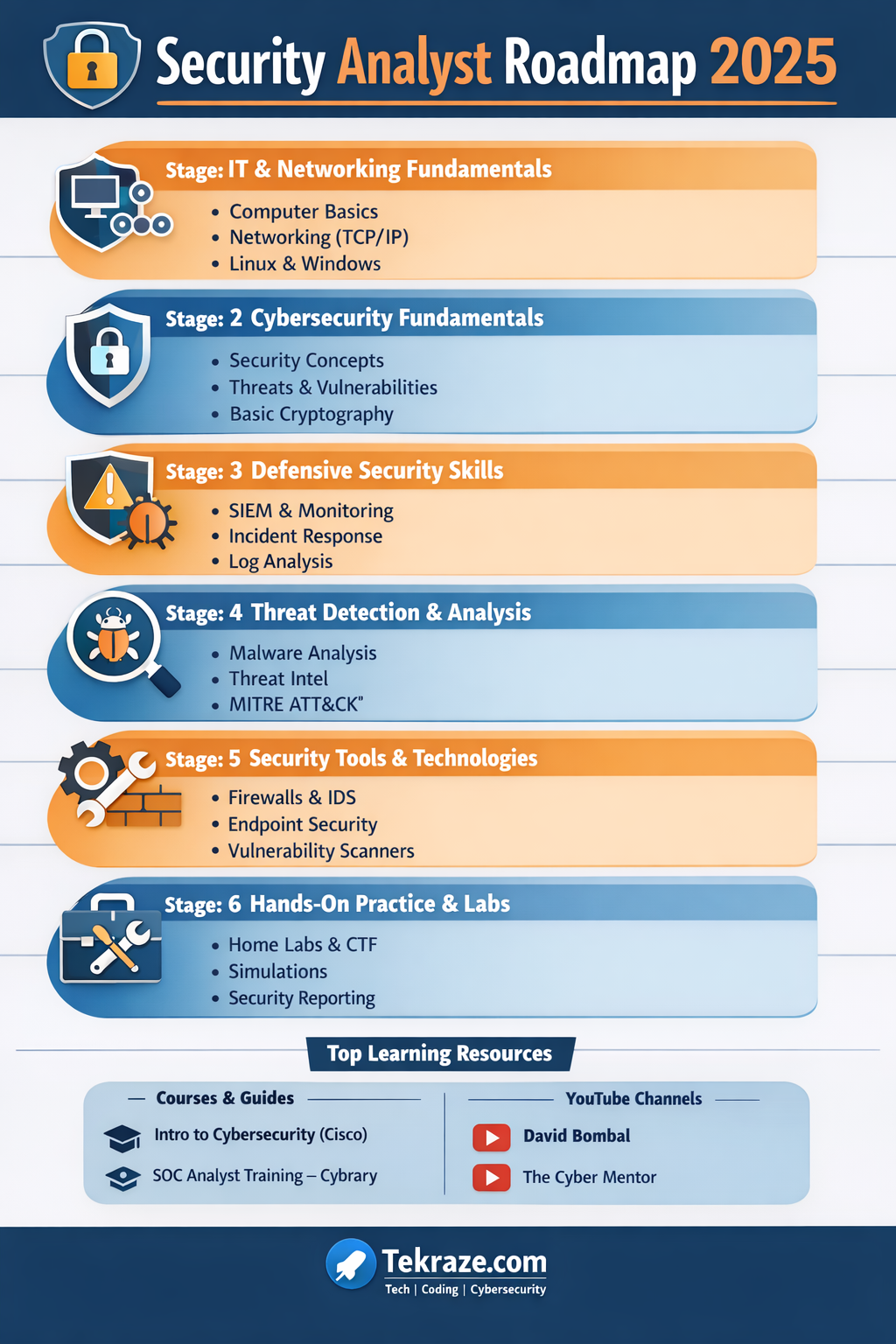
This Security Analyst roadmap explains what to learn, in what order, and why to build a career in cybersecurity. It is designed for beginners, IT professionals, and career switchers who want a clear and practical entry into security roles.
Who Should Follow This Security Analyst Roadmap?
- Beginners interested in cybersecurity
- IT professionals moving into security roles
- Students exploring blue team careers
- Professionals upskilling for SOC roles
What Does a Security Analyst Do?
A Security Analyst is responsible for monitoring, detecting, and responding to security threats across systems, networks, and applications. The role focuses on prevention, incident response, and continuous security improvement.
Security Analyst Learning Roadmap
Stage 1: IT & Networking Fundamentals
- Computer fundamentals and operating systems
- Networking basics (TCP/IP, DNS, HTTP)
- Linux and Windows fundamentals
Goal: Understand how systems and networks work before securing them.
Stage 2: Cybersecurity Fundamentals
- Security principles (CIA triad)
- Threats, vulnerabilities, and attacks
- Basic cryptography concepts
Goal: Learn core security concepts and terminology.
Stage 3: Defensive Security & SOC Skills
- Security monitoring and log analysis
- SIEM tools and alert handling
- Incident response basics
Goal: Develop hands-on skills used in Security Operations Centers (SOC).
Stage 4: Threat Detection & Analysis
- Malware fundamentals
- Threat intelligence concepts
- Attack frameworks (MITRE ATT&CK)
Goal: Identify and analyze real-world attack patterns.
Stage 5: Security Tools & Technologies
- Firewalls and IDS/IPS
- Endpoint security tools
- Vulnerability scanners
Goal: Learn industry-standard security tools.
Stage 6: Hands-on Practice & Career Readiness
- Home labs and simulations
- Capture The Flag (CTF) challenges
- Security documentation and reporting
Goal: Become job-ready through real-world practice.
Recommended Learning Resources
These external resources can help you reinforce key security concepts while following this roadmap. They are optional and best used alongside hands-on labs and practice.
IT & Networking Fundamentals
- Computer Networking Full Course – David Bombal (YouTube)
- Computer Networking Basics – GeeksforGeeks
- Linux Journey – Learn Linux Step by Step
Cybersecurity Fundamentals
- Introduction to Cybersecurity – Cisco
- Cybersecurity Fundamentals – Cybrary
- What Is Cybersecurity? – Cloudflare
Defensive Security & SOC Skills
- Introduction to SIEM – Splunk
- MITRE ATT&CK Framework (Official)
- SOC & Defensive Security – The Cyber Mentor (YouTube)
Hands-On Practice & Labs
- TryHackMe – Beginner-Friendly Security Labs
- Hack The Box – Practical Security Challenges
- OWASP Top 10 – Web Security Risks
Security Ethics & Best Practices
External resources are provided for learning reference. Tekraze does not control third-party content.
Essential Skills for Security Analysts
Technical Skills
- Networking & OS knowledge
- Threat detection
- Log analysis
- Incident response
Soft Skills
- Analytical thinking
- Attention to detail
- Communication
- Decision-making
Security Analyst Career Path
- Junior Security Analyst
- SOC Analyst
- Senior Security Analyst
- Security Engineer
- Security Architect or Consultant
Recommended Learning Resources (Optional)
These external resources can help reinforce key security concepts while following this roadmap. Use them as supporting material alongside hands-on practice.
Security Analyst Roadmap FAQs
Is this roadmap suitable for beginners?
Yes. This roadmap starts with basic IT and networking concepts before moving into cybersecurity-specific skills.
Do I need programming skills to become a security analyst?
Basic scripting knowledge helps, but strong networking and security fundamentals are more important initially.
How long does it take to become a security analyst?
Most learners can become job-ready in 6–12 months with consistent practice.
This guide is part of TekRaze Career Roadmaps.