
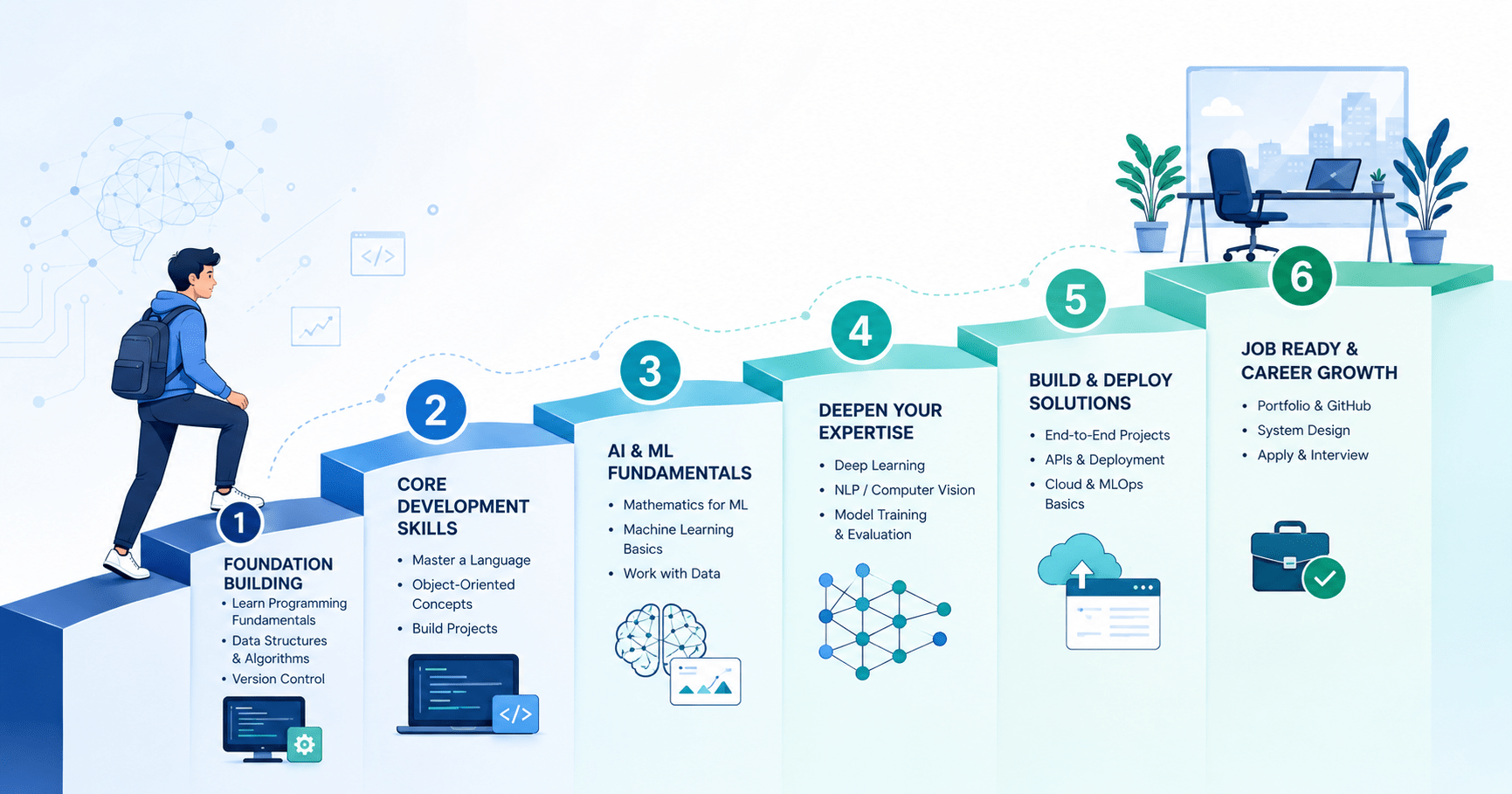
This AI developer roadmap lays out exactly what to learn, in what order, and why, taking you from programming basics to building real AI applications you can put in a portfolio. It’s built for beginners, students, and career switchers who want a clear, job-ready path instead of a random pile of tutorials.
Who Should Follow This AI Developer Roadmap
This path works whether you’re starting from zero or pivoting an existing tech career:
- Beginners starting from scratch
- Software developers moving into AI
- Students exploring AI as a career
- Professionals upskilling for future-ready roles
You do not require any experience in AI whatsoever. What really takes you places is simple logical reasoning and an ability to program every single day.
Point to note: The roadmap outlined here will teach you how to be an AI developer, not just about the subject itself. You’ll implement your knowledge of AI, not merely read up on it.
What Is an AI Developer?
The AI developer creates applications and systems that learn from data, make predictions, automate processes, or make decisions. This type of job does not involve writing academic papers; instead, the AI developer is evaluated based on practical, delivered systems.
Some tasks of a typical workday include:
- Developing AI-powered applications
- Training and deploying models
- Working with APIs, data pipelines, and cloud platforms
Roadmap Stages: Step by Step
Below you will find the complete journey divided into six stages, with one stage optional for specialisation. Each successive stage is dependent upon the previous one, so try not to jump to the “exciting stuff” until you have the basics sorted out.
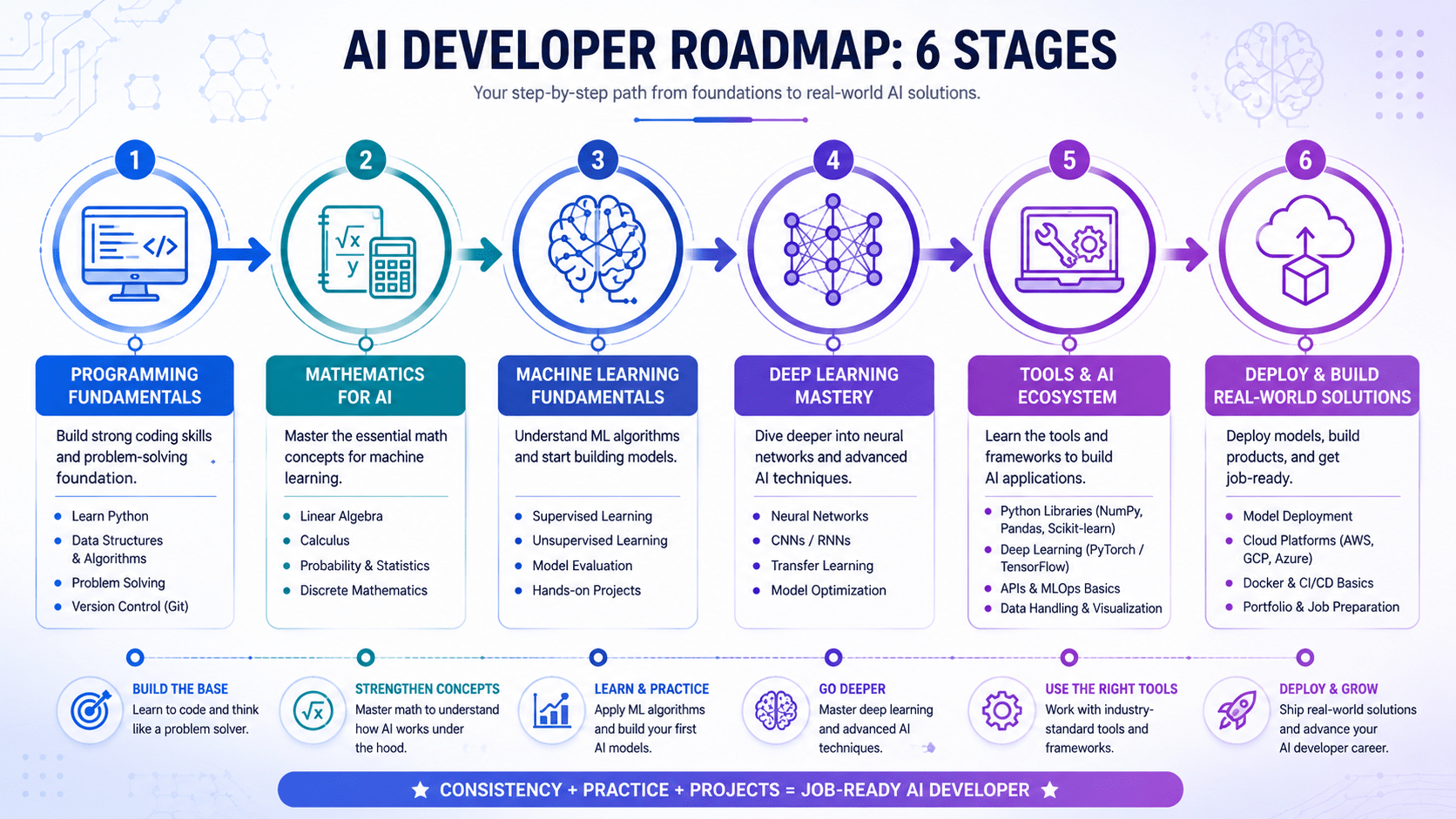
Why This AI Developer Roadmap Works Best in Order
Skipping stages is the most common reason self-taught learners stall out. Treat the order below as a dependency chain, not a menu.
Stage 1: Programming Foundations
Goal: become comfortable writing clean, logical code.
- Python basics
- Data structures and algorithms
- Git and version control
Stage 2: Math and Data Fundamentals
Goal: understand how AI models actually learn from data.
- Linear algebra basics
- Probability and statistics
- Data analysis with Python
Stage 3: Machine Learning Core
Goal: build and train your first real ML models.
- Supervised and unsupervised learning
- Model evaluation techniques
- Feature engineering
Stage 4: Deep Learning and AI
Goal: get comfortable with modern AI systems, not just classical ML.
- Neural networks
- NLP and computer vision basics
- Large language models (LLMs)
Optional Specialization: Generative AI and LLMs
If you want to specialize further once the core stages are solid:
- Large language models (LLMs)
- Prompt engineering fundamentals
- Text, image, and code generation
- Responsible and ethical AI usage
Also Read: What Are Tokens in Large Language Models? Simple Explanation with Examples – a good next stop once you reach the LLM stage of this roadmap.
Stage 5: Tools and Frameworks
Goal: get fluent in the tools the industry actually uses.
- TensorFlow / PyTorch
- Scikit-learn
- LangChain and AI APIs
Stage 6: Projects and Deployment
Goal: become job-ready, not just knowledgeable.
- End-to-end AI projects
- Model deployment (cloud / APIs)
- Monitoring and optimization
Skills You Need to Become an AI Developer
This path isn’t only about what you study. It’s also about which skills you can actually demonstrate to a hiring manager.
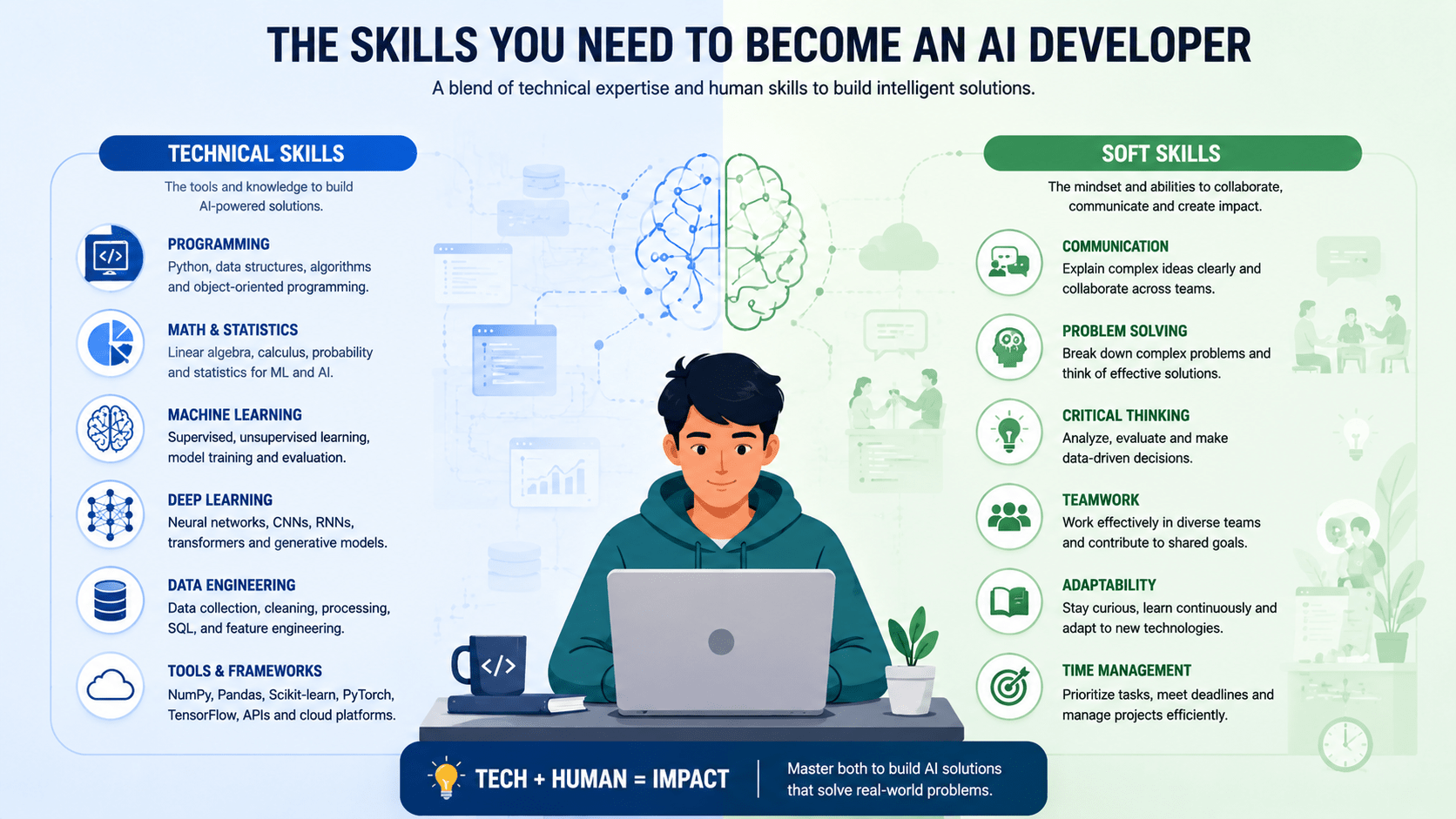
Technical Skills
- Python programming
- Machine learning algorithms
- Data handling and preprocessing
- Model deployment
Soft Skills
- Problem-solving
- Critical thinking
- Communication
- Ethical awareness
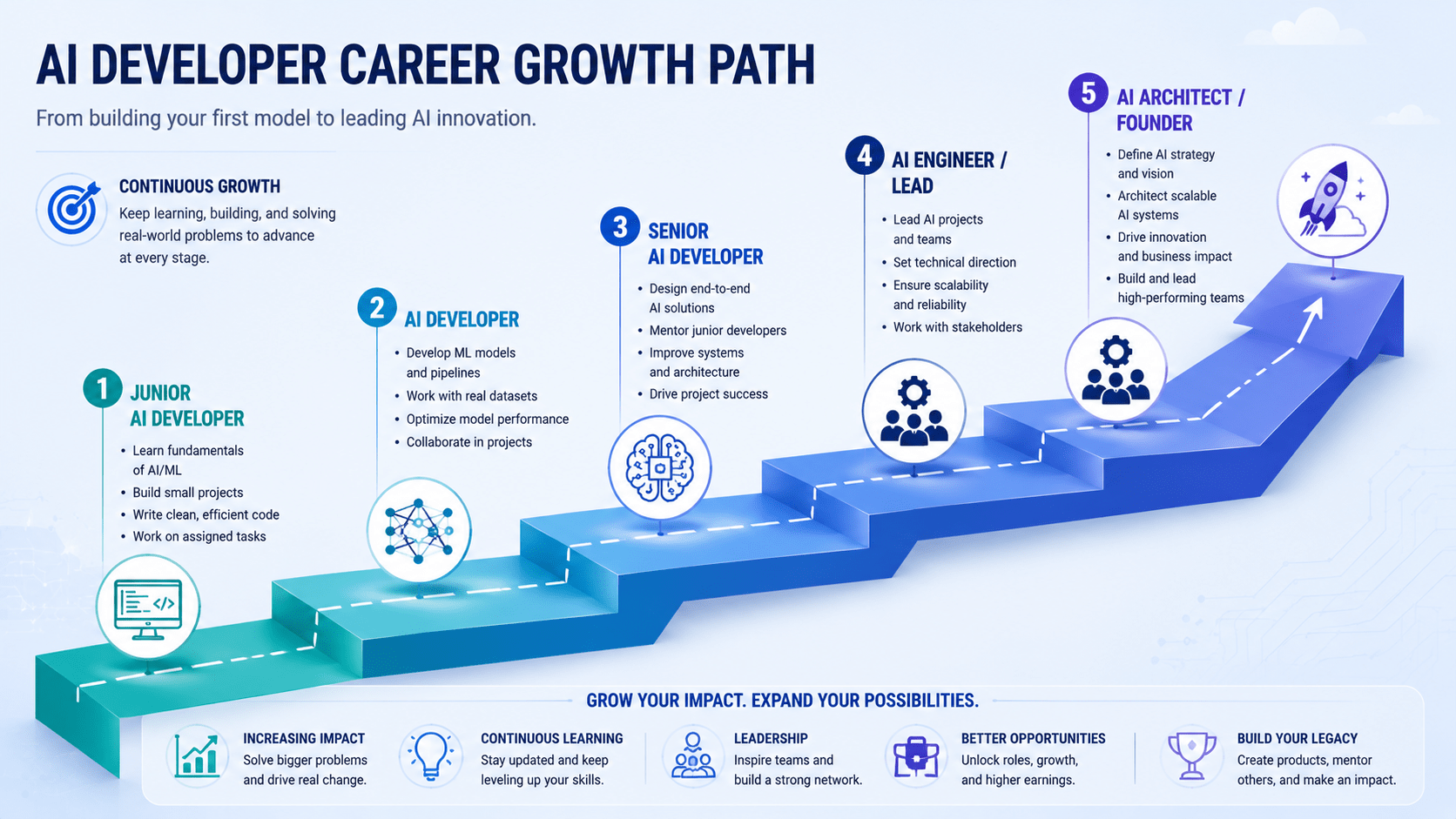
AI Developer Career Growth Path
Once you’ve worked through this roadmap, here’s the typical progression:
- Junior AI Developer
- AI Engineer
- Senior AI Developer
- AI Architect / Lead
- Consultant or Founder
AI developers currently work across healthcare, fintech, SaaS, e-commerce, and startups, so the roadmap above transfers across industries rather than locking you into one.
Learn by Building Real Projects
Reading about AI won’t get you hired. Building will. Use the stages above alongside real projects like:
- An AI chatbot
- A recommendation system
- A text classification API
- An AI-powered web app
Also Read: How Token Limits and Context Windows Actually Work in — useful background once you start building anything that calls an LLM API.
How This Roadmap Is Different
- Not course-driven
- Not syllabus-based
- Focused on real-world AI development
- Designed for long-term career growth
Recommended Learning Resources
These sources support the ideas presented in the roadmap. Utilize them in conjunction with practical work, and not as a replacement. The external sources provided are for your reference only. Tekraze does not regulate third party material.
Programming Foundations
- Python for Beginners – freeCodeCamp (YouTube)
- Git Basics – Atlassian
Machine Learning
- Machine Learning Full Course – freeCodeCamp
- Machine Learning Concepts – StatQuest
- ML Crash Course – Google
Deep Learning and AI
- Neural Networks – 3Blue1Brown (YouTube)
- Deep Learning Overview – IBM
Tools and Deployment
- PyTorch Tutorials – Official Docs
- Deploy ML Models – AWS Guide
- TensorFlow Guides
Projects and Deployment
- End-to-End ML Project – freeCodeCamp (YouTube)
- Deploy ML Models with FastAPI – Tech With Tim (YouTube)
- Deploying Machine Learning Models – AWS (Article)
- ML Model Monitoring – Google Cloud (Article)
Ethics and Responsible AI
- Responsible AI – Google
- AI Ethics – IBM (Article)
- Responsible AI – Microsoft Learn (Article)
AI Developer Roadmap FAQs
Do I need a degree to become an AI developer?
No. Skills, projects, and practical experience matter more than a formal degree to most hiring managers in this field.
Is AI development a good career in 2026?
Yes. AI roles keep growing across industries, and companies increasingly need developers who can integrate AI into real products, not just researchers.
How long does it take to become an AI developer?
Typically 6–12 months of consistent learning and project work, though this varies based on your starting point and how much time you can put in weekly.
Is this AI developer roadmap suitable for complete beginners?
Yes. It starts with programming and data fundamentals, then moves toward machine learning, deep learning, and real-world AI projects.
Do I need to learn Generative AI first?
No. Generative AI builds on core AI and deep learning concepts. Understand programming, machine learning, and neural networks first, then explore generative AI tools.
Should I focus on tools or fundamentals first?
Fundamentals first. Tools and frameworks change often, but a strong foundation in programming, data, and algorithms makes it far easier to adapt as new tools appear.
Final Conclusion
While this roadmap for an AI developer won’t make the job easy for you, it will definitely save you months of efforts that could have been wasted on wrong activities done in the wrong sequence. Begin with Stage 1, create something simple first, and don’t dive into generative AI right away until you master the basics. Choose one of the projects listed above and start today.
This guide is a part of Tekraze Career Roadmaps series.
Also Read: llm tokens context windows prompt engineering guide