
LLM tokens explained simply, this is precisely what this guide provides. Ever been curious about why you see unexpected high costs for API services, or why your model sometimes appears to “forget” previous instructions? The reason is always in tokens and context windows. LLMs process information in a very different way compared to how humans process texts.
They analyze all texts using tiny pieces of text known as tokens, and these tokens have to be of limited size. Knowing this and understanding basic prompt engineering principles is what makes the difference.
What Are LLM Tokens?
LLM tokens are the fundamental element in a language model’s input and output process. A token does not correspond to a single word. For instance, a simple word would be one token, but longer or more technical words may form two or three tokens. Even spaces, punctuation, and capitalization influence tokenization.
A reliable rule of thumb: 1 token is roughly 4 characters of English text, or about 75 words per 100 tokens.
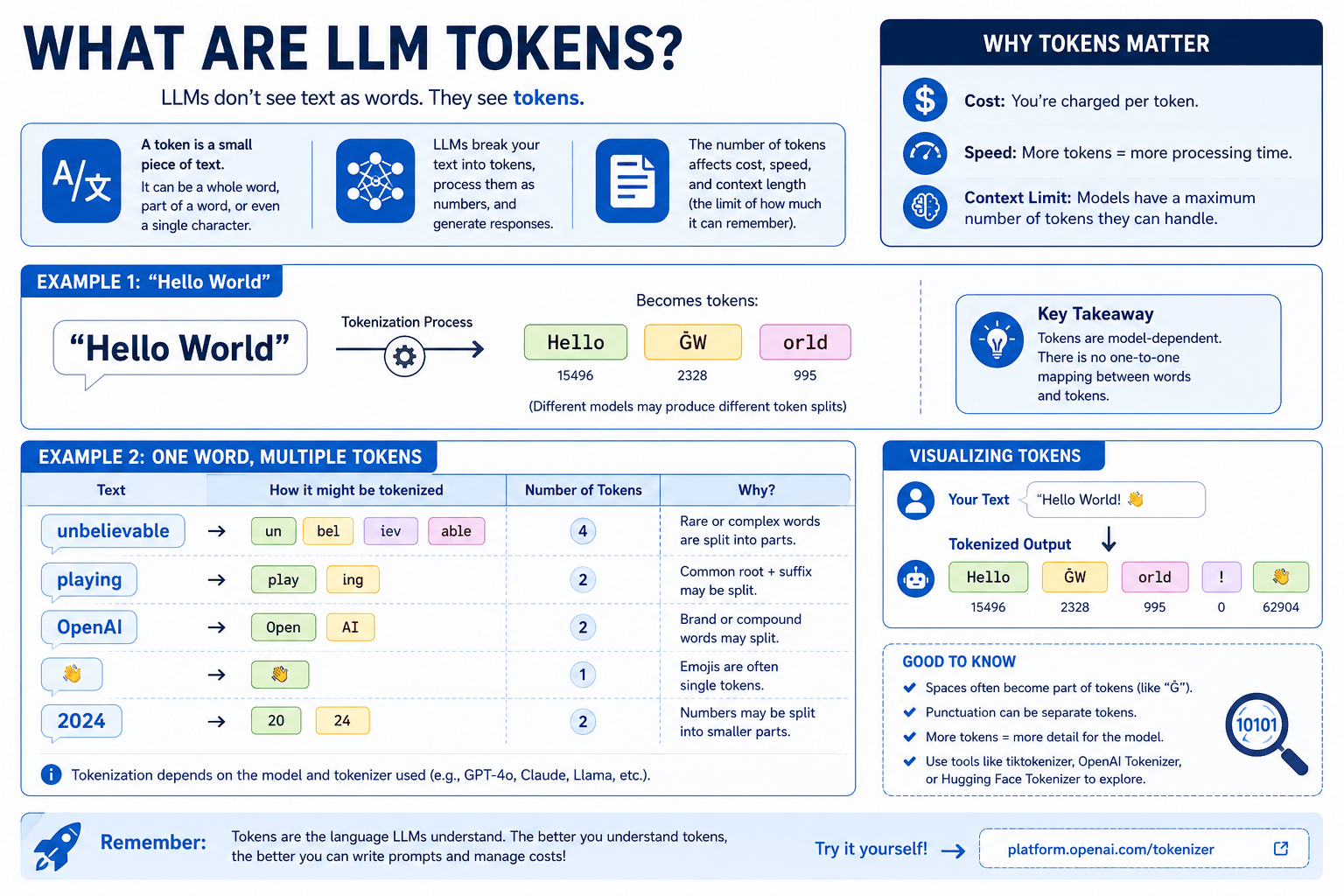
Every time you send a request or receive an answer, you pay based on the number of tokens used. Understanding tokens helps you write prompts that are clear and cost efficient.
What Are Context Windows?
The context window is the maximum amount of information a model can process in a single interaction. It includes your system prompt, conversation history, and the current user message everything counts toward the limit.
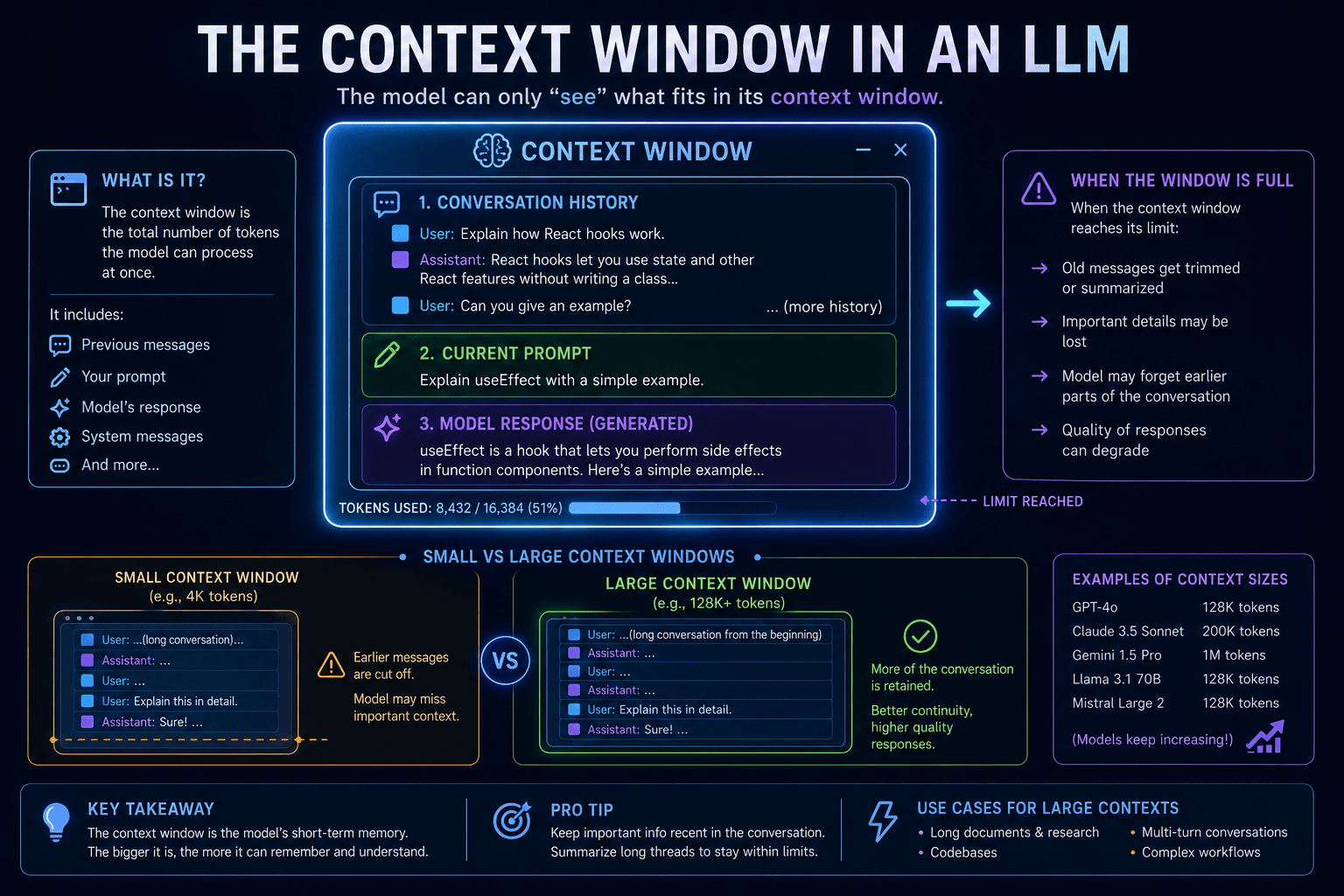
Important: Bigger is not always better. Research has consistently shown that models give less accurate answers when the context is packed with irrelevant information — a phenomenon sometimes called the “lost in the middle” problem. A focused, well-structured context almost always outperforms a bloated one.
How LLM Tokens and Context Windows Work Together
Tokens fill up the context window. If your prompt is too long, you reach the limit faster and spend more money.
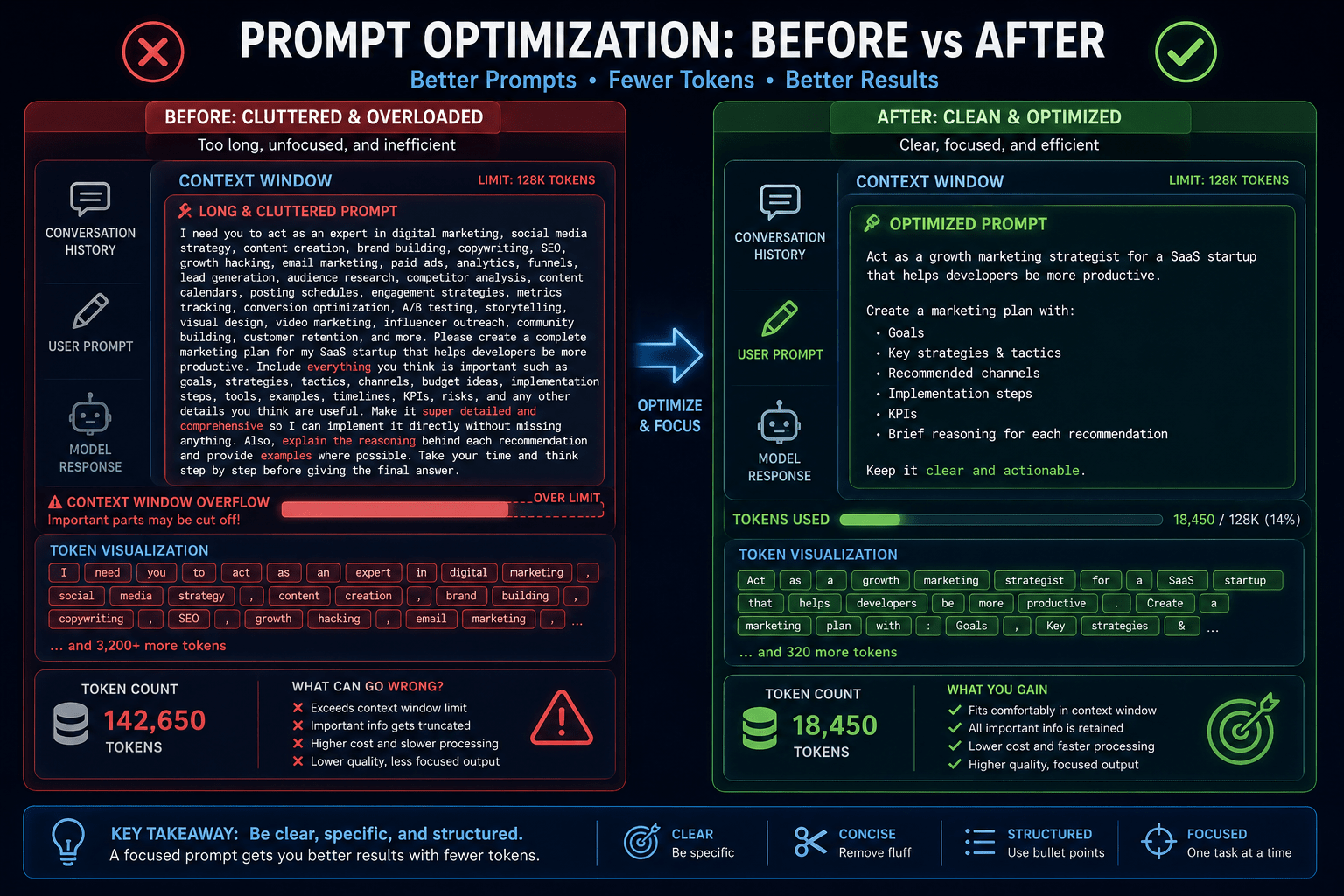
Cost scales with tokens. More tokens in means more tokens billed. A 10,000-token conversation costs significantly more than a 500-token one.
Position matters. Models pay more attention to content at the very beginning and end of a prompt. Put your most critical instructions at the end, not buried in the middle. Good practice is to trim your context aggressively.
Remove repetitive instructions, summarize long conversation histories instead of passing them in full, and only include information genuinely needed for the current task.
The Art and Science of Prompt Engineering
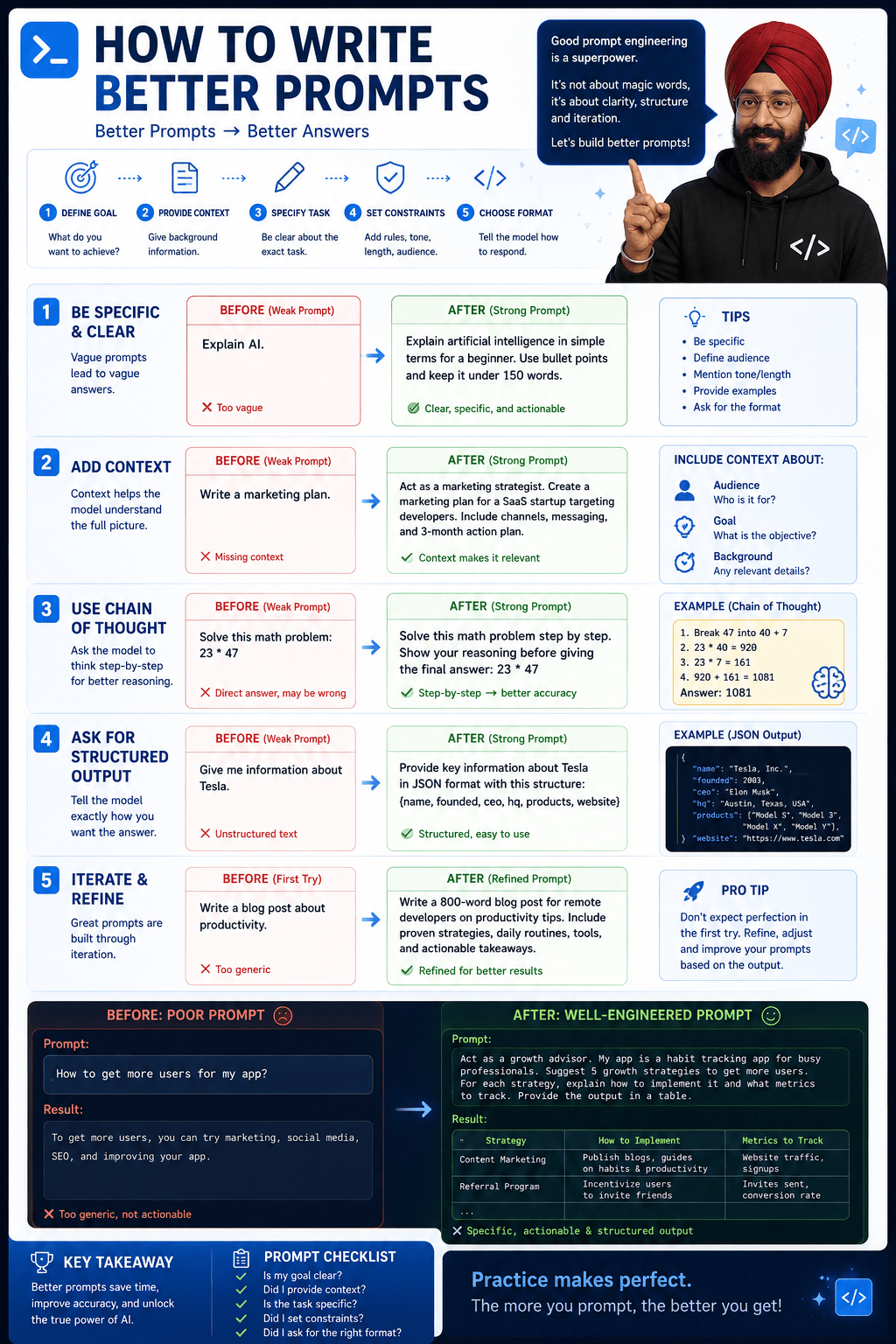
Prompt engineering means writing clear instructions so the model gives you the exact result you want. Small changes in how you write a prompt can lead to much better answers.
Good prompts are not merely questions; rather, they provide tasks to be completed, context for the completion of those tasks, and the proper formatting of the output. Subtle differences in wording can make all the difference in generating high-quality responses. This guide is concerned with prompt engineering techniques that apply in production.
Start with these simple rules:
- Be specific about the task you want completed.
- Give short, clear examples when needed.
- Tell the model exactly how you want the answer formatted.
- Keep your instructions short and direct.
Useful Prompt Engineering Techniques in 2026
Many developers use these proven approaches:
- Ask the model to think step by step before answering (this is often called chain of thought).
- Request answers in a structured format such as lists, tables, or simple code blocks.
- Assign a clear role to the model, for example “act as an experienced senior developer reviewing code”.
- Combine multiple techniques and test what works best for your project.
Practical Tips for Developers
- Begin with short and simple prompts, then add more details only if needed.
- Try different models for different tasks. Smaller models can give excellent results for simple work at much lower cost.
- Build your own collection of effective prompts that you can reuse and improve.
- Always check the number of tokens your prompt uses before sending large requests.
Common Mistakes and How to Avoid Them
Overloading the prompt. Developers often try to handle every edge case in a single prompt. The result is usually a confused model and inconsistent output. Write for the common case first.
Skipping format instructions. If you need output in a specific format, say so explicitly. “Give me a list of five items” produces more consistent results than hoping the model guesses your preference.
Making assumptions about consistency without validation. LLMs are probabilistic, and the same prompt will produce
varying outputs, particularly when operating at high temperature levels. Validate prompts using multiple samples before applying them in a real-world setting.
Failing to consider prompt caching. Most LLM providers today have a prompt caching option in which static parts of the context are saved between API calls. For scenarios in which there is a consistent system prompt, this can reduce costs by 50% to 80%.
Frequently Asked Questions
Q:What is the best way to reduce costs with LLM tokens?
Focus on shorter prompts, enable prompt caching when available, and use clear output instructions. Small changes can reduce usage by thirty to sixty percent in many cases.
Q:How large should my context window be?
Use only as much context as needed for the task. Extra information increases costs and can sometimes make answers less accurate.
Q: What is the difference between zero-shot and few-shot prompting?
Zero-shot prompting gives the model no examples — just a task description. Few-shot prompting includes two to five input/output examples alongside the task. Few-shot is generally more reliable for formatting-sensitive tasks. Zero-shot works well when combined with chain of thought reasoning.
Q: Which models are best for developers in 2026?
It depends on your use case. Claude 3.5 Sonnet and GPT-4o lead on complex reasoning and codetasks. Gemini 1.5 Pro is strong for long-context document work. For cost-sensitive production workloads, smaller models like GPT-4o mini and Claude Haiku offer strong performance at significantly lower cost. Always benchmark against your specific task before committing.
Is prompt engineering still important in 2026?
Yes. Good prompting remains one of the most effective ways to get reliable results and control expenses.
Which models handle tokens and context best?
Different models have different strengths. Test a few options for your specific use case.
Conclusion
Getting the most from large language models comes down to three things: understanding how tokens are counted and billed, using context windows efficiently rather than maximally, and developing strong prompt engineering habits.
None of this requires a machine learning background. It requires attention to how you communicate with the model which, with some deliberate practice, becomes second nature.
Start with one or two techniques from this prompt engineering guide, test them against your real use cases, and build from there. The developers seeing the best results are not using more powerful models they are using the same models more thoughtfully