
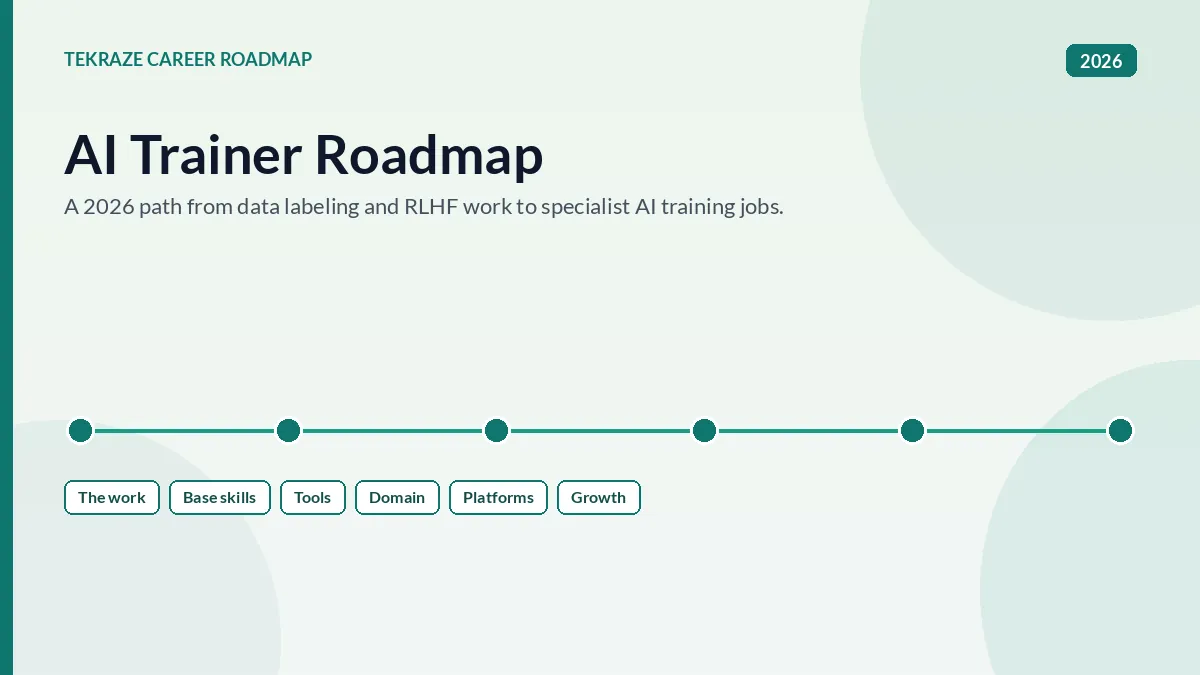
This AI trainer roadmap lays out what to learn, in what order, and why, so you can move from basic data labeling into specialist AI training jobs. It is built for beginners, domain experts, and career switchers who want a clear path into remote work such as data labeling, RLHF preference ranking, and model evaluation.
Who Should Follow This AI Trainer Roadmap
This path works whether you are starting from zero or bringing a specialist background:
- Beginners who want a structured way into data annotation jobs and AI training jobs
- Writers, teachers, linguists, and other detail-oriented professionals who can follow long guidelines
- Specialists in coding, math, STEM, finance, law, medicine, or languages who want to apply that knowledge to AI work
- Career switchers looking for remote, project-based work, including a later move into data ops or machine learning
You do not need a computer-science degree to start. Careful reading, clear writing, and the patience to follow instructions matter more. Coding helps later, but it is not the entry ticket for most labeling and evaluation work.
Point to note: Platforms, tools, and posted rates change. Treat this roadmap as a skill path, not a promise of constant work or a particular hourly rate. Always check the official listing before you apply.
What Is an AI Data Annotator or AI Trainer?
A data annotator, sometimes called a data labeler, adds structure to raw data so machine-learning systems can learn from it. That can mean drawing a box around a car in a photo, transcribing a clip of speech, tagging entities in a sentence, or marking whether a chatbot answer is accurate and safe.
An AI trainer does related work, often at a higher level of judgment. Instead of only labeling objects, you may write tasks, compare model answers, score responses against a rubric, or try to break a model so a lab can make it safer. On many platforms the two titles overlap, which is why this roadmap covers both.
Alignerr, a Labelbox-led expert network, describes the work as creating nuanced training data, evaluating AI model responses, and aligning AI performance with diverse human preferences. Outlier, operated by Scale AI, similarly asks experts to write challenging prompts, create grading rubrics, and rate or rank answers. The common thread is human judgment that a model cannot invent on its own.
For a fuller explainer of the labeling work itself, including the main types, why the jobs are booming, and how platforms such as Alignerr hire, read What Is Data Annotation? Then return here for the step-by-step skill path.
Roadmap Stages: Step by Step
The path below is divided into six stages. Each one depends on the stage before it, so resist the urge to apply everywhere before you understand the work, or to chase a specialist rate before you can follow a simple guideline set without errors.
Why This AI Trainer Roadmap Works Best in Order
Skipping stages is the usual reason new contributors stall. Domain expertise will not save missed instructions, and a fast application will not help if you cannot explain your judgments in clear English. Treat the order below as a dependency chain, not a menu.
Stage 1: Understand What the Work Actually Is
Goal: know the main types of AI training work, so you can pick projects you can actually do well.
Start by learning the difference between classic data labeling and the newer LLM-training tasks. You will meet some or all of the following:
- Image, text, and audio labeling. You mark objects, transcribe speech, classify documents, or tag entities so a model can learn from examples.
- RLHF preference ranking. Reinforcement Learning from Human Feedback asks you to compare two or more model answers and choose which is better, and usually to explain why.
- Response evaluation. You score an answer against a rubric: is it correct, complete, safe, and on-instruction?
- Prompt and task writing. You write the problems, scenarios, or instructions that will be used to test or train a model.
- Red teaming. You try to make a model fail, produce unsafe output, or ignore its policy, so the lab can find and fix those weaknesses.
Spend a week or two reading official role descriptions and practicing the mindset: slow down, follow the rubric, and justify every decision. Project: evaluate one chatbot answer, note what is correct or missing, and explain which of two rewrites is better.
Stage 2: Build the Base Skills
Goal: become someone a reviewer can trust with a long, picky guideline document.
Most AI training jobs rest on a small set of skills that matter more than any one tool:
- Clear English writing. Your comments, justifications, and rewritten answers are often the training signal. Vague notes are not useful.
- Attention to detail. A missed instruction, a swapped label, or a skipped edge case can get a task rejected.
- Following long guidelines. Project docs can run to many pages. The habit of checking the doc before you improvise is a core skill.
- Basic AI and LLM literacy. You should understand, in plain language, what a model is, what a prompt is, what a hallucination looks like, and why human feedback is used.
You do not need to become an engineer at this stage. If you want a clearer picture of how models and prompts fit together, the AI Developer Roadmap is a useful companion, not a prerequisite.
Plan two to four weeks of practice. Project: rewrite a long model answer so it follows a tight brief, then write five bullets on what you changed and why.
Stage 3: Get Comfortable With the Tools
Goal: be fluent enough in common annotation tools that a new platform interface does not slow you down.
You will rarely need every tool on day one. Still, knowing the landscape helps you learn faster and talk about your work clearly.
- Labelbox is a commercial data platform used to create training and evaluation data. Alignerr onboarding includes an introduction to the Labelbox platform.
- Label Studio is a widely used open-source tool for data labeling, human preference collection, and evaluation workflows, including RLHF-style ranking.
- CVAT is a data annotation platform focused on images, video, 3D, and audio, with a free open-source community edition as well as cloud and enterprise options.
- Spreadsheets still show up for reviews, quality checks, simple taxonomies, and tracking your own work.
- Basic Python is a plus, not a must, for entry-level labeling. It becomes useful if you want to move toward data ops, quality tooling, or machine learning later.
Plan two to three weeks to try at least one open tool. Project: label a small public dataset in Label Studio or CVAT, then write a short note on your label rules and the mistakes you almost made.
Stage 4: Pick a Domain and Go Deeper
Goal: become easier to hire, and able to earn more, by pairing general annotation skill with a field you already know.
Alignerr is direct about this: the more specialized and in-demand your skills are, the more you can earn. The same pattern shows up across other platforms. General writing and everyday judgment work exists, but specialists in scarce fields are the ones listed at the higher end of a pay band.
Common specialist domains include:
- Coding. Reviewing model-written code, writing solutions, and explaining trade-offs.
- Math and STEM. Checking proofs, working scientific problems, and catching subtle reasoning errors.
- Finance. Evaluating analysis, market reasoning, or operations tasks against professional standards.
- Law. Judging whether a legal explanation is sound, complete, and appropriately cautious.
- Medicine. Reviewing clinical or scientific answers with the care the field requires. Only do this if you actually have the background.
- Languages. Translation, locale quality, and bilingual evaluation, when you are truly fluent.
Pick one domain you can defend on a resume and in an interview, not three you barely know. Project: write a one-page brief that lists your proof of skill and three example tasks you are qualified to evaluate.
Stage 5: Platforms and Getting Hired
Goal: apply in a way that matches how these platforms actually hire, and avoid wasting attempts on the wrong roles.
Several well-known platforms currently hire for data annotation and AI training work. Eligibility, pay, and available projects vary, and work is not guaranteed:
- Alignerr is Labelbox’s expert network. You sign in, upload a resume, review your auto-filled profile, set skill and domain preferences, and apply to listed jobs. Identity verification is required. Some roles add a Zara AI interview or a domain assessment, as described on Alignerr’s process page.
- Outlier, operated by Scale AI, has a four-step flow: create a profile, import and review skills, verify your identity, then complete skill checks and start work. Onboarding is described as taking about 30 to 90 minutes, after which project-specific steps may follow.
- DataAnnotation asks you to create an account, take a starter assessment, and, if you pass, begin work on available projects. Its site has listed availability for applicants in the US, Canada, the UK, Ireland, New Zealand, and Australia, with a waitlist-style sign-up for other countries.
- Mercor matches professionals to remote AI training projects. The process typically includes sharing your background, completing an AI evaluation or AI interview, and then being matched to a project if there is a fit. Mercor says you do not need prior AI experience.
- Remotasks, also backed by Scale AI, is more task-based: you train on a project, unlock tasks such as image or audio labeling, and are paid for accepted work. Remotasks says it is available in 90+ countries and pays weekly via PayPal or AirTM.
Tips that travel well across assessments and AI interviews:
- Apply only to roles that match skills you can actually demonstrate. Inflated claims get caught quickly in a domain interview.
- Use a clean, current resume. Tighten it first with the Tekraze Resume Analyzer so your domain and writing experience are easy to scan.
- On Alignerr, review the auto-filled profile carefully, especially your location, before you apply.
- Read every guideline twice. Most failed assessments come from missed instructions, not from a lack of intelligence.
- In a Zara-style AI interview, answer out loud in a quiet room, give concrete examples, and say when you do not know something instead of bluffing.
- For written tasks, show your reasoning in clear English. A correct click with a weak justification is often not enough.
- Do not outsource the assessment to another model or another person if the rules say the work must be yours. That is a fast way to get removed.
Stage 6: Pay Ranges, Quality, and Career Growth
Goal: understand how pay is set, why quality matters more than raw speed, and where this work can lead.
Rates are set per project and change over time, so treat any number as a snapshot, not a salary offer. On Alignerr’s homepage in November 2026, posted examples included English writing generalist roles at $30–40/hr, a sales and revenue-operations task author role at $20–50/hr, AI ethics review and film-scene work at $40–120/hr, and an investment strategy analyst role at $60–120/hr. Alignerr’s About page also says contributors can earn up to $150/hr. Other platforms post their own bands; some generalist work pays less, and scarce specialist work can post higher upper bounds. Your actual earnings depend on the role you qualify for, the hours available, and how much of your work is accepted.
Quality is the growth engine. Consistent, high-quality work is what leads to review or QA work, a small lead role, or guideline writing. From there, a natural path looks like this:
- Contributor or annotator, learning to hit quality and speed targets
- Reviewer or QA, checking other people’s work and giving precise feedback
- Team lead or guideline specialist, helping a project stay consistent
- Data ops or annotation operations, running queues, tooling, and quality processes
- ML ops or machine-learning engineering, if you add programming, data, and model skills
If you want that last step, switch to the AI Developer Roadmap once your annotation fundamentals are solid. The judgment you build as a trainer is useful there, but it does not replace programming, data, and deployment skills.
Watch Out for Scams
Never pay to join a data annotation or AI training platform. Legitimate networks such as Alignerr, Outlier, DataAnnotation, Mercor, and Remotasks do not charge a fee for you to apply or to start work. They may ask you to verify your identity and to set up payout details with a known provider such as Stripe, PayPal, or AirTM.
Treat a listing as a scam if it:
- Asks for an application fee, a training fee, or payment for a starter kit
- Contacts you only on WhatsApp or Telegram and pushes you off the official site
- Asks for your banking password, OTP, or full card number in a chat
- Promises a fixed high salary with no assessment and no project details
- Uses a lookalike domain or an email address that is not from the company’s official website
Apply only through official sites, read the contract, and remember that project work can slow down or stop. That is normal. A recruiter who says otherwise is selling you a story.
AI Trainer Skills Checklist
Core Skills
- Clear written English and the habit of justifying every decision
- Careful reading of long guidelines, rubrics, and examples
- Basic literacy in AI, LLMs, prompts, and common failure modes
- Comfort with at least one annotation tool and with spreadsheet tracking
- A specialist domain you can prove, if you want higher-end work
Soft Skills
- Patience with repetitive tasks and with changing instructions
- Honesty about uncertainty, instead of guessing quietly
- Time management in a remote, often asynchronous, contractor setup
- Openness to reviewer feedback without taking it personally
AI Trainer Career Growth Path
Once you have worked through this roadmap, a typical progression looks like this:
- Data annotator, AI trainer, or evaluation contributor on a platform or vendor team
- Reviewer, QA, or rater lead
- Project or community lead, or a guideline writer
- Data operations, annotation program, or ML ops specialist
- Machine-learning engineer, applied AI role, or independent consultant, if you add the technical skills
This work is usually contractor-based and project-shaped. It can be a flexible income stream or a stepping stone, but it is less often a single permanent job with a fixed salary, so plan accordingly.
How This Roadmap Is Different
- Not tied to one paid course or one platform’s marketing page
- Covers both classic data labeling and newer LLM work such as RLHF, evals, and red teaming
- Puts skills and judgment before sign-ups, so you do not waste assessments
- Uses official, checkable sources for pay examples and platform facts, and flags scams clearly
- Shows a growth path beyond gig work, including data ops and the AI Developer path
Recommended Learning Resources
These sources support the ideas presented in the roadmap. Use them alongside practical work, not as a replacement. External resources are provided for learning reference only. Tekraze does not control third-party content.
Platforms and official process pages
- Alignerr — expert network homepage, with current role examples
- How to become an Alignerr — resume, verification, assessments, and onboarding
- About Alignerr — how the network describes the work and pay
- Alignerr on Labelbox — how Labelbox describes the expert network
- Outlier — Scale AI’s expert platform
- DataAnnotation — official site and role board
- Mercor for experts — remote AI training projects for professionals
- Remotasks — task-based annotation platform
Tools
- Labelbox — commercial data platform for training and evaluation data
- Label Studio — open-source labeling, RLHF, and evaluation
- CVAT — image, video, 3D, and audio annotation
AI Trainer Roadmap FAQs
Do I need a degree to get AI training jobs?
Not always. Many generalist data annotation jobs care more about writing, judgment, and guideline-following than about a formal degree. Specialist roles in law, medicine, advanced STEM, or senior engineering usually expect proven expertise.
Do I need to know how to code?
No, not for most entry-level labeling and evaluation work. Basic Python becomes useful if you want better tools, data ops work, or a later move into machine learning. Use the AI Developer Roadmap when you are ready for that path.
Is this a stable full-time job?
Usually not in the traditional sense. Most of this work is remote contract or task-based, and projects can be busy for weeks and then slow down or end. Treat it as variable income and do not rely on one platform alone.
Which platform should I start with?
Start with the official site that accepts applicants in your country and matches your skills. Alignerr and Mercor suit specialist expertise; DataAnnotation is assessment-led; Outlier and Remotasks, both connected to Scale AI, are also widely used, with Remotasks closer to classic task-based labeling. Check each site’s current eligibility rules before you invest time in an exam.
How long does it take to get started?
You can learn the basics and submit applications in a few weeks. Assessments may take longer, and some applications end with no project offer. That is common. Keep practicing evaluation writing while you wait.
How do I avoid scams?
Never pay to join. Use official domains only, and never share OTPs or banking passwords in a chat. If a “recruiter” rushes you off the official site, stop.
Final Conclusion
This AI trainer roadmap will not invent a project for you, but it will keep you from spending months on the wrong applications in the wrong order. Start with Stage 1, practice one careful evaluation this week, and only then open a platform account.
When you are ready to apply, tighten your resume with the Tekraze Resume Analyzer. If you want more background on the work itself, read What Is Data Annotation? Then keep going with related guides in the Tekraze Career Roadmaps series, including the AI Developer Roadmap if you later want to build models, not only train them.