
For instance, most students learn the important maths theorems just the night before an exam then forget about them after one week from the test date. They learn the statement of the theorem, copy its proof and do some practice problems and when the next exam approaches everything gets forgotten. These theorems resurface each and every year due to the fact that students only learn how to memorize them without really understanding them. That is what this series aims to tackle.
Let us start off by asking ourselves why this occurs at all. This is because theorems are not taught in terms of understanding them but rather learning them by heart. Students learn that the Pythagoras Theorem states that a square plus b square is equal to c square but there is no explanation given on how it works and its applications beyond the context of a triangle diagram.
What This Series of Important Maths Theorems Covers
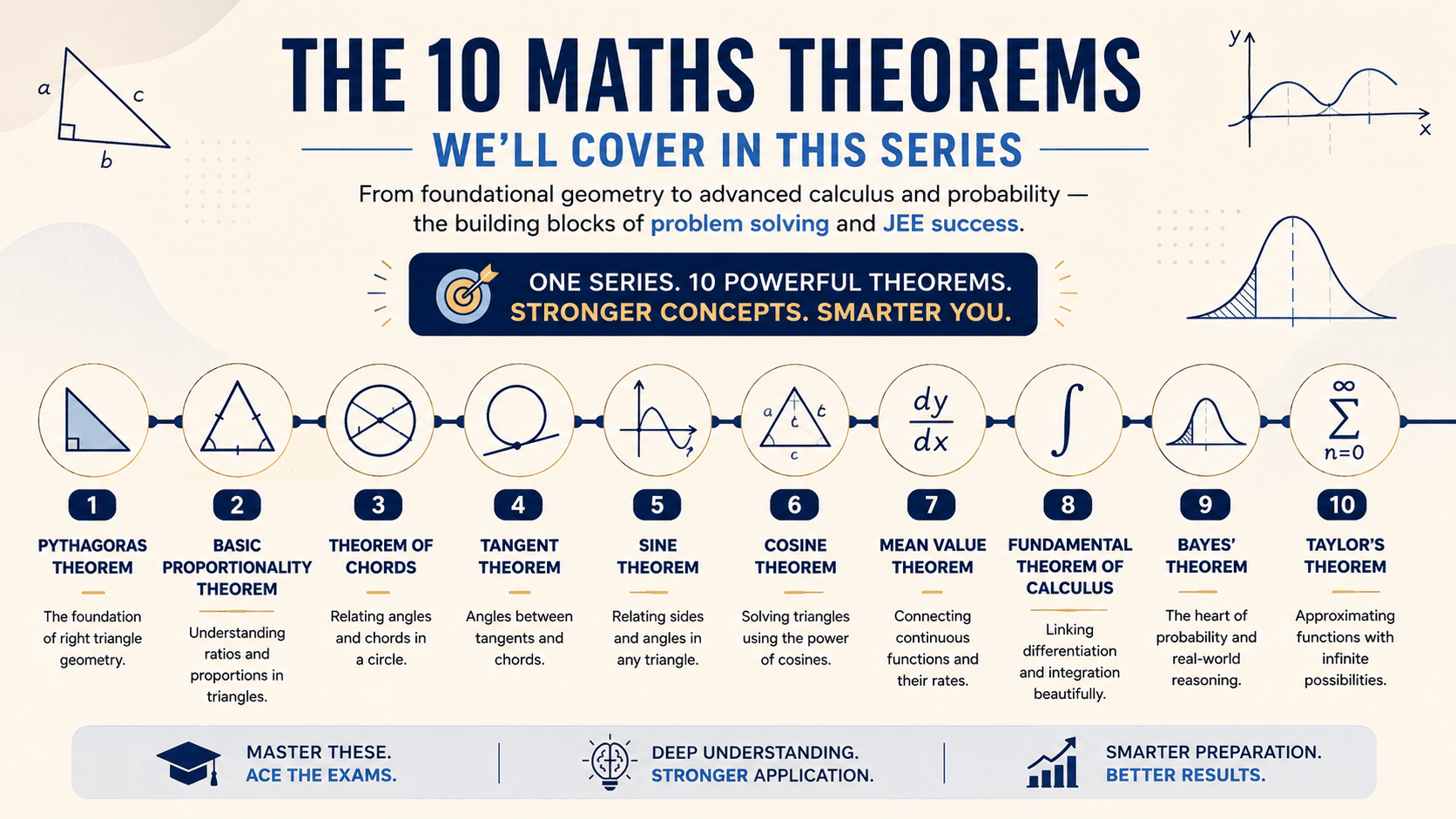
In the upcoming few posts, we will dissect 10 such theorems which recur throughout CBSE Class 10-12 and Engineering syllabus along with a few others that come in handy when studying AI and Machine Learning. In every single post, the theorem is first explained in simple English – what it is all about, how it works, and how it was derived. The discussion of various problems, starting from very basic to advanced levels, follows thereafter.
Here’s what’s coming:
- Pythagoras Theorem – the foundation of geometry, coordinate geometry, and half of physics
- Remainder Theorem – a shortcut that shows up constantly in polynomial questions
- Factor Theorem – how to actually find roots and factors without guesswork
- Binomial Theorem – expansions, probability, and a favorite in competitive exams
- Bayes’ Theorem – the backbone of statistics and modern AI/ML
- Total Probability Theorem – the setup that makes Bayes’ Theorem make sense
- Mean Value Theorem (MVT) – a core idea in engineering math and advanced calculus
- Fundamental Theorem of Calculus – the bridge between differentiation and integration
- Rolle’s Theorem – the simpler cousin of MVT, and usually taught right before it
- Taylor’s Theorem – numerical methods, engineering approximations, and AI optimization
Why These Specific Theorems
In each of the posts, it goes from defining terms and doing easy examples to working on difficult and exam-like problems. Therefore, no matter if you have never seen the theorem before or need a little refreshment before the exams, it is all included here.
There are two of them which are not only exam questions but also mathematical concepts used within your everyday AI tools. Those theorems include Bayes’ theorem and Taylor’s theorem. We will mention the connection to AI at the moment it becomes relevant.
Also Read: New to how AI models actually process information? Check out our explainer on what tokens are in large language models before you get to the Bayes’ Theorem post in this series.
A Note for JEE Aspirants
In case you are preparing for JEE Mains and Advanced separately, you’ll find this set of posts tailored to you as well. Each post takes things beyond the basic statement in the CBSE syllabus and goes all the way up to challenging problems of JEE Advanced level, which use the same theorem in some difficult-looking but actually simple problem. Be ready to see the same theorem tested via coordinate geometry, calculus, and probability applications, since this is how JEE combines different topics. In case you know the basic statement by heart, go straight to the advanced problem sections.
Who Is This Series For
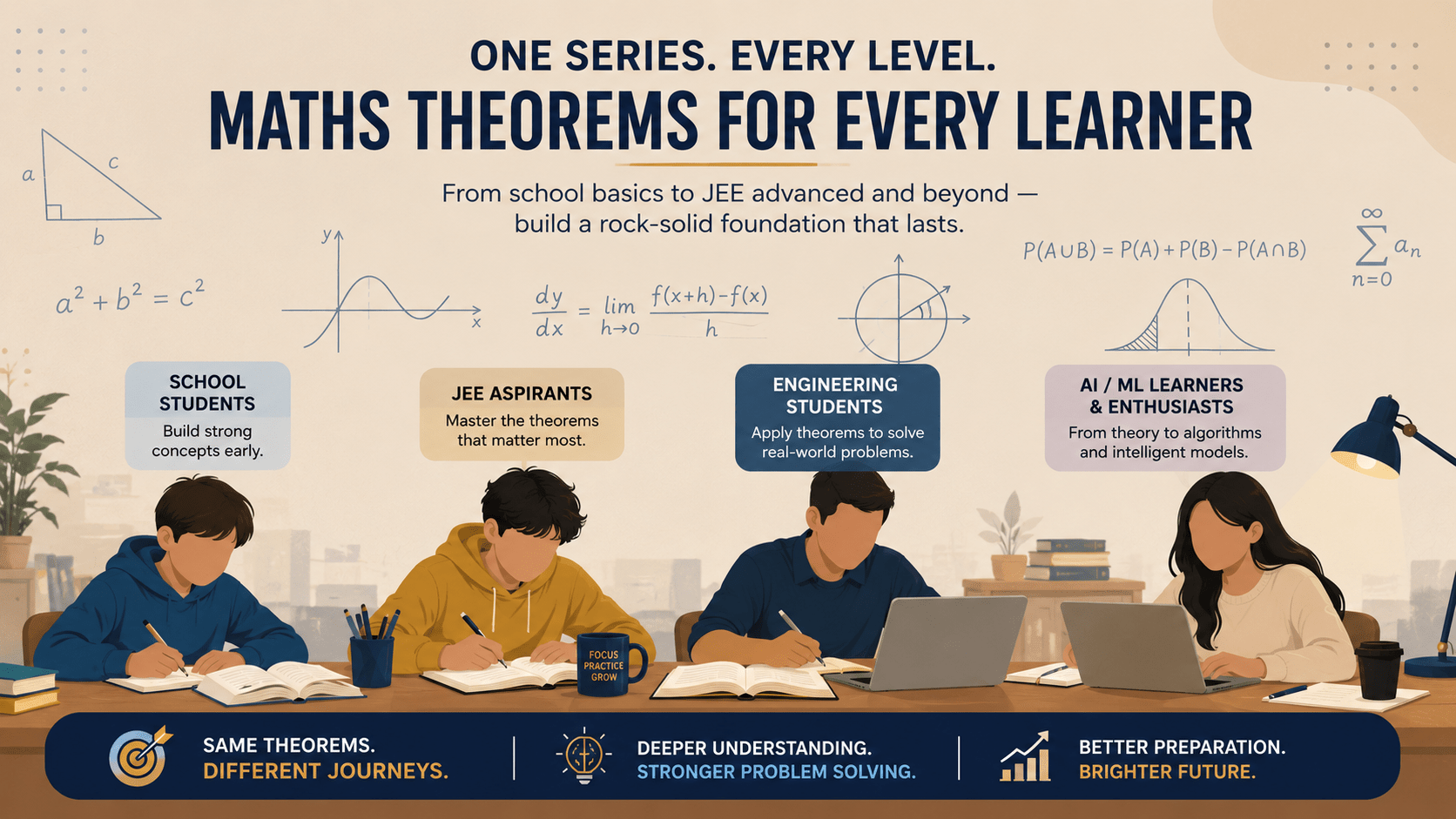
- CBSE Class 10-12 students who want the “why” behind a theorem, not just the statement to copy into an answer sheet
- JEE aspirants (Mains and Advanced) who already know the basic version of a theorem but need to see it in trickier, exam-style questions
- Engineering students revisiting these theorems in a more formal, applied context
- Anyone getting into AI or machine learning who keeps running into Bayes’ Theorem or Taylor’s Theorem and wants an actual explanation instead of a Wikipedia definition
This does not mean that you have to be having problems with math in order to benefit from this. In case you think you have mastered any given theorem, getting an explanation of these critical math theorems will help you fill the holes in your knowledge.
FAQ
Do I need to read these in order?
No. Each post stands on its own. If you only need Binomial Theorem for an upcoming test, jump straight to that one.
Is this only for JEE students?
No. The examples range from basic CBSE-level questions up to JEE Advanced, so there’s a starting point regardless of where you’re at.
Why include Bayes’ Theorem and Taylor’s Theorem alongside school-level topics like Pythagoras?
Because they’re not just exam theorems. Among all the important maths theorems in this series, these two are also foundational to how AI and machine learning models actually work, and we wanted this series to be useful past the exam too.
Will there be practice questions in every post?
Yes. Every post moves from basic examples to JEE Advanced-level questions, so you can test yourself as you go.
How often will new posts come out?
New theorems will be posted over the next few days. Check back on this page for links as each one goes live.

Conclusion
Ten significant theorems of mathematics, all explained in their true sense: What these theorems signify, Why do they work, and How these theorems emerge when hidden behind a question. Either start with the theorem that is required by you, or begin from Pythagoras Theorem to have a series of them.