
The Spider-Man Brand New Day marketing campaign is shaping up to be one of the rare movie rollouts people still cite as a case study years later, and not because Sony spent the most money. It’s because almost every piece of it, from a redacted Instagram clip to a Brooklyn Bridge takeover, was built around a specific, nameable marketing principle.
This is not a trailer recap or a review. It’s a breakdown of the strategy underneath the spectacle, aimed at marketers, SEO writers, and anyone trying to understand why some campaigns become the story, not just the promotion.
A word on sourcing before we start: every claim below is tied to something reported by Marvel, Sony, Samsung, or trade outlets like Deadline, Variety, and Forbes. Where a number is an estimate or a rumor rather than a confirmed figure, that’s stated explicitly. Nothing here is invented to sound more dramatic than the reporting actually supports.
The Spider-Man Brand New Day Marketing Campaign vs. No Way Home’s Strategy
Spider-Man: No Way Home (2021) sold itself almost entirely on one mechanic: multiverse secrecy. The campaign’s whole job was hiding Tobey Maguire and Andrew Garfield until opening night, and it worked because the surprise was the pitch.
Brand New Day can’t run that playbook twice. The returning-Spider-Man variants trick only works once, so Sony and Marvel built a different core hook: Peter Parker is famous as Spider-Man again, but the world has genuinely forgotten who he is underneath the mask. The synopsis frames it as a story where fighting crime full-time in a world that doesn’t remember him forces a change in Peter he may not be able to control. That’s an emotional hook, not a cameo hook, and it lets the marketing lean on character stakes instead of stunt-casting.
The tradeoff shows up in box office tracking. Early three-week tracking pointed to a $180–190 million domestic opening, which would be the franchise’s second-best debut but well behind No Way Home’s $260.1 million opening in 2021. That gap is the price of not having a once-in-a-franchise gimmick to sell. The campaign’s job, then, became proving the character stakes could carry the same weight the multiverse novelty once did, and later tracking suggests it worked: by late July, some trackers had moved the domestic projection as high as the $225 million range for the net production, with rival estimates running notably higher than the early numbers.
Marketing principle: when you lose your one-time novelty, replace it with a structural theme the whole campaign can repeat without spoiling anything. “The world forgot him” is repeatable in every trailer, poster, and social post without giving away a single plot twist.
Timeline: From First Teaser to Release Day
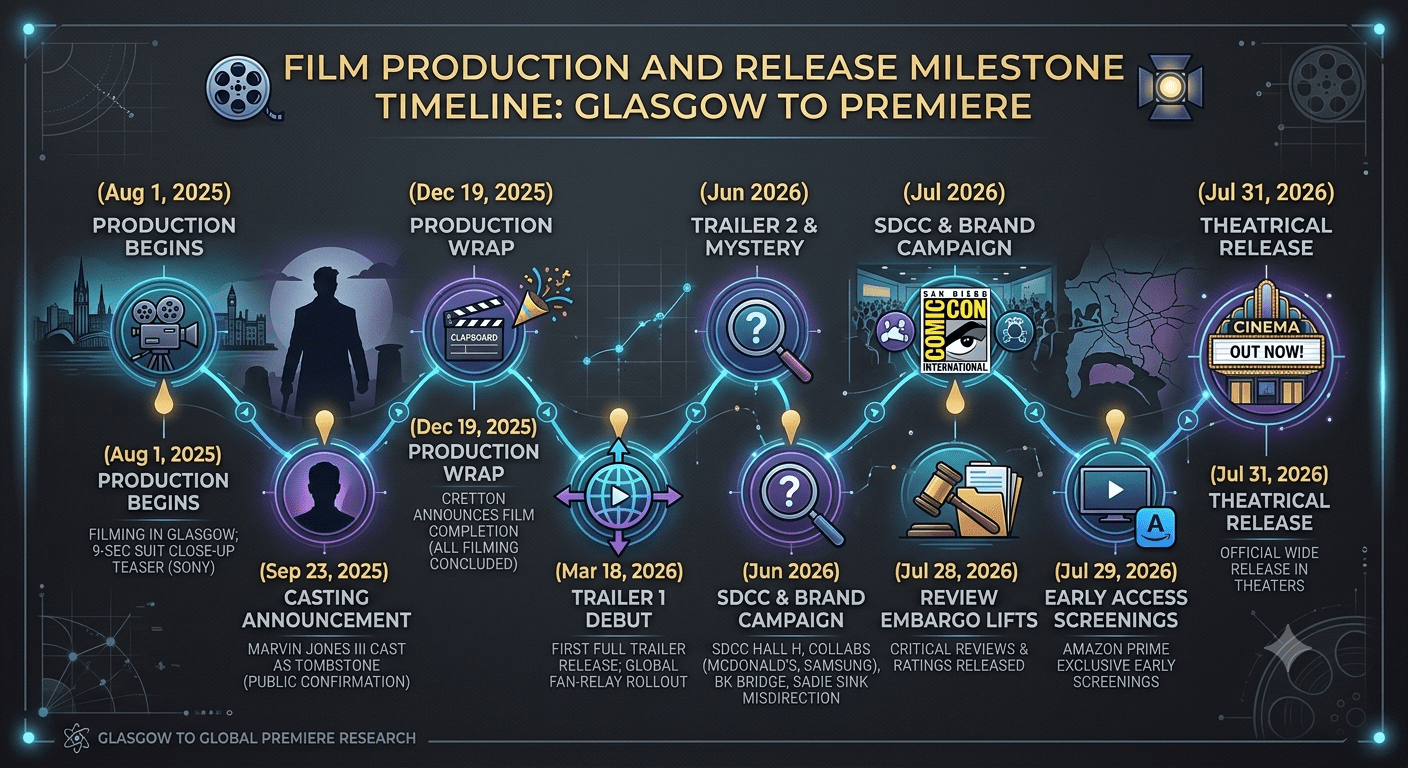
A campaign’s pacing is itself a strategic choice, and the Spider-Man Brand New Day marketing campaign spread its reveals across nearly a full year instead of front-loading them. Here’s the verified sequence:
Production & Release Timeline
Key milestones from filming to theatrical release
Filming begins in Glasgow; Sony releases a 9-second suit close-up teaser on the same day production started
Marvin Jones III cast as Tombstone, confirmed publicly via official casting announcement
Cretton announces the film has wrapped production
First full trailer releases, using a fan-relay rollout across global time zones instead of a single studio upload
Second trailer drops, deepening the villain and Sadie Sink mystery threads
San Diego Comic-Con Hall H panel, exclusive footage, brand collaboration wave (Samsung, McDonald’s, apparel, collectibles), Brooklyn Bridge installation, Sadie Sink misdirection videos
Review embargo lifts
Amazon Prime early-access screenings
Theatrical release
| Date | Milestone |
|---|---|
|
01
August 1, 2025
|
Filming begins in Glasgow; Sony releases a 9-second suit close-up teaser on the same day production started |
|
02
September 23, 2025
|
Marvin Jones III cast as Tombstone, confirmed publicly via official casting announcement |
|
03
December 19, 2025
|
Cretton announces the film has wrapped production |
|
04
March 18, 2026
|
First full trailer releases, using a fan-relay rollout across global time zones instead of a single studio upload |
|
05
June 2026
|
Second trailer drops, deepening the villain and Sadie Sink mystery threads |
|
06
July 2026
|
San Diego Comic-Con Hall H panel, exclusive footage, brand collaboration wave (Samsung, McDonald’s, apparel, collectibles), Brooklyn Bridge installation, Sadie Sink misdirection videos |
|
07
July 28, 2026
|
Review embargo lifts |
|
08
July 29, 2026
|
Amazon Prime early-access screenings |
|
★
July 31, 2026
|
Theatrical release |
Marketing principle: the campaign stretches nearly a full year, but reveals are metered, not front-loaded. Casting news, a suit tease, and a wrap announcement kept the film in conversation through late 2025 without needing a single trailer.
3D Posters and Key Art: Designed to Be Photographed, Not Just Viewed
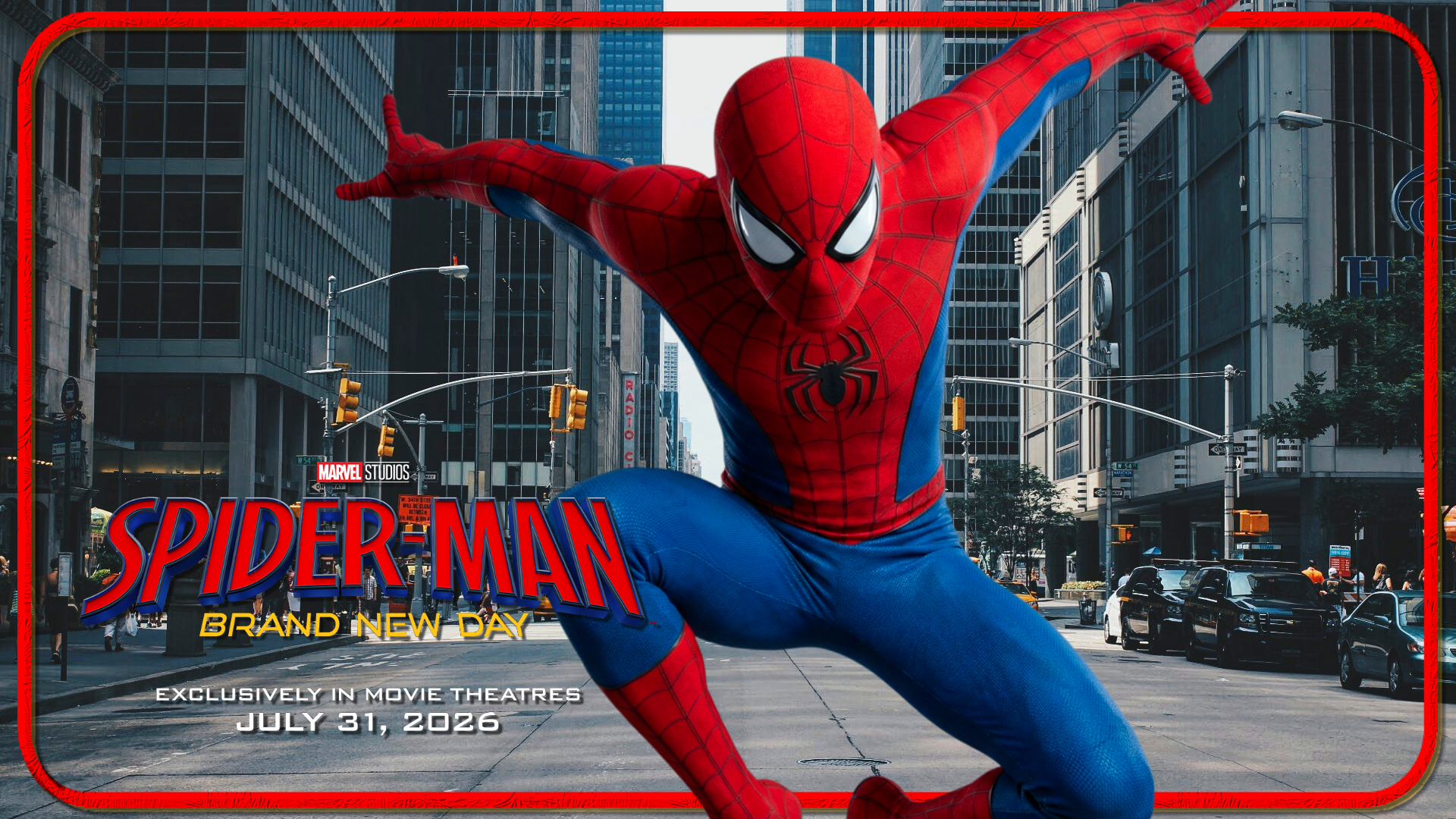
Marketing observers have singled out the film’s international poster art as a standout piece, the kind of image fans would want to own as a print. That’s not incidental. A poster that works as wall art gets photographed, shared, and re-shared by people who aren’t being paid to promote the film, which is the entire point of “earned media.”
The psychological mechanism is simple: people share things that make them look good, not things that make the studio look good. A poster fans would frame does double duty as a billboard inside someone else’s Instagram feed, at zero incremental media cost to Sony.
Marketing principle: treat key art as a shareable object first and an advertisement second. If the art only works as an ad, it dies the moment the ad budget stops. If it works as something people want to keep, it keeps circulating for free.
Trailer Marketing: Mystery as a Content Format, Not Just a Secret
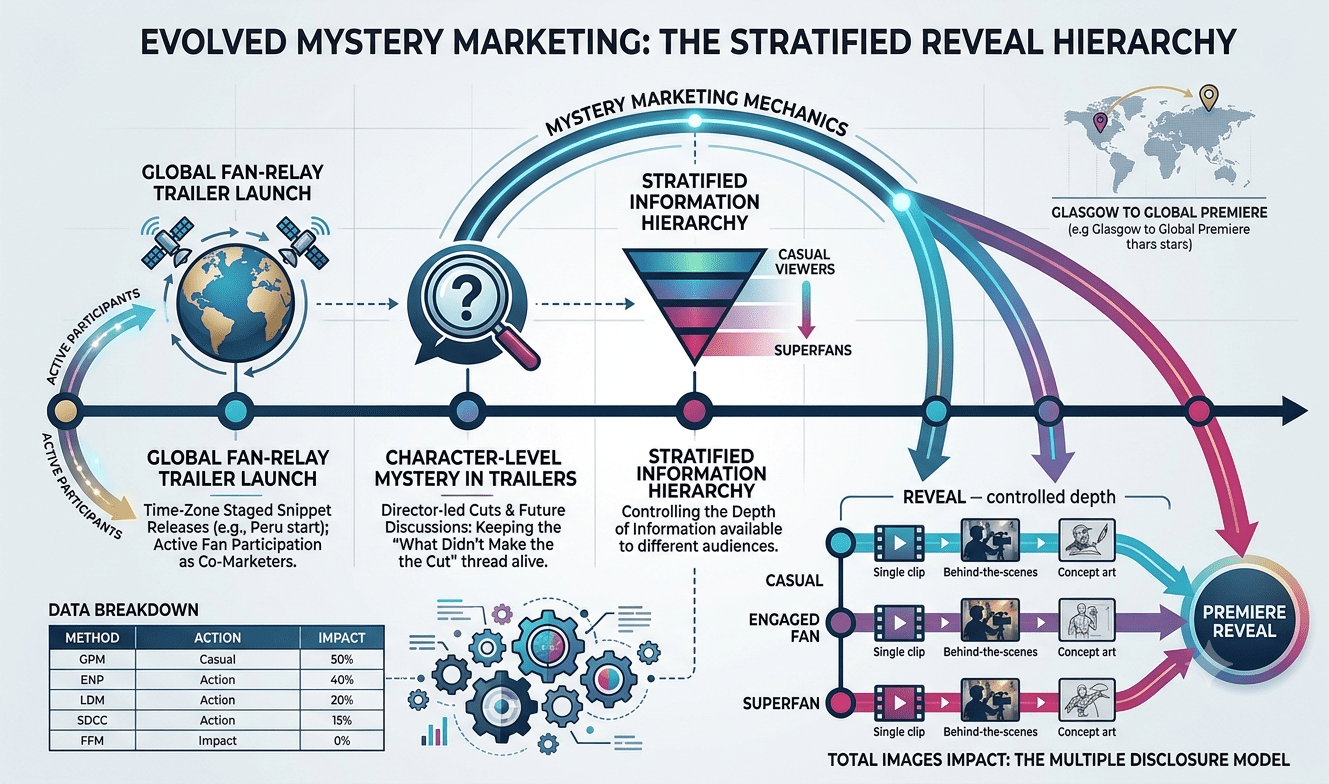
The trailer rollout itself became a marketing story before anyone saw the footage. Rather than dropping the first trailer through a single studio channel, Tom Holland asked fans to help “kick off the trailer launch” by sharing snippets from their own accounts as the sun rose across different time zones, starting with a fan account in Peru.
This does three things a normal trailer drop doesn’t:
- It turns passive viewers into active participants, which increases emotional investment before they’ve even seen the footage.
- It generates dozens of separate viral moments (one per region) instead of one single moment, multiplying total impressions.
- It signals, correctly, that this campaign sees fan communities as co-marketers rather than an audience to broadcast at.
Inside the trailers themselves, the mystery marketing continues at the character level. Director Destin Daniel Cretton has said a planned multi-villain fight sequence was ultimately cut from the film, even though the villain designs were already finished, leaving the door open to revisit it in a future project. Whether or not that specific scene resurfaces, the effect of talking about it publicly is the same: it keeps a “what didn’t make the cut” thread alive in entertainment press for weeks after the trailer itself stops being new.
The villain reveal pacing also follows a clear hierarchy. Scorpion and Tombstone were confirmed early through casting news, but Tombstone was deliberately kept out of the trailers and major footage for most of the campaign, only surfacing in a leaked clip that closely mirrors a classic comic cover. Holding back a confirmed character’s footage while his casting is already public knowledge is a distinct technique from hiding his existence entirely. It rewards people who follow the marketing closely with a payoff (the first real look) that a casual viewer doesn’t get until the film itself.
Marketing principle: mystery marketing isn’t only “don’t tell people something.” It’s controlling the order in which different depths of information become available, so casual audiences, engaged fans, and superfans each get their own reveal moment on a separate timeline.
Outdoor Advertising: Turning the City Into the Set
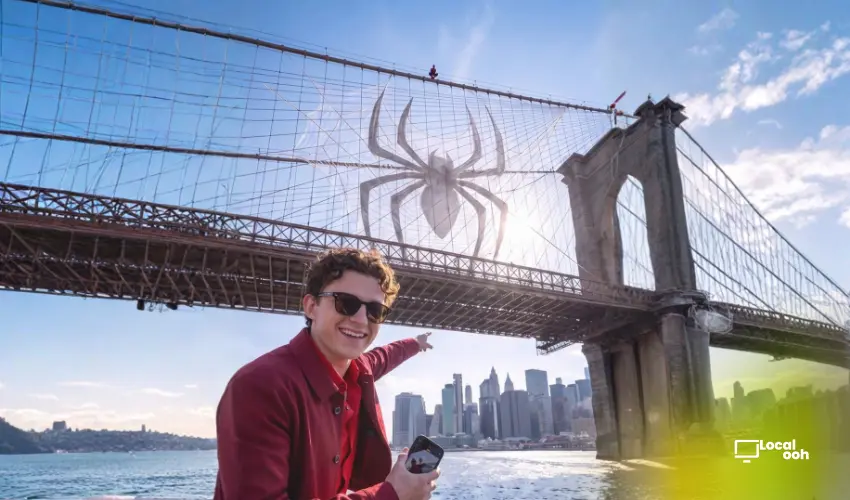
For the campaign’s outdoor push, marketers wrapped the Brooklyn Bridge in a large-scale Spider-Man installation, turning one of New York’s most recognizable landmarks into a promotional canvas that’s difficult for residents or visitors to ignore. Times Square billboards and digital promo spots followed as the release date approached, making outdoor placement one of the most visible pillars of the Spider-Man Brand New Day marketing campaign.
The reasoning behind location choice matters more than the reasoning behind format choice. A billboard in a generic location advertises at people. A takeover of a landmark specifically tied to the character’s home city advertises through the character’s own mythology, since Spider-Man’s story has always been anchored to New York. The location does narrative work a generic billboard placement can’t.
There’s a practical constraint worth naming honestly: the film will not have any IMAX screenings at release, because that premium format is locked up by a competing film through its own release window. That’s a real limitation on premium-format outdoor and in-cinema promotion that the campaign has had to work around rather than something within its control.
Marketing principle: environmental advertising earns organic social shares in a way static billboards don’t, because passersby become the distribution channel the moment they take a photo. Landmark selection should reinforce brand mythology, not just maximize foot traffic.
Social Media: Redaction as an Engagement Mechanic
The clearest example of platform-native strategy is the Sadie Sink mystery-character rollout. The official Spider-Man account posted a video on July 22 in which Sink begins to say “Hi, my name is Sadie Sink, and I play…” before a spider-web graphic slams over her mouth mid-sentence, and the clip had drawn nearly 964,000 views shortly after posting.
A follow-up video pushed the joke further rather than resolving it. Sink offered three “confirmed” facts about her role in an Instagram clip, only one of which was actually informative: that she is, in fact, in the movie. That’s a deliberate anti-reveal, and it works because the conversation about the mystery generates more total engagement across TikTok, X, and Reddit than a straight confirmation would.
Music has been folded into the same multi-platform push. The promotional campaign has also leaned on new original songs tied to the soundtrack, including tracks from NF and Olivia Rodrigo, to build anticipation ahead of release. A high-profile soundtrack single gives the film a foothold on music-streaming and short-form video platforms that a trailer alone doesn’t reach.
Marketing principle: on social platforms, ambiguity often out-performs information. A confirmed answer ends the conversation. A well-timed non-answer extends it, and extended conversation is the actual currency these platforms reward.
Influencer and Creator-Led Marketing
Sony has adopted a creator-led promotional approach, releasing trailer snippets through fans and digital creators across global markets before unveiling the complete trailer, a method designed to turn audiences into active participants rather than passive viewers.
This overlaps with the fan-relay trailer rollout described in Section 4, but the strategic distinction is who gets access first. Handing early snippets to creators and regional fan accounts, rather than posting everything simultaneously through the main studio channel, means the “leak” moment is engineered rather than accidental. Each creator effectively becomes a micro-premiere, with their own audience getting a version of the “first to see it” excitement that used to be reserved for press embargoes.
Marketing principle: distributing exclusivity across many small creators generates more total first-mover excitement than concentrating it in one official channel, because it multiplies the number of audiences who feel like insiders.
Brand Collaborations: Why Each Partner Was Chosen
The film has partnered with a wide range of consumer brands for tie-in promotion, spanning fast food, gaming, and beyond. These tie-ins are one of the most commercially important layers of the Spider-Man Brand New Day marketing campaign, since they reach audiences who may never see a trailer. Here’s how the major, verified partnerships map to a strategic purpose:
Brand & Partner Ecosystem
How each partner extends the film’s reach into different markets
| Brand / Partner | Category | Why It Fits |
|---|---|---|
|
01
Samsung Galaxy
|
Technology | Samsung’s own marketing team framed the tie-in around innovation and “seeing possibilities where others don’t,” building an exclusive brand film that folds Galaxy foldables into Spider-Man’s world rather than just slapping a logo on a poster. It also powered SpideyTracker.net, an interactive in-universe/real-world hybrid site unveiled with Jacob Batalon in character as Ned Leeds. |
|
02
McDonald’s
|
Fast food / family audience | A Happy Meal tie-in and themed activity book extend reach to a family audience the trailers alone don’t target. |
|
03
Adidas, Aéropostale
|
Apparel | Positions the film in everyday lifestyle retail, not just collector merchandise. |
|
04
Funko, Hasbro, Sideshow
|
Toys / collectibles | Includes figures, role-play toys, and premium statues; notably, some Hasbro and Lego products previewed Hulk and villain appearances before the studio’s own official reveals, functioning as an unintentional but real marketing leak channel. |
|
05
Citizen
|
Watches / limited collectibles | A 1,500-piece limited watch run creates artificial scarcity for collectors, a separate audience from moviegoers entirely. |
|
06
PUBG Mobile
|
Gaming | Brings the character into an existing live-service game’s own player base and in-game economy. |
Marketing principle: a strong brand collaboration slate doesn’t just chase the biggest possible partner logos. It deliberately covers different, non-overlapping audiences — tech buyers, families, collectors, gamers — so no single tie-in has to work twice as hard.
Digital Infrastructure: The Website That’s Also Part of the Story
Sony built SpideyTracker.net as both a real-world marketing site and an in-universe artifact, presented as something Ned Leeds himself created to keep tabs on Spider-Man’s movements. The same site was used to promote a Comic-Con panel appearance and tease upcoming villains.
Marvel also ran a recurring “Web Sightings Wednesday” activation, encouraging fans to follow social accounts and decode tracker-board clues tied to real product sightings from licensees and retailers around the world. This converts routine retail merchandising into a low-effort scavenger-hunt content series that fans actively participate in, rather than a passive shelf display.
Marketing principle: a campaign website doesn’t have to be a static hub for trailers and showtimes. Framed as an in-universe object, it becomes content in its own right, something fans visit repeatedly rather than once.
The Psychology Underneath the Whole Campaign
Every tactic above maps to a specific psychological lever:
- Curiosity gap: the Sadie Sink non-reveal and the Tombstone footage embargo both work because an unresolved question is more compelling than a resolved one, up to a point.
- Scarcity: the 1,500-unit Citizen watch run and limited early Amazon Prime screening access both create urgency through hard limits, not marketing copy.
- FOMO: the fan-relay trailer rollout means missing the “first wave” of reveals genuinely means seeing a different, later version of the reveal than early participants did.
- Nostalgia: referencing suit designs and visual cues tied to prior Spider-Man eras (a technique the franchise leaned on heavily in No Way Home) continues to surface in costume and prop details.
- Community participation: letting fans and creators post the “first” trailer clips, rather than the studio itself, converts an announcement into a shared event people feel they helped build.
Marketing principle: the individual tactics matter less than which specific psychological lever each one is pulling. A campaign that only uses one lever (say, pure scarcity) burns out fast. Rotating between curiosity, scarcity, nostalgia, and participation keeps audience attention fresh across a nearly year-long rollout.
Marketing Budget: What’s Actually Verified
No studio has published an official number for the Spider-Man Brand New Day marketing campaign’s total spend, so this section follows Tekraze’s standing rule: no invented numbers. Here’s what reporting actually supports, and what doesn’t have a confirmed source.
- Production budget: Estimates vary by outlet. One industry report frames it as a roughly $225 million net production, while a separate, lower-authority social post cites a $275 million figure. Neither has been confirmed directly by Sony or Marvel, so both should be read as industry estimates, not official numbers.
- Marketing budget specifically: One entertainment-finance outlet estimated the marketing spend at roughly half the production budget again, spent entirely on promotion, which is offered as a general explanation for why blockbusters need such large box office totals to be considered profitable. This is a single-source estimate, not a studio-confirmed figure, and should be treated accordingly.
- Cast compensation: Reports place Tom Holland’s fee in the $15–20 million range with backend participation, Zendaya’s around $5–8 million, and Sadie Sink’s in the $2–4 million range, though none of these are studio-confirmed.
For comparison, Warner Bros. reportedly committed roughly $200 million specifically to marketing Superman (2025), on top of a reported $225 million production budget, which gives a useful benchmark for what a modern tentpole marketing spend can look like when a studio does disclose figures informally through trade press.
What we won’t do: state a single confirmed marketing-budget number for Brand New Day as fact, because no studio-sourced figure exists in the reporting reviewed for this article.
Competitor Comparison: What Brand New Day Did Differently
Blockbuster Marketing Campaigns Compared
How recent superhero films engineered their pre-release hype
| Film | Core Marketing Hook | Standout Tactic |
|---|---|---|
|
01
Spider-Man: No Way Home (2021)
|
Multiverse secrecy, hiding prior actors | Total denial strategy; the reveal itself was the entire campaign |
|
02
Deadpool & Wolverine (2024)
|
Meta-humor and cameo speculation | Ryan Reynolds’ personal social channels doing much of the promotional heavy lifting |
|
03
Superman (2025)
|
Tonal reset for an entire franchise | Landmark stunts including a statue atop London’s Shard and a Super Bowl Puppy Bowl tie-in, alongside a teaser that reportedly drew 250 million views in 24 hours |
|
04
Fantastic Four: First Steps (2025)
|
Retro-futuristic world-building | In-universe press-style materials establishing the team’s world before the plot itself |
|
05
Spider-Man: Brand New Day (2026)
|
Character-driven mystery, not a one-time gimmick | Fan-relay trailer rollout, redacted character reveals, cross-category brand tie-ins covering non-overlapping audiences |
Placed side by side, the Spider-Man Brand New Day marketing campaign shares more DNA with Superman and Fantastic Four: First Steps than with its own franchise predecessor. The clearest pattern: campaigns that can’t rely on a single unrepeatable twist (Superman, Fantastic Four, and now Brand New Day) lean harder on sustained, multi-channel activation instead. Campaigns built around one unveiling (No Way Home) can be simpler but only work once.
What Every Brand Can Learn From Spider-Man: Brand New Day
For startups: you don’t need a landmark takeover to use the same principle. Pick one channel where your actual users already gather and give them something to participate in, not just something to read.
For SaaS companies: the “controlled information hierarchy” from Section 4 translates directly. Give your most engaged users (beta testers, community members) earlier and deeper access to a launch than your general mailing list, on purpose.
For ecommerce brands: the brand-collaboration table in Section 8 is the transferable lesson. Match partners to distinct customer segments instead of chasing the single biggest possible co-brand name.
For creators: the fan-relay trailer rollout shows that being early to distribute something official, even in small pieces, builds more goodwill with an audience than posting a polished recap after the fact.
For marketers generally: the psychology section is the real takeaway. Before greenlighting a tactic, name the specific psychological lever it’s meant to pull. If you can’t name it, the tactic is probably decoration, not strategy.
FAQ
Is the Spider-Man Brand New Day marketing budget publicly confirmed? No single studio-confirmed marketing-budget figure exists in current reporting. Estimates from entertainment-finance outlets exist but are not officially verified by Sony or Marvel.
Why did Marvel hide Tombstone’s footage even after confirming his casting? Confirming a character’s casting and revealing his actual footage are two separate reveals. Holding back the footage kept a payoff in reserve for engaged fans following the campaign closely, distinct from casual viewers who only see the finished film.
Who is Sadie Sink playing in Brand New Day? As of this article, Marvel has not officially confirmed her character. Fan theories point toward Jean Grey, based on visual cues in promotional material, but this remains unconfirmed speculation, not a verified fact.
How does this campaign compare to Superman’s 2025 marketing? Both campaigns avoided relying on a single unrepeatable twist and instead built sustained, multi-channel activity across roughly a year. Superman’s reported budget and landmark stunts (like the Shard statue) are publicly discussed in more concrete financial terms than Brand New Day’s have been so far.
What’s the single most transferable marketing lesson from this campaign? The Spider-Man Brand New Day marketing campaign’s biggest lesson is matching each tactic to a specific psychological lever (curiosity, scarcity, nostalgia, participation) rather than repeating the same lever throughout the entire campaign.
Conclusion
The Spider-Man Brand New Day marketing campaign works because almost nothing in it is decorative. The redacted reveals, the landmark takeover, the brand tie-ins split across non-overlapping audiences — each maps to a specific, nameable principle rather than just “more marketing.” Whether the film’s box office ultimately lands closer to the conservative $180 million tracking or the more bullish $250 million-plus range, the campaign itself is already a usable reference for anyone building a launch on more than one big reveal.
Also Read: free ai tools for content creators