
Pythagoras theorem examples are usually the first place students get stuck, not because the formula is hard, but because nobody shows enough worked problems before throwing a board exam question at you.
That’s what this article fixes. You’ll get the formula, a quick proof, and then problems that move from basic to JEE-level, so you can see exactly how the same idea gets tested at every stage.
What Is the Pythagoras Theorem?
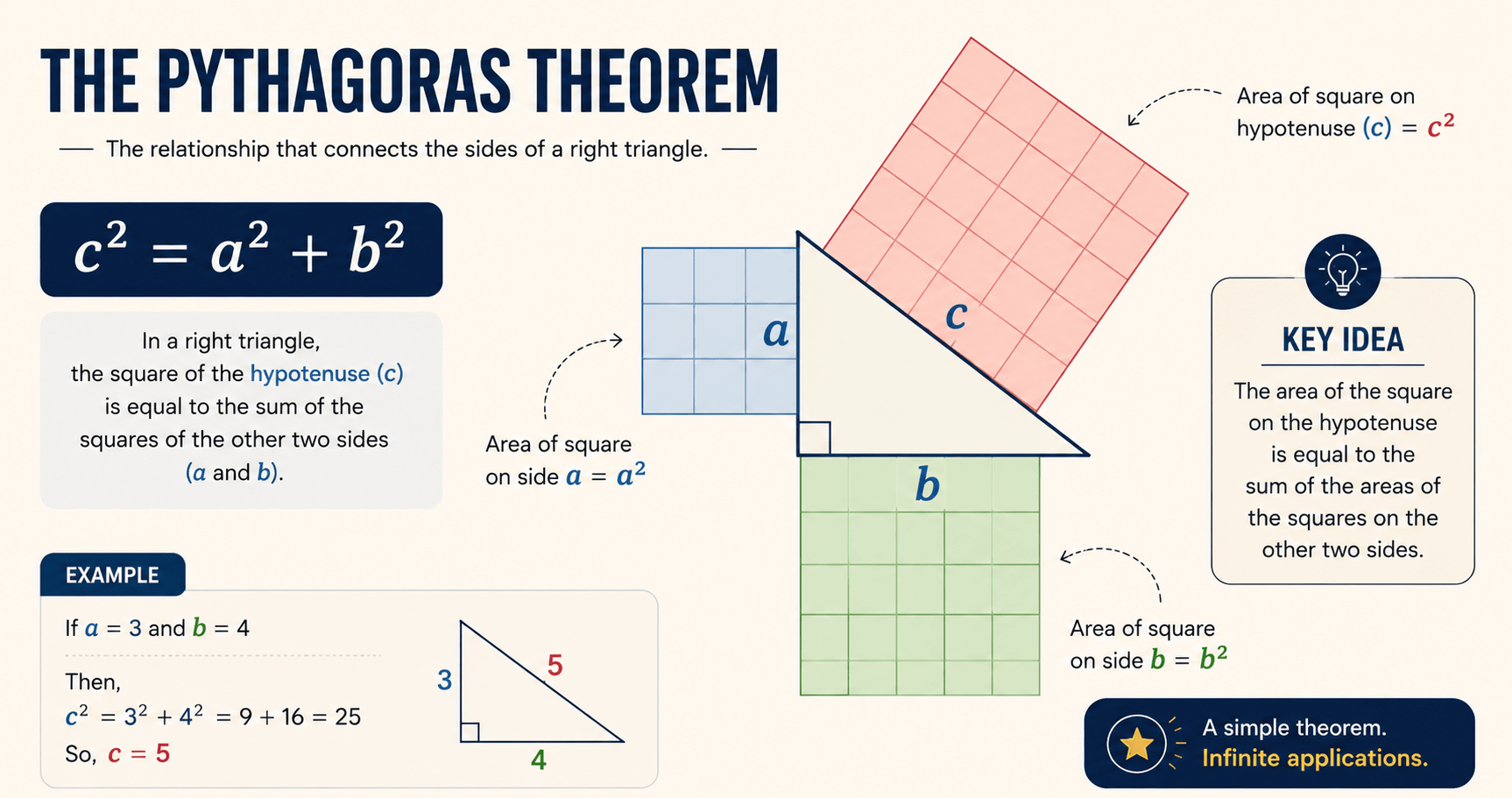
The Pythagoras theorem states that in a right-angled triangle, the square of the hypotenuse equals the sum of the squares of the other two sides.
Written as a formula: c² = a² + b², where c is the hypotenuse (the side opposite the right angle) and a, b are the other two sides.
This only works for right-angled triangles. If there’s no 90° angle anywhere in the triangle, the formula doesn’t apply.
The theorem is credited to the Greek mathematician Pythagoras, though evidence shows Babylonian and Indian mathematicians used the same relationship centuries earlier. Regardless of who found it first, the Pythagoras theorem became one of the foundational results in geometry, and it still appears in every CBSE, ICSE, and JEE syllabus today.
Also Read: Once you’re comfortable with this, the next post in this series covers the Remainder Theorem, another CBSE and JEE staple.
Pythagoras Theorem Proof (Short Version)
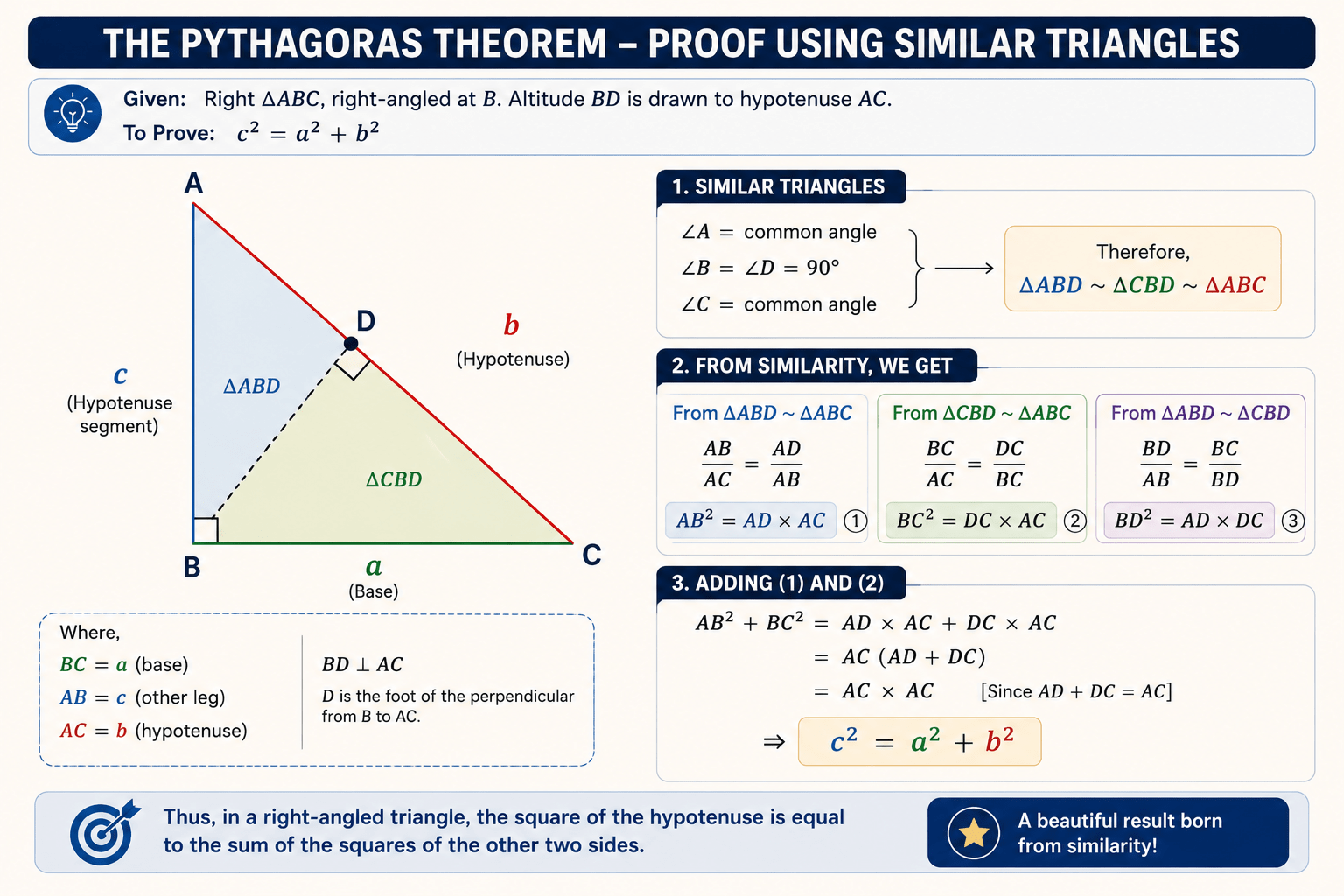
Here’s the standard proof used in CBSE Class 10, using similar triangles.
Take a right triangle ABC, right-angled at B. Draw BD perpendicular to AC.
Triangles ABD and ABC share angle A, and both have a right angle, so they’re similar (AA similarity). This gives:
AB/AD = AC/AB, which rearranges to AB² = AD × AC.
The same logic on triangles CBD and CBA gives BC² = CD × AC.
Add both results: AB² + BC² = AD × AC + CD × AC = AC × (AD + CD) = AC × AC = AC².
That’s the full proof: AB² + BC² = AC², which is exactly the Pythagoras theorem.
How to Check If a Triangle Is Right-Angled (The Converse)
The converse of the Pythagoras theorem is just as useful as the theorem itself, especially in “check whether this is a right triangle” questions.
Converse rule: If a² + b² = c² for the three sides of a triangle, the angle opposite the longest side is 90°.
This means you can test any triangle with three known side lengths, without measuring a single angle.
Basic Pythagoras Theorem Examples
Start here if you’re meeting this topic for the first time.
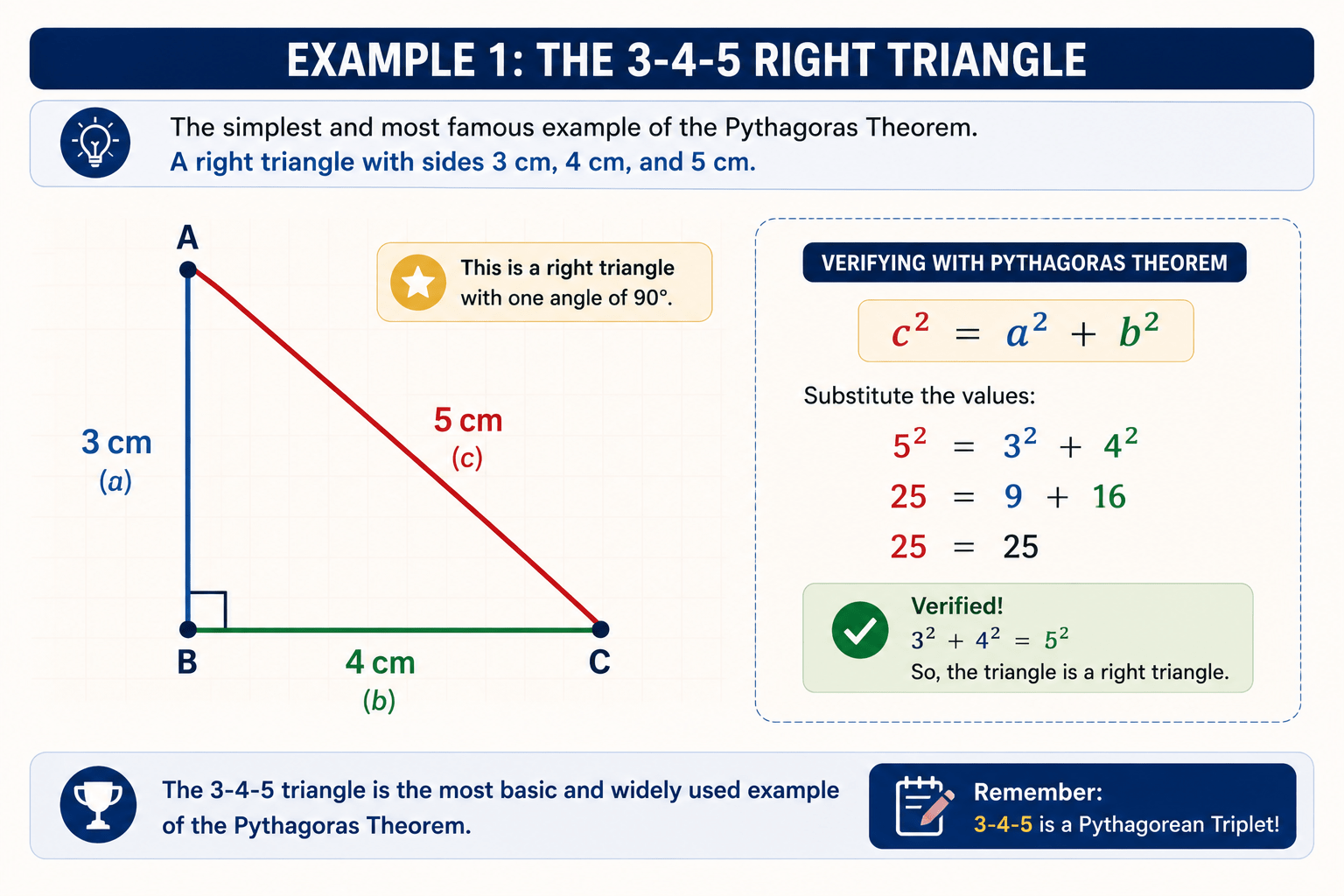
Example 1: A right triangle has legs of 3 cm and 4 cm. Find the hypotenuse.
c² = 3² + 4² = 9 + 16 = 25, so c = 5 cm. This is the classic 3-4-5 triangle you’ll see referenced constantly.
Example 2: The hypotenuse of a right triangle is 13 cm, and one leg is 5 cm. Find the other leg.
b² = 13² − 5² = 169 − 25 = 144, so b = 12 cm.
Example 3: Check whether a triangle with sides 6 cm, 8 cm, and 10 cm is right-angled.
6² + 8² = 36 + 64 = 100, and 10² = 100. Since both sides match, yes, it’s a right triangle.
Intermediate Examples (Class 10 Board Level)
These match the word-problem style you’ll actually see in board exams.
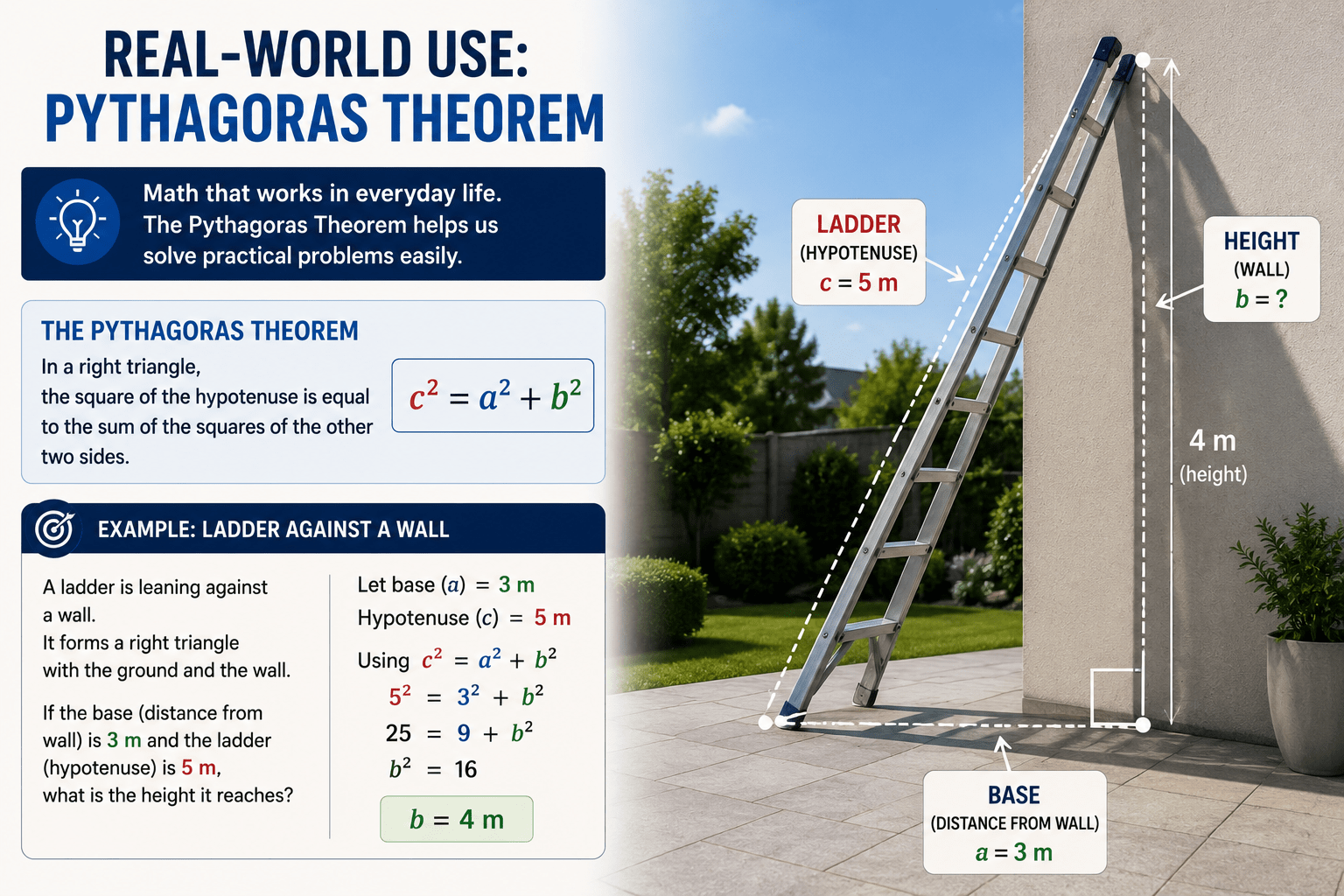
Example 4: A ladder 10 m long rests against a wall. Its foot is 6 m from the wall’s base. How high up the wall does the ladder reach?
Height² = 10² − 6² = 100 − 36 = 64, so height = 8 m.
Example 5: Find the distance between the tops of two vertical poles, 6 m and 11 m tall, standing 12 m apart on level ground.
The height difference is 11 − 6 = 5 m, and the horizontal distance is 12 m. Distance² = 5² + 12² = 25 + 144 = 169, so distance = 13 m.
Example 6: A rectangle has length 24 cm and width 7 cm. Find the length of its diagonal.
A rectangle’s diagonal splits it into two right triangles, so diagonal² = 24² + 7² = 576 + 49 = 625, giving diagonal = 25 cm.
Advanced Pythagoras Theorem Examples (JEE Level)
These combine the theorem with coordinate geometry or algebra, which is how JEE typically raises the difficulty.
Example 7: Points A(1, 2) and B(4, 6) are given. Find the distance AB using the Pythagoras theorem.
Distance formula comes directly from Pythagoras: AB² = (4−1)² + (6−2)² = 9 + 16 = 25, so AB = 5 units.
Example 8: In triangle ABC, right-angled at B, AB = x, BC = x + 7, and AC = x + 8. Find x.
Using the theorem: x² + (x+7)² = (x+8)². Expand: x² + x² + 14x + 49 = x² + 16x + 64. This simplifies to x² − 2x − 15 = 0, which factors to (x − 5)(x + 3) = 0. Since a side length can’t be negative, x = 5.
Example 9: A cuboid has dimensions 6 cm × 8 cm × 10 cm. Find the length of its space diagonal.
The 3D version of the theorem extends to: diagonal² = l² + b² + h² = 36 + 64 + 100 = 200, so diagonal = √200 = 10√2 cm.
Practice Problems: Test Yourself
Try these three before checking any solution online. They cover the same range as the Pythagoras theorem examples above, from basic to board-level.
- A right triangle has legs of 9 cm and 12 cm. Find the hypotenuse.
- The hypotenuse of a right triangle is 17 cm, and one leg is 8 cm. Find the other leg.
- A ladder 13 m long leans against a wall, with its foot 5 m from the base. How high does it reach?
If you can solve all three without looking back at the worked examples, you’ve genuinely understood the Pythagoras theorem, not just memorized the formula.
Common Mistakes Students Make
Most errors come from misidentifying which side is the hypotenuse, not from the formula itself.
The hypotenuse is always the side opposite the 90° angle, and it’s always the longest side. If a question gives you three lengths without labeling angles, the longest one is your hypotenuse by default.
Another frequent slip: forgetting to take the square root at the end and leaving the answer as c² instead of c.
Real-World Uses of the Pythagoras Theorem
This isn’t just a textbook formula. It shows up in construction (checking a corner is truly square), navigation (calculating the shortest direct path between two points), and screen size calculations (a TV’s diagonal size uses exactly this formula on its width and height).
Even GPS distance approximations over short ranges lean on the same logic before more complex geometry takes over.
Architects use it to confirm a wall meets the floor at a true right angle before laying a foundation. Surveyors use it to calculate land distances that can’t be measured directly, like the width of a river. Once you start looking, the Pythagoras theorem shows up far more often than a typical geometry chapter suggests.
Conclusion
The Pythagoras theorem comes down to one relationship, c² = a² + b², but the way it gets tested ranges from a straightforward triangle to coordinate geometry and algebraic setups. Work through the examples above in order, then attempt the practice problems without peeking at the solutions.
Next in this series: the Remainder Theorem, which shows up constantly once polynomial questions start appearing in your syllabus.
FAQ
What is the Pythagoras theorem in simple words?
It’s a rule for right-angled triangles: the square of the longest side (hypotenuse) equals the sum of the squares of the other two sides.
Does the Pythagoras theorem work on all triangles?
No. It only applies to right-angled triangles, where one angle is exactly 90°.
What is the converse of the Pythagoras theorem used for?
It lets you check if a triangle is right-angled just from its three side lengths, without measuring any angle.
How is the Pythagoras theorem used in coordinate geometry?
The distance formula between two points is a direct application of the theorem, treating the horizontal and vertical gaps as the two legs of a right triangle.
Is the Pythagoras theorem asked in JEE?
Yes, usually combined with coordinate geometry, algebra, or 3D geometry rather than as a standalone question.
Also Read: important maths theorems series