
If you have been shopping for a TCL P6K vs V6C vs P7K comparison, you have probably noticed something confusing. Some sites list the P6K and V6C as two separate TVs. Others show them with almost identical specs, prices, and even the same panel. That is not a mistake on their part, and it is not you missing something either.
This TCL P6K vs V6C vs P7K breakdown exists because the model names alone don’t tell the real story. Here is the short version before we go deep: the P6K and V6C are the same television, sold under two different names in two different markets. The P7K is the one that is genuinely different, with a QLED panel, better color, and a faster refresh rate. Let us break down exactly what that means for your buying decision.
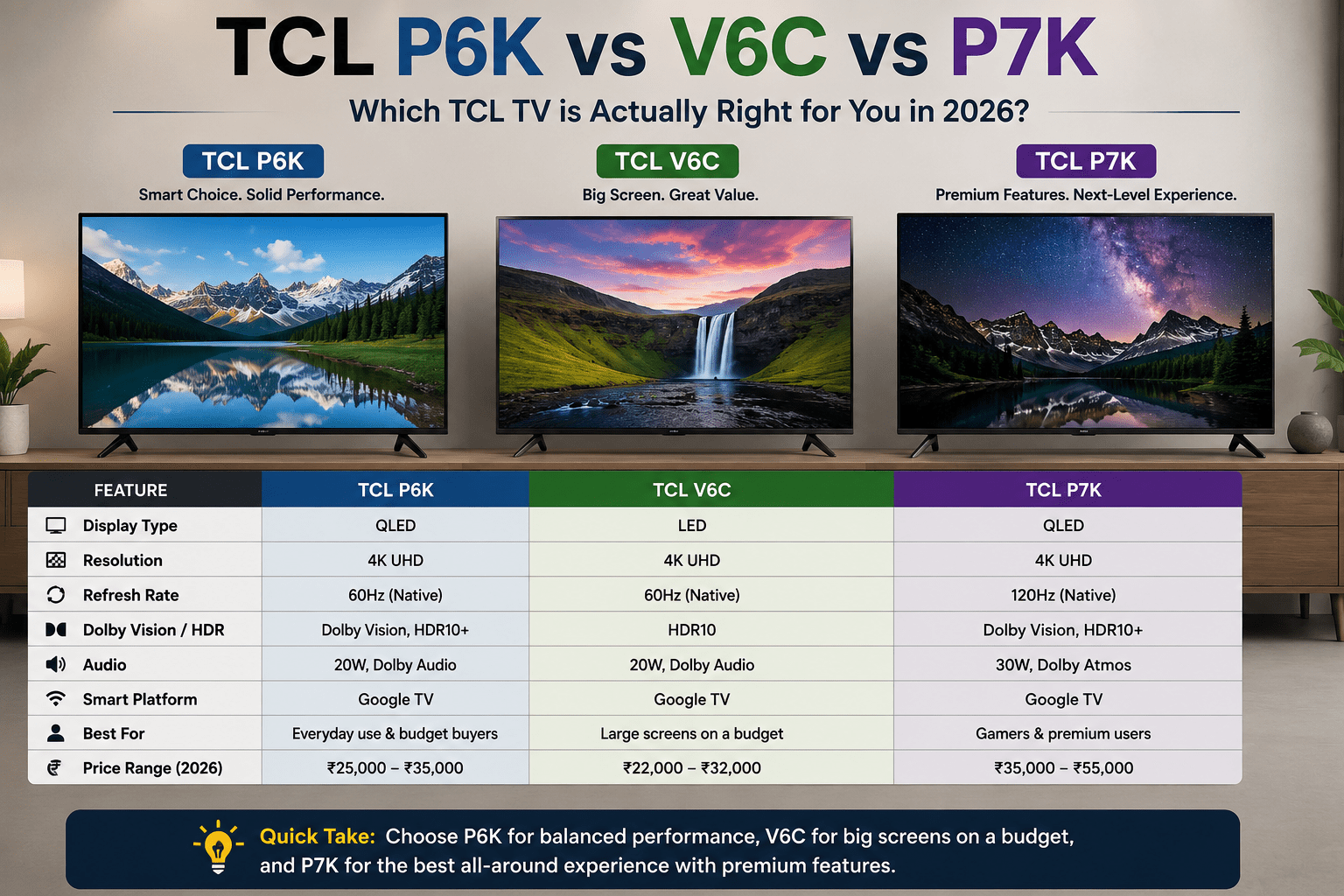
TCL P6K vs V6C vs P7K at a Glance
TCL TV Comparison: P6K vs V6C vs P7K
Side-by-side specs comparison of TCL’s popular LED and QLED TV models. Find the best fit for your home entertainment setup.
| Feature | TCL P6K | TCL V6C | TCL P7K |
|---|---|---|---|
| Panel Type | LED (HVA) | LED (HVA) | QLED (HVA) |
| Sold In | India, Asia | UK, Europe | India, Global |
| Native Refresh Rate | 60Hz | 60Hz (4K); up to 120Hz in FHD only | Up to 120Hz (VRR) |
| Color Gamut | Standard LED gamut | Standard LED gamut | 93% DCI-P3 |
| HDR Support | HDR10, HDR10+ | HDR10, HDR10+, Dolby Vision | Dolby Vision, HDR10+ |
| Peak Brightness | 260–330 nits (size-dependent) | ~330 nits (largest model) | Higher; brand does not publish an exact nit figure for India units |
| Processor | AiPQ Processor | AiPQ Processor | AiPQ Processor |
| Sound | 2×10W (2×15W on 75″) | Comparable 2-channel setup | 30–35W, ONKYO-tuned, 2.1ch with subwoofer on larger sizes |
| Smart Platform | Google TV | Google TV | Google TV |
| Design | Metallic bezel-less | Similar slim design | Slim & uni-body metal frame |
| Sizes (India) | 43″, 55″, 65″, 75″ | Not the primary India SKU name | 43″, 50″, 55″, 65″, 75″ |
| Starting Price (India) | ₹24,490 (43″) | ₹27,990 (43″, where listed) | ₹30,990 (43″) |
Prices above reflect street prices tracked in mid-2026 and change often. Always check the live listing before you buy.
Why P6K and V6C Are Basically the Same TV
This is the part most comparison articles skip. TCL sells one entry-level 4K LED lineup for 2025-26 and simply brands it differently by region. In the India and Asia markets, it ships as the P6K. In the UK and Europe, the identical hardware ships as the V6C. Both use the same direct-LED backlight, the same HVA panel for improved contrast over a standard VA panel, the same AiPQ image processor, and the same 60Hz native refresh rate on the 4K models.
This matters for readers because if you see a “TCL V6C” listed on an Indian retail site alongside a “TCL P6K,” you are very likely looking at the same television with a name mismatch from a global listing, not two genuinely different products to weigh against each other. The real decision most Indian buyers face is P6K vs P7K.
Panel and Picture Quality: LED vs QLED
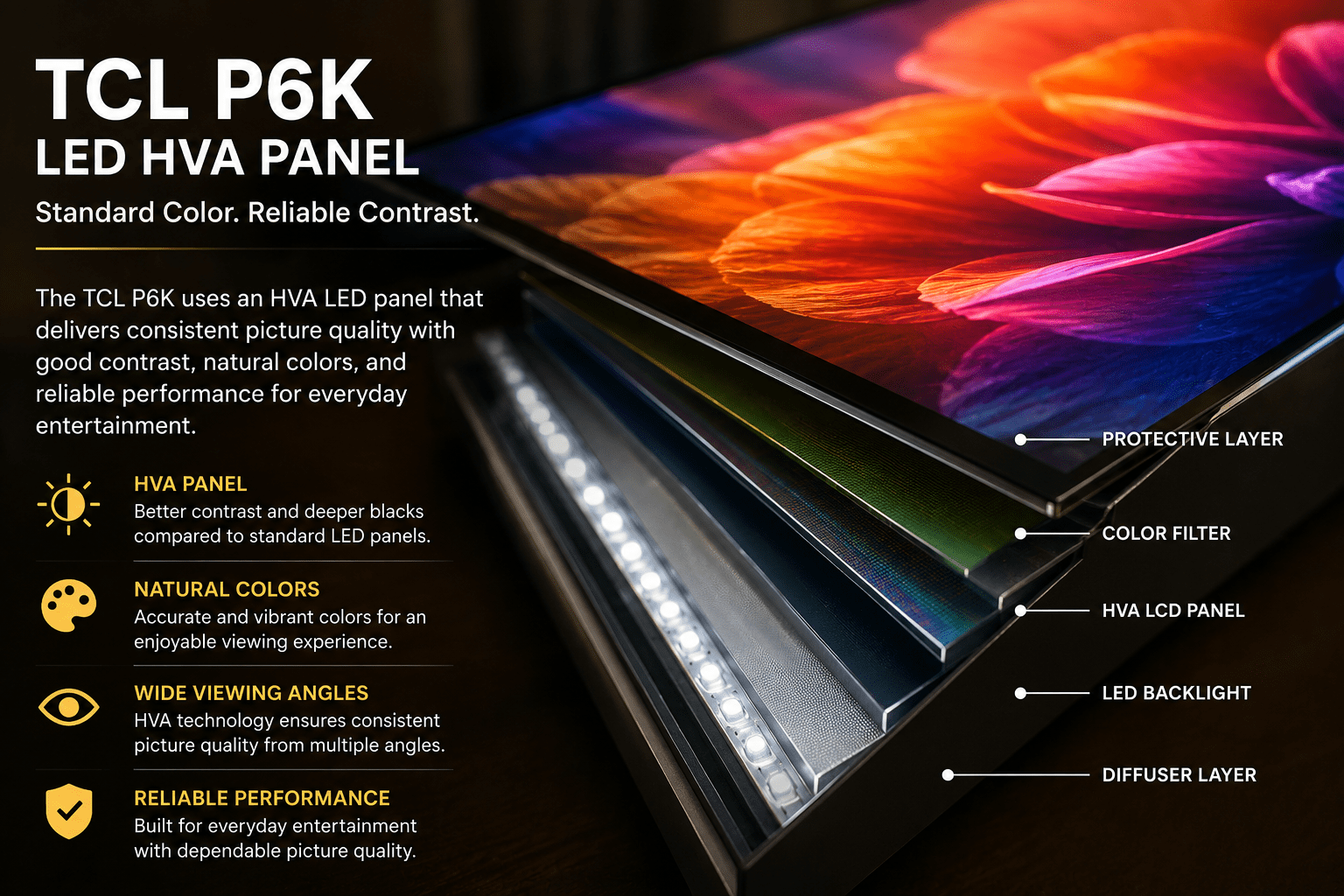
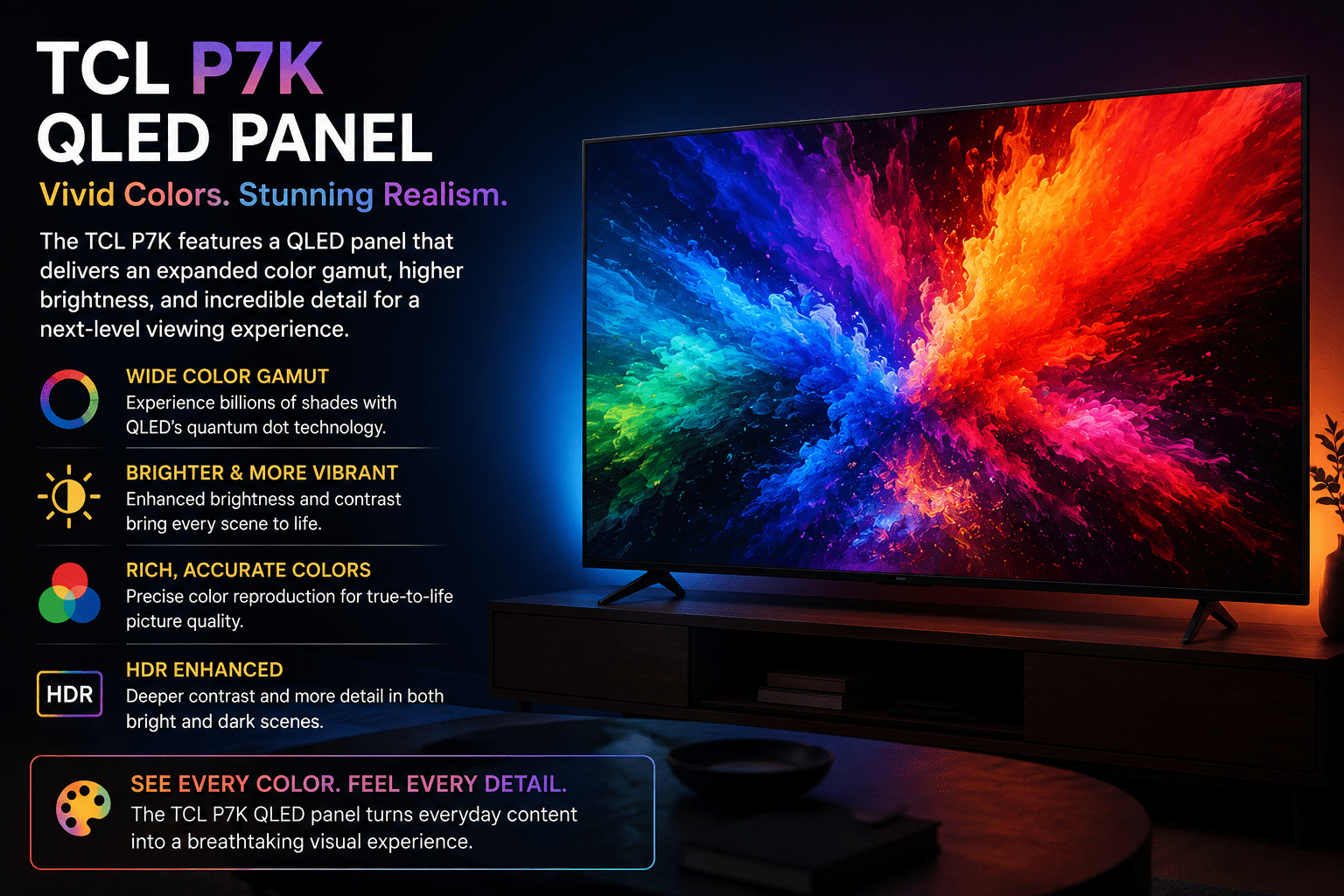
The P6K and V6C use a standard LED panel with an HVA layer, which improves contrast and viewing angles over a basic VA panel but does not add color volume. The P7K steps up to a QLED panel, which adds a quantum dot layer in front of the backlight. In practical terms, this means richer, more saturated colors and a wider 93% DCI-P3 color gamut on the P7K, noticeable most clearly with HDR content, animated movies, and sports broadcasts where color saturation matters.
For everyday viewing, mixed streaming content, and casual use, the P6K/V6C panel is genuinely fine and not a downgrade that jumps out at you. The difference becomes obvious side by side, in a dark room, on HDR-mastered content not in daylight viewing of a cricket match.
HDR and Dolby Vision Support
Both lines support HDR10 and HDR10+. The meaningful gap is Dolby Vision, which TCL includes on the V6C globally and on the P7K, but does not consistently list for Indian P6K units. If Dolby Vision playback matters to you specifically (a growing share of Netflix and Apple TV+ content is mastered in it), the P7K is the safer, confirmed choice for Indian buyers. Not officially confirmed for every P6K India variant check the exact model’s spec sheet before assuming Dolby Vision support.
Refresh Rate and Gaming
Here is where the P7K pulls ahead for anyone who games. The P6K and V6C top out at 60Hz native refresh on their 4K panels. The P7K supports up to 120Hz with variable refresh rate (VRR), which makes a real difference for PS5, Xbox Series X, or PC gaming where smoother motion and reduced input lag change how the game actually feels to play, not just how a spec sheet reads.
If your TV is mostly for streaming, YouTube, and cable or set-top box content, 60Hz is not a limitation you will notice. If you are connecting a current-gen console for competitive or fast-paced games, the P7K’s higher refresh ceiling is worth the price gap.
Sound: Where the P7K’s Extra Cost Shows Up
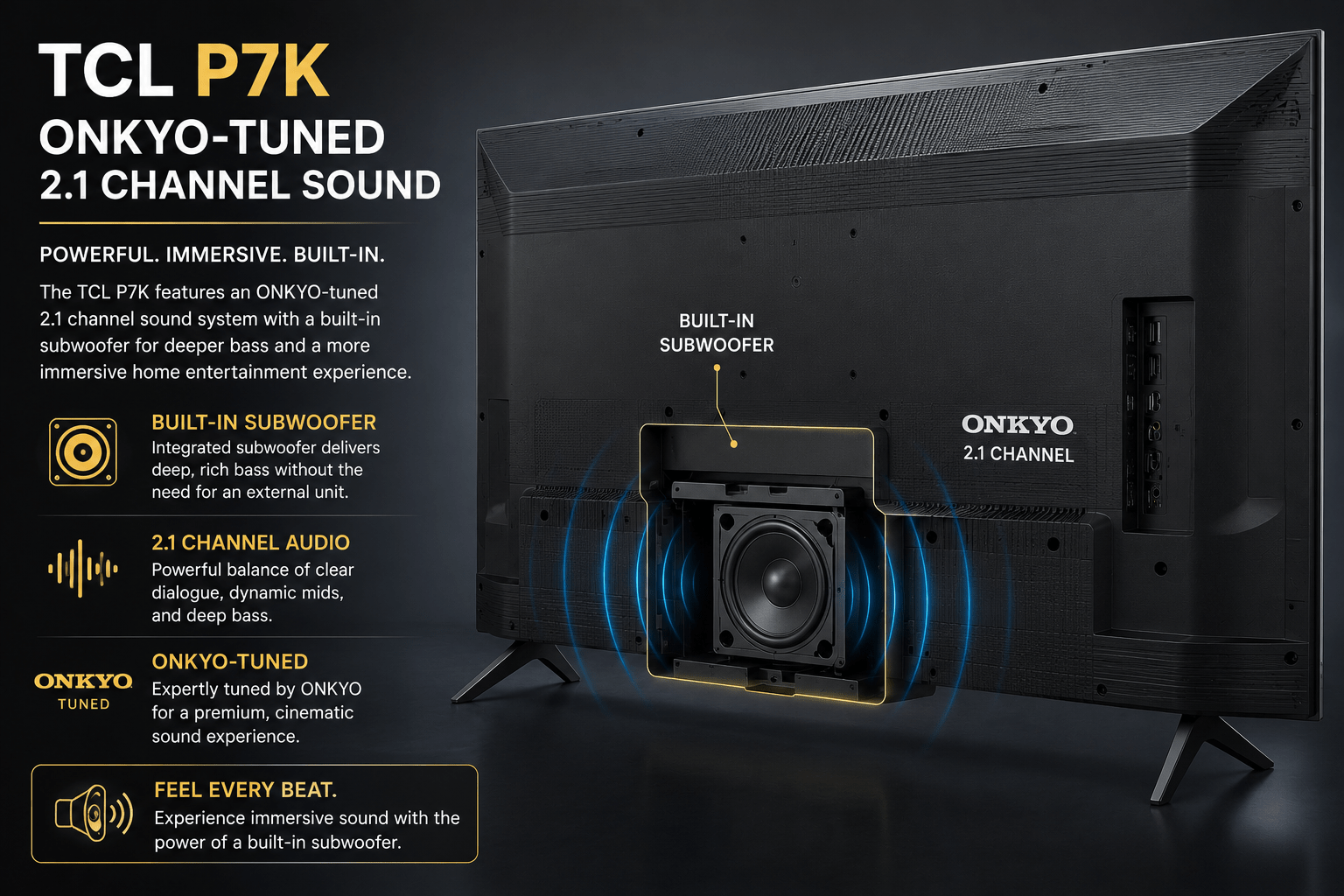
The P6K and V6C ship with a standard 2x10W (or 2x15W on the 75-inch) stereo setup, adequate for casual viewing but thin on bass, as with most TVs at this price. The P7K includes an ONKYO-tuned 2.1-channel system with a dedicated subwoofer on the 55-inch and 75-inch models, rated around 30–35W total. That subwoofer is the single most noticeable real-world difference between the two tiers if you are not planning to add a soundbar. Anyone budgeting for a soundbar anyway can treat this as a smaller factor in the decision.
Real-World Ownership: What Buyers Actually Report
Pulled from user reviews on Flipkart and Amazon India across both series, a few patterns repeat. P6K and V6C owners consistently describe the picture as good for the price and the setup process (Google TV account, voice remote pairing) as straightforward. P7K owners specifically call out the sound quality and color as noticeably better, with several reviews naming the subwoofer directly.
Common complaints across both series, as with most budget-to-mid TVs, involve occasional Google TV interface lag after months of use and app load times that are slower than the top-shelf QLED competition from Samsung or Sony. Not officially confirmed whether this is a units-level issue or a software update matter; if it concerns you, checking recent review dates for either model is worth doing before purchase.
Who Should Buy Which
Best Overall for Most Buyers: TCL P6K solid 4K picture, reliable Google TV experience, and the lowest price of the three for someone who is not chasing gaming refresh rates or Dolby Vision.
Best Value: TCL P6K (43-inch or 55-inch) the price-to-picture-quality ratio here is hard to beat in the sub-₹35,000 4K segment.
Best for Gaming: TCL P7K the only one of the three with VRR and up to 120Hz, which matters if you own a current-gen console. Best for Movies: TCL P7K Dolby Vision support plus the wider color gamut makes a genuine difference on movie content.
Best for Sound Without a Soundbar: TCL P7K the ONKYO 2.1 setup with subwoofer is the clearest upgrade over the P6K/V6C tier.
If You’re Shopping Outside India: Look for the V6C name specifically in UK and European listings it is the P6K’s regional twin, not a separate model to research from scratch.
Buying Decision Flow
- Choose the P6K if you want a dependable 4K TV for streaming and general use and want to spend the least.
- Choose the P7K if you game on a PS5, Xbox Series X, or gaming PC and want VRR and higher refresh rate.
- Choose the P7K if you watch a lot of Dolby Vision content on Netflix, Prime Video, or Apple TV+.
- If your budget is under ₹35,000, the P6K covers your needs without compromise for casual use.
- If you are outside India and see “V6C,” treat it as the same purchase decision as the P6K same hardware, different regional name.
- If sound quality without a soundbar is a priority, the P7K’s subwoofer justifies the price jump on its own for many buyers.
Verdict: There Isn’t One Winner Here
The straight answer is that this is not even a comparison, as the P6K and V6C are exactly the same television but sold in different regions. This should be a P6K vs P7K comparison, and ultimately, it boils down to whether you need gaming refresh rates, Dolby Vision, and improved sound for about ₹15,000 to ₹20,000 more than the P6K.
When it comes to a living room television set primarily meant for watching movies, streaming shows, and regular viewing, the P6K will give most of what you need at a reduced price. When building a dedicated gaming station or a home theater with movie nights in mind, the P7K QLED and audio improvement make up the extra cost.
Checking out TCL P6K vs V6C vs P7K before the purchase makes sense as the names really don’t help you distinguish between them.
Frequently Asked Questions
Is the TCL V6C the same TV as the TCL P6K? Yes. Multiple TCL regional spec pages and independent review sites confirm the V6C and P6K share the same LED panel, processor, refresh rate, and design. TCL sells it as the P6K in India and other Asian markets and as the V6C in the UK and Europe.
Is TCL P7K worth the extra money over the P6K? If you game on a current-gen console, watch Dolby Vision content regularly, or want noticeably better built-in sound, yes. If your primary use is casual streaming and general viewing, the price gap buys upgrades you may not use often enough to justify.
Does the TCL P6K support Dolby Vision in India? This is not consistently confirmed across all India P6K listings. The P7K’s Dolby Vision support is confirmed. If Dolby Vision is a must-have for you, verify the exact model number’s spec sheet or choose the P7K to be certain.
Which TCL model is better for PS5 or Xbox Series X gaming? The P7K, because it supports up to 120Hz with variable refresh rate (VRR). The P6K and V6C are capped at 60Hz on their 4K panels, which limits how much benefit you get from a current-gen console’s higher frame rate modes.
Do the P6K and P7K both run Google TV? Yes, all three P6K, V6C, and P7K run on Google TV with TCL’s AiPQ processor handling picture optimization.
Also Read: spider man brand new day marketing campaign
Conclusion
TCL’s P6K and V6C confusion is really a naming issue, not a genuine product decision; once you know they are the same hardware sold under different regional names, the real comparison simplifies down to P6K vs P7K. Pick the P6K if you want dependable 4K viewing at the lowest price. Pick the P7K if gaming performance, Dolby Vision, or built-in sound quality matter enough to justify the jump. Either way, check current pricing before you buy, since TCL’s India street prices shift by a few thousand rupees month to month.