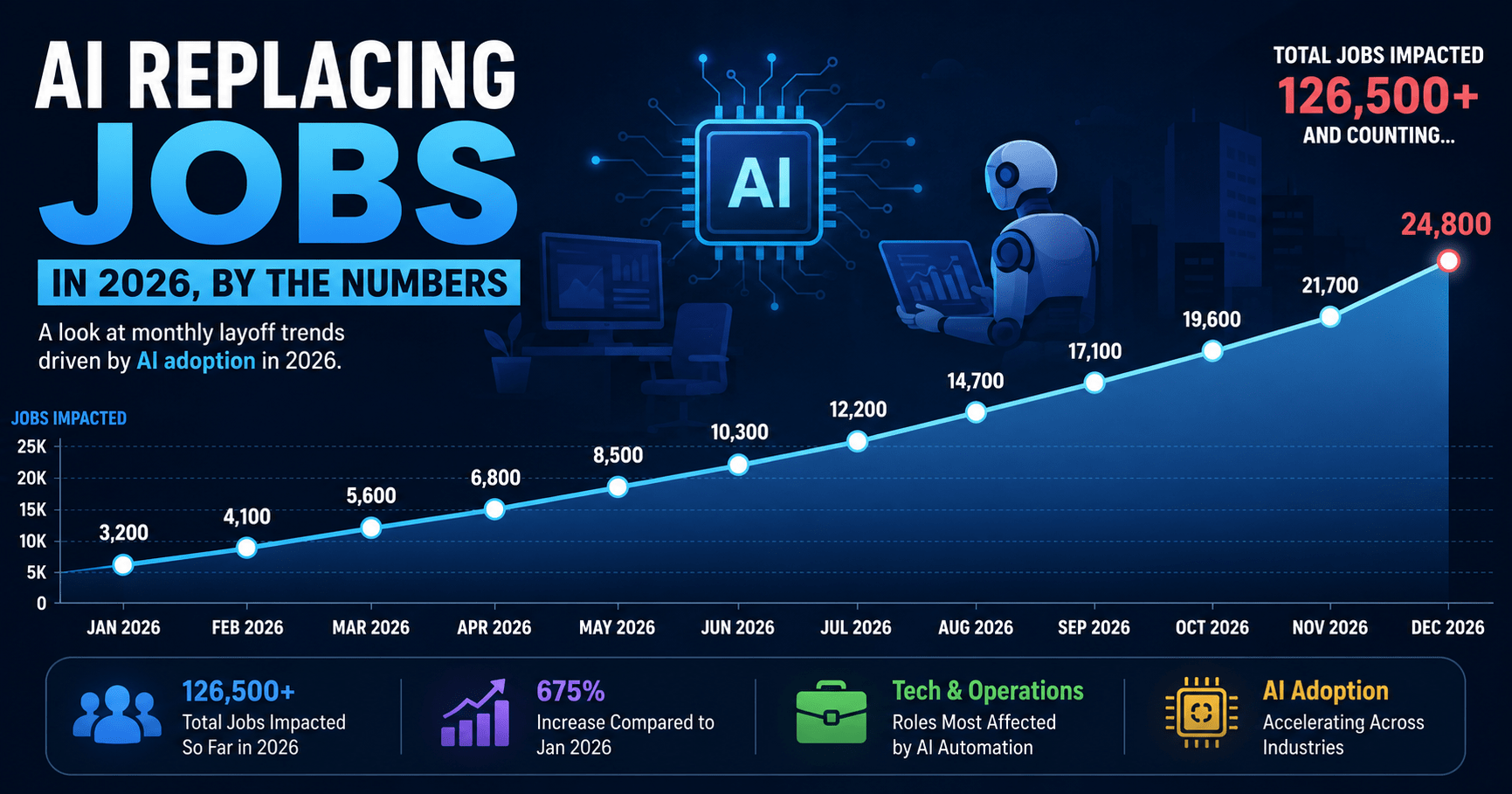

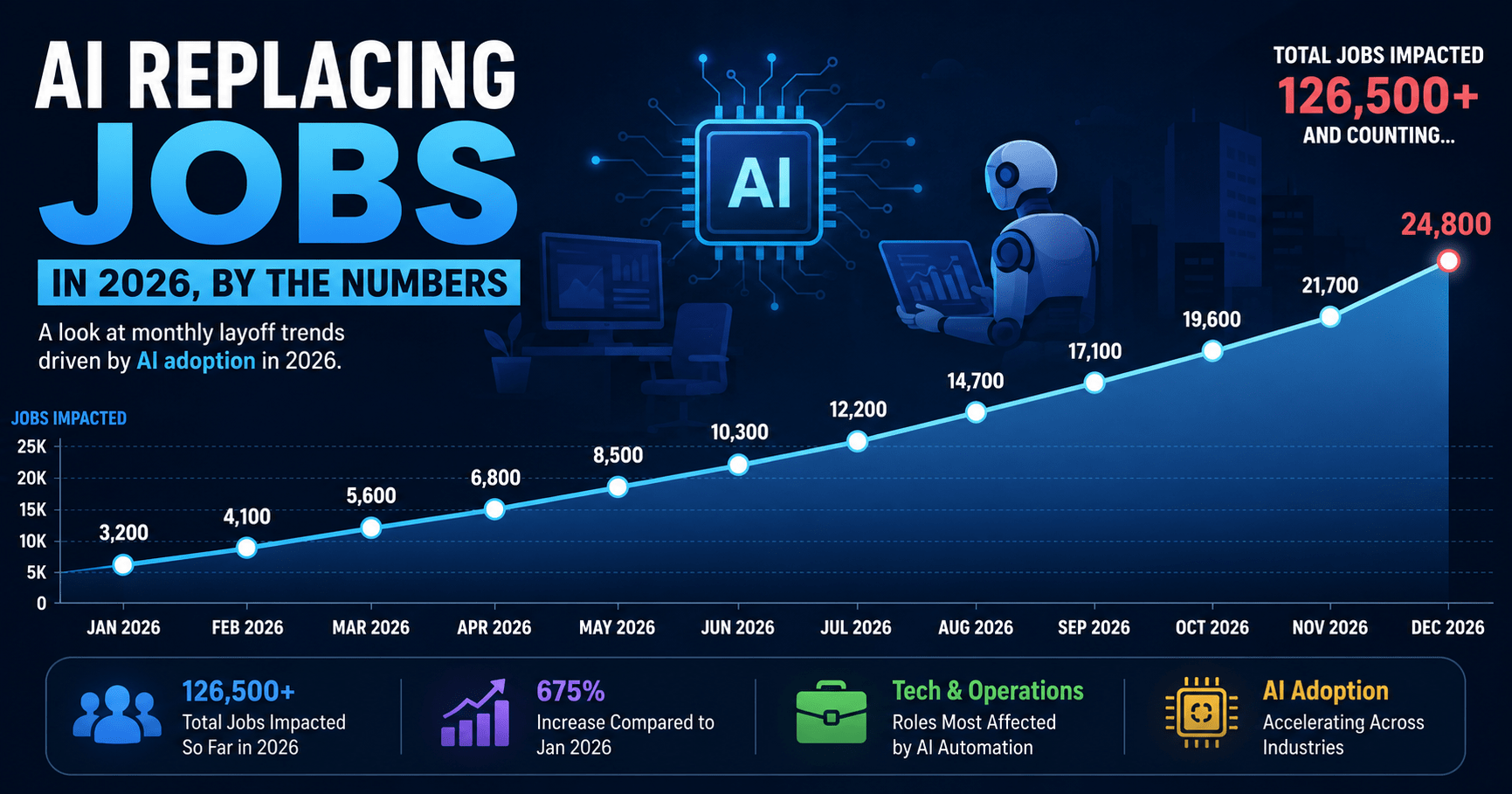
AI replacing jobs the idea was that it would be a slowly unfolding tragedy to happen in the future. It turned into an actual monthly report by the government in 2026. Each month, a staffing company counts the exact number of layoffs caused by AI, and each month it grows.
However, there is one thing which the majority of news articles leave out: the largest cases of “AI replaced us” already fell through this year. IBM introduced automation in HR requests, then had to increase the number of entry-level hires threefold. A large Australian bank had to apologize for AI-led layoffs it had not anticipated in advance. So, which one is it? Is it the case of real replacement, or is the boom falling through?
The truth is that it depends. There is real replacement going on in certain sectors of the economy and failed boom in others. Let us have a look at what is really going on, based on numbers rather than feelings.
What “AI Replacing Jobs” Actually Means Right Now
What people typically imagine when AI replaces jobs is a robot going into an office and sitting at someone’s desk. What’s really happening in 2026 is quite different. It’s the convergence of three distinct trends that are getting reported in unison as one trend.
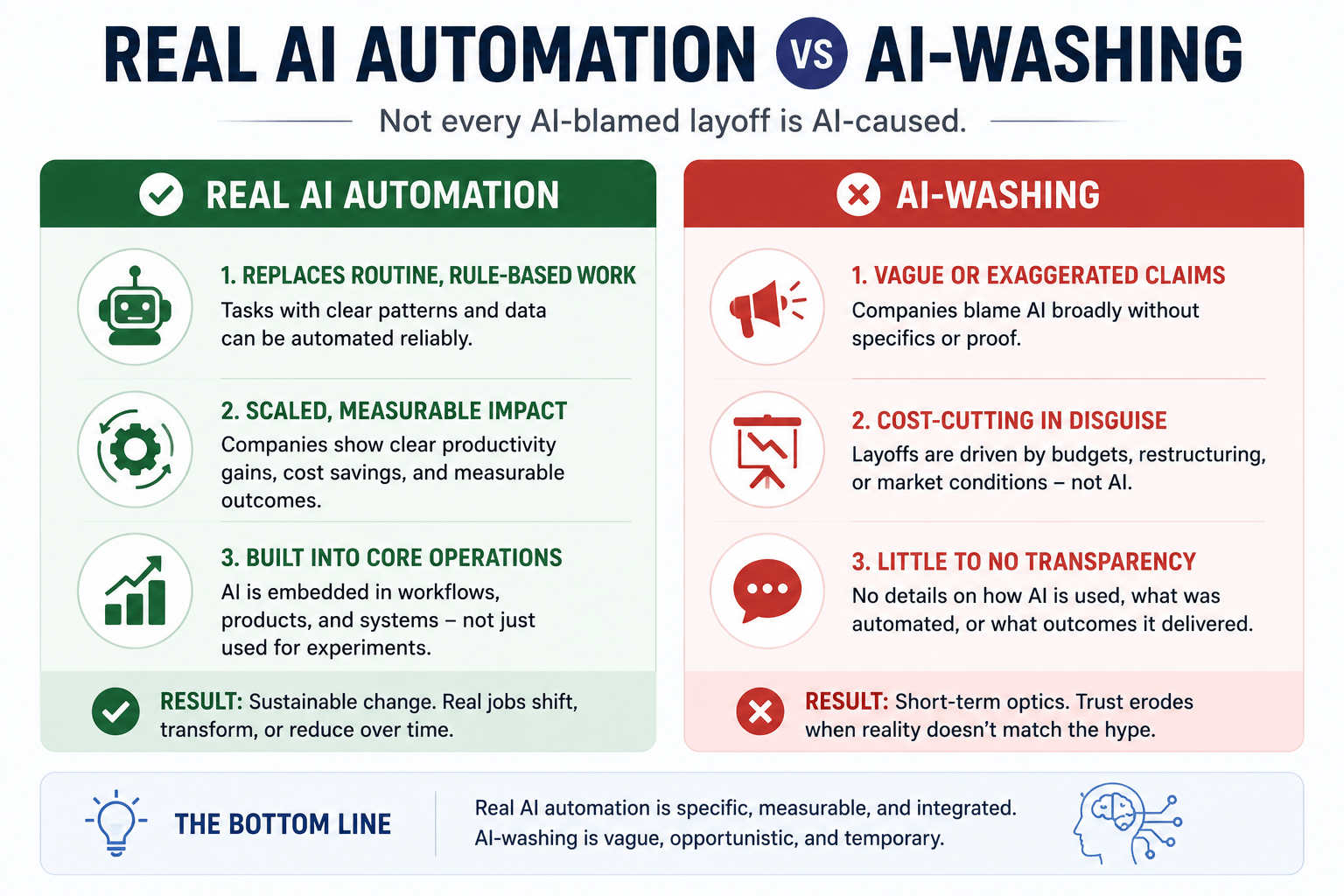
First, there’s the actual automation: a chatbot, coding agent, or AI review replacing what a human does without any rehiring. Second, there’s “AI-washing”: a company lays off employees for budgeting reasons and pretends it’s all because of AI rather than their overstaffing. Third, there’s the more subtle kind of reorganization where some contracts aren’t renewed and a job opening is advertised as asking for “AI fluency” rather than hiring more people.
All three of those stories come together in the same news cycle, which is one reason why it seems contradictory. Distinguishing between them is the only way to know whether AI replacing jobs is actually working for the organizations that use it.
The Real Numbers Behind AI Replacing Jobs in 2026
Challenger, Gray & Christmas tracks the stated reason behind every announced layoff in the US, and its monthly reports give the clearest paper trail available. The trend line only goes one direction.
AI-Cited Job Cuts in 2026
How artificial intelligence became the leading driver of workforce reductions
| Month (2026) | AI-cited job cuts | Share of all cuts that month |
|---|---|---|
|
01
February
|
4,680 | ~10% |
|
02
March
|
— | AI became the leading cited reason |
|
03
April
|
21,490 | 26% |
|
04
May
|
— | AI cited more than any other reason |
|
★
June
|
14,029 | 31% — highest share on record |
AI had accounted for job cut announcements totaling 101,743 by the end of June 2026, accounting for 23% of all layoffs reported for 2026 so far. This surpasses the 54,836 AI-driven layoffs reported for the entirety of 2025. With Challenger starting its reporting on AI-related layoffs in 2023, the total comes out to 173,568 so far, making AI the top reason for monthly layoff reports in four consecutive months.
As Andy Challenger, chief revenue officer at the company puts it bluntly in one report, AI has become the top reason for layoff announcements among any cost-cutting and business restructuring measures.
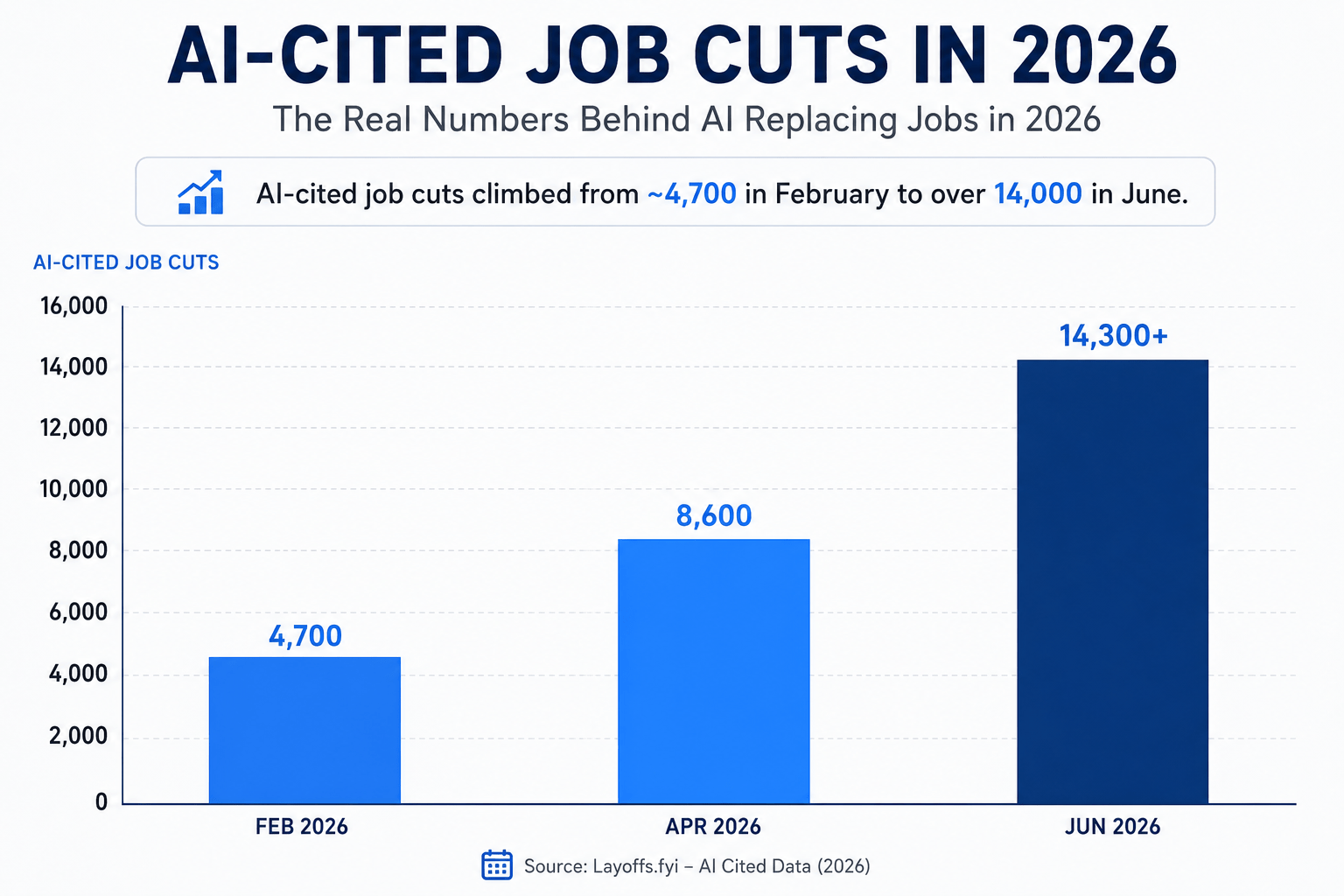
This clearly shows AI taking over jobs from humans, and that is not just a result of media exaggeration. But an increasing amount of job cuts announced does not necessarily mean that full automation is already a reality and that is where the companies that have tried the extreme way come into play.
Also Read: Our guide on how tokens and context windows actually work explains the mechanics behind the AI systems doing this automation.
The High-Profile “AI Replaced Us” Stories That Backfired
A handful of companies made headlines by going further than anyone else with AI replacing jobs, and a few of those bets are already unwinding in public.
IBM handed its human resources department to the AI. The program managed roughly 94% of the tasks without any issues. The rest of the 6% was comprised of ethical decisions that could not be made by the AI, prompting IBM to declare an intent to triple US entry-level hiring in 2026.
Commonwealth Bank of Australia It announced cuts to jobs it said were AI-powered, but later backtracked on that. It stated that “it had not appropriately considered all business considerations in relation to these decisions,” and that it could have been more careful about identifying those jobs that were truly replaceable.
Klarna is the most cited example, and perhaps the most misinterpreted one. The CEO of Klarna stated that an AI chatbot was doing the job of 700 customer service employees, and their number decreased from several thousand to around 4,000 by early 2026. This move can be seen as a reversal, but in fact, what happened here is that Klarna stopped hiring so rapidly and started hiring certain human employees again for the complicated cases, without going back on its main decision.
In all three cases discussed, the problem of full automation, when humans were not involved in any part of the process, reached its limit at the very moment when some kind of judgement or empathy was required.
Where the Job Losses Are Real vs Where It’s AI-Washing
Without the headline cases, however, there is a more modest pattern of AI taking jobs revealed through payroll statistics.
The Digital Economy Lab at Stanford University, in conjunction with the payroll processor ADP, analyzed 4.6 million people who work at 25,000 companies through April 2026. Employment of people aged 22 to 25 years old in AI-affected occupations has decreased by about 13% since the ChatGPT application was launched in late 2022. Employment of younger software developers, on the other hand, decreased by nearly 20%.
Look beyond that particular age cohort, however, and the picture becomes much less dire. Employment of all people in AI-exposed occupations has decreased by merely 0.2% year over year. Older workers in the same occupational groups have seen either flat or increased employment. The impact is selective, not universal.
There is an additional wrinkle that supports the “AI washing” idea: in several surveys conducted among companies reducing their workforce, a majority cited the AI as the reason, regardless of the actual cause being money-related. Journalists reporting on this phenomenon now make sure to note that “AI-cited” and “AI-caused” are not synonymous labels.
Who’s actually absorbing the early damage:
- Entry-level and junior developers, especially those under 25
- Customer support and clerical roles
- Contractors whose agreements simply aren’t renewed, with no formal layoff announcement at all
Who mostly isn’t, at least so far:
- Senior developers and engineers with several years of experience
- Roles requiring judgment calls, client relationships, or handling exceptions
- Workers in AI-exposed roles who are past their mid-20s
Also Read: If you’re trying to stay ahead of this shift as a developer, our guide to prompt engineering covers the exact skill companies are now screening for in job postings.
What the “Godfather of AI” and OpenAI’s CEO Actually Disagree About
Even the people building this technology aren’t reading the data the same way, and that disagreement is worth sitting with rather than picking a side prematurely.
Geoffrey Hinton, the computer scientist often called the godfather of AI, has been blunt about where this is heading. He’s said AI already has the capability to replace jobs in call centers and expects that to extend to many other roles as models handle longer, more complex tasks over time. He’s compared the shift to the industrial revolution, this time affecting cognitive work instead of physical labor.
Sam Altman, OpenAI’s CEO, has walked back his own earlier warnings. He now argues a large-scale “jobs apocalypse” is unlikely in the near term, for a specific reason worth noting: the companies adopting AI most aggressively aren’t necessarily the ones cutting the most jobs. In several cases, they’re the ones hiring the most, using AI to grow output rather than shrink headcount.
Both men are looking at the same AI replacing jobs data and reaching different conclusions, largely because they’re describing different timeframes. Hinton is talking about where capability is headed. Altman is talking about where adoption actually stands today, mid-transition, messy, uneven. Neither claim cancels the other out.
What AI Replacing Jobs Actually Means If You Write, Code, or Create Content for a Living
For developers, writers, and content creators concerned about AI and job displacement, the most important thing to note from the figures above is that “know your place.”
For those just entering the workforce, especially in software development or content-related industries, the statistics above indicate that you’re part of the category experiencing a real employment loss. This doesn’t mean your profession will disappear tomorrow. But it does mean that AI skills, including the kind Shopify now evaluates as part of performance reviews, are becoming a genuine edge over simply an addition.
If you’re an experienced worker, however, the situation is less one of “AI takes your job” and more one of “AI shifts the way you do it.” The critical thinking skills needed to make decisions in which the automated HR system of IBM failed, and the judgments that necessitated Commonwealth Bank’s apology, are what experience workers continue to get paid to do.
In either case, it makes far more sense to get fluent with the tool itself now, before the debate concludes.
Conclusion
AI job displacement revolution has neither been unsuccessful nor has it really begun yet. AI-led job displacements have only been increasing every month in 2026, and it’s affecting real people and real jobs. This job displacement revolution has mainly affected entry level employees. However, all these promises of full automation by companies like IBM and Commonwealth Bank have been facing failure at the very instance where human intervention is required. And some of this headcount is slowly but surely making its way back. Just wait and watch how these companies actually implement their recruitment strategy in the next few quarters.
FAQ
Is AI actually replacing jobs in 2026, or is it mostly hype? Both are true at once. AI-cited layoffs are real and climbing every month, but a meaningful share of them are companies citing AI for cuts that were really financial. AI replacing jobs is happening fastest in entry-level and junior roles, not across the board.
Which jobs are most at risk from AI replacing jobs right now? Entry-level and junior developers, customer support agents, and clerical roles are seeing the clearest employment declines. Senior roles requiring judgment calls have mostly held steady so far.
Did any company reverse a decision on AI replacing jobs? Yes. IBM rehired heavily after its AI-run HR system couldn’t handle the 6% of requests involving ethical judgment, and Commonwealth Bank of Australia apologized for AI-driven cuts it admitted were poorly assessed.
How many jobs has AI actually cut in 2026? Through June 2026, Challenger, Gray & Christmas had tracked AI as the stated reason behind 101,743 announced job cuts in the US, about 23% of all layoffs announced that year.
Will AI replacing jobs get worse or better from here? Experts disagree. Geoffrey Hinton expects the trend to accelerate as models handle longer tasks. Sam Altman argues the companies adopting AI most aggressively are often hiring more, not less, which suggests the picture will stay mixed rather than turning into a single clean trend.
Also Read: Our Kimi K2.6 breakdown