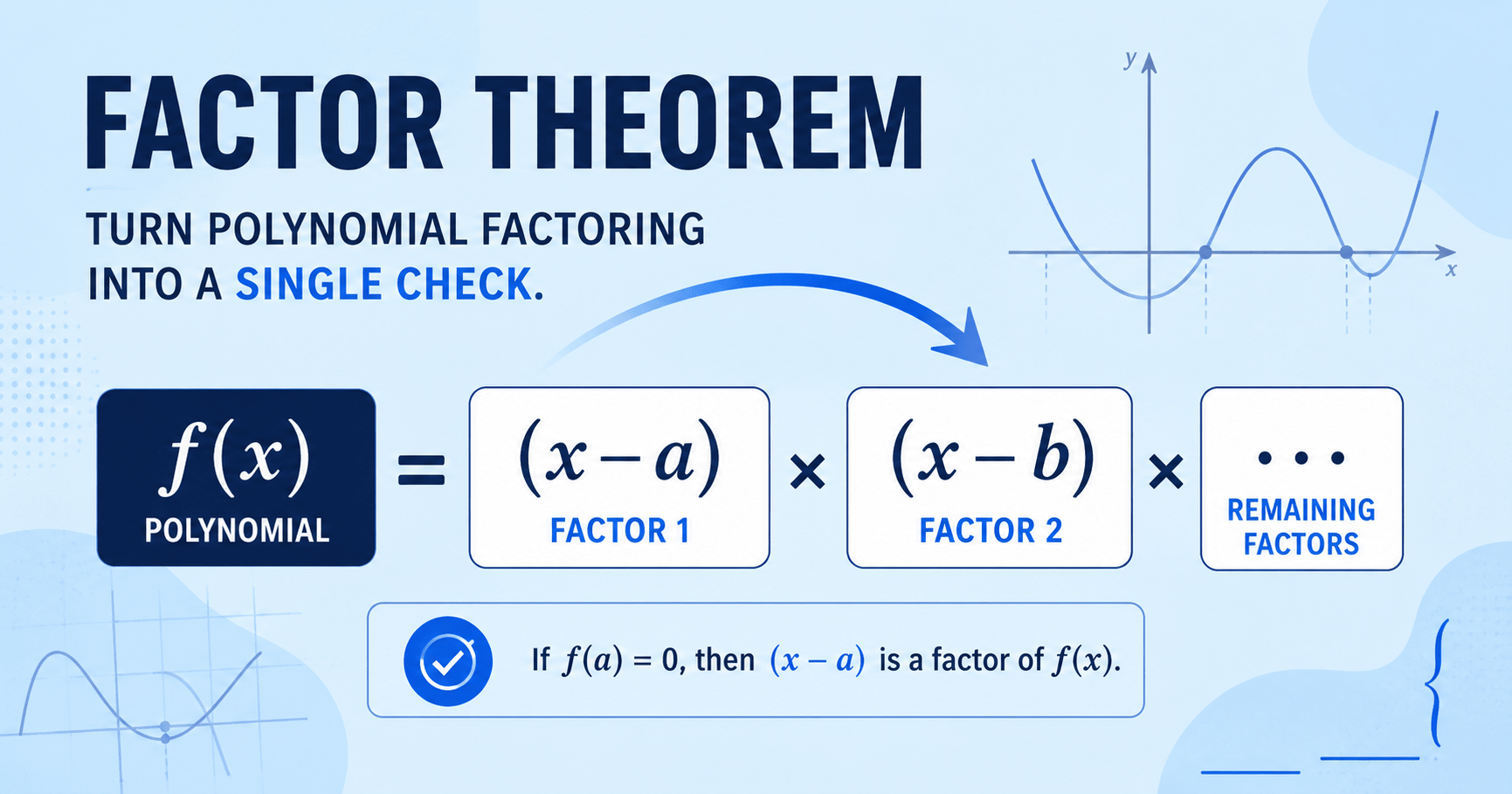

The factor theorem solves a problem that comes up all the time when studying algebra: will this binomial divide my polynomial perfectly or am I going to spend the next ten minutes doing long division for no reason? You test before you do anything else.
This is the third post in the theorems in mathematics series. If this is your first time seeing one of our posts on a mathematical theorem then I’d recommend starting out by reading the previous post on the remainder theorem.
What Is the Factor Theorem
The theorem says that the binomial (x − a) will be a factor of the polynomial p(x) if and only if p(a) = 0.
This is important because of the “if and only if” part. This means that the two things go hand in hand. When one is true, the other is also true. And when one is not true, then the other is not true either.
Factor Theorem Formula
If p(a) = 0, then (x − a) is a factor of p(x).
If p(a) ≠ 0, then (x − a) is not a factor of p(x).
How This Theorem Connects to the Remainder Theorem
This theorem is simply a particular case of the remainder theorem. The remainder theorem states that when p(x) is divided by (x − a), there will be a remainder p(a). The only question is: What occurs when this remainder equals zero? Zero remainder implies an exact division, which means the expression is indeed a factor of p(x).
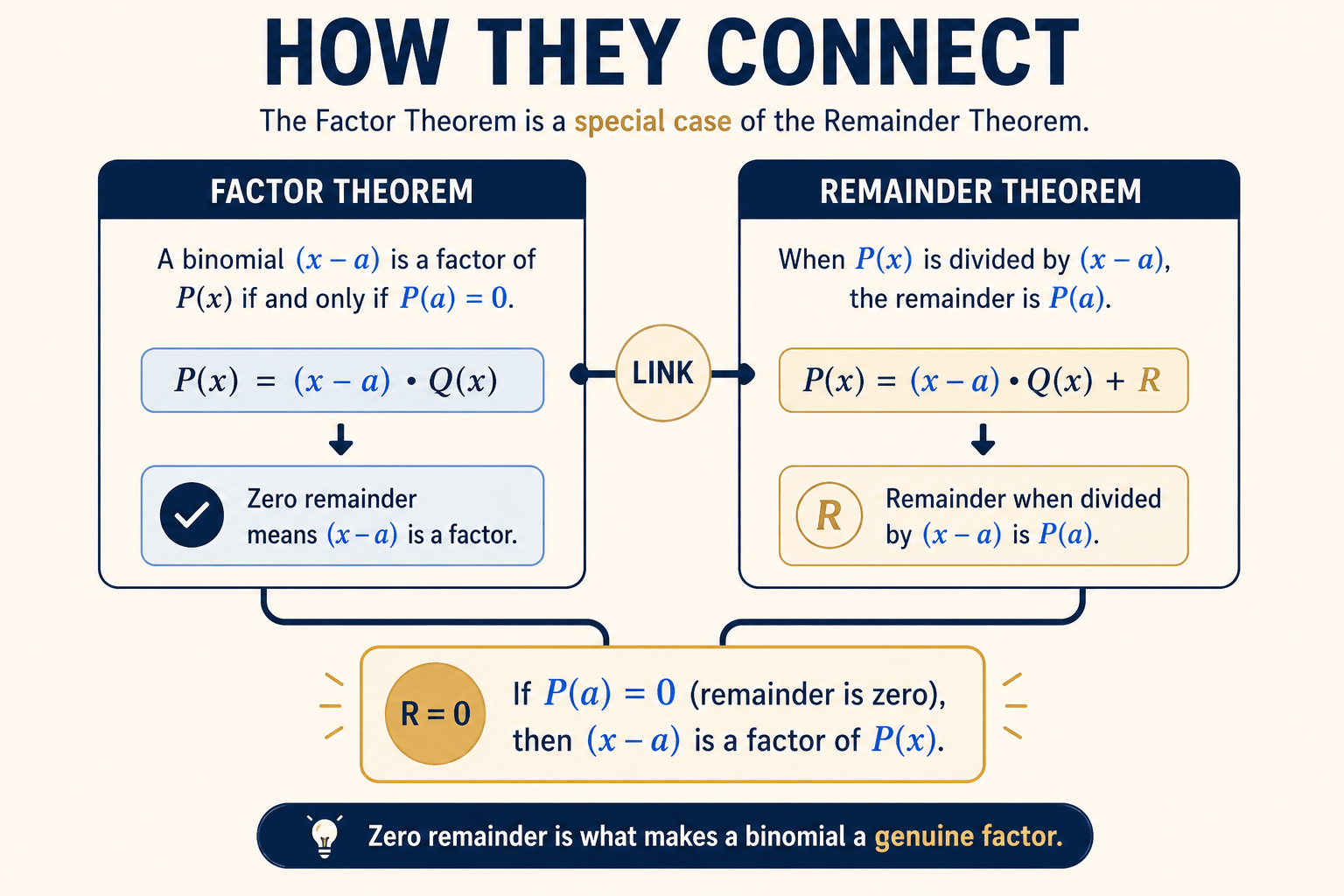
If you are not familiar with the proof of the remainder theorem, it would be good to know about it before reading the proof below, since the proof below relies on it directly.y.
Factor Theorem Proof
Let p(x) be a polynomial, and suppose (x − a) is a factor of p(x). That means we can write:
p(x) = (x − a) × q(x)
where q(x) is the quotient. Now substitute x = a:
p(a) = (a − a) × q(a)
p(a) = 0 × q(a)
p(a) = 0
This proves that one way of the statement is true; namely, that if (x – a) is a factor of p(x), then p(a) = 0. The other way can be proved using the remainder theorem; namely, if p(a) = 0, then when p(x) is divided by (x – a), the remainder is zero.
Worked Examples
Example 1: Confirming a Factor
Check whether (x − 1) is a factor of p(x) = x³ − 6x² + 11x − 6.
Solution: Set x − 1 = 0, so x = 1. Substitute into the polynomial:
p(1) = (1)³ − 6(1)² + 11(1) − 6
p(1) = 1 − 6 + 11 − 6
p(1) = 0
Since p(1) = 0, (x − 1) is confirmed as a factor.
Example 2: Ruling Out a Factor
Check whether (x + 2) is a factor of p(x) = x³ + 5x² − 2x + 1.
Solution: Set x + 2 = 0, so x = −2. Substitute into the polynomial:
p(−2) = (−2)³ + 5(−2)² − 2(−2) + 1
p(−2) = −8 + 20 + 4 + 1
p(−2) = 17
Since p(−2) = 17, not zero, (x + 2) is not a factor.
Example 3: Fully Factoring a Polynomial
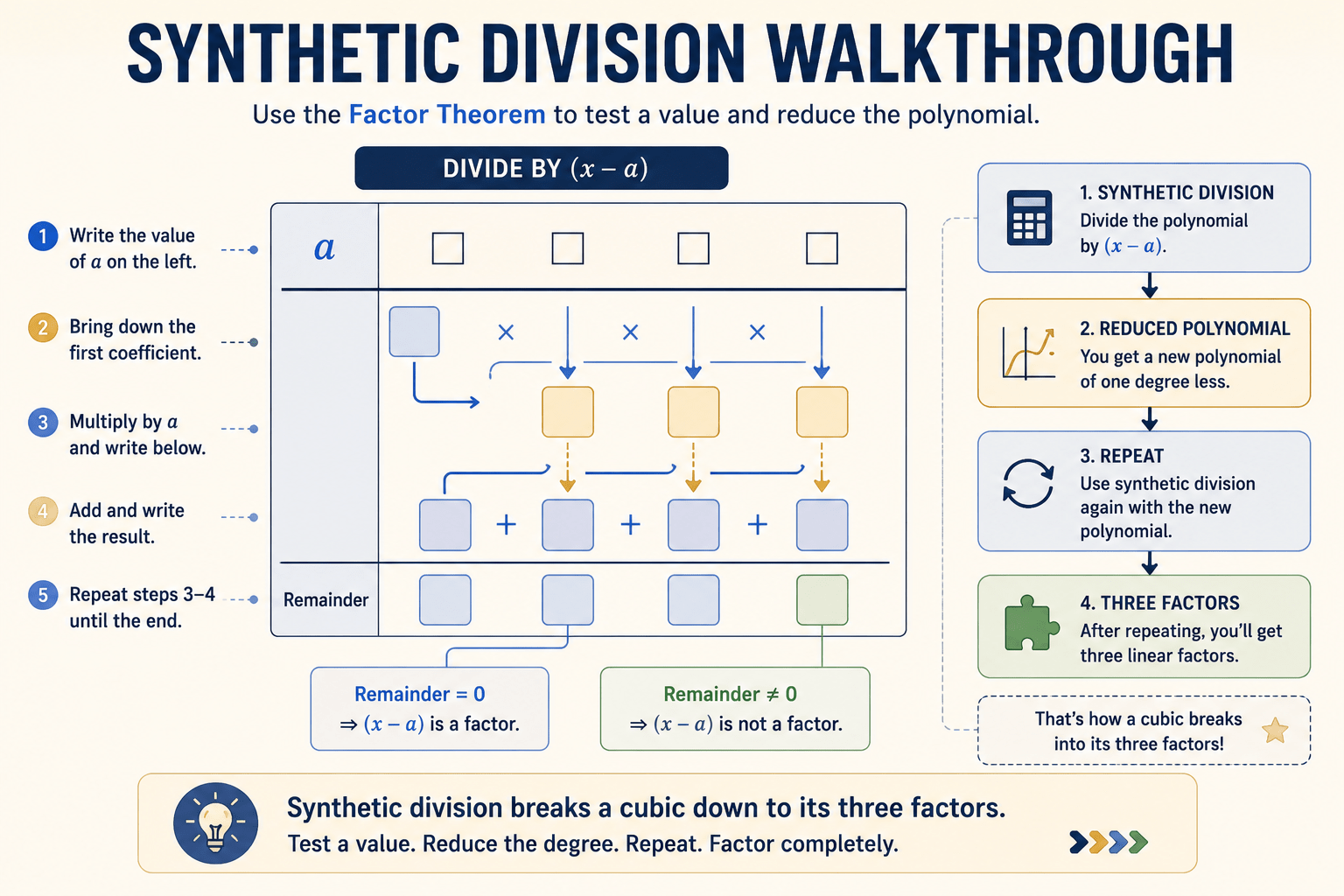
This is where this theorem earns its keep. Take p(x) = x³ − 6x² + 11x − 6, the same polynomial from Example 1. We already know (x − 1) is a factor. To factor it completely, divide p(x) by (x − 1) using synthetic division:
1 | 1  −6   11   −6
  |     1   −5    6
  |_____________________
    1  −5    6    0
The quotient is x² − 5x + 6, and the remainder is 0, confirming (x − 1) again. Now factor the quotient:
x² − 5x + 6 = (x − 2)(x − 3)
So the fully factored form is:
p(x) = (x − 1)(x − 2)(x − 3)
This is the real value of this approach: it doesn’t just confirm one factor, it gives you a starting point to break down the entire polynomial.
Common Mistakes to Avoid
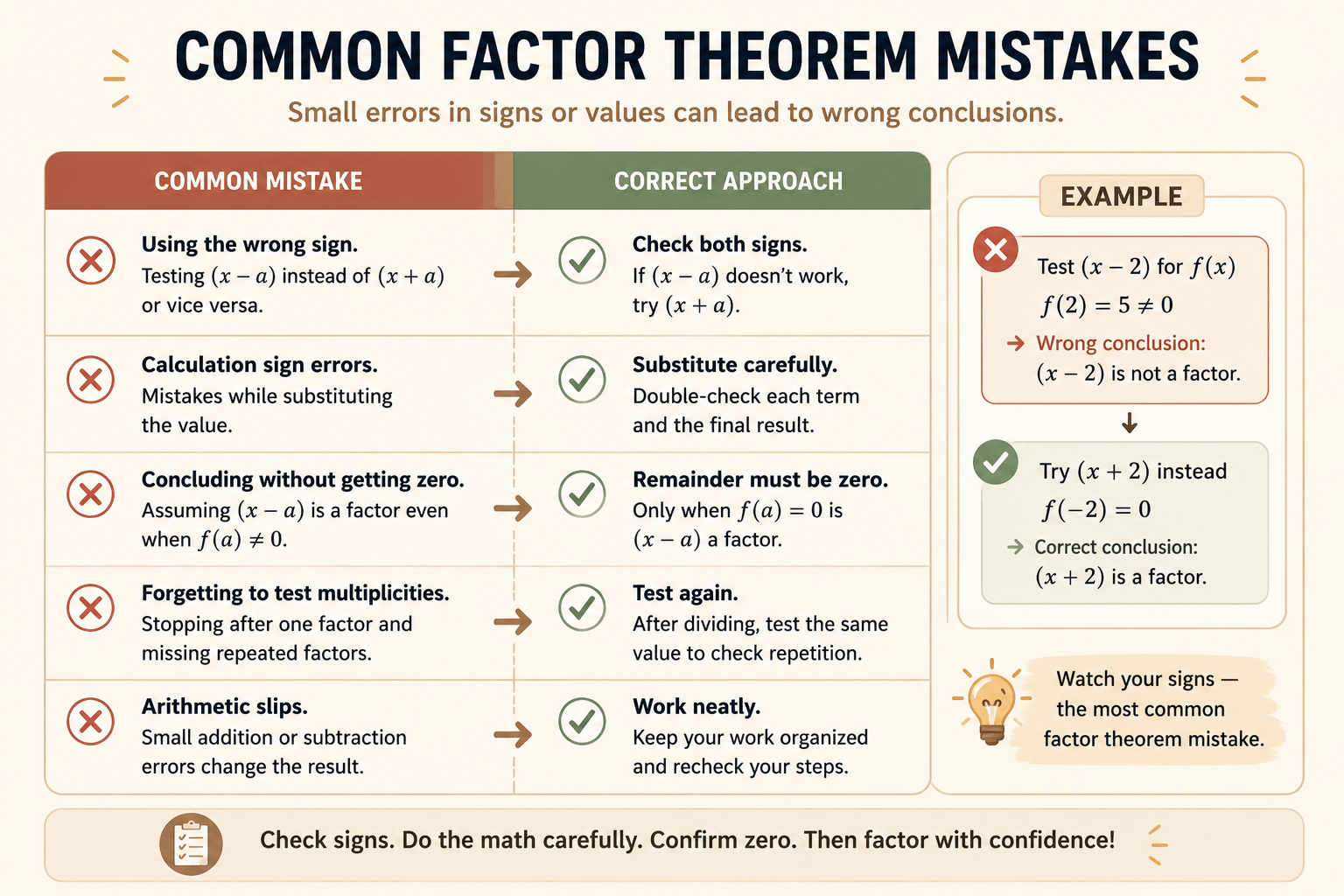
- Substituting the wrong value. For a factor (x + a), you substitute x = −a, not x = a. Mixing up the sign is the single most common error.
- Stopping after finding one factor. If the polynomial has a degree higher than the number of factors you’ve found, keep dividing the quotient down.
- Confusing this theorem with the remainder theorem. The remainder theorem gives you any remainder. The factor theorem specifically checks whether that remainder is zero.
- Assuming a factor without checking. A binomial only qualifies as a factor once you’ve actually substituted and confirmed p(a) = 0.
Conclusion
Factor theorem replaces “is this a factor?” by one simple substitution rather than performing long division. After realizing that the factor theorem is simply the special case of the remainder theorem where the remainder equals zero, the two theorems do not seem to be two different things to remember. Let’s try out the approach used in Example 3 to any cubic function of your choice. See you in the next post where we will talk about the binomial theorem.
FAQ
What is the difference between the factor theorem and the remainder theorem?
The remainder theorem tells you the remainder of any polynomial division. This is the special case where that remainder is zero, which confirms the binomial is a genuine factor.
Does this theorem work for any polynomial?
It works for any polynomial divided by a linear binomial in the form (x − a). It applies to real and complex coefficients alike.
Can I use this theorem to fully factor a polynomial?
Yes. Once you confirm one factor, divide it out using synthetic division, then repeat the process on the resulting quotient until it’s fully factored, as shown in Example 3 above.
Why does JEE test the factor theorem so often?
Because it combines cleanly with other topics like coordinate geometry and calculus. A JEE Advanced question rarely asks for the theorem directly; it usually hides it inside a longer problem that expects you to spot the shortcut.