
The binomial theorem examples will baffle you at just one place. While the general term formula is perfect in your book, when a JEE question comes where you have to find a certain coefficient or independent term, no one has ever told you how to do it.
This article takes care of that. First, you will learn the formula, then the general term formula shortcut and then problems that move from basic expansions to genuine JEE-level coefficient hunting.
What Is the Binomial Theorem?
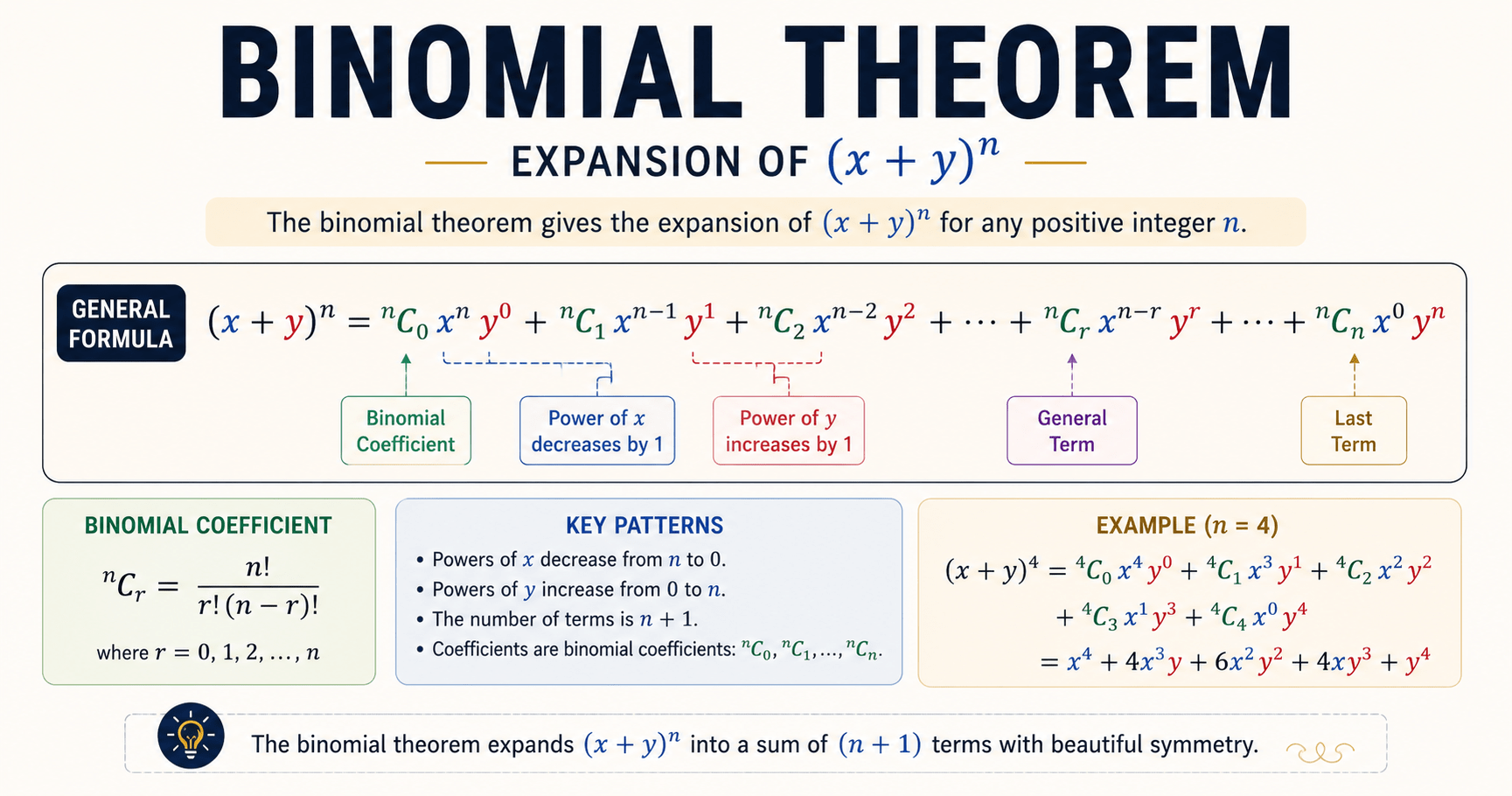
Binomial Theorem is a method to expand an expression of binomial raised to any power. In other words, binomial theorem provides a way to expand any power of binomial expressions without actually performing multiplication each time.
For a positive integer n,
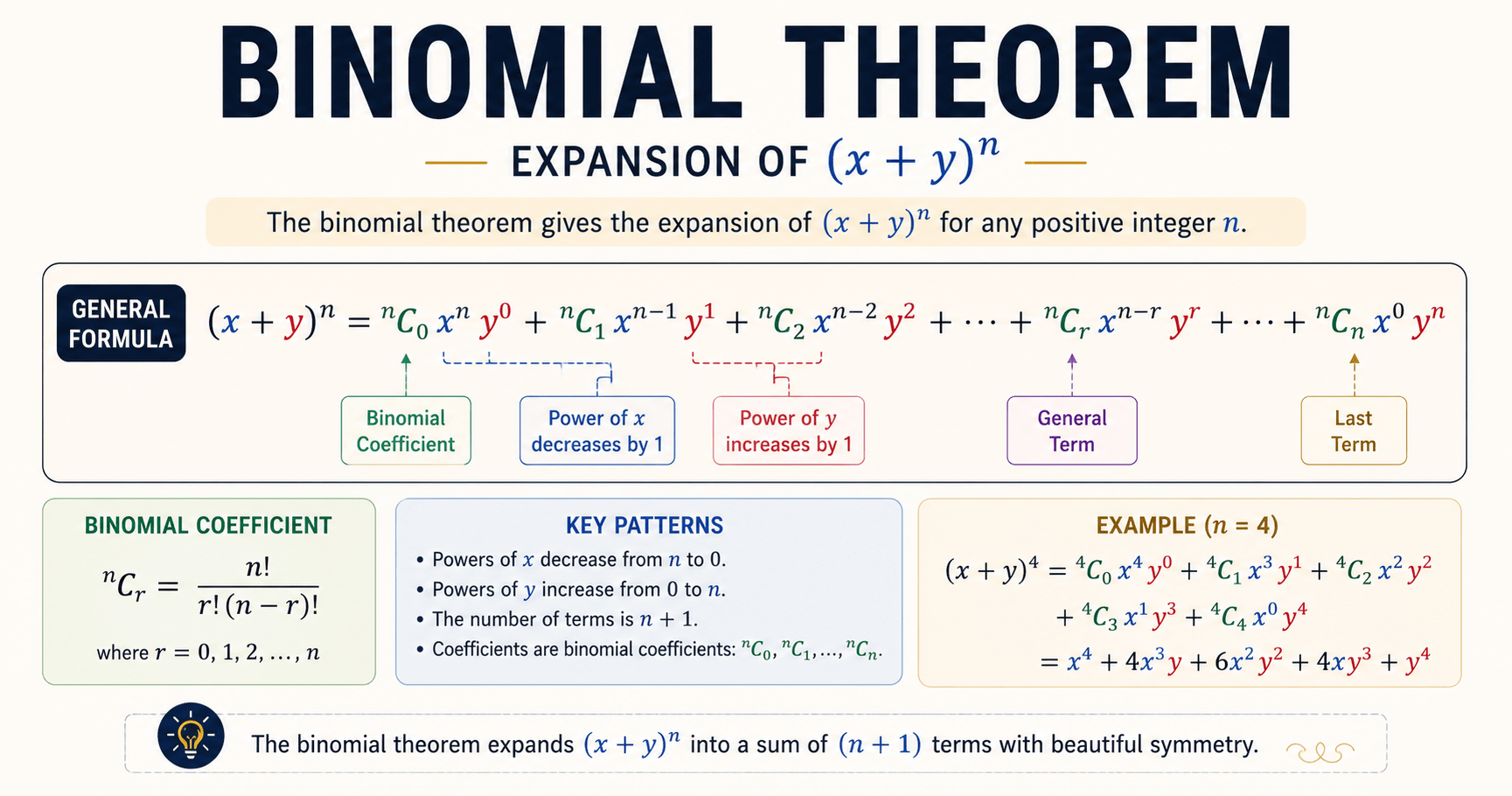
(x + y)ⁿ = ⁿC₀xⁿ + ⁿC₁xⁿ⁻¹y + ⁿC₂xⁿ⁻²y² + … + ⁿCₙyⁿ
wherein ⁿCᵣ is the binomial coefficient which can be found using n! / (r!(n − r)!).
There are (n + 1) terms in this expansion.
Isaac Newton had further generalized Binomial Theorem to accommodate non-integer exponents but CBSE/JEE curriculum concentrates on the case explained above only.
Binomial Theorem General Term Formula
You don’t need to expand the whole equation; the general term formula will take you directly to any particular term you wish.
General Term: Tᵣ₊₁ = ⁿCᵣ xⁿ⁻ʳ yʳ
This is the (r+1)th term in the expansion of (x + y)ⁿ. Almost all JEE problems which require you to find “the coefficient of x⁵” or “the 6th term” actually involve finding r using this formula.
Middle Term and Independent Term Shortcuts
Two short tricks keep appearing in binomial theorem problems.
Middle Term Trick: When n is even, there will be one middle term with position number (n/2 + 1). In case n is odd, then there will be two middle terms with positions (n+1)/2 and (n+3)/2.
Term Independent of x: For obtaining the term which is independent of x, take the general term and make the sum of exponents of x zero.
The Pascal’s Triangle Connection
But before getting into some examples, let us first understand why the coefficients behave in such a manner.
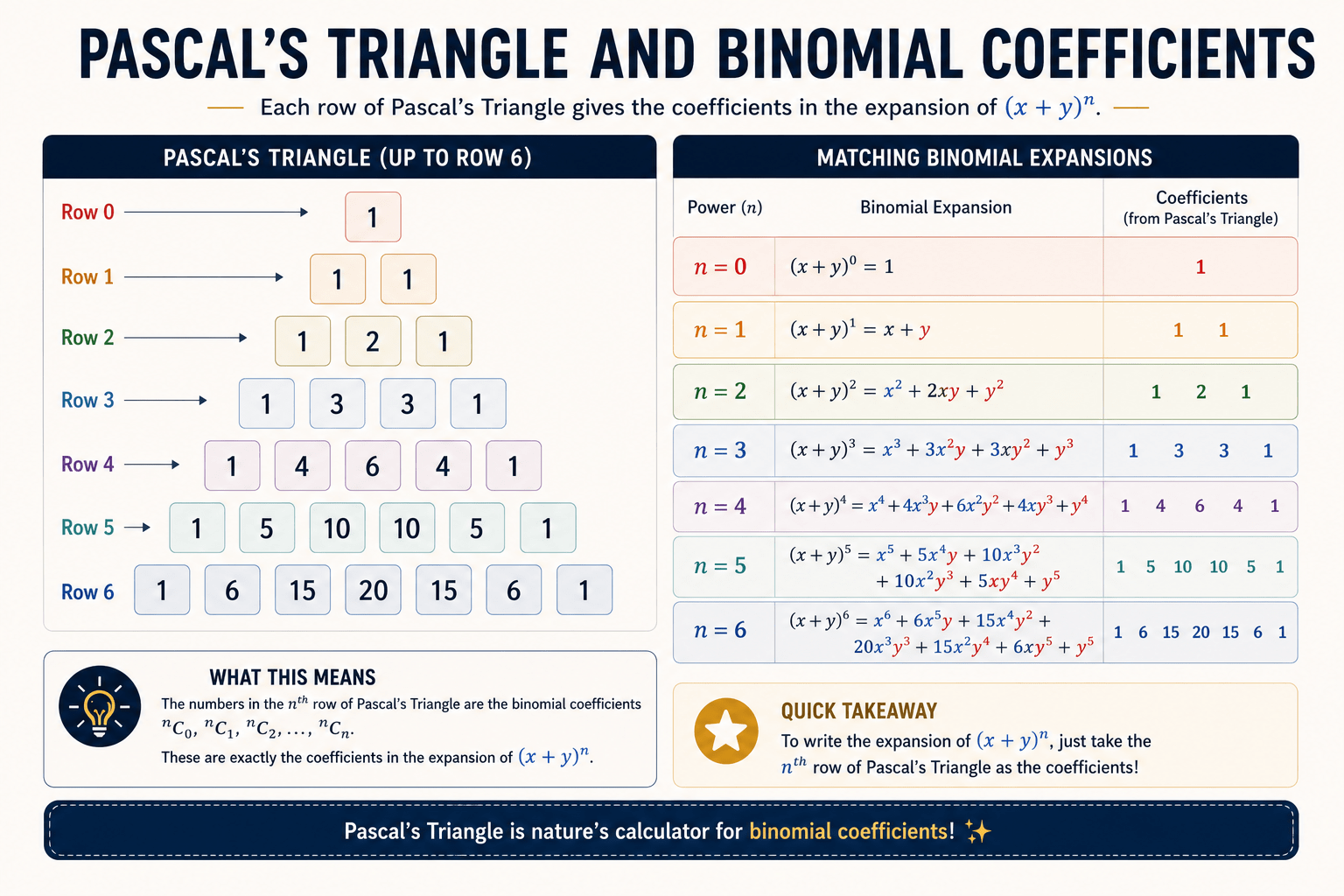
The coefficients corresponding to each power in the expansion can be found using rows of Pascal’s Triangle. Row 0 consists of only “1,” row 1 contains “1, 1,” row 2 includes “1, 2, 1,” row 3 consists of “1, 3, 3, 1,” and so forth. Each number in the row is the sum of two numbers in the row immediately above it.
And this exactly corresponds to the statement of the binomial theorem: coefficients ⁿC₀, ⁿC₁, ⁿC₂, … , ⁿCₙ are the same as row n of Pascal’s Triangle. If we have low values of n, we can just go ahead and find the coefficients without any calculation at all. However, when n is relatively large, the formula for general term will work much faster than finding rows of Pascal’s Triangle manually.
Binomial Theorem Examples
Start here if this is your first time expanding a binomial.
Basic Binomial Theorem Examples
Example 1: Expand (x + 2)³ using the binomial theorem.
(x + 2)³ = ³C₀x³ + ³C₁x²(2) + ³C₂x(2)² + ³C₃(2)³ = x³ + 6x² + 12x + 8.
Example 2: Find the number of terms in the expansion of (a + b)⁷.
The expansion of (a + b)ⁿ always has n + 1 terms, so (a + b)⁷ has 8 terms.
Example 3: Find the 4th term in the expansion of (x + y)⁶.
Using Tᵣ₊₁ = ⁿCᵣ xⁿ⁻ʳ yʳ, the 4th term means r = 3: T₄ = ⁶C₃x³y³ = 20x³y³.
Intermediate Binomial Theorem Examples (Class 11 Board Level)
These match the coefficient and term-finding style seen in board exams.
Example 4: Find the coefficient of x³ in the expansion of (2x − 3)⁵.
General term: Tᵣ₊₁ = ⁵Cᵣ(2x)⁵⁻ʳ(−3)ʳ. For the x³ term, 5 − r = 3, so r = 2. T₃ = ⁵C₂(2x)³(−3)² = 10 × 8x³ × 9 = 720x³. Coefficient is 720.
Example 5: Find the middle term in the expansion of (x + 1/x)⁸.
Since n = 8 is even, the middle term is at position (8/2 + 1) = 5th term. T₅ = ⁸C₄x⁴(1/x)⁴ = 70.
Example 6: Find the term independent of x in the expansion of (x² + 1/x)⁹.
General term: Tᵣ₊₁ = ⁹Cᵣ(x²)⁹⁻ʳ(1/x)ʳ = ⁹Cᵣx¹⁸⁻²ʳ⁻ʳ = ⁹Cᵣx¹⁸⁻³ʳ. Setting 18 − 3r = 0 gives r = 6. The independent term is ⁹C₆ = 84.
Advanced Binomial Theorem Examples (JEE Level)
These raise the difficulty by combining the theorem with algebraic manipulation or multiple binomials.
Example 7: Find the coefficient of x⁵ in the expansion of (1 + x)⁷(1 − x)³.
Expand both factors’ relevant terms and combine coefficients of x⁵ across the product. Working through the combinations gives a coefficient of −7, a common JEE-style multi-binomial question.
Example 8: Find the greatest coefficient in the expansion of (1 + x)¹⁰.
For even n, the greatest coefficient occurs at r = n/2. Here n = 10, so r = 5, giving the greatest coefficient as ¹⁰C₅ = 252.
Example 9: Find the sum of the coefficients in the expansion of (2x + 3y)⁴.
Sum of coefficients is found by setting x = y = 1: (2 + 3)⁴ = 5⁴ = 625.
Practice Problems: Test Yourself
Try these three before trying anything on the internet. The questions have been designed to test all levels of difficulty ranging from easy to very difficult (as seen in the examples given above for binomial theorem).
- Expand (x + 1)⁴ by using binomial theorem.
- Determine the fifth term in the expansion of (x + 2y)⁷.
- Find the term independent of x in the expansion of (x + 1/x²)⁹.
If you can do all these three questions without referring to the solved examples, you have truly mastered the binomial theorem.
Common Mistakes Students Make
Almost all of the mistakes are as a result of confusion between r and (r+1) while applying the general term formula.
Note that the (r+1)th term is Tᵣ₊₁; hence, when asked for the 6th term, you use r = 5, and not r = 6. The latter mistake alone is the cause of many wrong answers, in spite of other calculations being correct.
The third mistake is forgetting the sign while one of the two terms of the binomial is negative; hence, all the odd numbered terms become negative.
The fourth mistake happens where the expression involves multiplication of two binomials, just like in example 7: students tend to expand everything in both brackets while they only need the terms that will make the power equal to the required one.
Real-World Uses of the Binomial Theorem
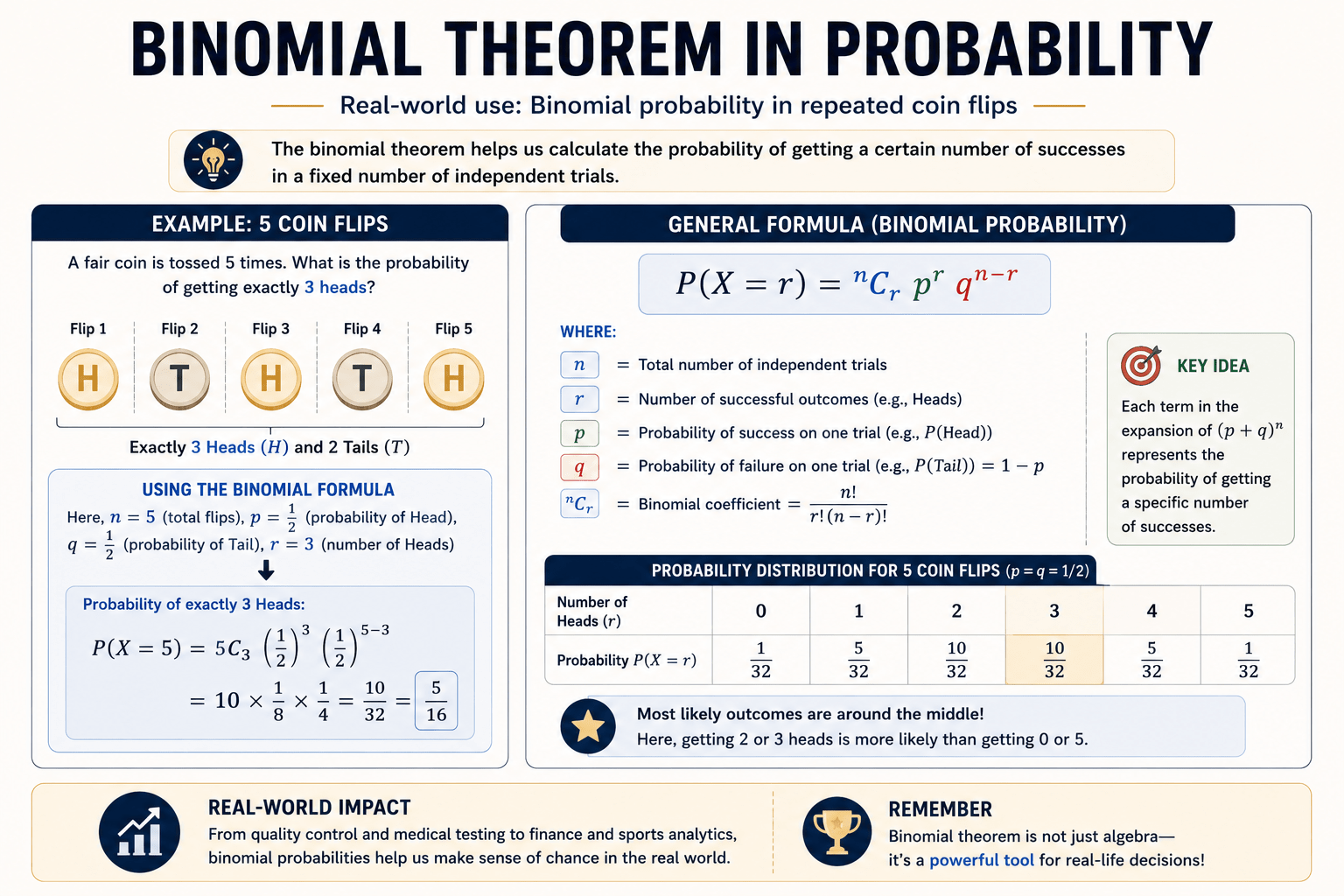
Binomial theorem is not simply an exercise in algebra; rather, it is the backbone of the Binomial Distribution probability, which is applicable whenever there is a need to calculate the probability of a definite number of success outcomes in successive trials.
It is useful in compound interest calculations, polynomial curve fittings, and combinatorial questions that require counting without having to list all possibilities.
Naive Bayes Classifiers are a simple kind of Machine Learning algorithm that uses probability distributions and hence utilizes binomial coefficients.
Conclusion
Though the binomial theorem is simply a formula, (x+y)ⁿ, expanded using the binomial coefficients, JEE tests students on their understanding of the theorem using general term, middle term, independent term, and multi-binomial products. After working on the above examples in order, try solving the practice problems without looking at the solutions.
The next topic in this series will be Bayes’ Theorem, that follows from the concept of probability introduced by the binomial theorem.
FAQ
What is the binomial theorem in simple words?
It’s a formula for expanding (x + y) raised to a power, without multiplying the expression out term by term.
What is the general term in the binomial theorem?
Tᵣ₊₁ = ⁿCᵣ xⁿ⁻ʳ yʳ. It lets you find any specific term in the expansion directly, without expanding the whole thing.
How do you find the middle term in a binomial expansion?
If n is even, there’s one middle term at position (n/2 + 1). If n is odd, there are two middle terms.
Is the binoamial theorem used in probability?
Yes. The binomial coefficients in this theorem are the same ones used in the binomial probability distribution.
Is the binomial theorem asked in JEE?
Yes, frequently, usually combined with coefficient-finding, independent terms, or multiple binomial expressions multiplied together.