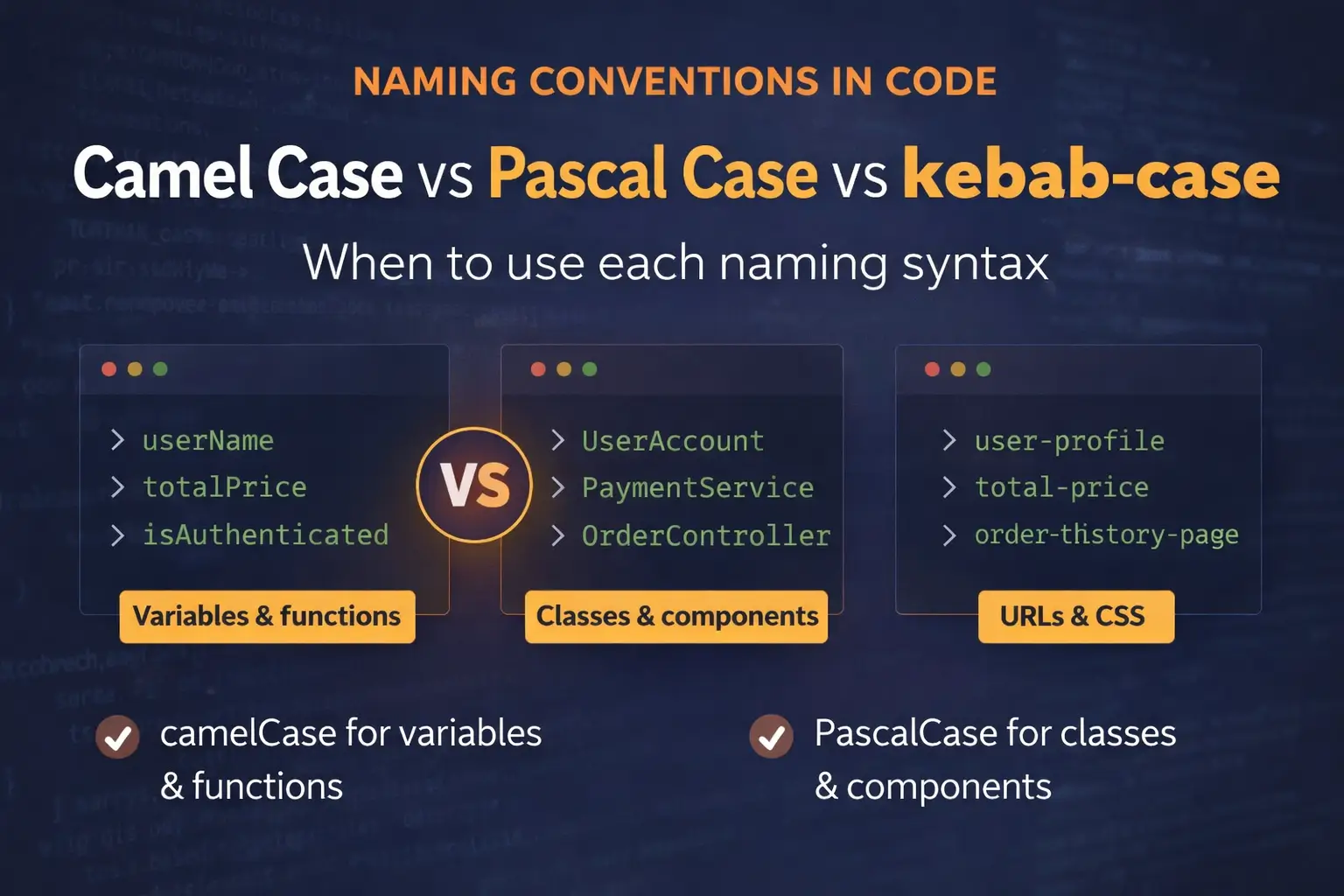

Naming things in code looks simple until a project grows. Then suddenly, inconsistent naming starts slowing everyone down. Kebab Case, CamelCase and PascalCase are often treated as style preferences, but in practice, they shape how developers read and reason about code usage in the program. camelCase is used for variables and functions, PascalCase for classes and components, and kebab-case for URLs and CSS.
Understanding when to use each one is less about rules and more about clarity that all can understand.
Syntax vs Semantics in Naming
Syntax refers to how code is written.
Semantics refers to what the code communicates.
In naming conventions, camelCase and PascalCase are syntactic differences. Both are valid and won’t affect how the program runs.
Semantically, they signal intent:
- camelCase usually represents variables or functions
- PascalCase usually represents classes or components
This visual distinction helps developers understand code faster without reading implementation details.
Also Read | Common WordPress Problems
What Is camelCase?
camelCase starts with a lowercase letter, and each new word begins with an uppercase letter.
Examples:
userName
totalPrice
isAuthenticated
camelCase is commonly used for:
- Variables
- Functions
- Methods
- Object properties
It reads naturally in expressions and works well when chaining logic. In most modern languages, camelCase is the default for anything that performs an action or stores a value.
What Is PascalCase?
PascalCase starts with an uppercase letter, and every new word is also capitalized.
Examples:
UserAccount
PaymentService
OrderController
PascalCase is typically used for:
- Class names
- Constructors
- React or UI components
- Types and interfaces (in typed languages)
PascalCase signals structure. When developers see it, they expect something that represents a concept, not an operation.
Camel Case vs Pascal Case: When to Use Each
| Use Case | Recommended Style |
|---|---|
| Variables | camelCase |
| Functions / Methods | camelCase |
| Classes | PascalCase |
| React Components | PascalCase |
| Types / Interfaces | PascalCase |
These conventions help code communicate intent visually. You can often tell what a piece of code represents without reading its body.
Language-Specific Expectations
JavaScript and TypeScript
- camelCase for variables, functions, hooks
- PascalCase for classes, components, and types
Also Read | JavaScript Naming Conventions
Java
- camelCase for methods and variables
- PascalCase for classes
C# / .NET
- PascalCase for public members and classes
- camelCase for private fields and method parameters
Each ecosystem has its own expectations. Following them makes your code easier for others to understand and maintain.
Common Naming Mistakes
Using PascalCase for functions
function CalculateTotal() { } // Misleading
This looks like a class, not a function.
Using PascalCase for variables
let UserName = "John"; // Confusing
It visually suggests a type or constructor.
Mixing styles without meaning
Inconsistent naming doesn’t break code, but it breaks readability and slows down collaboration.
Also Read | Free Graphic Design Website for Graphic Designers
What Is kebab-case?
kebab-case uses all lowercase letters, with words separated by hyphens.
Examples:
user-profile
total-price
order-history-page
kebab-case is commonly used for:
- URLs and slugs
- File names
- CSS class names
- HTML attributes
Unlike camelCase and PascalCase, kebab-case is not used inside most programming languages for variables or functions, mainly because hyphens are interpreted as subtraction operators.
Why kebab-case Exists (And Where It Makes Sense)
kebab-case is optimized for readability outside code execution.
- URLs are easier to read and scan
- Search engines prefer hyphen-separated words
- CSS and HTML conventions rely on it heavily
For example:
<div class="user-profile-card"></div>
Trying to use kebab-case inside JavaScript variables would break the syntax, but in markup and URLs, it’s the most natural choice.
camelCase vs PascalCase vs kebab-case (Quick Comparison)
| Naming Style | Common Usage |
|---|---|
| camelCase | Variables, functions, methods |
| PascalCase | Classes, components, types |
| kebab-case | URLs, CSS classes, file names |
Each naming style serves a different layer of the stack:
- Logic layer → camelCase
- Structure layer → PascalCase
- Presentation & routing layer → kebab-case
Common Mistake With kebab-case
Using kebab-case where the language doesn’t support it:
let user-name = "John"; // Invalid JavaScript
This is why understanding context matters more than preference when choosing naming conventions.
Also Read | Tailoring Web Design for Niche Markets
Why Naming Conventions Matter in Real Projects
In small scripts, naming style rarely matters. In large codebases, it matters a lot.
Consistent naming:
- Reduces cognitive load
- Makes code easier to scan
- Improves onboarding for new developers
- Supports tooling, linters, and IDEs
Good naming acts as silent documentation. Bad naming creates friction that compounds over time.
Final Recommendation
- Use camelCase when something acts
- Use PascalCase when something represents
- Use kebab-case when something needs to be read by humans or browsers
That simple distinction covers most real-world scenarios.
Conclusion
camelCase and PascalCase are not competing styles. They serve different purposes. When used consistently, they help code communicate meaning without extra comments or explanations.
Follow the conventions of the language and framework you’re using. Consistency will always matter more than personal preference.