

Hugging Bay verified AI model registry This is the buzzword that’s been appearing everywhere on AI Twitter or X, now.
There’s a new platform known as “The Pirate Bay for Open LLMs.” This moniker is fun. It can be confusing too, which we will tell you why shortly.
Hugging Bay is an index of open-source AI models, data sets, AI tools and AI agents with torrent links and hosting mirrors for each, and verification of their origin.
This is incredibly useful for anyone who routinely downloads model weights. Let’s talk about it, how it works and whether it lives up to the buzz.
What is Hugging Bay?
Hugging Bay is an officially recognized open-source AI artifact registry. That is what it calls itself on their website.
Simply put, it is a searchable database for AI artifacts. The artifacts could be LLMs, embedding models, image generators, audio models, datasets, and other tools.
Unlike any regular search engine that merely shows you the links to all these, Hugging Bay adds additional information for each item. This includes type of the license, origin of the model/file, reputation score, and number of downloads.
Then there is another layer of distribution services. Files can either be downloaded via hosted mirrors, or via torrents using magnets.
The service was officially announced on the Internet in early July of 2026. It spread very quickly when AI commentators mentioned it on social networks, drawing a parallel between Hugging Bay and filesharing service Pirate Bay.
Why Hugging Bay Matters
Hugging Bay is an officially acknowledged open source AI artifact registry. At least that is how it refers to itself on its website.
In other words, it is a searchable database of AI artifacts. Artifacts can be any from LLMs, embedding models, image generators, audio models, datasets and other tools.
Unlike any ordinary search engine which would simply give you links to all these, Hugging Bay offers additional metadata for each artifact. This data comprises licensing type, origin of the model/file, reputation score and download count.
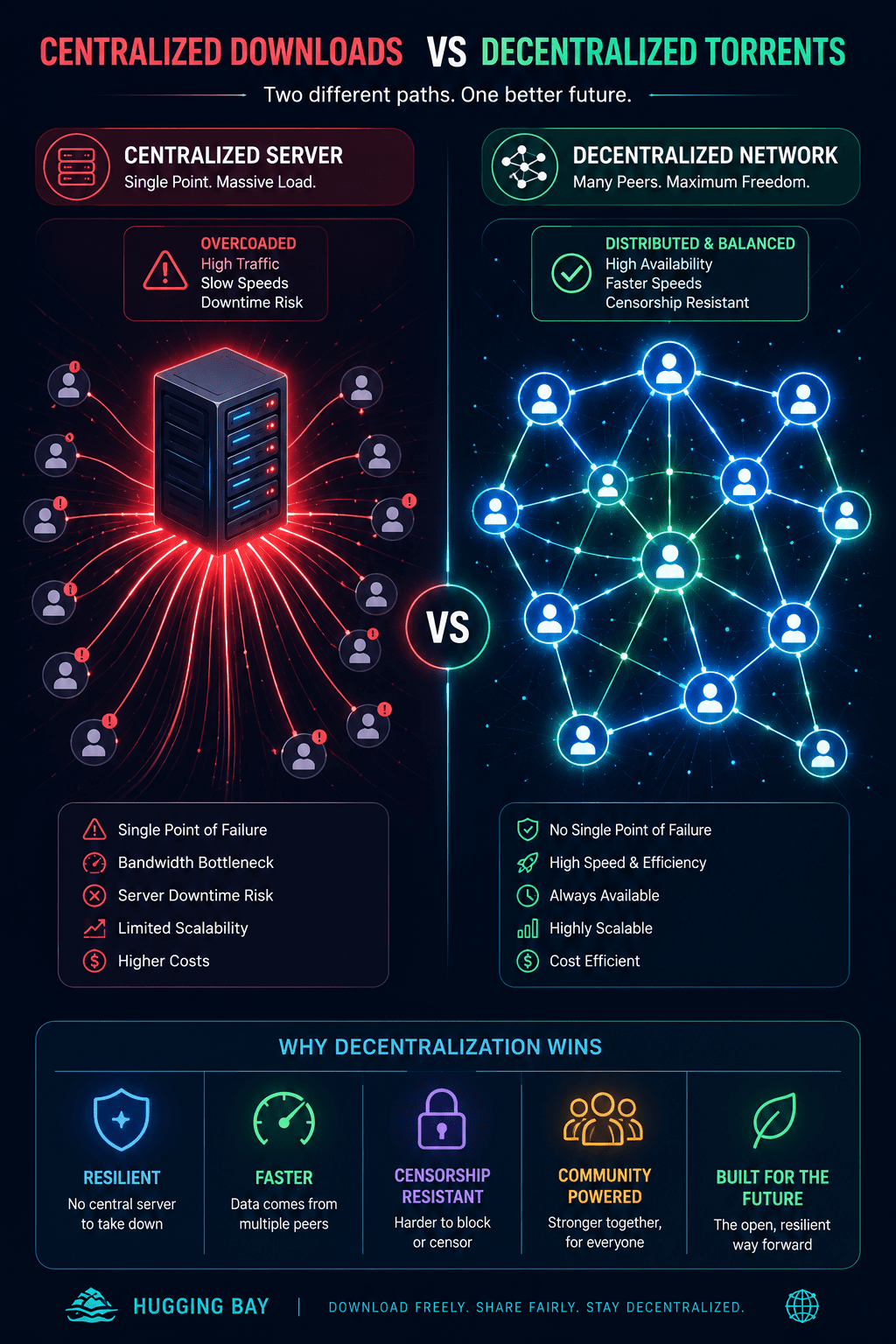
And there is another level of distribution services. The files can either be downloaded via hosted mirrors or torrented using magnets.
It has been officially announced to the public Internet in early July of 2026. But it rapidly gained popularity after AI bloggers started talking about it on social networks, comparing it to filesharing website Pirate Bay.
Key Features
Here’s a quick rundown of what Hugging Bay actually offers.
Verified Artifact Registry
Every artifact listed on Hugging Bay goes through a review step before it’s fully indexed. The platform checks:
- Where the file originated from
- What license applies to it
- Whether the metadata matches the actual upstream source
Listings carry labels like “hosted files,” “external metadata,” and license tags such as Apache 2.0 or MIT, so you know exactly what you’re getting before downloading anything.
Torrent Downloads
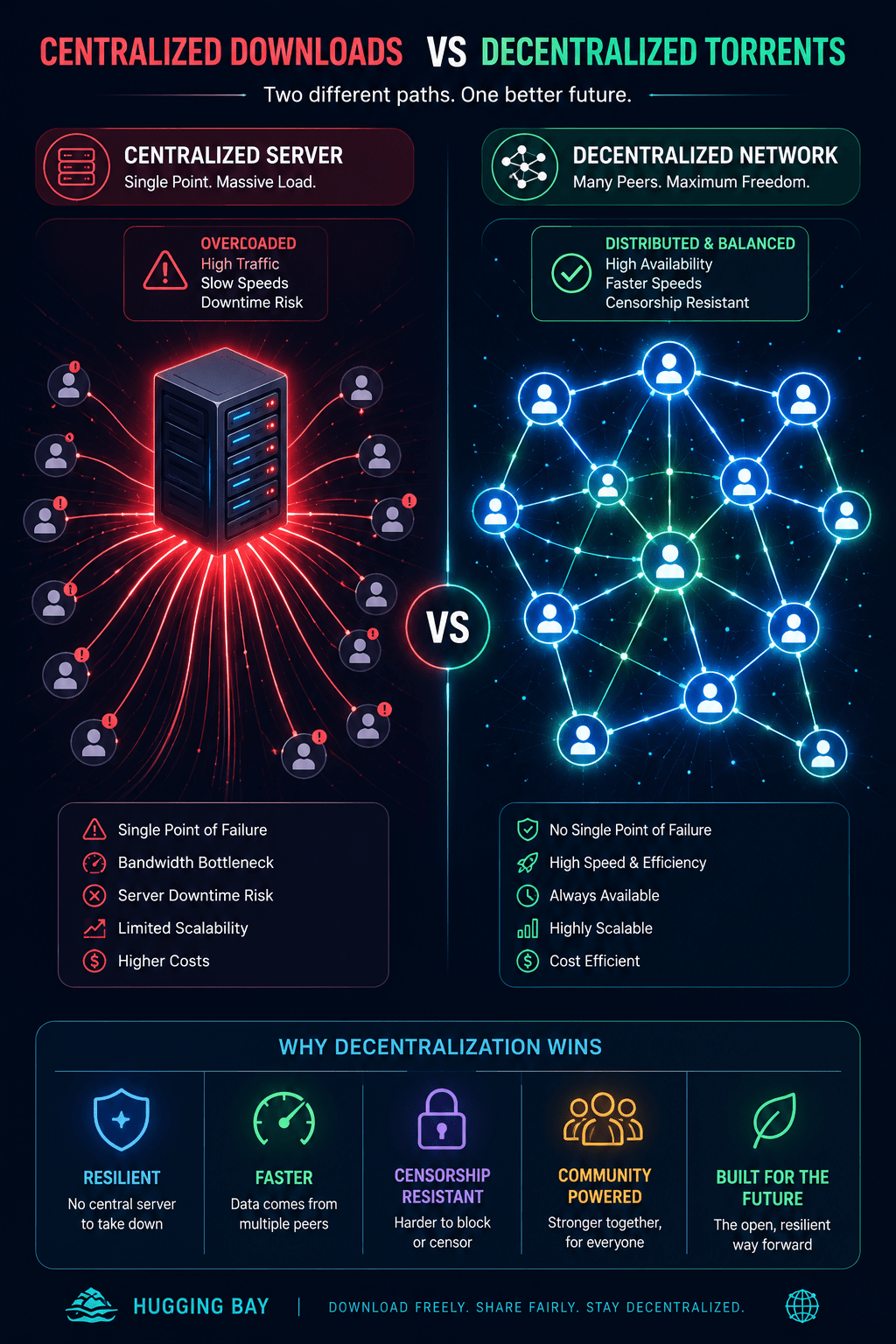
Instead of routing every download through a single server, Hugging Bay generates torrent files and magnet links for supported artifacts.
This means:
- Faster downloads when many people are seeding the same model
- Lower hosting costs for the platform itself
- No single point of failure if one mirror goes down
Hosted Mirrors
However, not all objects stored on Hugging Bay require downloading through torrent files only. Some of them are placed on mirrors with their corresponding cryptographic hash values.
The reason why this is important is that you may check whether your download was corrupted or not using hash values from the artifact’s webpage.
Semantic Search and Reranking
“However, Hugging Bay is not simply based on keyword matches. It accepts natural language queries.”
“Say, you want to find the best small commercial embedding model for RAG? You can enter something along the lines of ‘best small commercial embedding model for RAG,’ and the system will provide a semantic re-ranking in order to retrieve the actual relevant matches.”
“This is indeed an important usability feature.”
Supported Categories
Hugging Bay organizes its catalog into clear categories, which makes browsing far less chaotic than scrolling through an unsorted list of repositories.
- LLMs
- Embedding models
- Visual (image) models
- Audio models
- Open-source agents
- Datasets
- Apps
- Tools
- Evaluation suites
The platform also publishes curated ranking pages, including lists for top open models, hosted “run-ready” artifacts, and community-verified entries.
Hugging Bay vs Hugging Face
Comparisons to Hugging Face were inevitable given the name and the overlap in purpose. Here’s how the two actually differ.
| Feature | Hugging Bay | Hugging Face |
|---|---|---|
| Primary Distribution | Torrents + Selective Hosted Mirrors | Centralized Hosted Downloads |
| Core Focus | Verified Catalog and Discovery Layer | Full ML Platform (Hosting, Spaces, Inference, Training) |
| Search | Semantic Search with Reranking | Keyword and Tag-Based Search |
| Community Tools | Answer Packs, Trust Queue, Rankings | Model Cards, Discussions, Community Likes |
| Maturity | New, Launched July 2026 | Established Since 2016 |
| Hosting Scale | Selective, Review-Based | Massive, Open Upload for Verified Accounts |
The important distinction: Hugging Bay isn’t trying to replace Hugging Face’s role as a full ML platform with Spaces, inference APIs, and training infrastructure.
It’s positioning itself as a discovery and distribution layer that sits closer to the metadata and file-transfer side of the problem.
A Complement, Not Necessarily a Replacement
The majority of the artifacts that are indexed by Hugging Bay were actually created within the Hugging Face ecosystem anyway.
Therefore, what actually happens is that Hugging Bay acts as a curated entry point and an alternative distribution method, not as a competing source with its own separate database.
Benefits for Developers
For individual developers and ML engineers, Hugging Bay’s biggest value shows up in three places.
- Faster large-file downloads through peer-assisted torrenting, especially useful on capped or metered connections in some regions.
- Cleaner license visibility, so you’re not left guessing whether a model is safe to use commercially.
- Better discovery through natural-language search, which saves time compared to manually filtering tags.
If you’re building locally hosted apps or experimenting with local AI setups, having verified hashes also reduces the risk of running a corrupted or tampered checkpoint.
Benefits for Enterprises
Enterprises evaluating open-weight models care about two things above all else: legal risk and reliability.
- License clarity reduces the chance of accidentally deploying a model under restrictive terms.
- Provenance checks help confirm a model actually comes from the claimed source, not a re-uploaded or modified copy.
- Redundant distribution (mirrors plus torrents) reduces downtime risk if a single hosting source becomes unavailable.
None of this replaces a proper internal AI governance process. But it does give teams a faster starting point for due diligence.
Potential Challenges
No new platform is without friction points, and Hugging Bay is genuinely new it only became publicly visible in the first week of July 2026.
- Limited track record. The platform hasn’t been independently stress-tested at scale yet, so long-term reliability is unproven.
- Torrent health depends on seeders. A model with few people seeding it can download slowly, unlike a hosted mirror with guaranteed bandwidth.
- Verification isn’t the same as endorsement. Confirming provenance and license doesn’t guarantee a model performs well or is free of other issues.
- Newness and trust. As with any young project, it will take time before the wider AI community fully vets its verification processes.
Who Should Use Hugging Bay
If any of these applies to you, Hugging Bay is for you:
- Frequently download big open-weight models and want fast distributed downloads
- Use local AI environments and prioritize validation of file integrity
- Require prompt licensing confirmation before commercial use of the model
- Are looking for an intuitive, natural language search over LLMs, embeddings, and datasets
It’s less essential if you mostly rely on hosted inference APIs and never touch raw model weights directly.
Future of Open AI Model Distribution
The emergence of Hugging Bay is part of a larger trend occurring within the broader space of open-source artificial intelligence.
With the increasing size and number of open-weighted models, it is difficult for centralized hosting services to keep up with demand. P2P distribution, verification layers, and better search are now required infrastructure, not added value.
Whether Hugging Bay sticks around or is joined by other verification layer competitors is yet to be determined. One thing is certain: the challenge that Hugging Bay solves efficient and trustable distribution of open AI will not go away.

Final Verdict
Hugging Bay is indeed an interesting project to consider within the open AI landscape. It won’t replace Hugging Face, but it will definitely fulfill one of its gaps – efficient distribution of large model files along with their verification.
It is a great combination of torrents, verification of file integrity, and semantic search.
The only drawback is that it is too young at the moment.
Conclusion
The Hugging Bay verified AI model registry is definitely worth keeping an eye on if you deal with open LLMs, embeddings, or datasets on a day-to-day basis.
It does actually add value to the process by providing provenance verification, license clarity, P2P downloads, and more intelligent searching, all rolled into one catalog.
It is not going to beat Hugging Face anytime soon. However, as a complementary layer for discovery and distribution, it does fill an important niche in the current state of affairs surrounding open-weight models.
FAQs
1. What is Hugging Bay? Hugging Bay is a verified open-source AI artifact registry that indexes LLMs, embedding models, datasets, and tools, offering both torrent downloads and hosted mirrors.
2. Is Hugging Bay the same as Hugging Face? No. Hugging Face is an end-to-end ML platform with hosting capabilities, Spaces, and inferencing utilities. Hugging Bay is a discovery and distribution layer that centers around verified catalog metadata and peer-to-peer downloads.
3. Why is Hugging Bay called the “Pirate Bay for open LLMs”? The nickname comes from its use of torrents and magnet links to distribute large model files, similar to how the original Pirate Bay distributed files via BitTorrent.
4. Does Hugging Bay host pirated or gated content? No. Hugging Bay states it does not bypass gated, private, or admin-only sources. It indexes public metadata and hosts only reviewed public files.
5. How does Hugging Bay verify models? It checks source provenance, license information, and community trust signals before indexing an artifact, and attaches cryptographic hashes to hosted files for integrity verification.
6. Can I search Hugging Bay using natural language? Yes. Hugging Bay supports semantic search with reranking, so queries like “best small commercial embedding model for RAG” return relevant results instead of just keyword matches.
7. What categories does Hugging Bay support? LLMs, embedding models, visual models, audio models, open-source agents, datasets, apps, tools, and evaluation suites.
8. Is Hugging Bay safe to use for downloading AI models? Hugging Bay adds license and provenance checks plus file hashes, which improves trust. That said, it’s a new platform, so it’s wise to verify hashes yourself and stick to well-reviewed listings.
9. Do I need special software to use torrent downloads on Hugging Bay? Yes, you’ll need a standard BitTorrent client to use the magnet links provided for torrent-based artifacts.
10. Will Hugging Bay replace Hugging Face? Unlikely in the near term. Hugging Bay complements Hugging Face’s catalog rather than replacing its full platform of hosting, Spaces, and inference infrastructure.