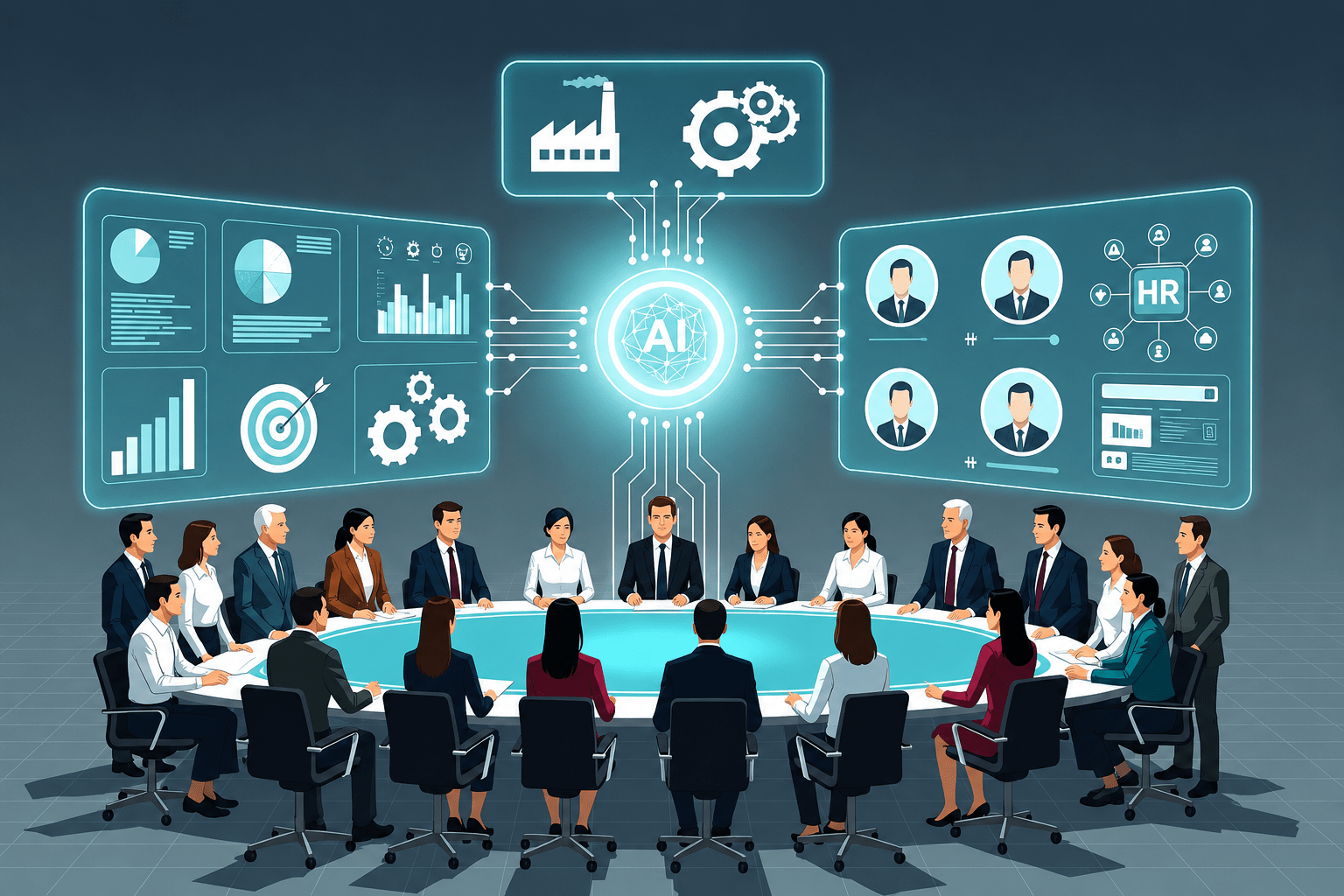

Artificial intelligence is not something to expect in the future anymore when talking about B2B companies. AI technology is here and already influencing business decision-making, customer service, and business process management in general.
Using AI in B2B eliminates slow and error-prone manual procedures in favor of faster and more efficient automated processes in such spheres as marketing, manufacturing, human resources management, and business process automation.
This guide provides an overview of the main directions where AI proves itself in the field of B2B and how this can be beneficial for companies.
Why AI Matters for B2B Businesses
B2B companies deal with large volumes of data, complex decision-making processes, and long sales cycles. These are exactly the conditions where AI performs best.
AI-based systems can detect patterns in data far more efficiently than human analysts. They process information faster, work without fatigue, and improve their own performance over time through machine learning. For B2B companies, this translates into better targeting, smarter resource allocation, and more consistent results across departments.
The advantages go beyond speed. AI reduces costly human errors in data analysis, helps businesses understand their target audiences more precisely, and enables teams to focus on strategic work rather than repetitive tasks.
Every major industry has felt this shift. Business intelligence, customer service, sales management, recruiting, and healthcare have all been transformed by AI adoption in the B2B space.
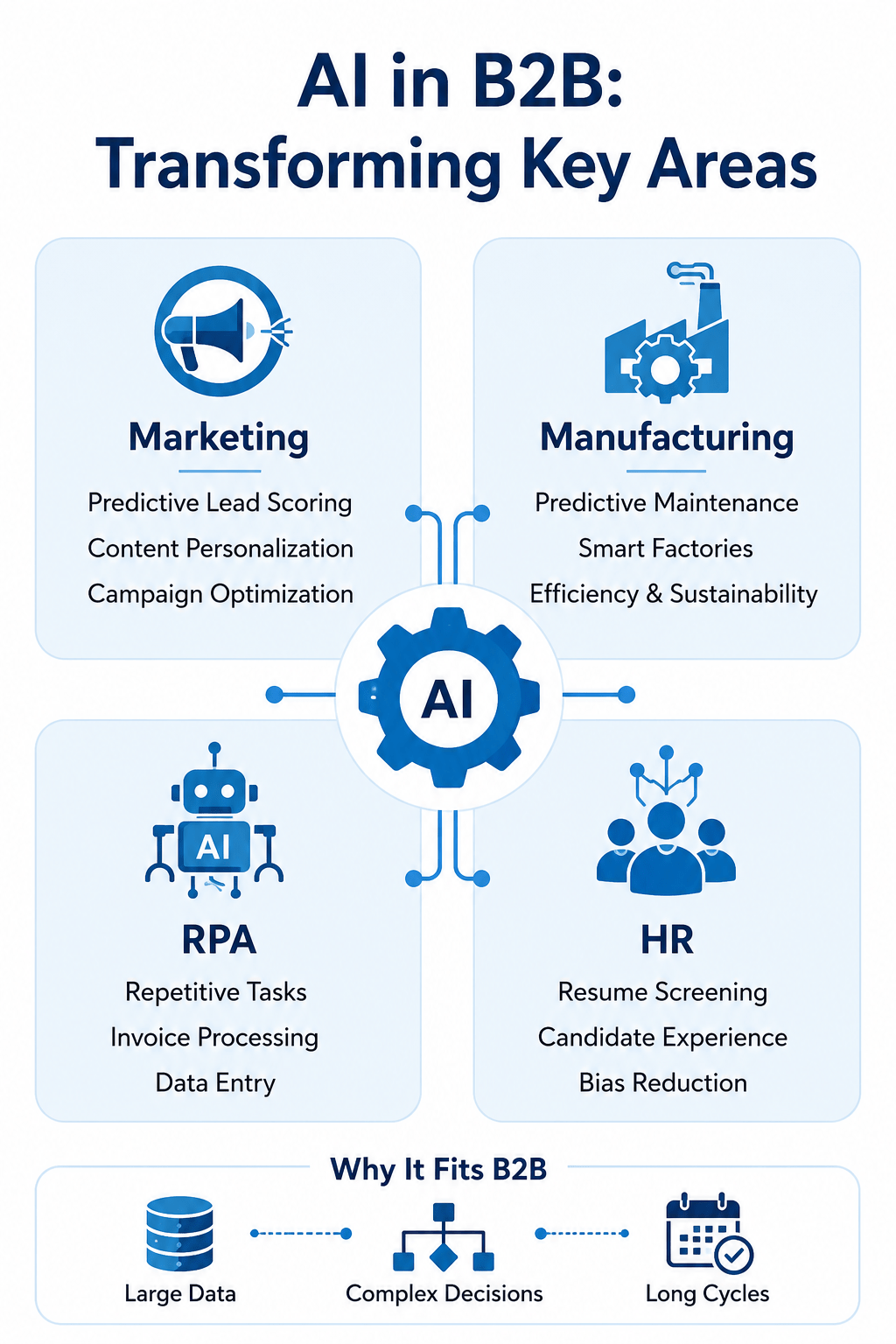
AI in B2B Marketing
AI in B2B has produced some of the most notable benefits in marketing. Traditional marketing made certain assumptions about customer behavior. But AI provides actual predictions based on data.
How AI Improves B2B Marketing
ML algorithms study past customer behavior in order to anticipate future actions of the customer. They determine what type of prospect is more likely to buy the product, at what time of the day to contact them, and what message would be appropriate for them. All of this data helps marketers allocate money and efforts on those channels and campaigns that yield the best results.
AI also makes it possible to reach very specific audiences that cannot be reached through manual segmentation. Instead of demographic data, they can be segmented based on their behavior and intent signals.
Practical Applications
- Predictive lead scoring: AI ranks leads based on their likelihood to convert, helping sales teams prioritize follow-ups
- Content personalization: AI tools serve different content to different visitors based on their behavior and stage in the buying journey
- Campaign optimization: Machine learning adjusts ad targeting and spend in real time based on performance data
- Customer retention: AI identifies early signals of customer churn and triggers proactive outreach before accounts are lost
The result is marketing that is more efficient, more targeted, and significantly less wasteful than traditional approaches.
Also Read — Optimizing Digital Content: Web Tools and Writing Techniques
AI in B2B Manufacturing
The manufacturing industry was one of the earliest industries to embrace the technology of AI, and the impact has been tremendous. Using AI, manufacturers can create more efficient plants, cut down on wastage, improve quality control, and ensure safety.
Industry 4.0 and Smart Factories
Industry 4.0 refers to intelligent manufacturing. Intelligent factories utilize artificial intelligence in order to observe their machinery in real time, to forecast the need for repairs before a failure happens, and automatically optimize their production process based on available data.
It is easy to measure the benefits of such a solution. Unexpected downtime causes manufacturers losses worth billions of dollars each year. AI-driven predictive maintenance can decrease this downtime.
Real-World Examples
Siemens and GE are two companies at the forefront of implementing AI in manufacturing. The company utilizes neural network AI to make the best performance decisions based on several parameters within their industrial processes. The company analyzes large amounts of data provided by sensors and makes changes that increase efficiency and decrease energy usage.
GE implements AI in its industrial machinery for the monitoring and prediction of performance and potential breakdowns in thousands of machines at once.
These aren’t pilot programs; they’re real-life implementations providing tangible benefits.
Environmental Benefits
AI can also help manufacturers lessen their impact on the environment. Energy-efficient production, less waste, and efficient logistics are all aspects of environmentally sustainable business. For B2B manufacturers under increasing pressure to prove their sustainability, AI technology offers useful solutions.
AI in Robotic Process Automation
Robotic Process Automation, commonly known as RPA, uses software to handle repetitive, rule-based tasks that previously required human effort. When combined with AI, RPA becomes significantly more powerful.
What RPA Does for B2B Companies
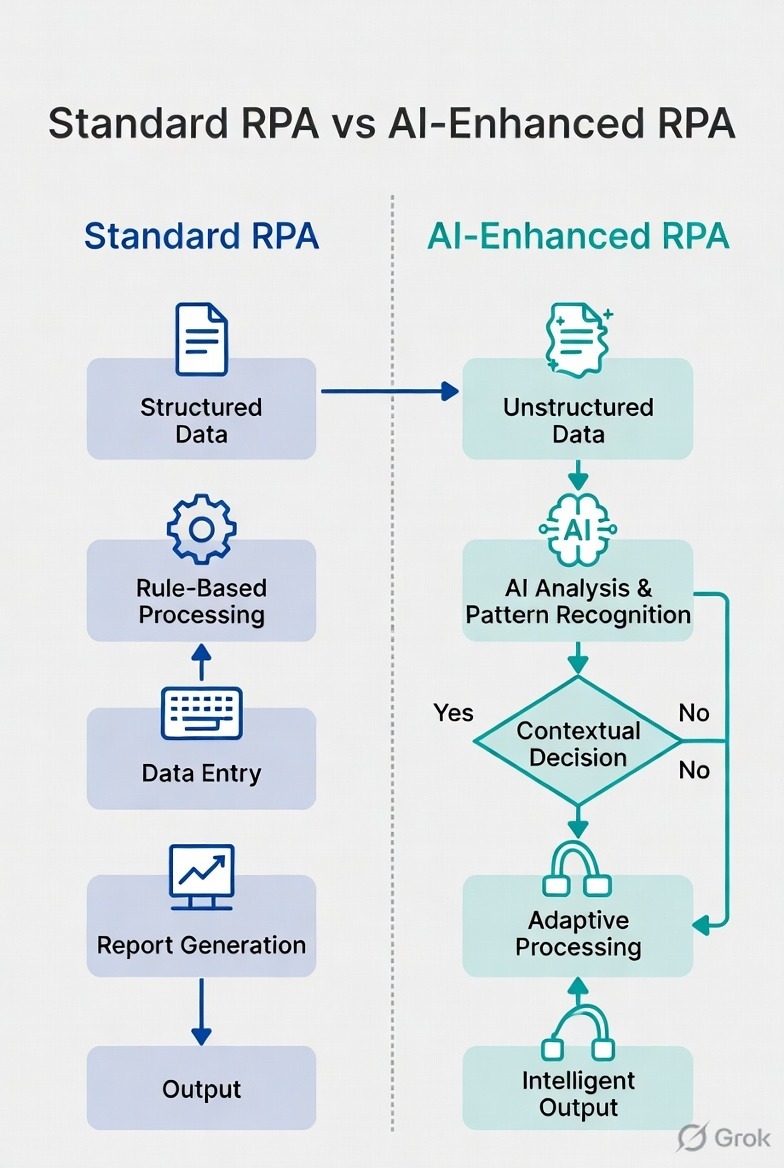
Standard RPA handles structured, predictable tasks. Think of processes like data entry, invoice processing, report generation, and record maintenance. These tasks are time-consuming, prone to human error, and add little strategic value when done manually.
AI-enhanced RPA goes further. It can handle unstructured data, make contextual decisions, and adapt to variations in the processes it manages. This makes it applicable to a much wider range of business functions.
Consider a practical example. A B2B company that publishes performance reports to multiple platforms can either spend hours doing that manually every week or deploy RPA software to generate and distribute those reports automatically. The time saved compounds quickly across a team.
Tools Worth Knowing
GetEmail.io is one such AI-driven software that employs the concepts of Big Data and Machine Learning to extract professional emails within seconds. The only thing needed to obtain validated information is to enter the first name, last name, and company domain of the prospect. Such tools prove invaluable for B2B sales teams as they make prospecting easier and quicker than ever before.
Tasks that RPA handles well in B2B settings include:
- Maintaining and updating records across multiple systems
- Data extraction and entry from documents and forms
- Invoice processing and accounts payable workflows
- Generating and distributing scheduled reports
- Onboarding new clients or suppliers with standardized document workflows
AI in B2B Human Resources
Hiring is among the most resource-demanding activities within any B2B business organization. The advent of AI technology has transformed this procedure through increased speed, automation, and reduced dependence on the subjective opinion of a single recruiter.
How AI Is Changing B2B Hiring
Artificial Intelligence-driven recruitment software programs are capable of reviewing as many as 100 resumes within the amount of time required by one human recruiter to review only ten. These programs analyze both the job description and the candidate’s profile and then determine the best fit in terms of skills and experience required.
Apart from just the initial stage of resume screening, artificial intelligence can also detect discriminatory wording in job descriptions through linguistic analysis. It is used by organizations in developing better-written and inclusive job descriptions.
Improving the Candidate Experience
AI can improve the candidate experience, as well. AI-based scheduling systems will prevent the need to schedule interviews by communicating back and forth. Chatbots with AI can respond to inquiries from the candidates regarding the position and organization at any time.
Limitations to Keep in Mind
Hiring through the use of AI is not immune from problems. Hiring algorithms can end up being biased by virtue of being trained using historical data. As a B2B company that is using AI for hiring purposes, it is important to have your systems audited periodically to avoid the unintended consequence of screening out qualified candidates due to inherent bias.
Properly applied, the use of AI makes the process of hiring much faster without taking away the human element required in the process.
Also Read — When AI Joins Hands With Mobile Apps
Common Mistakes B2B Companies Make With AI
Knowing the pitfalls helps you avoid wasting time and budget on implementations that do not deliver.
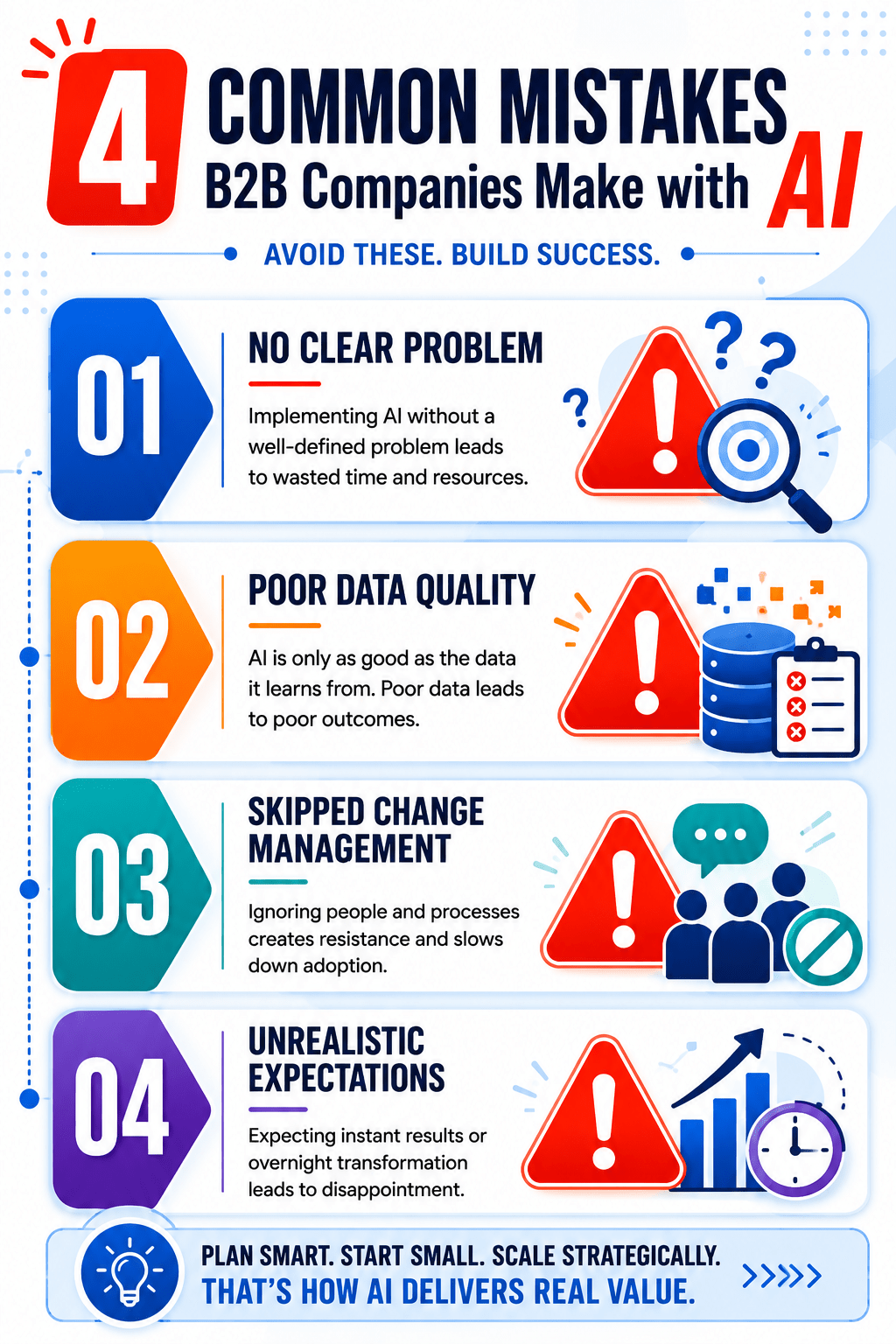
Adopting AI without a clear problem to solve. AI is a tool, not a strategy. Businesses that implement it without identifying a specific operational challenge rarely see meaningful results. Start with the problem, then find the AI solution that addresses it.
Underestimating the data requirement. AI systems are only as good as the data they learn from. Companies with poor data quality, inconsistent data collection, or siloed data systems will struggle to get value from AI regardless of how sophisticated the tool is.
Skipping change management. AI adoption changes how people work. Teams that are not prepared for those changes resist them. Invest in training and communication alongside the technology itself.
Expecting immediate results. Machine learning systems improve over time as they process more data. B2B companies that expect immediate transformative results often abandon implementations before they have had enough time to mature.
Best Practices for Adopting AI in B2B
- Start with a single high-impact use case rather than trying to transform everything at once
- Audit your existing data quality before selecting any AI tool
- Involve the teams who will use the system in the selection and implementation process
- Set measurable goals before you start so you can evaluate whether the investment is working
- Review AI outputs regularly. Automation does not mean unattended
- Build in human oversight for any AI system making decisions that affect customers or employees
Frequently Asked Questions
What is AI in B2B?
AI in B2B refers to the use of artificial intelligence technologies including machine learning, natural language processing, and robotic process automation to improve business operations, decision-making, and customer interactions in business-to-business environments.
Which B2B functions benefit most from AI?
Marketing, manufacturing, human resources, and process automation currently show the strongest returns from AI adoption in B2B settings. Sales forecasting and customer service are also significant areas of impact.
Is AI in B2B only for large companies?
No. Many AI tools are now accessible to small and mid-size B2B companies through affordable SaaS platforms. The barrier to entry has dropped significantly in recent years.
How does AI improve B2B marketing specifically?
AI improves B2B marketing by enabling predictive lead scoring, content personalization, automated campaign optimization, and more precise audience targeting based on behavioral data rather than broad demographics.
What is the difference between RPA and AI?
RPA automates structured, rule-based tasks. AI adds the ability to handle unstructured data, make contextual decisions, and improve performance over time. AI-enhanced RPA combines both capabilities.
How long does it take to see results from AI adoption in B2B?
It depends on the use case and data quality. Some applications like email automation or report generation show results almost immediately. Predictive models and machine learning systems typically require several months of data before they perform at their best.
Are there risks to using AI in B2B?
Yes. Data privacy, algorithmic bias, over-dependence on automation, and the expenses associated with a bad implementation process are all actual concerns. These are easily controllable if proper planning and system audits are done.
Final Thoughts
AI in B2B is a development trend that organizations cannot ignore. Organizations that adopt AI today are creating competitive advantages that are likely to become harder to overcome in the future.
The important thing is to start right. Have a problem you are solving. Use the tools appropriate for your data environment. Involve your people in the process. And be honest about the results.
For its part, AI serves well as an amplifier of effective business practices, but not as a replacement of such. The organizations benefiting most from AI are those that apply AI capabilities in combination with business strategy and high-quality data management.
Take any one item from this guide. Apply it rigorously. The results will show what comes next.