
Cloud gaming concept showing one game running on a data centre and streamed to a laptop, phone and TV
Cloud gaming sounds almost too good to be true: you play a huge game on an old laptop, a phone or a TV, while a data centre far away does the heavy work. So is it really good, or just too early?
Everyone loves games, and a lot of developers quietly wonder if they should move into game development. I have modded games and vibe coded a few small ones, so I tinker with game code, but I am not a full game developer yet. This Game Dev Series is me learning one idea at a time and writing down what I find. In the first post we looked at how game maps work, and this time we look at something that changes where a game even runs.
I will go through the history of cloud gaming, follow a single frame from your controller and back, look at image quality, data use and games that suit it, and then do the honest maths of paying a subscription against buying hardware that gets outdated. One note before we start. This is a developer’s reading of published specs, research and prices, not a lab test, and I mark clearly which numbers are examples and which are quoted.
Also Read: https://tekraze.com/game-map-basics/
What is cloud gaming in simple words?
Cloud gaming, also called game streaming, runs the game on a remote server and sends the result to you as video. Your device sends back your button presses, and the server reacts. The Wikipedia overview of cloud gaming describes it the same way.
A normal game works differently. Your PC or console runs the logic, draws every frame with its own GPU and shows it. With cloud gaming the GPU lives in a data centre, and your device only decodes video and reads your controller. That is why a cheap phone can show a game its own chip could never run.
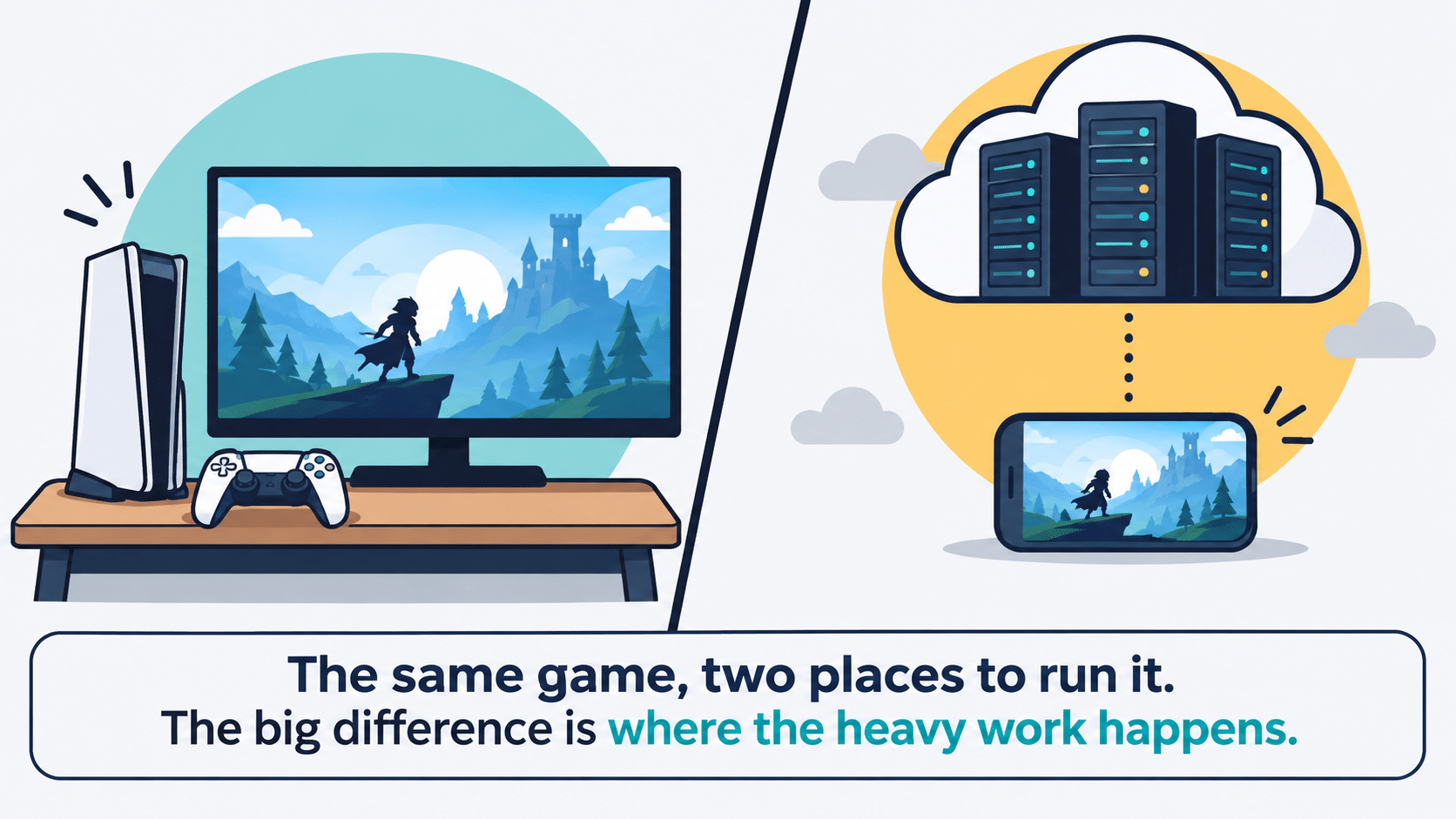
The same game, two places to run it. The big difference is where the heavy work happens.
How did cloud gaming start in the first place?
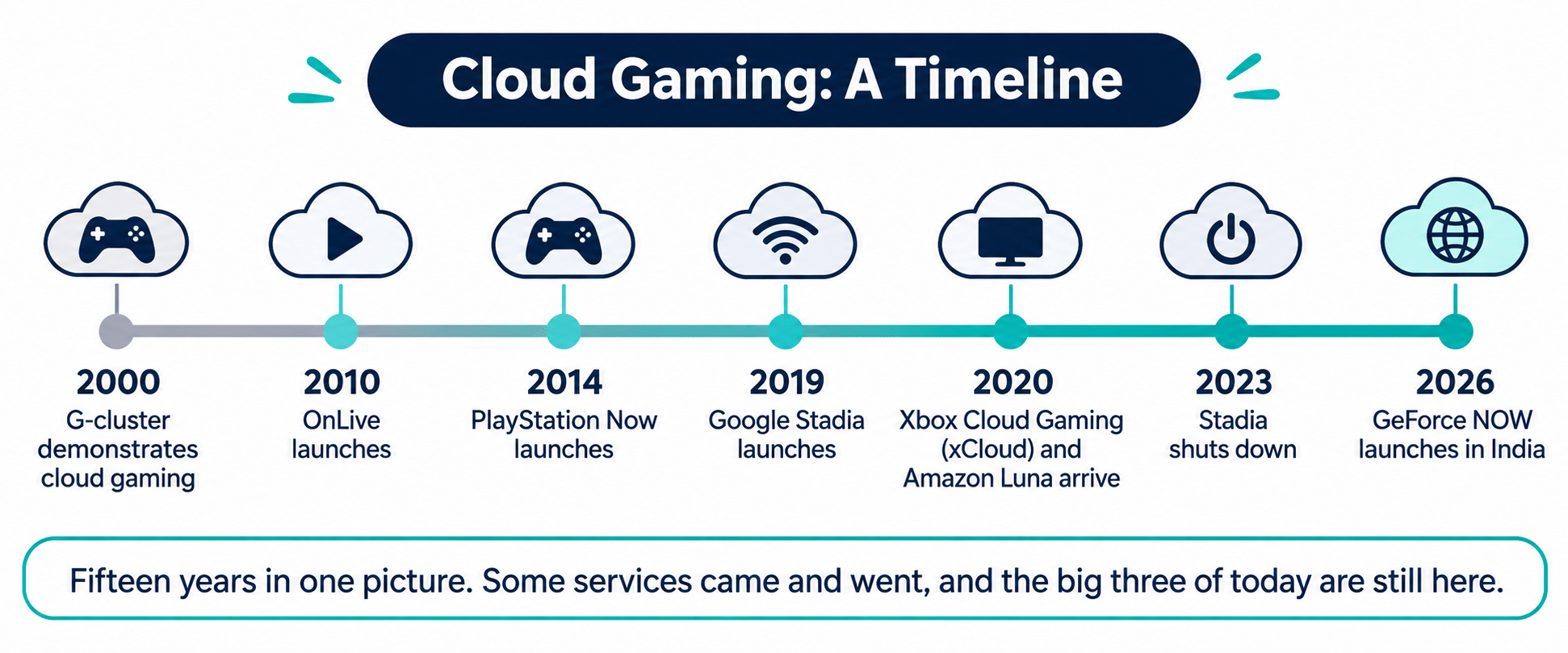
Cloud gaming is much older than most people think. According to the Wikipedia history, a company called G-cluster showed cloud gaming at E3 2000 and shipped around 2003, mainly through TV providers. The big problem was always the same. Home internet was not fast or steady enough, and the video technology was not good enough yet.
OnLive and Gaikai tried it first
The modern attempt began when Steve Perlman revealed OnLive at the Game Developers Conference in March 2009. It launched in June 2010 with its own small console, and it picked up support from publishers like Ubisoft, 2K and THQ, but never became profitable. Gaikai, from David Perry, took a different path and streamed game demos, which gave it more publisher support.
Sony announced the purchase of Gaikai on July 2, 2012, and the law firm that advised Sony reports a price of $380 million with the deal closing on August 10. Sony later bought OnLive’s assets in April 2015 and shut the service down. All of this is covered in the cloud gaming history on Wikipedia.
PlayStation Now brought it to consoles
Sony used Gaikai’s technology for PlayStation Now. It was announced at CES on January 7, 2014, and the Sony timeline lists the North America launch in July 2014 on PlayStation 4. In 2022 Sony folded PlayStation Now into the new PlayStation Plus, and PS Now customers moved to the Premium tier.
Stadia, xCloud and Luna made it mainstream
Google launched Stadia in November 2019, and the BBC remembers it being touted as a “Netflix for games”. In 2020 two big players joined. Microsoft started cloud gaming inside Game Pass Ultimate on September 15, 2020, as a beta on Android in 22 markets, and Amazon opened early access to Luna on September 24, 2020. Luna later became generally available in the US on March 1, 2022.
NVIDIA’s version began life as GRID in 2012 and grew into GeForce NOW. Boosteroid from Ukraine describes its own story on its About page and has been running commercially since 2019.
Timeline of cloud gaming services from G-cluster in 2000 to GeForce NOW in India in 2026
Fifteen years in one picture. Some services came and went, and the big three of today are still here.
Which cloud gaming services matter today?
There are many services, and this table is only a snapshot of the ones people ask about most. Everything here comes from the official pages I link in this post, and I checked prices in late October 2026. Plans change often, so confirm on the official page before you pay.
| Service | How it works | Quoted India price | India status |
|---|---|---|---|
| GeForce NOW | You stream PC games you already own from supported stores, with free, Performance and Ultimate tiers | Free tier, Performance ₹999 and Ultimate ₹1,999 a month, Day Passes ₹399 and ₹799 | Launched in India on July 15, 2026 |
| Xbox Cloud Gaming | Included with Game Pass tiers, you can also stream some games you own | Essential ₹499, Premium ₹699, Ultimate ₹1,089 a month | Launched in India in November 2025 |
| PlayStation Plus | Cloud streaming for higher tiers in some countries | Varies by tier | The India page I checked lists Essential, Extra and Deluxe and does not list cloud streaming |
| Amazon Luna | Channel style subscriptions streamed from Amazon servers | Priced per country | Amazon lists cloud gaming for a limited set of countries and India was not on it |
| Boosteroid | Rent a cloud PC style service and play your own library | Varies | I could not find an official India launch |
| Google Stadia | Streamed games bought from the Stadia store | Not applicable | Shut down on January 18, 2023 |
Sources are the official GeForce NOW launch coverage on Gadgets 360, the Xbox India store page and Xbox Wire, the PlayStation India page, Amazon help and the Stadia FAQ.
The GeForce NOW numbers come from the India launch coverage, for example Gadgets 360 and IGN India. Xbox Cloud Gaming came to India in November 2025, as Xbox Wire explains, and the plan prices come from the Xbox India Game Pass page. That page also lists cloud playtime of 5 hours a month on Essential and 10 hours on Premium, while Ultimate is sold on the best quality and shortest waits.
What happens to one frame in cloud gaming?
This is the part I like most, because game development and networking meet in cloud gaming. In a local game the frame has a short trip. In cloud gaming the same frame takes seven stops.
- Controller. Your device reads the button or stick and packs the input.
- Uplink. The input travels over the internet to the data centre.
- Game frame. The server runs the game and renders the frame. At 60 frames per second that is one frame every 16.7 milliseconds.
- Encode. The server compresses the frame into video.
- Downlink. The video travels back to you.
- Decode. Your device unpacks the video.
- Display. Your screen shows the picture.
Seven-stop path of one frame in cloud gaming, from controller to server and back to the screen
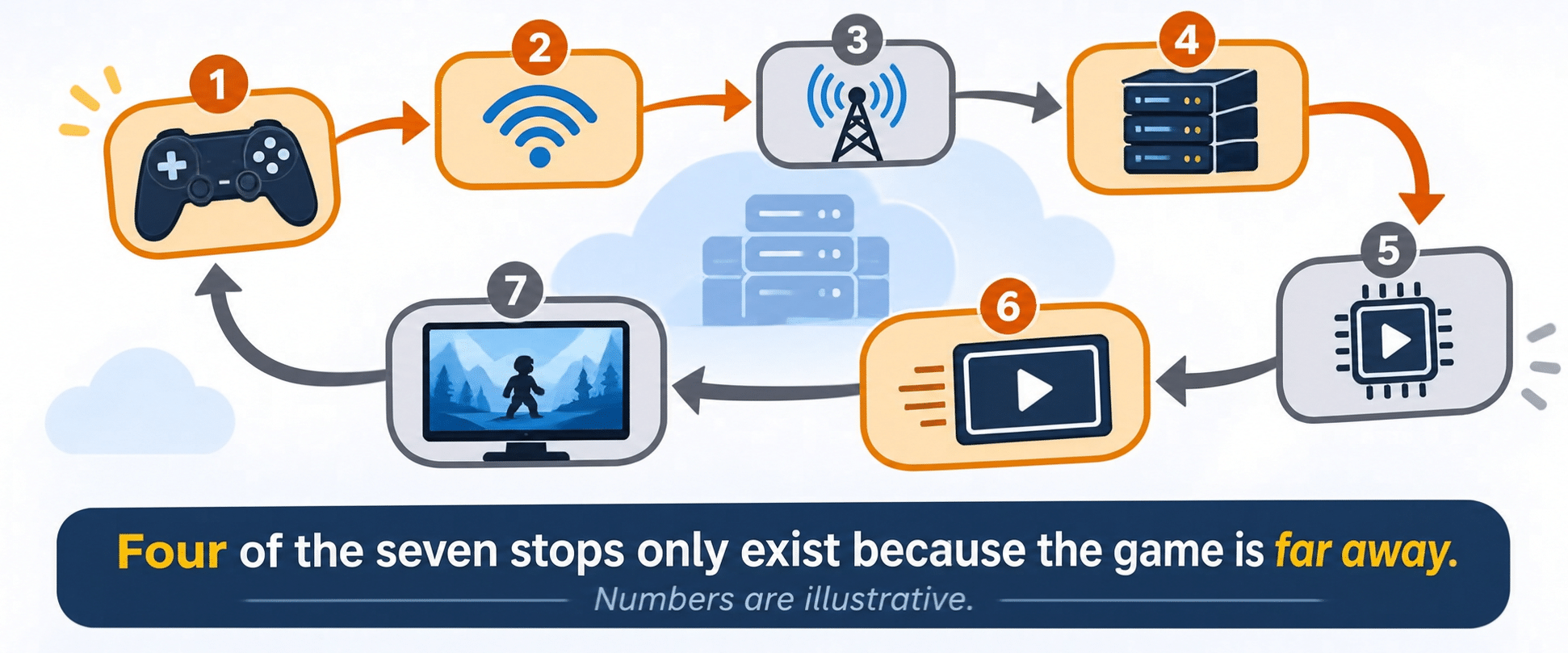
Input lag is the total time from your press to the change on screen. Your internet can only affect the two travel stops, but the encode and decode stops are extra work that a local game never does.
How big is the cloud gaming latency budget?
I wrote a tiny Python script to add up the stops. The numbers are examples, not measurements, so please do not quote them as facts. They use a controller delay of 4 ms, encode and decode of 5 ms each and a display delay of 8 ms, and then they change only the round trip time of the network.
python
# Illustrative latency budget in milliseconds. These are example numbers, not measurements.
STAGES = ["controller", "uplink", "game frame", "encode", "downlink", "decode", "display"]

def budget(rtt_ms, fps=60, encode=5, decode=5, controller=4, display=8):
    frame = 1000 / fps
    one_way = rtt_ms / 2
    return dict(zip(STAGES, [controller, one_way, frame, encode, one_way, decode, display]))

def local(fps=60, controller=4, display=8):
    return {"controller": controller, "game frame": 1000 / fps, "display": display}

cases = {
    "Local PC or console": local(),
    "Cloud, good link (30 ms RTT)": budget(30),
    "Cloud, average link (60 ms RTT)": budget(60),
    "Cloud, poor link (100 ms RTT)": budget(100),
}

if __name__ == "__main__":
    for name, parts in cases.items():
        print(f"{name:34} total = {sum(parts.values()):6.1f} ms")
text
Local PC or console                total =   28.7 ms
Cloud, good link (30 ms RTT)       total =   68.7 ms
Cloud, average link (60 ms RTT)    total =   98.7 ms
Cloud, poor link (100 ms RTT)      total =  138.7 ms
Bar chart of example total input lag for local play and cloud gaming at 30, 60 and 100 ms round trip time
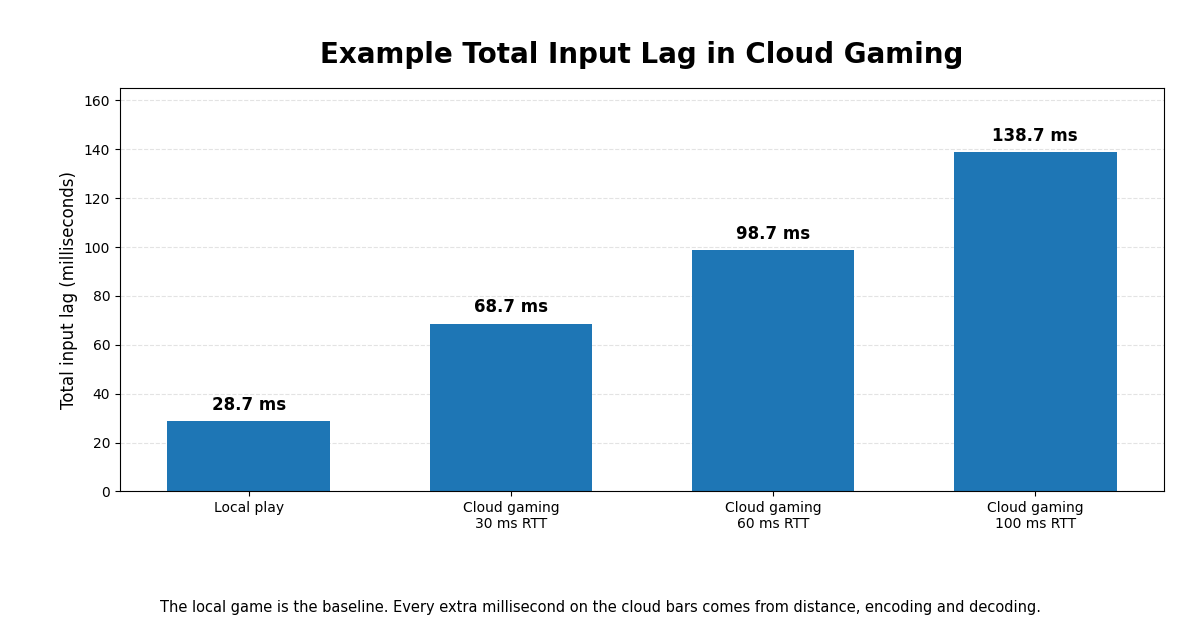
The local game is the baseline. Every extra millisecond on the cloud bars comes from distance, encoding and decoding.
Two things stand out. Even on a very good link the cloud version in this example costs about 40 ms more than local, and that is before your Wi-Fi has a bad day. Also, the frame time itself stays the same, so the extra delay is almost entirely distance and video work.
NVIDIA says it requires less than 80 ms of network latency to its data centre and recommends under 40 ms, which matches this picture. The closer your server, the smaller the bars.
Which games suffer from latency and which feel fine?
Not every game cares about cloud gaming delay equally. A well known study called Latency and Player Actions in Online Games proposed a precision and deadline model. Actions that need high accuracy and have to finish fast are hurt most by delay, while loose, slow actions are forgiving. First person games with direct control sit near the sensitive end, and strategy games where you command units from above sit near the tolerant end.
The more a game rewards fast, exact inputs, the more every extra millisecond hurts.
- Turn based and strategy. You think, then click. A 100 ms delay barely matters.
- Story and adventure. Slow camera, forgiving combat. This is the sweet spot for cloud gaming.
- Open world RPGs. Fine on a stable link, though big action fights can feel floaty.
- Competitive shooters. Aim and reaction time are the game. Cloud players give up a little edge, and that matters if you play ranked.
- Fighting games. Moves are measured in frames, and one frame is about 16.7 ms at 60 fps. Extra delay changes what combos you can land.
- Rhythm games. Many have a calibration setting to offset audio and display lag, but a streamed game adds delay that moves around, which is harder to calibrate.
As someone who tinkers with game code, this matches what I see in how games are built. A fighting game is basically a tight loop that checks input every frame. A story game can afford to wait a few frames before reacting. Cloud gaming simply adds a few frames to both.
How good is the image quality?
The video you see in cloud gaming is compressed. A 1080p frame at 60 fps in raw form would need a huge connection, so the server encodes it with a video codec and sends a much smaller stream. Compression is smart, but it is lossy, which means some detail is thrown away.
Where you notice it depends on the scene. Fast motion, smoke, rain, particles and foliage are hard to compress, so they can turn blocky or smeared when bitrate is low. Dark scenes can show banding and small HUD text can look soft. The quality also shifts during play, because the service may lower the bitrate or resolution if your network wobbles.
Bitrate, resolution and frame rate trade against each other. For GeForce NOW the system requirements page asks for 15 Mbps for 720p, 25 Mbps for 1080p at 60 fps, 35 Mbps for 1440p at 120 fps, 45 Mbps for 4K at 120 fps and 65 Mbps for 5K at 120 fps. NVIDIA’s own help article recommends 50 Mbps for 1080p, 64 Mbps for 1440p and 75 Mbps for 4K for the best experience.
On the free tier in India the stream is up to 1080p at 60 fps with one hour sessions, Performance goes up to 1440p at 60 fps, and Ultimate goes up to 5K at 120 fps, as the India launch coverage lists. Xbox raised its top stream to up to 1440p for Game Pass Ultimate members on select titles, and it lets you pick your own resolution.
How much data does cloud gaming use?
Cloud gaming is continuous video, so data adds up fast. This second tiny script turns a bitrate into gigabytes per hour. It uses the minimum speeds NVIDIA lists, so treat the results as a ceiling, because real bitrate adapts and is often lower.
python
# Data used per hour for a given stream bitrate (Mbps) and what that means per month.
def gb_per_hour(mbps):
    return mbps / 8 * 3600 / 1000          # Mbps -> MB/s -> MB/hour -> GB/hour

# Minimum speeds quoted on NVIDIA's GeForce NOW system requirements page
for label, mbps in [("1080p 60 fps", 25), ("1440p 120 fps", 35), ("4K 120 fps", 45), ("5K 120 fps", 65)]:
    h = gb_per_hour(mbps)
    print(f"{label:14} {mbps:3d} Mbps  up to {h:5.1f} GB/hour  |  2 h a day for 30 days = {h*60:6.0f} GB")
text
1080p 60 fps    25 Mbps  up to  11.2 GB/hour  |  2 h a day for 30 days =    675 GB
1440p 120 fps   35 Mbps  up to  15.8 GB/hour  |  2 h a day for 30 days =    945 GB
4K 120 fps      45 Mbps  up to  20.2 GB/hour  |  2 h a day for 30 days =   1215 GB
5K 120 fps      65 Mbps  up to  29.2 GB/hour  |  2 h a day for 30 days =   1755 GB
Those totals look big next to Indian broadband limits. For example, the JioAirFiber terms treat use beyond 1000 GB in a billing cycle as exceeding the Fair Usage Policy and throttle speed to 64 Kbps afterwards. Some fibre plans have much higher limits, and the cap depends on your provider and plan, so check yours.
If you play two hours a day at the highest settings, you can get close to or past a 1 TB limit at the ceiling, and that is before anyone else in your home watches a video.
Does Wi-Fi or ethernet matter for cloud gaming?
Yes, a lot. Speed is only half of the cloud gaming story. Cloud gaming needs steady, low delay, and Wi-Fi is the part of your chain most likely to add random spikes.
NVIDIA recommends a 5 GHz connection over 2.4 GHz and asks you to run its built in network test, because a normal speed test does not measure the route to its data centre. For the high resolution and frame rate modes it says a wired Ethernet connection is needed in balanced mode.
What about queues, session limits and ownership?
A local game is always ready. Cloud gaming needs a free machine in a data centre. On the free tier you may wait in a queue, and the India launch coverage says free sessions last one hour, Performance gives six hours and Ultimate gives eight hours. Paid tiers get priority access. Xbox sells cloud playtime in hours on its lower plans, as I mentioned above.
Ownership in cloud gaming is the part developers think about more than players. There are two models. In the first, you stream a library the service owns, like a Game Pass catalogue. Games can leave the catalogue and you lose access.
In the second, you stream games you own from a store. That feels safer, but publishers like Activision Blizzard and Bethesda made NVIDIA pull their games from GeForce NOW in the past, so the library can shrink without warning. Also, not every game on Steam or other stores is available, so check the supported games list before you pay.
Is cloud gaming available in India?
Cloud gaming is here now, and that is new. Xbox Cloud Gaming expanded to India in November 2025, and Xbox called it the 29th market. GeForce NOW went through about three months of early access and then launched fully on July 15, 2026, with UPI payments supported according to NVIDIA payment help.
Having cloud gaming servers in the country matters because a nearby data centre cuts the distance in the latency budget. Services without Indian servers can still be used by some people, but you may see much longer delays.
What happens if a cloud gaming service shuts down?
This is the question that makes me most careful about cloud gaming, and Stadia is the example. Google announced on September 29, 2022 that it was winding down Stadia because it had not gained the traction it expected, and the servers closed on January 18, 2023. Google promised refunds for hardware and game purchases, and the Stadia FAQ explains that Stadia Pro fees paid before the announcement were not refunded.
The refund was fair, but the games were gone. A game installed on your own device does not vanish when a company changes strategy, and a game that only lives on a company’s servers can. So I treat a cloud gaming subscription like renting, and I keep anything I really care about somewhere I hold a local copy.
What does cloud gaming mean for game developers?
This is the part I find most interesting as someone learning to build games. A few things change when cloud gaming runs the game in a data centre.
- Your game is a video source. The server needs a GPU for every player, so the cost of rendering moves from the player to the service. Light, efficient games are cheaper for cloud gaming services to stream.
- Instant play becomes possible. Gaikai started with demos, because streaming a demo means no download. Unreal Engine now has a feature called Pixel Streaming that runs an app remotely and sends the video to a browser, so a player can try something without installing anything.
- Input handling matters more. If you know a player may have 50 to 100 ms of extra delay, you can add small mercy windows for jumps, parries and dodges so the game stays fair.
- Always online is the default. Cloud games need a connection, so features like save syncing and live content come naturally, but offline play is gone.
- One build for many devices. The Pixel Streaming docs point out that you can package once and let people use any platform, which is attractive for small teams.
What does cloud gaming mean for the future of gaming?
I do not think cloud gaming will replace hardware. I think it will sit next to it. Cloud gaming is great for trying a game, for playing on a weak device, for travel and for big titles you will only play once. Local hardware is still better for competitive play, for modding, for offline use and for people who like to own their library.
A few trends look likely to me. Subscriptions will bundle cloud access, as Game Pass already does, more games will offer streamed demos, and edge data centres in more countries will cut latency. Still, physics has a limit, so the most delay sensitive games will keep favouring local play for a long time. Whether it is too early depends on your game, your internet and your expectations.
Is cloud gaming cheaper than buying a gaming PC?
This is the question behind the whole post. People pay for a monthly subscription, or they buy a gaming PC that becomes outdated. I built a small cloud gaming cost calculator so the assumptions are visible and you can change them for your own life. It compares cumulative cost over five years, which is a common lifetime for a gaming PC before an upgrade is needed.
Here are the inputs, with each one labelled so you know what is quoted and what is my assumption.
- Quoted. GeForce NOW Performance ₹999 and Ultimate ₹1,999 a month in India, from the launch coverage linked earlier. Xbox Game Pass Ultimate ₹1,089 a month, from the Xbox India store page. Prices checked on October 28, 2026.
- Quoted. A Ryzen 5 7600X and RTX 5060 build comes to ₹1.12 lakh to ₹1.26 lakh according to the GetPC build guide, updated in 2026. I used ₹1,20,000. The guide also estimates about 200 W while gaming.
- Quoted. The RTX 5060 12 month median price in India is about ₹38,400 on GPUprix, although the cheapest in stock card on October 27, 2026 was about ₹54,000, so the market is moving.
- Assumption. One GPU swap of ₹40,000 after year three to keep up with new games.
- Assumption. Three hours of play a day and ₹8 per unit of electricity, which gives about ₹144 a month.
- Assumption. Both options need the same internet, the same games and the same screen, so I left those out. I also ignore resale value of the PC.
python
# Five year cost calculator in rupees. Every number below is an assumption or a quoted price.
MONTHS = 60

# Local PC (assumptions)
pc_build      = 120_000   # mid of GetPC's 1.12 to 1.26 lakh Ryzen 5 + RTX 5060 build, Aug 2026
gpu_refresh   = 40_000    # assumed GPU swap in month 36 (RTX 5060 12 month median is about 38,400 on gpuprix)
watts, hours_per_day, rupee_per_unit = 200, 3, 8   # assumed power draw, daily play time, tariff
power_per_month = watts / 1000 * hours_per_day * 30 * rupee_per_unit

# Cloud (quoted India prices, Oct 2026), held flat
plans = {"GeForce NOW Performance": 999, "Xbox Game Pass Ultimate": 1089, "GeForce NOW Ultimate": 1999}

def pc_total(months=MONTHS):
    return pc_build + (gpu_refresh if months > 36 else 0) + power_per_month * months

def cloud_total(price, months=MONTHS, yearly_hike=0.0):
    total = 0
    for m in range(months):
        total += price * (1 + yearly_hike) ** (m // 12)
    return total

if __name__ == "__main__":
    print(f"Power for the PC: about Rs {power_per_month:,.0f} a month")
    print(f"{'Option':44}{'1 yr':>10}{'3 yr':>11}{'5 yr':>11}")
    rows = [("Build a PC, GPU swap in year 4", pc_total)]
    rows += [(n, lambda m, p=p: cloud_total(p, m)) for n, p in plans.items()]
    rows += [("GeForce NOW Ultimate, +10% price rise a year", lambda m: cloud_total(1999, m, 0.10))]
    for name, fn in rows:
        print(f"{name:44}{fn(12):10,.0f}{fn(36):11,.0f}{fn(60):11,.0f}")
text
Power for the PC: about Rs 144 a month
Option                                            1 yr       3 yr       5 yr
Build a PC, GPU swap in year 4                 121,728    125,184    168,640
GeForce NOW Performance                         11,988     35,964     59,940
Xbox Game Pass Ultimate                         13,068     39,204     65,340
GeForce NOW Ultimate                            23,988     71,964    119,940
GeForce NOW Ultimate, +10% price rise a year    23,988     79,400    146,449
| Option | After 1 year | After 3 years | After 5 years |
|---|---|---|---|
| Build a PC and swap the GPU after year 3 | ₹121,728 | ₹125,184 | ₹168,640 |
| GeForce NOW Performance | ₹11,988 | ₹35,964 | ₹59,940 |
| Xbox Game Pass Ultimate | ₹13,068 | ₹39,204 | ₹65,340 |
| GeForce NOW Ultimate | ₹23,988 | ₹71,964 | ₹119,940 |
| GeForce NOW Ultimate with a 10% yearly price rise (assumption) | ₹23,988 | ₹79,400 | ₹146,449 |
Cumulative cost in rupees. Cloud prices are quoted, the PC build is quoted, and the swap, power use and price rise are assumptions.
Line chart of five-year cumulative cost in rupees for a gaming PC compared with cloud gaming subscriptions
The PC starts high and flattens. Subscriptions start at zero and keep climbing as long as you keep paying.
Look at the shape of the cloud gaming costs rather than one number. On these assumptions even the top cloud tier stays below the PC for five years, and the cheaper tiers cost roughly a third of it. A 10 percent yearly price rise on the top tier still stays below the PC at five years, but the gap shrinks. The PC line only wins if you keep it much longer than five years, or if you also count what it does besides gaming, like coding, editing or running Blender.
A few fair warnings. A GeForce NOW subscription does not include games, so you still buy them. Game Pass does include a library, but games leave it. A cloud service also needs a fast, uncapped internet line, which is not free. The PC option holds some resale value and works offline, and GPU prices in India have been unstable this year, so your own quote could look very different.
If you only play now and then, a Day Pass of ₹399 for Performance or ₹799 for Ultimate can be cheaper than any monthly plan.
What are the pros and cons of cloud gaming from a developer’s point of view?
Pros of cloud gaming
- Cheap hardware plays big games. A basic laptop, phone or TV becomes a gaming device if the network is good.
- No downloads or patches. You press play and the game is ready.
- Always the latest hardware. The provider upgrades the GPUs, so you do not.
- Play anywhere. Start on a TV, continue on a phone, with saves following you.
- Low upfront cost. You can start for a day pass or a month and stop if it is not for you.
Cons of cloud gaming
- Added input lag. The seven stop trip is physics. It will never be as quick as local.
- Compression artefacts. Fast scenes, dark scenes and small text can look worse than native.
- You depend on the internet. A bad evening of Wi-Fi makes a bad evening of gaming.
- Data and caps. Heavy play can break a fair use limit.
- You rent access. Libraries change and services can shut down, as Stadia showed.
- Queues, session limits and modding. Free users may wait, sessions end after a set time, and tinkering with game files is far harder on a remote machine.
Who should and shouldn’t use cloud gaming?
Cloud gaming is a good fit if you play story games, strategy, RPGs or casual titles, you have a stable wired or 5 GHz connection, you have a weak device, you travel, or you want to try big games before you commit to hardware. It also suits people who cannot afford a gaming PC right now and want to start without a large upfront cost.
Cloud gaming is a poor fit if you play ranked shooters or fighting games, you have a slow, capped or unstable connection, you live far from the nearest data centre, you love mods, or you hate the idea of renting.
What is my quick verdict on cloud gaming?
So is cloud gaming really good, or just too early? My honest answer is both, depending on the game. For slow and cinematic games on a decent connection, it is already good and the cost maths is attractive. For fast competitive games, it still feels early, because the delay is built into how it works.
Cloud gaming is not a replacement for a PC or console yet. It is a very useful second option, and for some people in India with a good fibre line it may be the first time a big game is within reach.
What tips and tricks give the best cloud gaming experience?
- Use the built in network test. Services like GeForce NOW have one that checks the route to their servers, which is more useful than a normal speed test.
- Pick Ethernet or 5 GHz Wi-Fi. Avoid 2.4 GHz if you can.
- Choose the closest server. A nearby data centre reduces the travel stops in the budget.
- Use a wired controller or a good Bluetooth one. A wireless link with its own delay adds to the budget.
- Start with a day pass. Test your own connection and favourite games before a monthly plan.
If your problem is the opposite, a low end PC that you want to improve, see how to play games on a low end PC easily for ways to get more from the hardware you already own.
What common mistakes should I avoid?
- Buying a long plan before testing your own connection.
- Expecting cloud gaming to match a local PC in competitive shooters.
- Forgetting that you still need to own the games on stores like Steam when you stream your own library.
- Treating streamed games as permanent, when a catalogue or a service can change.
- Trusting old prices, because plans and regions change often.
- Ignoring data limits, because a throttled line late in the month ruins a session.
Frequently asked questions
What is cloud gaming?
Cloud gaming runs a game on a remote server and streams the video to your device. Your inputs go to the server, so even a weak phone or laptop can play demanding games if the internet is good.
Does cloud gaming have input lag?
Yes. Cloud gaming input has to travel to the server and the video has to travel back, and it also needs encoding and decoding. On a good connection the extra delay can be small, but it is always higher than a local game.
How much internet speed do I need for cloud gaming?
GeForce NOW asks for 25 Mbps for 1080p at 60 fps and recommends 50 Mbps. Higher resolutions and frame rates need more. NVIDIA also requires under 80 ms of network latency to its data centre and recommends under 40 ms.
Is cloud gaming cheaper than buying a gaming PC?
Over five years it can be, based on the assumptions in this post. A subscription at about ₹999 to ₹1,999 a month costs less than a ₹1.2 lakh PC build plus a GPU swap, but you still buy the games and need a fast internet line. If you keep a PC for much longer than five years, it can catch up.
Can I play cloud games in India?
Yes. Xbox Cloud Gaming launched in India in November 2025 and GeForce NOW launched in India on July 15, 2026. Availability and prices change, so check the official page before you subscribe.
What happens to my games if a cloud gaming service shuts down?
It depends on the model. When Google shut down Stadia on January 18, 2023, the games could no longer be played, though Google refunded hardware and game purchases. If you stream games you own from a store, you keep the licence but lose the streaming service.
Conclusion
That wraps up my look at cloud gaming. The Game Dev Series carries on with the building blocks of games, like engines, cameras, physics, sound and enemy AI, one idea at a time, so come back and learn along with me.