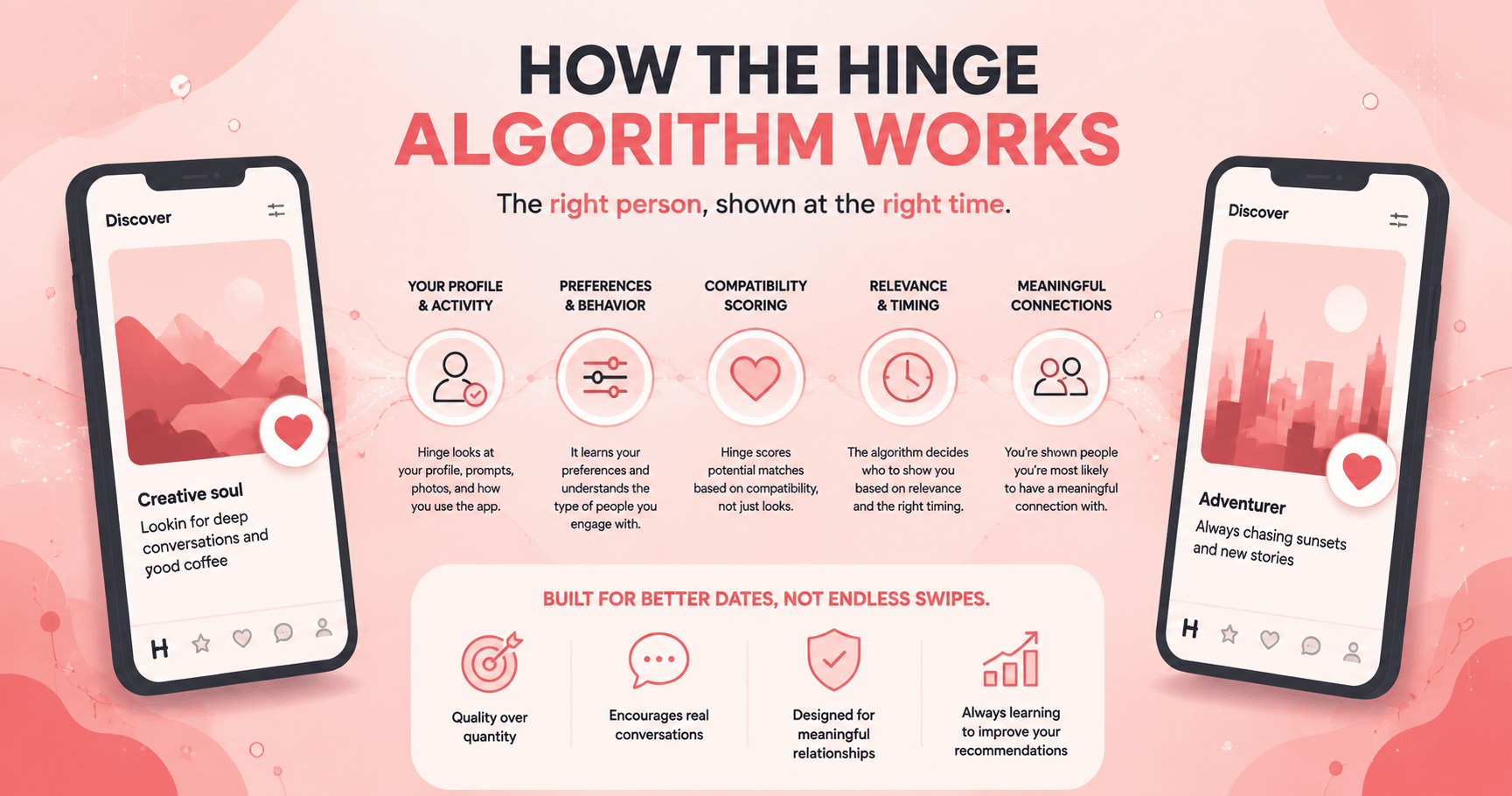

The Hinge algorithm decides who you see, who sees you, and honestly, whether your dating life feels like a grind or a genuine possibility and almost nobody who downloads the app actually understands how it works. Let’s fix that.
If you’ve ever swiped (well, tapped “like”) on someone gorgeous with a solid job and a golden retriever and heard absolutely nothing back, while your roommate with three blurry gym selfies is somehow drowning in matches, you already know something is going on behind the curtain. That something is the Hinge algorithm, and it is not random. It is not “just luck.” It’s a system, and once you get how it thinks, you can actually work with it instead of yelling at your phone at 1 a.m.
This guide is the one I wish existed when I first downloaded Hinge in college. No fluff, no “just be yourself” nonsense that doesn’t help anyone with an actual strategy. Just how the Hinge algorithm actually works, what the data says, and what you can do about it starting tonight.
So What Is the Hinge Algorithm, Actually?
Here’s where things get interesting. The Hinge algorithm isn’t trying to show you the “hottest” people in your city. It’s trying to predict mutual interest who you’ll like and who will like you back. Hinge has publicly confirmed it uses a version of the Gale-Shapley algorithm, a matching model from 1962 that later won its creators a Nobel Prize in Economics.
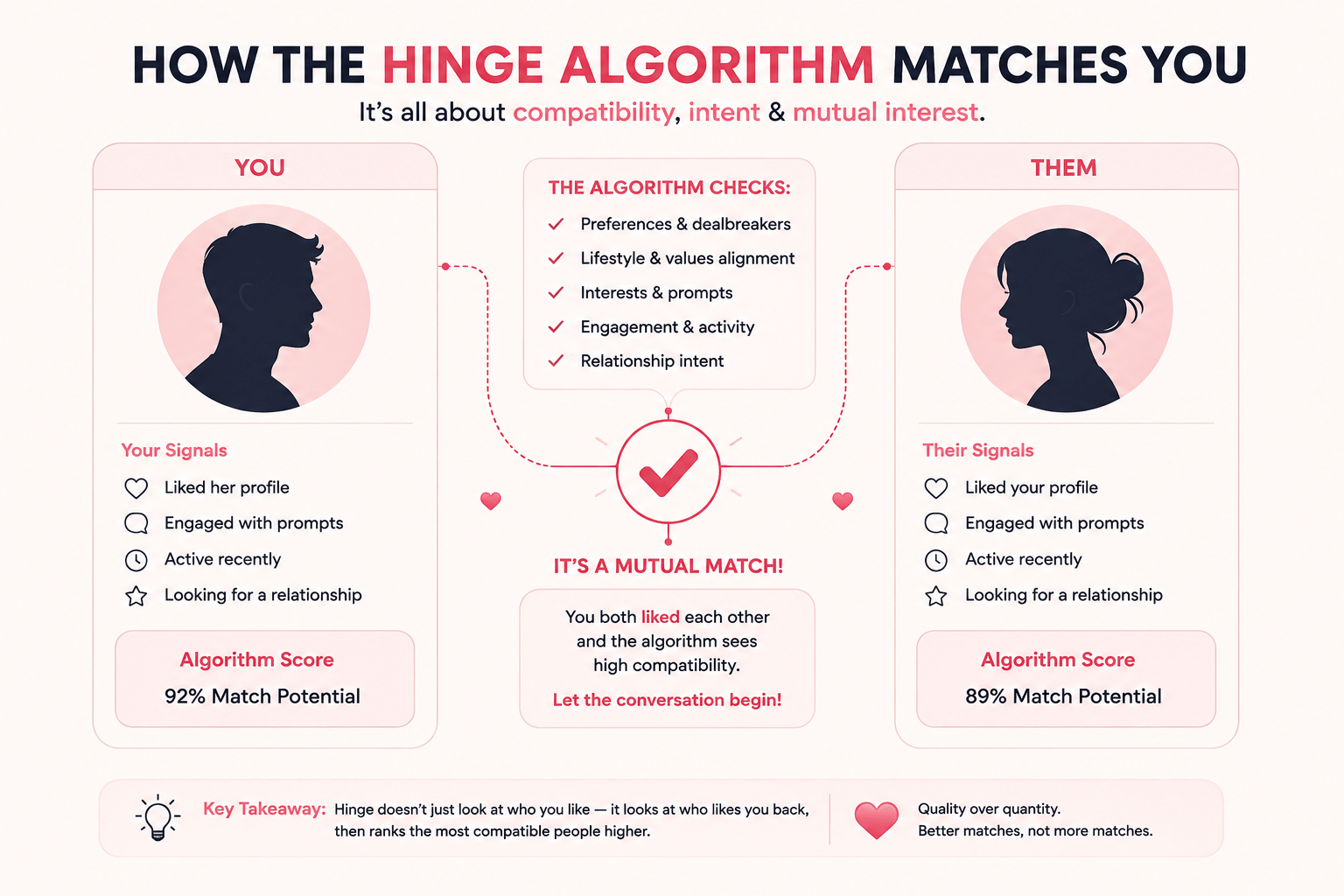
Think of it like this: Tinder is a popularity contest. Hinge is more like a really nosy matchmaker who’s been quietly taking notes on everyone you’ve ever liked, commented on, and actually messaged back.
The Nobel Prize math, in plain English: Gale-Shapley was originally built to solve the “stable matching problem” how do you pair people up so nobody keeps chasing someone who’d never choose them back? Hinge adapted it for dating: instead of showing you every single person in a 10-mile radius, the Hinge algorithm narrows the pool down to people it thinks have a realistic shot of liking you back too. This is why your Discover feed looks nothing like your friend’s, even with the same filters. The Hinge algorithm isn’t just reading your preferences it’s reading your behavior.
What it’s actually watching:
- Comments beat plain likes. The Hinge algorithm weighs a like with a comment on it way higher than a silent double-tap. Hinge’s own data says prompt likes with comments are close to twice as likely to lead to an actual date.
- Roses carry real weight. Since they’re limited to one free per week, sending one is a strong signal.
- Your recent activity matters -ghosting the app for three weeks then expecting a full inbox isn’t how this works.
- Who you actually message back matters more than who you like. The algorithm learns from follow-through, not just first impressions.
Also Read: What Are Tokens in Large Language Models? Simple Explanation with Examples if “how does the black box actually decide things” content is your thing, our AI series scratches the same itch. (internal link slug inferred, verify)
Your First 48–72 Hours Are Basically a Free Trial
Brand-new profiles get a temporary visibility boost most users see a real spike in matches during their first two to three days, which tapers off after that. The Hinge algorithm uses this window to gather data on how people respond to you, and that early data shapes how it treats your profile going forward. Don’t half-finish your profile planning to “fix it later.” Later doesn’t get the same boost.
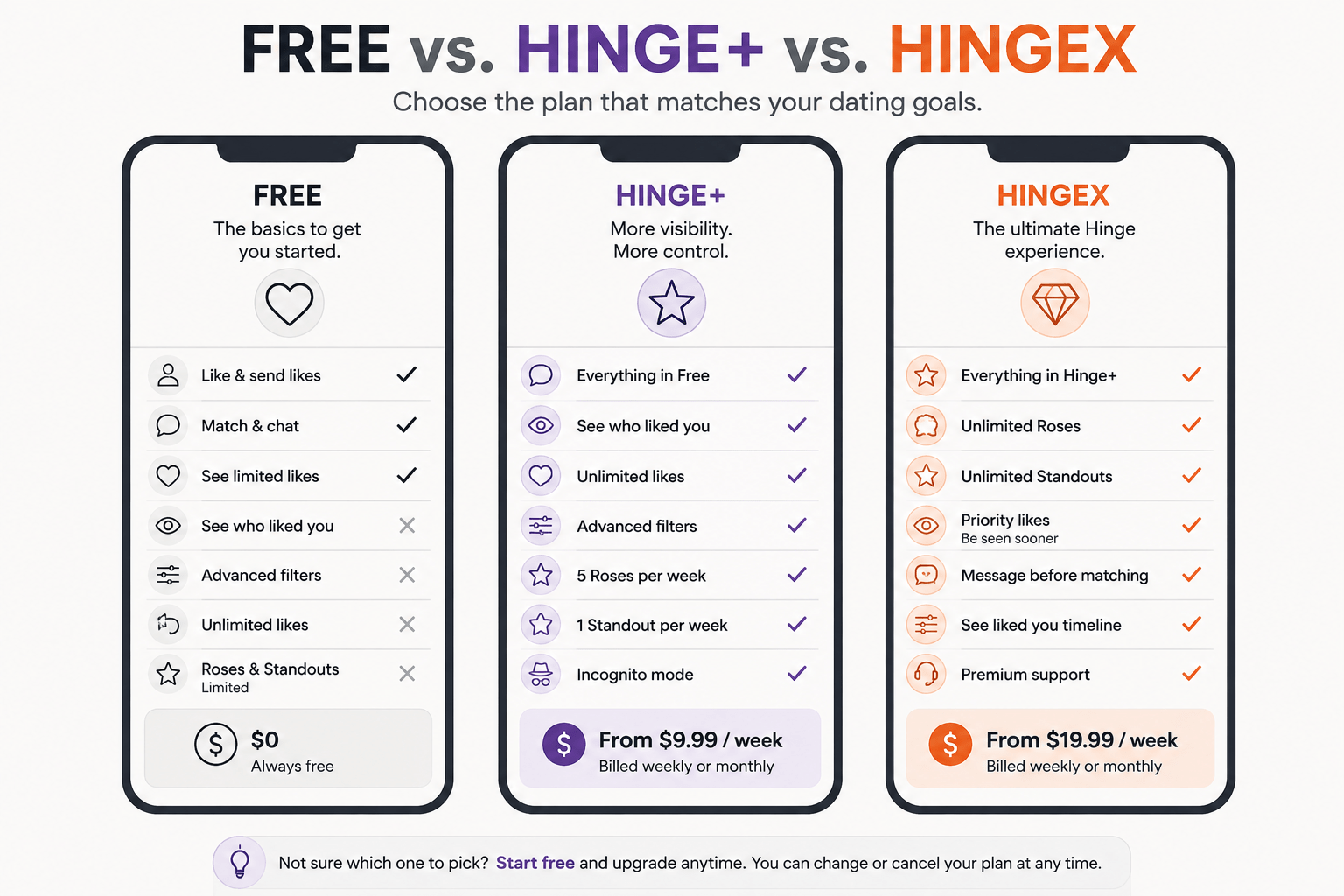
Free vs. Hinge+ vs. HingeX: What You’re Actually Paying For
Let’s be honest free Hinge caps you at a handful of likes per day (the count has shrunk over the past couple of years), resetting every 24 hours. That’s the algorithm’s way of forcing quality over spam, since it learns more from a handful of intentional likes than a hundred careless ones.
Hinge Free vs Hinge+ vs HingeX
Side-by-side comparison of Hinge subscription tiers. Compare daily likes, roses, standouts, advanced filters, and algorithm priority to pick the right plan for you.
| Feature | Free | Hinge+ | HingeX |
|---|---|---|---|
| Daily likes | Limited (~8/day) | Unlimited | Unlimited |
| Roses | 1 free/week | 1 free/week | 1 free/week + priority boost |
| Standouts access | Yes | Yes | Yes, skip-the-line placement |
| Advanced filters | No | Yes | Yes |
| Algorithm priority placement | No | No | Yes |
Neither paid tier changes how the algorithm evaluates you it changes how many chances you get and how visible those chances are. A weak profile with HingeX is still a weak profile, just shown to more people faster. Is it worth it? Only if your profile is genuinely solid and you’re just capped on volume. If your profile has real problems, fix those first the algorithm won’t compensate for a weak profile just because you’re paying.
Standouts and Roses: How They Actually Work
Standouts is a separate feed from Discover, curated by the same algorithm, just with a different filter. It shows people getting a lot of attention who still match your preferences but you can’t send a regular like here, only a Rose. Everyone gets one free Rose weekly, refreshed Sundays. It doesn’t roll over, so use it or lose it.
Honest take: Standouts profiles can feel more desirable purely because they’re gated behind a Rose. That scarcity is doing psychological work on you recognize it so you’re sending Roses out of genuine interest, not FOMO.
The Profile Checklist Almost Everyone Gets Wrong
Everything here feeds directly into how the algorithm reads your profile, so treat it as the foundation, not busywork.
Photo order actually changes swipe behavior. Your first photo does more work than the other five combined. Lead with a clear, forward-facing solo shot no sunglasses, no group photo where a stranger has to guess which one is you. Varied photo types (a close-up, a full body shot, an action shot) consistently outperform five photos that all look the same.
Why more selfies usually means fewer matches. The algorithm isn’t penalizing selfies directly, but a profile stacked with them reads as “no life outside the bathroom mirror” to actual humans, even if that’s not true. One or two is fine. Five is a red flag not because selfies are bad, but because it signals nobody was around to take a normal photo of you.
Checklist:
- Lead photo: solo, clear face, good lighting, no sunglasses
- Mix of types: one close-up, one full body, one “doing a thing”
- All three prompts filled, each doing a different job
- No blank prompts, no copy-pasted generic answers
- Recent photos nothing older than a year or two
Writing Prompts That Actually Get Comments
Hinge doesn’t really have a bio in the Tinder sense it has prompts, and they convert far better than any paragraph bio could. Prompt likes are meaningfully more likely to lead to an actual date than a photo like, and a comment beats a plain like by a wide margin. The algorithm treats comments as a much stronger signal than silent likes, which is exactly why your prompts deserve more thought than your photos.
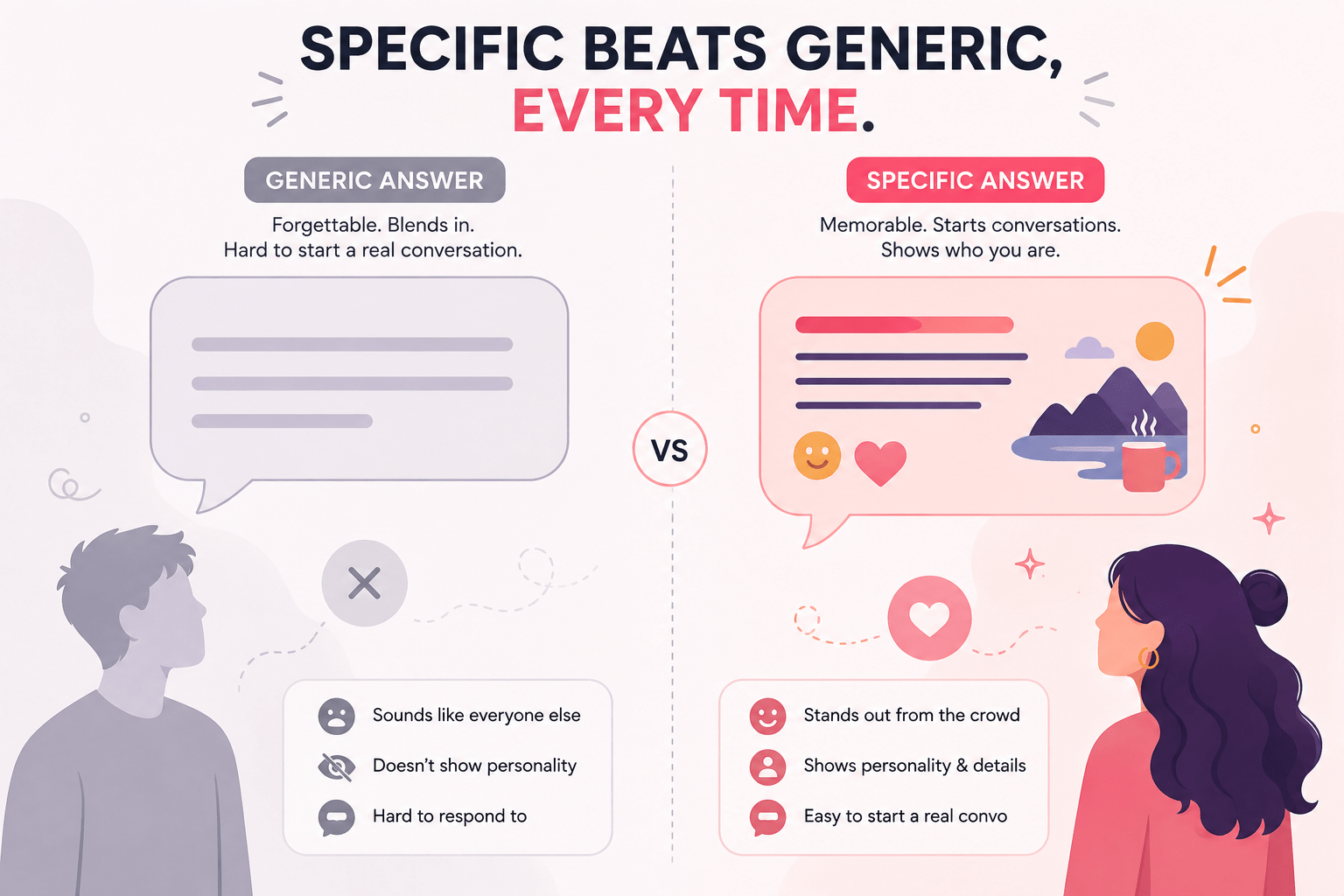
Example of a specific Hinge prompt answer versus a generic one
The three-prompt formula use your slots to do three different jobs:
- One personality/humor prompt – makes them smile, shows your vibe.
- One depth/values prompt – shows what you actually care about, not a generic “I want someone who doesn’t take life too seriously” line that’s on a third of the app.
- One conversation-starter prompt – hands them an easy, specific hook to reply to. This is the one the algorithm loves most, since it pulls in comments instead of silent likes.
Why generic prompts fail, even with great photos: “I like food” isn’t a conversation starter -everyone likes food. Swap abstractions for a proper noun and a sensory detail. “I love traveling” gets skipped. “Got stranded in a rainstorm in Udaipur and it’s still one of my best nights ever” gets a reply.
Also Read: What Is Prompt Engineering? A Practical Guide for Developers – “prompt” means something very different in our AI series, but the underlying principle (specificity beats vagueness) holds up here too. (internal link slug inferred, verify – see honesty note below)
What Men and Women Generally Look For
Women’s profile feedback tends to favor prompts revealing emotional intelligence and specific interests over pure photo-dump vibes. Men’s profile feedback tends to respond more to playful, easy-to-riff-on prompts and clear, unposed photos over heavily filtered ones. The overlap matters more than the difference: both groups reward specificity – nobody wants another “partner in crime” line, and the algorithm rewards the resulting comments either way.
First Messages and Conversation Flow
Commenting on a specific prompt beats “hey” every time – it’s not close. It tells your match you actually read their profile, and it’s the exact behavior the algorithm is designed to reward with better placement over time.
What works: referencing the specific detail in a prompt, asking a genuine follow-up, keeping the first message short.
What doesn’t: “hey” or “you’re cute” (ignored constantly, for good reason), generic appearance compliments, interview-style rapid-fire questions before any rapport exists.
Reading Green Flags, Red Flags, and Avoiding Ghosting
Green flags: specific, filled-out prompts; recent photos that actually look like the person; consistent response times; a profile that reads like an actual person wrote it – all things the algorithm also rewards with better visibility.
Red flags: every photo a group shot with no caption; prompts left blank or copy-pasted word-for-word from a “best prompts” list; conversation stalling the moment you suggest meeting up.
On ghosting: it happens, and it’s rarely about you. Match volume means plenty of conversations quietly die for reasons that have nothing to do with your worth, and no amount of studying the algorithm changes that. Follow up once if nothing comes back, move on.
Common Hinge Myths, Debunked
- “Deleting and remaking your account resets the algorithm.” It doesn’t meaningfully help, and it wastes your account’s early history.
- “Paying for HingeX guarantees better matches.” It buys visibility and volume, not a different, more flattering algorithm.
- “Attractive people always get matches.” Plenty of conventionally attractive profiles underperform because the photos are all the same angle or nothing invites a comment.
- “The algorithm is against me.” More often, the profile hasn’t given the algorithm – or another person – much to work with yet.
Planning the Actual Date (and Staying Safe)
Once conversation is flowing, don’t let it live in the app for three weeks the algorithm can only do so much once two people have matched; the rest is on you. Suggest something low-pressure and time-boundcoffee, a walk, a casual drink somewhere public, during the day if it’s a first meet.
Basic safety habits that genuinely matter: meet in public, tell a friend where you’re going and roughly when you’ll be done, use your own transportation, and trust your gut if something feels off before you’ve even met. None of this is paranoid it’s standard practice, and it’s a step the algorithm has no way to take for you.
Frequently Asked Questions
Does being active on Hinge every day actually help?
Recent activity is one signal the algorithm weighs, but not the only one. A strong, complete profile with occasional activity usually outperforms daily logins on a weak profile.
Is Hinge+ or HingeX actually worth buying?
Only if your profile is already solid and you’re specifically capped on likes or filters.
Why do I keep getting matches but no replies?
Usually it’s the opening message, not the algorithm generic openers get ignored far more than comments referencing something specific.
Do Standouts profiles show up in the regular Discover feed too?
Sometimes, but no guarantee the algorithm treats the two feeds as related but separate. That’s what the weekly free Rose is for.
Is it bad to rotate my prompts often?
No updating one every few weeks if it isn’t getting comments is a normal, low-effort way to test what actually lands.
Does Hinge notify people when they’ve been selected as a Standout?
No. The person shown in your Standouts feed has no idea they’ve been highlighted to you.
Conclusion
Once you understand how the Hinge algorithm actually works, the app stops feeling like a black box. It isn’t rigged against you it’s just reading signals most people never bother to send clearly: specific prompts, comments instead of silent likes, photos that actually show who you are. Fix those, and it has something real to work with. Go update one prompt tonight and see what happens.