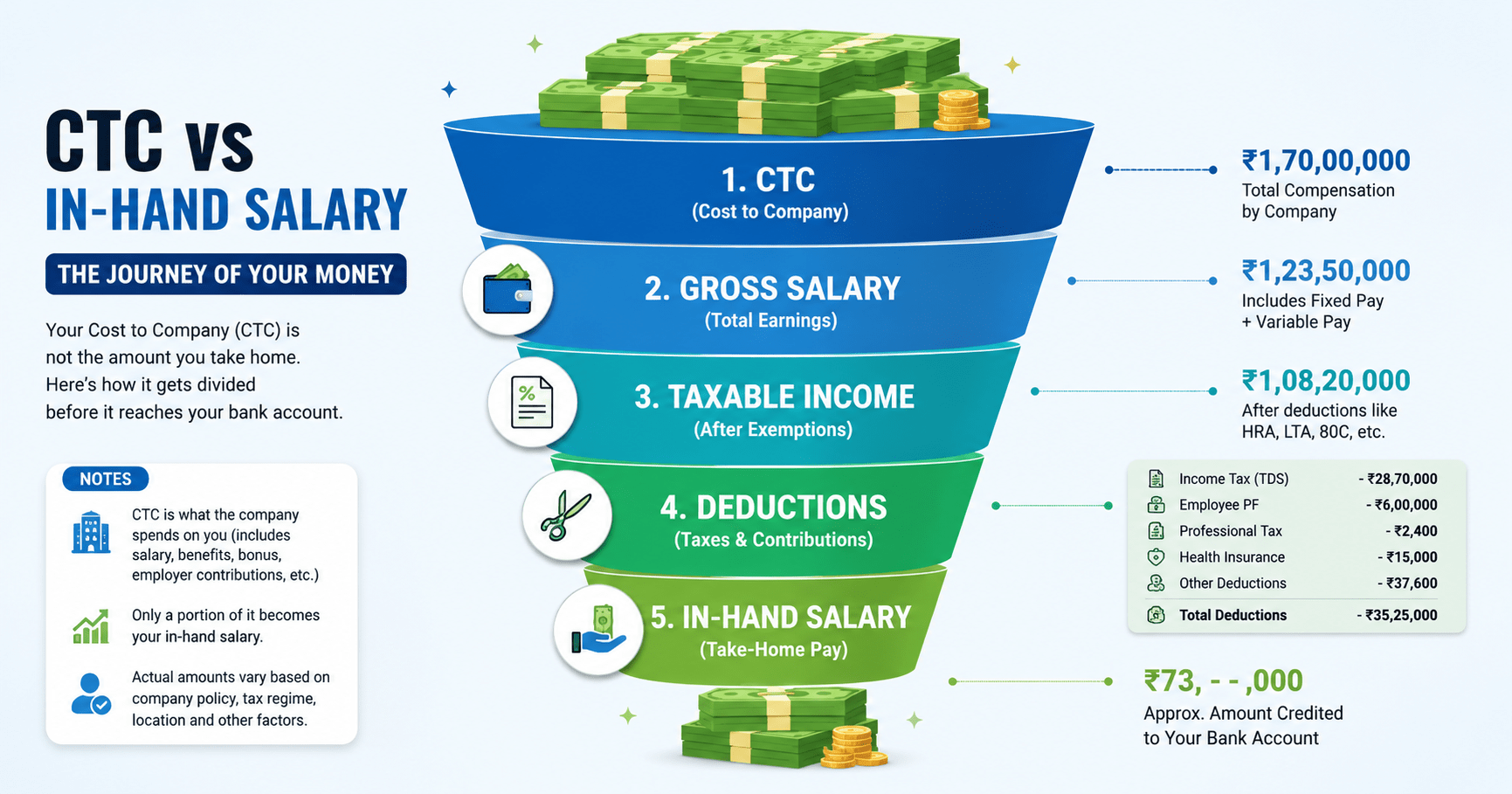

Your in-hand salary is almost never the number printed on your offer letter, and that gap catches even experienced developers off guard. A recruiter tells you the CTC is ₹1.7 crore, you do the math in your head, and you picture a certain amount landing in your bank account every month. Then the first payslip arrives, and the number looks nothing like what you expected.
This is not a mistake by your HR team. It is how Indian compensation packages are built. CTC, or Cost to Company, is the total amount a company spends on you in a year not the amount you spend. Your actual in-hand salary is what is left after tax, provident fund, and a handful of other deductions have already been taken out.
Let us break this down properly, using a realistic ₹1.7 crore CTC example, so you know exactly where every rupee goes before you sign your next offer letter.
What Is CTC, and Why Doesn’t It Match Your In-Hand Salary?
CTC stands for Cost to Company. It is the sum total of everything a company spends on employing you for one year your fixed pay, your bonus, employer contributions to your retirement fund, insurance premiums, and even equity like ESOPs or RSUs if the company offers them. None of this guarantees a matching in-hand salary.
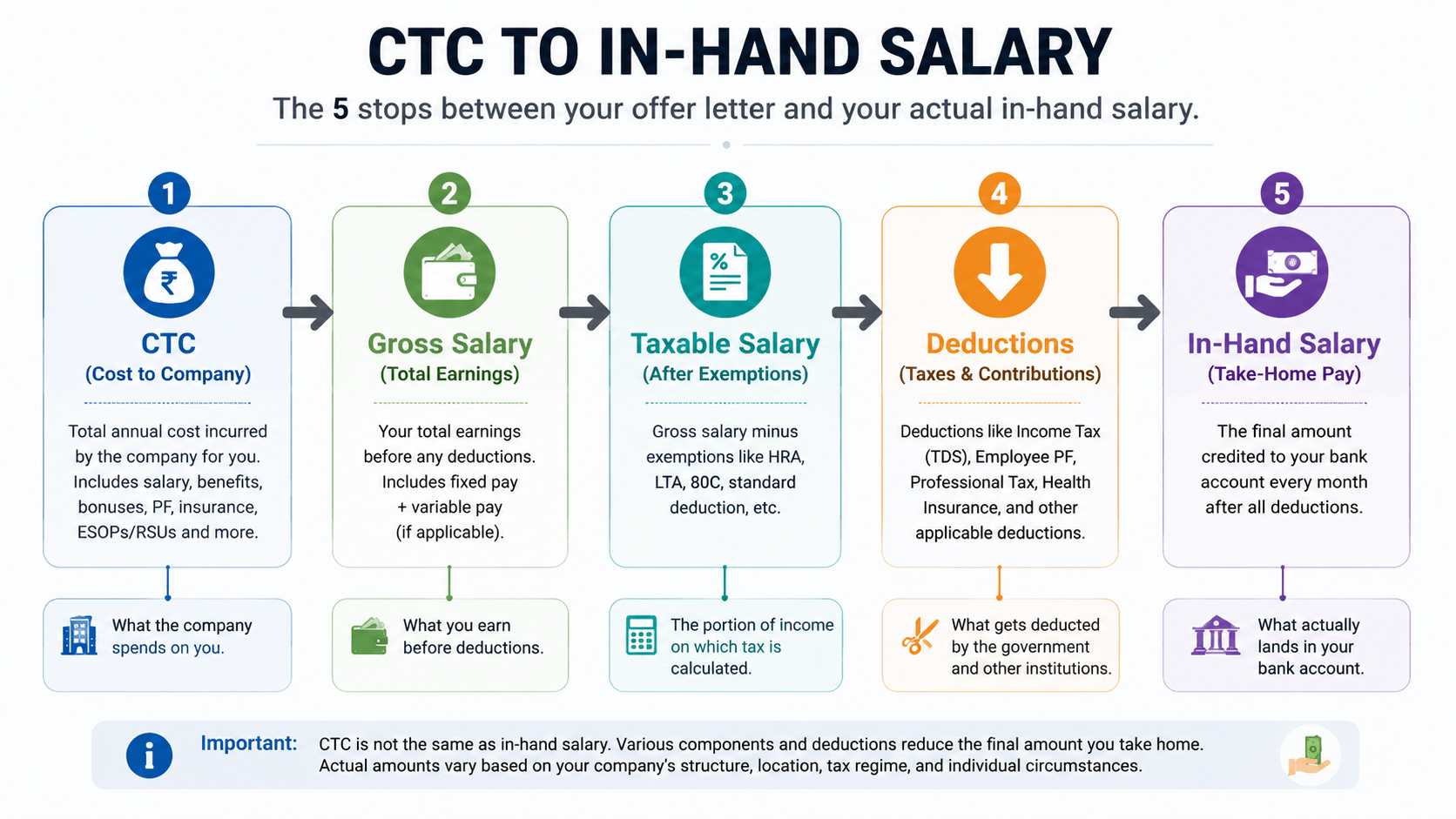
Your in-hand salary, on the other hand, is the amount that actually lands in your bank account after every deduction. Between these two numbers sit several intermediate stops: gross salary, taxable salary, and net salary. Each one strips away a bit more.
Also Read: If you’re weighing a full-time developer role against going independent, our guide on freelancing as a developer in India covers how income predictability changes outside a fixed CTC structure.
Here is the simplified flow every salaried employee should understand:
CTC → Gross Salary → Taxable Salary → Deductions → Net (In-Hand) Salary
- CTC includes your cash pay plus everything the company spends on you that never touches your bank account.
- Gross salary is your cash pay before any deductions basic, HRA, allowances, and bonus.
- Taxable salary is gross salary minus the standard deduction and any exemptions you’re eligible for.
- Net or in-hand salary is what remains after income tax, your own PF contribution, and professional tax are deducted.
Company practices differ, so always confirm with HR exactly which of these components apply to your specific offer.
The Salary Terms You Need to Know
Before we get to the numbers, here are the terms that show up on almost every Indian offer letter and that ultimately decide your in-hand salary:
- Fixed CTC – the guaranteed portion of your package: basic salary, HRA, and fixed allowances.
- Variable Pay / Performance Bonus – a portion tied to individual or company performance, paid quarterly or annually, not guaranteed.
- Joining Bonus – a one-time payment for accepting an offer, sometimes with a clawback clause if you leave early.
- Retention Bonus – paid to encourage an employee to stay for a defined period.
- Basic Salary – the core pay component that most other calculations (PF, gratuity) are based on.
- HRA (House Rent Allowance) – an allowance meant to offset rent; it carries tax exemptions only under the old tax regime.
- Special Allowance – a flexible, fully taxable component used to balance out the CTC.
- Employer PF Contribution – the company’s share toward your retirement fund, usually 12% of basic salary, deposited with the Employees’ Provident Fund Organisation.
- Employee PF Contribution – your own matching share, deducted from your gross pay before it reaches your account.
- Gratuity – a statutory long-term benefit paid out after five years of continuous service with the same employer, governed by the Payment of Gratuity Act.
- Professional Tax – a small state-level tax deducted monthly, varying by state.
- Income Tax / TDS – tax deducted at source from your salary every month, based on your projected annual income.
- ESOPs (Employee Stock Options)– the right to buy company shares at a fixed price after a vesting period.
- RSUs (Restricted Stock Units) – actual company shares granted to you, released gradually as they vest.
- Gross Salary – total cash pay before deductions.
- Net / Take-Home / In-Hand Salary = what actually reaches your bank account.
Some companies also label components differently, so treat this as a general map rather than a fixed template. Whichever labels your company uses, the same question applies: does this component add to your take-home pay this year, or not?
Also Read: Forward Deployed Engineer: Roles, Skills, Career Path, Tools and Roadmap
A ₹1.7 Crore CTC, Fully Broken Down
Let’s make this concrete. Below is an illustrative compensation structure for a senior tech employee with a ₹1.7 crore CTC, showing exactly which rows feed your in-hand salary and which don’t. The exact percentages will vary by company, role, and city this is one realistic way such a package could be structured, not a universal formula.
| Component | Illustrative Annual Amount | What It Actually Means |
|---|---|---|
| Fixed Pay (Basic + HRA + Allowances) | ₹1,08,00,000 | Cash paid monthly, fully guaranteed |
| Performance Bonus (target) | ₹12,00,000 | Cash, tied to performance, not guaranteed in full |
| Employer PF Contribution | ₹5,18,000 | Goes into your PF account, not your bank account |
| Gratuity Provision | ₹2,08,000 | Accrues yearly, paid only after 5 years of service |
| Health/Life/Accident Insurance | ₹45,000 | Employer-paid premium, a benefit, not cash |
| Other Benefits (meals, internet, LTA, wellness) | ₹1,80,000 | Reimbursements or perks, not direct salary |
| RSUs (annualized, vesting over 4 years) | ₹40,49,000 | Equity value at grant, not guaranteed cash |
| Total CTC | ₹1,70,00,000 | The number on the offer letter |
Notice that only the first two rows fixed pay and bonus are cash that can ever become in-hand salary in a given year, and even the bonus isn’t guaranteed. That’s already less than 71% of the CTC before a single rupee of tax is deducted, and tax is what shrinks it down further next.
Where Does Your ₹1.7 Crore CTC Actually Go?
This is the section most job seekers skip, and it’s the one that matters most for understanding your real in-hand salary. Here’s the path your ₹1.70 Cr CTC takes before any of it becomes usable in-hand salary:
₹1.70 Cr CTC → Remove RSUs, employer PF, gratuity, insurance, and other benefits (₹49.51 lakh none of this is cash this year) → ₹1.20 Cr gross cash salary (fixed pay + bonus) → Minus ₹75,000 standard deduction → ₹1.19 Cr taxable income → Minus income tax, surcharge, and cess (~₹37.76 lakh, calculated below) → Minus employee’s own PF contribution (₹5.18 lakh) and professional tax → Approximately ₹77 lakh net annual in-hand salary, or about ₹6.4 lakh in-hand per month
Your Real In-Hand Salary, Month by Month
Spread across twelve months, that ₹77 lakh in-hand salary works out to roughly ₹6.4 lakh landing in the bank every month a very different mental picture from “₹1.7 crore package,” even though both numbers describe the same job offer.
That means roughly 45% of the ₹1.7 crore CTC becomes cash you actually receive this year. The rest sits in RSUs vesting over four years, a PF account you can’t touch until you leave or retire, a gratuity payout five years away, and benefits that never appear in your bank statement at all. This is the single biggest reason your CTC and your in-hand salary will never be the same number.
How the Tax Actually Works (FY 2026–27)
Assumptions used in this section: Financial Year 2026–27, new tax regime (the default regime for most salaried employees unless you actively opt for the old one), resident individual, no additional income sources, and the ₹1.7 Cr CTC structure above. Change any of these and your actual in-hand salary will change too tax is the single biggest lever between CTC and in-hand salary for anyone at this income level.
Under the new regime, the slab rates for FY 2026–27 are:
| Taxable Income Slab | Tax Rate |
|---|---|
| Up to ₹4,00,000 | Nil |
| ₹4,00,001 – ₹8,00,000 | 5% |
| ₹8,00,001 – ₹12,00,000 | 10% |
| ₹12,00,001 – ₹16,00,000 | 15% |
| ₹16,00,001 – ₹20,00,000 | 20% |
| ₹20,00,001 – ₹24,00,000 | 25% |
| Above ₹24,00,000 | 30% |
Salaried employees also get a flat ₹75,000 standard deduction, and a Section 87A rebate wipes out tax completely for taxable income up to ₹12 lakh. Neither applies once your income is as high as our example, but they matter enormously for early-career and mid-career developers.
For our ₹1.7 Cr example, only the cash components fixed pay and bonus, totaling ₹1.20 crore count as taxable salary in the current year (RSUs are taxed separately, at vesting, as a perquisite). After the standard deduction, taxable income works out to ₹1,19,25,000.
Running that through the slabs gives roughly ₹31.58 lakh in tax before surcharge. Because taxable income falls between ₹1 crore and ₹2 crore, a 15% surcharge applies on top of that (the new regime caps surcharge at 25%, and only above ₹2 crore it never reaches the old regime’s 37% peak). Add 4% cess on top of tax-plus-surcharge, and total tax liability lands at roughly ₹37.76 lakh for the year.
That single line item tax is bigger than most people’s entire annual in-hand salary, and it’s the biggest reason a ₹1.7 Cr CTC doesn’t translate into ₹1.7 Cr of usable cash or a matching in-hand salary.
A few things worth knowing about the old vs. new regime:
- The new regime is the default from FY 2025–26 onward, with lower rates but almost no deductions (no 80C, no HRA exemption).
- The old regime allows deductions like 80C (up to ₹1.5 lakh), 80D (health insurance), and HRA exemption, but at higher slab rates.
- Which one saves you more tax and leaves you with a higher in-hand salary depends entirely on how much you can actually claim in deductions; there’s no universal answer.
- Always confirm current slabs directly on the Income Tax Department’s official portal before filing, since rules can change with each Budget.
ESOPs and RSUs: Why the Headline Equity Number Isn’t Cash
High CTC offers at tech companies almost always include some form of equity. It’s the part of the offer letter that inflates the headline number the most, without adding a single rupee to this year’s in-hand salary and the part most likely to be misunderstood.
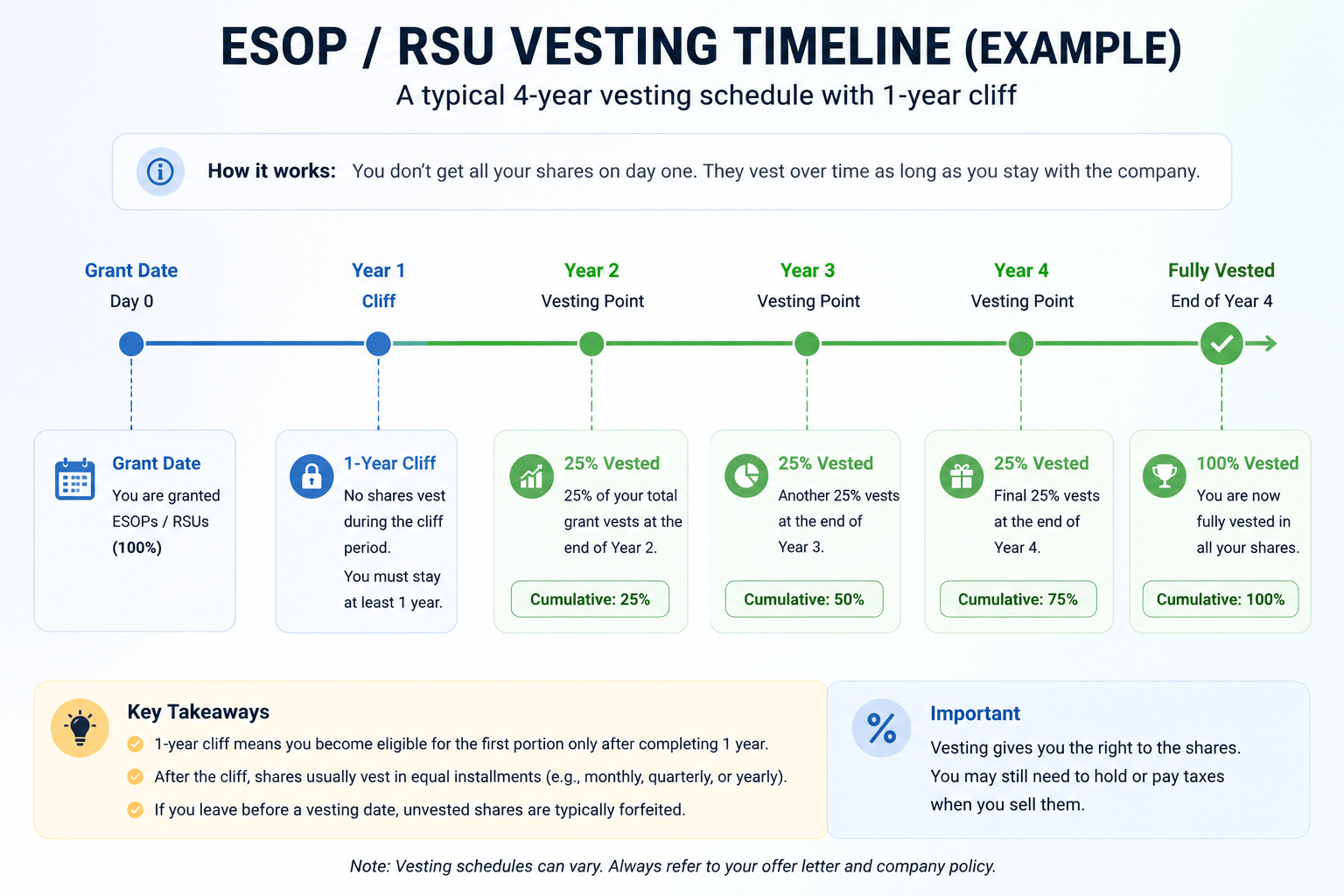
ESOPs (Employee Stock Options) give you the right, not the obligation, to buy company shares at a fixed “exercise price” after a waiting period. Key terms:
- Grant – the date and quantity of options you’re promised.
- Vesting the schedule over which you earn the right to exercise your options, commonly spread over 4 years.
- Cliff – an initial waiting period (often 1 year) before any options vest at all.
- Exercise Price -the fixed price you pay to convert options into actual shares.
- If you leave before your cliff, you typically walk away with zero ESOP value and zero impact on your in-hand salary, regardless of what your offer letter listed.
RSUs (Restricted Stock Units) are simpler in one way and riskier in another: the company grants you actual shares, but you only receive them as they vest, and their value moves with the stock price. Even after vesting, RSUs typically need to be sold before they turn into anything resembling in-hand salary.
If an offer says ₹1.7 Cr CTC = ₹52 Lakh fixed and bonus + ₹1.1 Cr RSUs, do not read that as ₹1.7 Cr in cash. The RSU portion is typically spread over four years, so a ₹1.1 Cr grant does not mean ₹1.1 Cr this year it might mean roughly ₹27.5 lakh vesting annually, and even that figure moves if the stock price rises or falls before each vesting date. ₹1.1 Cr RSUs over 4 years is not ₹1.1 Cr cash today, and annualizing it further only makes sense once the exact vesting schedule is confirmed in writing.
Health Insurance and Other Employee Benefits
Companies bundle several non-cash benefits into CTC because they genuinely cost the company money, even though none of it becomes in-hand salary and none of it changes your monthly bank credit:
- Group health insurance for you and dependents
- Life and accidental death insurance
- Meal cards or food allowances
- Internet and phone reimbursements
- Learning and development budgets
- Company-provided laptops or equipment
- Relocation assistance
A benefit worth ₹40,000 a year inside your CTC does not mean ₹40,000 in extra in-hand salary it means the company is covering an expense you would otherwise pay for yourself. That’s real value, but it’s a different kind of value than in-hand salary, and it’s worth knowing the difference when you compare two job offers.
Fixed Pay vs. Variable Pay: Why Two Equal CTCs Can Feel Very Different
Two offers with an identical CTC can produce very different in-hand salary every month, depending on how much of that CTC is fixed versus variable.
| Factor | Fixed Pay | Variable Pay |
|---|---|---|
| Predictability | High — paid regardless of performance | Depends on individual or company results |
| Payment Frequency | Every month | Usually quarterly or annual |
| Impact on Monthly Budgeting | Easy to plan around | Harder to plan around |
| Typical Share of CTC | Core compensation | Supplementary |
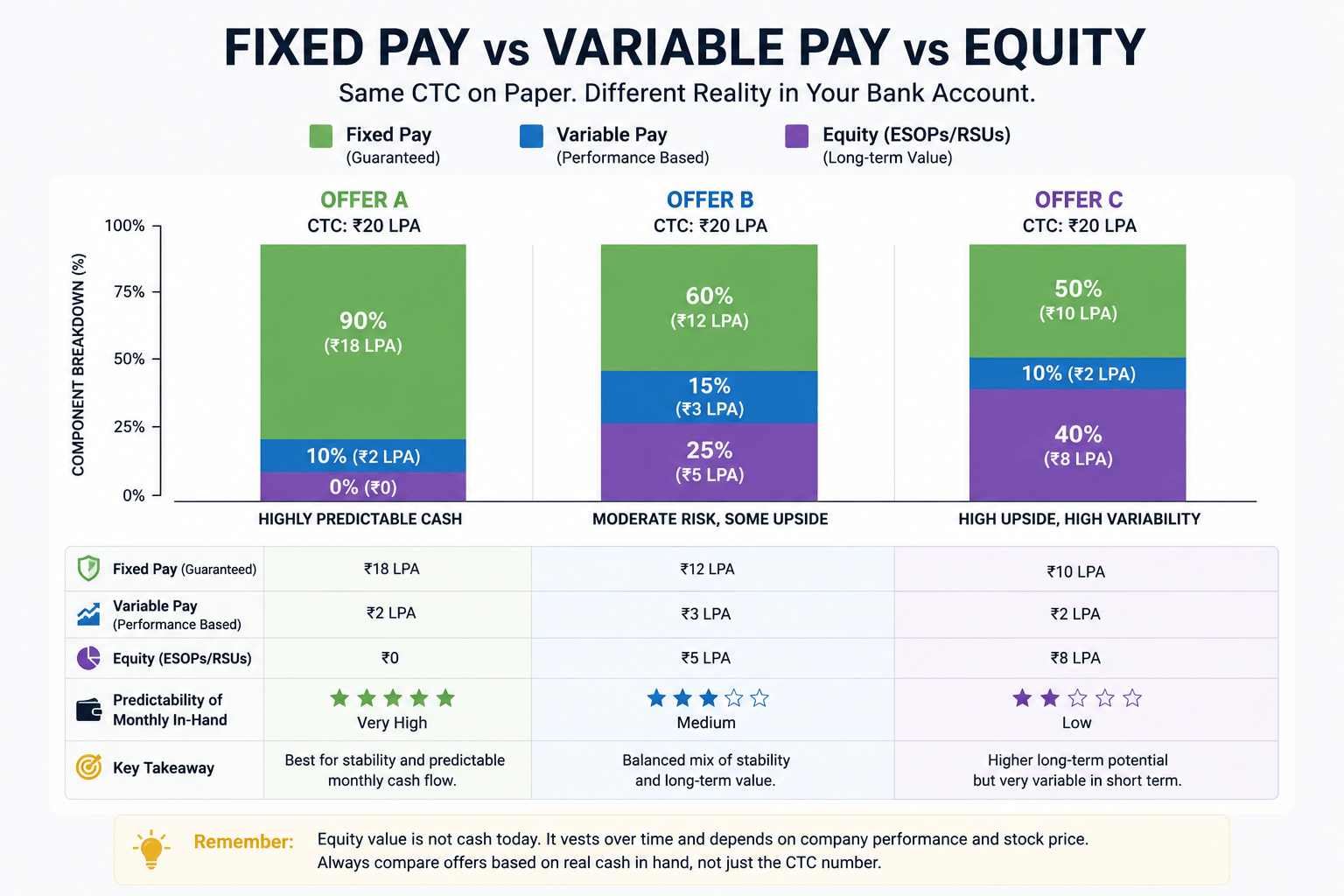
Example: Offer A pays ₹20 LPA with ₹18 LPA fixed. Offer B also pays ₹20 LPA, but only ₹10 LPA is fixed, with the remaining ₹10 LPA as variable pay. On paper, both offers list the same CTC but Offer B leaves your in-hand salary far more exposed if targets aren’t hit, or if company performance dips. Don’t treat two identical CTC numbers as equivalent without checking the fixed-to-variable split and what it does to your in-hand salary.
How to Read a Salary Offer Letter
Before accepting any offer, go through the letter line by line and confirm exactly what feeds your in-hand salary and what doesn’t:
- Total CTC – the full number being advertised.
- Fixed compensation – how much is guaranteed monthly.
- Variable compensation – the target amount, and the conditions to actually earn it.
- Bonus structure – joining, retention, or performance-linked, and any clawback terms.
- Employer PF contribution -onfirm it’s calculated correctly on your basic salary.
- Gratuity – check it’s included as per statutory rules, not inflated.
- Insurance and benefits – what’s covered, for whom, and at what value.
- ESOP/RSU allocation – the number of units or grant value, and the vesting schedule.
- Vesting schedule c-liff period and annual vesting percentage.
- Taxable components – which parts of your CTC will actually be taxed, and when.
- Employee deductions – PF, professional tax, and any other recurring deductions.
- Notice period and bond conditions, if any.
- Clawback clauses on joining or retention bonuses.
Also Read: For a broader look at evaluating a role beyond just the number on the offer, our tech stack selection guide for job seekers walks through how to weigh a job offer holistically.
Never compare two offers using the CTC figure alone. Instead, compare:
Fixed cash + realistic variable pay + equity value + benefits + tax impact + career upside.
Comparing Offers That Look the Same on Paper
Here’s how three offers with different structures can look similar in CTC but produce very different in-hand salary in your bank account:
| Offer | CTC | Fixed | Variable | Equity | What This Means |
|---|---|---|---|---|---|
| A | ₹20 LPA | ₹18 LPA | ₹2 LPA | ₹0 | High predictable in-hand salary every month |
| B | ₹20 LPA | ₹12 LPA | ₹3 LPA | ₹5 LPA | More upside, but more of your in-hand salary depends on conditions |
| C | ₹20 LPA | ₹10 LPA | ₹2 LPA | ₹8 LPA | Largest long-term equity bet, smallest guaranteed cash |
These are illustrative structures, not universal industry patterns always request the actual breakup in writing before comparing.
Conclusion: Ask This Before You Compare Any Two Offers
The number a recruiter calls your CTC is the company’s total compensation cost it is not necessarily the amount that lands in your bank account. As we’ve walked through with the ₹1.7 crore example, taxes, employer contributions, gratuity, insurance, and equity vesting schedules all sit between the offer letter and your actual in-hand salary.
The next time you’re comparing job offers, skip the CTC-to-CTC comparison entirely. Instead, ask one question: how much of this CTC is actually fixed cash, how much is variable, how much is equity, and how much goes toward employer-paid benefits and statutory contributions?
That single question will tell you more about your real in-hand salary than any headline CTC number ever will.
Frequently Asked Questions
Does a higher CTC always mean a higher in-hand salary? Not necessarily. A CTC loaded with equity, bonuses, and benefits can produce a lower in-hand salary than a smaller CTC that’s mostly fixed pay. Always check the fixed-to-variable ratio before assuming a bigger CTC means a bigger in-hand salary.
Why is my in-hand salary so much lower than my CTC? Because CTC includes employer PF contributions, gratuity, insurance premiums, and sometimes equity none of which are cash paid into your account. Income tax, your own PF contribution, and professional tax reduce your in-hand salary further.
Is the ₹1.7 Cr example the same for every company? No. This is one illustrative structure, and your own in-hand salary calculation will look different. Actual CTC breakups vary by company policy, role, city, and whether benefits or equity are included at all.
Should I choose the old or new tax regime? It depends on how much you can claim in deductions under the old regime (80C, 80D, HRA). If your deductions are small, the new regime’s lower slab rates usually produce a higher in-hand salary. Run both calculations before deciding.
What happens to my ESOPs or RSUs if I leave the company early? Typically, you lose any unvested ESOPs or RSUs, and neither ever reaches your in-hand salary. Vested ESOPs may still need to be exercised within a limited window after you leave check your company’s specific policy.
Is gratuity paid every year like a bonus? No. Gratuity accrues each year as a provision but never appears in your monthly in-hand salary it’s only paid out as a lump sum after you complete five years of continuous service (with some exceptions), or when you leave after becoming eligible.