
Python for AI is the default choice for machine learning teams in 2026, and if you’re a JavaScript or TypeScript developer wondering why, the short answer isn’t about raw interpreter speed. CPython is dynamically typed, interpreted, and slower line-for-line than V8 or a JVM. Yet almost every large language model you’ve used, from GPT-style transformers to open-weight models on Hugging Face, was trained and served through a Python codebase.
That contradiction is the whole story. Python for AI works not because the language itself is fast, but because Python acts as a thin, elegant control layer sitting on top of compiled C, C++, Rust, and CUDA engines that do the actual math. In this post, we break down the architecture behind that split, compare it against how Node.js handles native bindings, and walk through a real benchmark showing the size of the gap.
Also Read: Forward Deployed Engineer: Roles, Skills, Career Path, Tools and Roadmap
The Core Paradox: A Slow Interpreter Running Ultra-Fast Compute
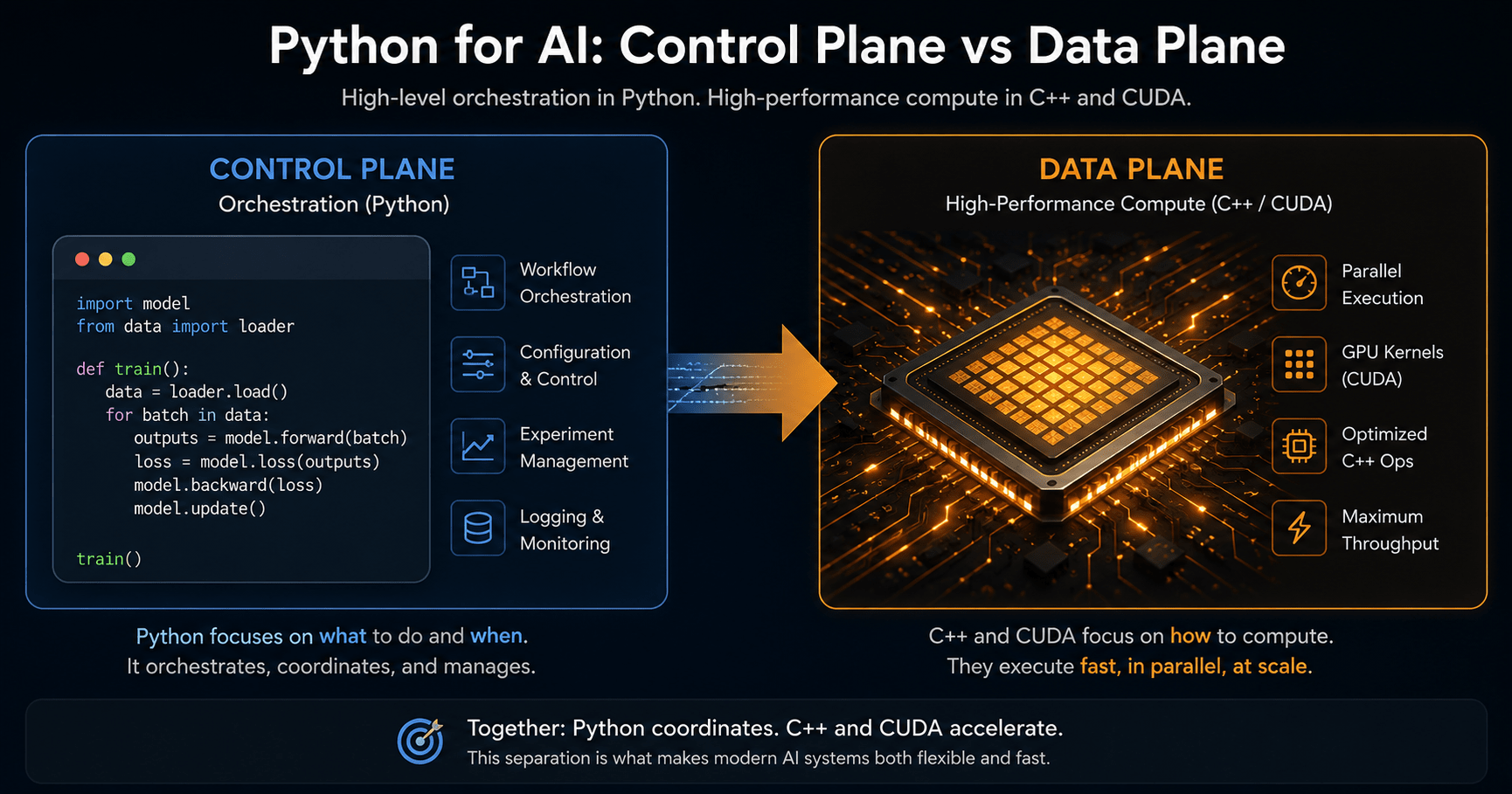
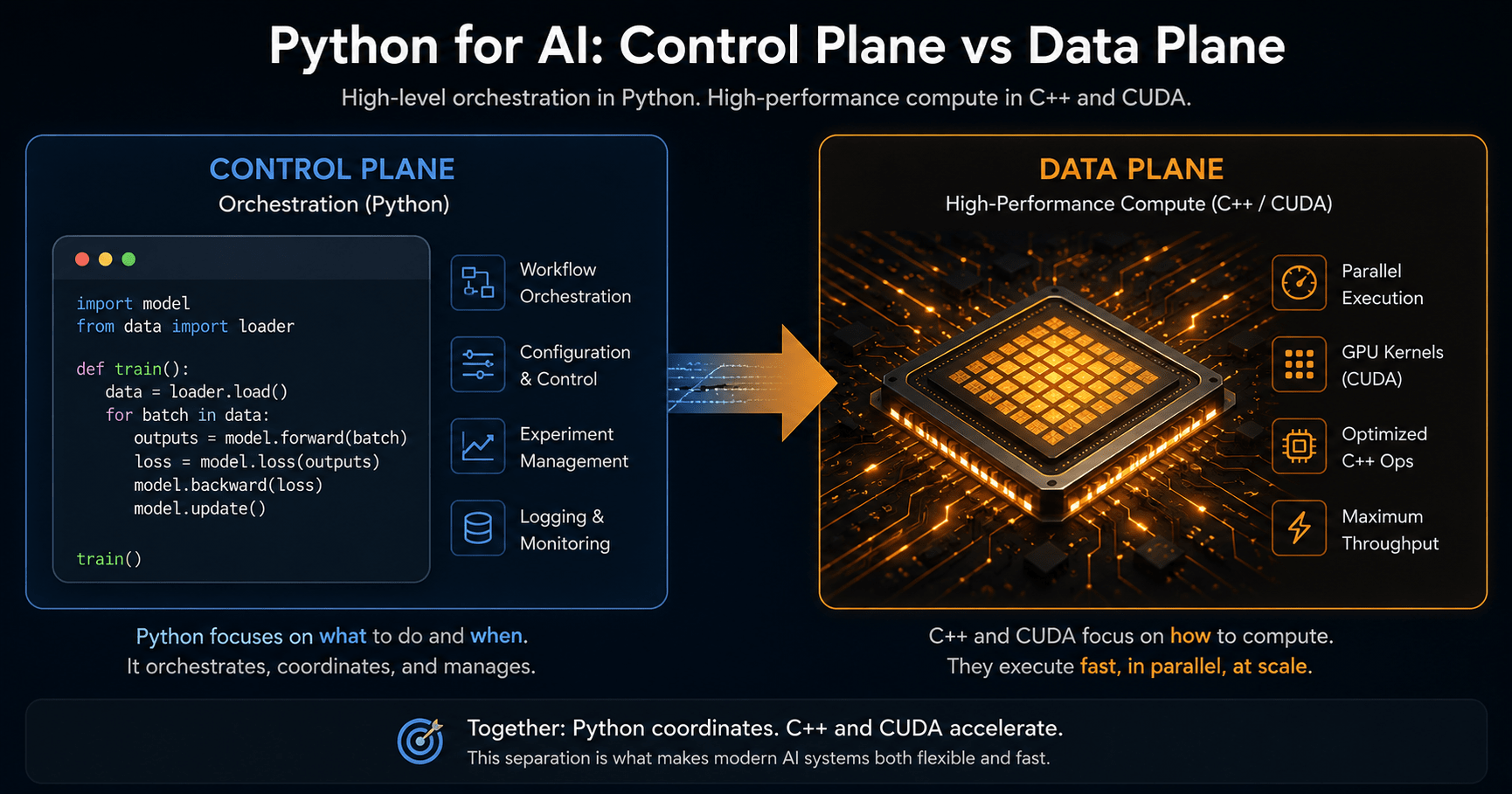
To understand Python for AI, separate two layers: the control plane that orchestrates your code, and the data plane that does the math.
The control plane is plain Python readable, dynamically typed, and easy to iterate on. This split is the reason Python for AI reads simply while still running at hardware speed underneath. The data plane is native code: C, C++, Rust, and CUDA extensions like ATen, LibTorch, and cuBLAS, plus SIMD-vectorized CPU instructions (AVX-512, ARM NEON). When you write PyTorch code like this:
python
import torch

# This line runs in Python (control plane)
x = torch.randn(4096, 4096, device="cuda")
y = torch.randn(4096, 4096, device="cuda")

# Execution drops into C++/CUDA (data plane)
z = torch.matmul(x, y)
the interpreter only issues a command. The floating-point work happens inside compiled CUDA kernels running on thousands of GPU cores, never inside Python bytecode.
How C/C++ Bindings Let Python Bypass Its Own GIL
CPython’s C API and PyBind11
Python was built from day one with a clean C extension API. Libraries use tools like PyBind11 or Cython to expose native C++ classes as Python modules with close to zero overhead.
Node.js has an equivalent path through N-API and V8 addons, but it has historically involved more abstraction, more breakage across V8 releases, and extra garbage-collection overhead crossing the JS runtime boundary. That gap in binding ergonomics is one reason the scientific Python ecosystem grew so much faster than its JavaScript counterpart.
Releasing the GIL: How Python for AI Gets Real Parallelism
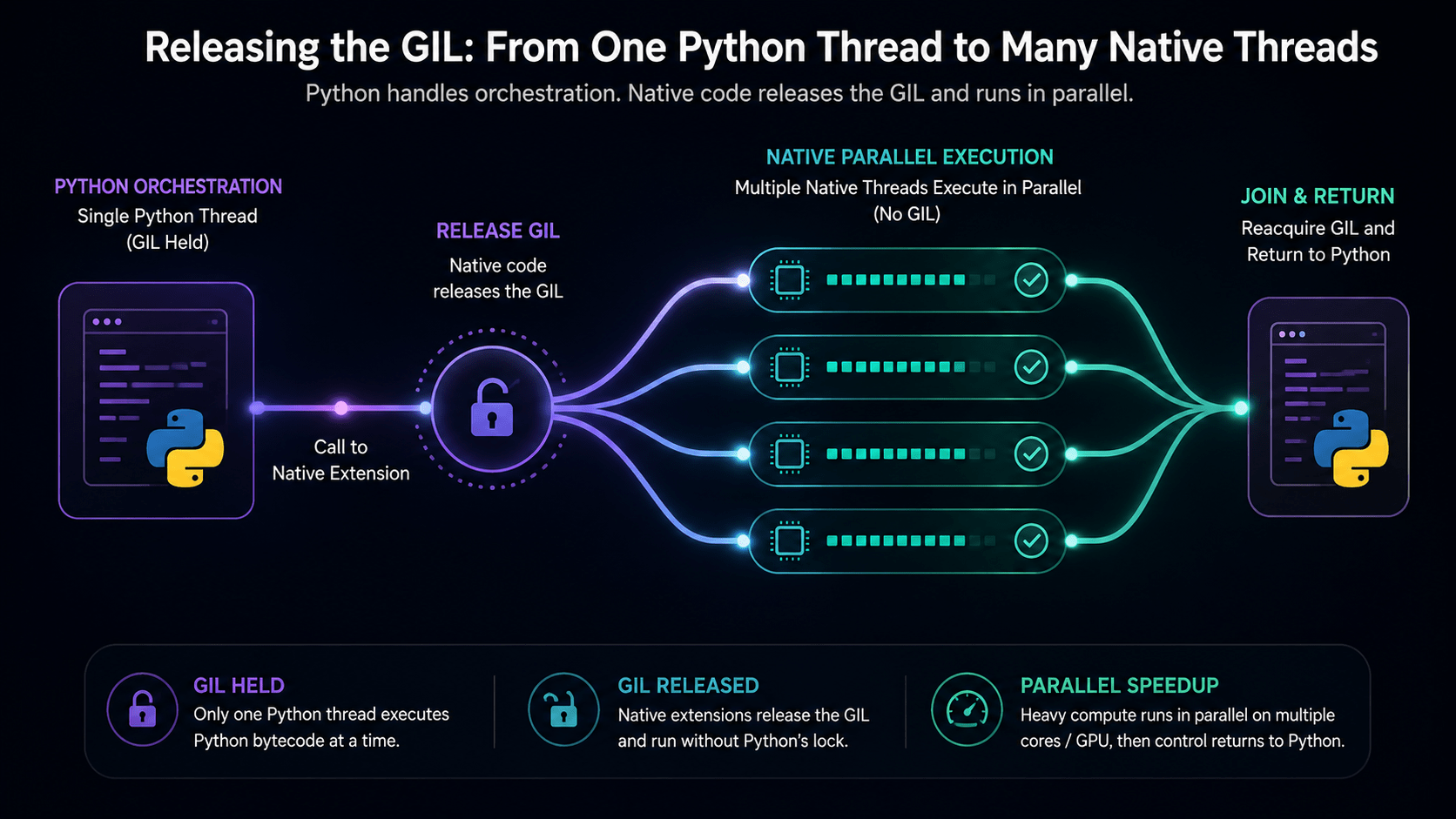
The Global Interpreter Lock (GIL) is Python’s most-criticized feature it stops multiple threads from running Python bytecode at the same time. For AI workloads, though, it barely matters:
- A C extension like PyTorch or NumPy calls
Py_BEGIN_ALLOW_THREADSbefore starting heavy numerical work. - That releases the GIL, letting native C++ worker threads or CUDA streams run in true parallel across CPU cores and the GPU.
- Once the calculation finishes, the native code re-acquires the GIL and hands control back to Python.
Your Python script stays single-threaded at the orchestration level. The actual computation never was and that handoff is the core mechanic that makes Python for AI workloads practical in the first place.
Hardware Acceleration: SIMD on CPU, CUDA on GPU
AI workloads are dominated by linear algebra matrix multiplication, dot products, tensor convolutions applied identically across millions of numbers at once. That’s exactly the kind of workload specialized hardware was built for, and it’s the second reason Python for AI scales past what a pure interpreter could ever do alone.
CPU SIMD Vectorization
Modern CPUs carry Single Instruction, Multiple Data (SIMD) registers such as Intel AVX-512 or ARM NEON. Instead of processing one float per cycle, a single instruction can process 16 floats at once. Python’s numerical stack links against BLAS implementations like OpenBLAS, Intel MKL, or Apple Accelerate to use that hardware fully.
GPU CUDA and Tensor Cores
NVIDIA GPUs add thousands of CUDA cores plus dedicated Tensor Cores built for mixed-precision matrix math (FP16, BF16, INT8), all exposed through the CUDA Toolkit.
| Compute Unit | Core Count | Strength |
|---|---|---|
| CPU (Intel/AMD) | 8–64 high-clock cores | Sequential logic, branching, deep caches |
| GPU (NVIDIA) | 10,000+ CUDA cores | Massively parallel tensor math |
PyTorch and TensorFlow link directly against CUDA, cuDNN, and cuBLAS. When your Python script calls a neural network layer, the actual work runs as hand-tuned CUDA kernels on the GPU, not as Python instructions.
Why Python for AI Beat JavaScript and Java
| Factor | Python | JavaScript / Node.js | Java |
|---|---|---|---|
| Execution model | High-level orchestrator over C/C++/CUDA | V8 JIT built for the web event loop | JVM bytecode + JIT |
| Native binding ergonomics | Excellent (C API, ctypes, PyBind11) | Complex (N-API, node-gyp) | Verbose (JNI, Foreign Function API) |
| Scientific ecosystem age | 30 years (NumPy, SciPy, BLAS) | Recent, fragmented (TensorFlow.js) | Enterprise-analytics focused |
| GPU/CUDA support | First-class, native | WebGL/WebGPU abstraction layers | Fragmented native wrappers |
| Research adoption | Dominant (PyTorch, Hugging Face) | Secondary (ONNX web runtime) | Legacy enterprise use |
V8 was built to excel at I/O, JSON handling, and dynamic objects on the web not hand-vectorized tensor math. And because browser security sandboxes assumed single-threaded, non-blocking execution, direct low-level GPU memory access stayed out of reach for JavaScript until WebGPU matured. None of that is a knock on JavaScript it just wasn’t built for the same job Python for AI ended up doing.
The Ecosystem Flywheel: From NumPy to Hugging Face
Python for AI didn’t happen overnight. It compounded over three decades of network effects:
- NumPy and SciPy (1995–2006) introduced fast, C-backed N-dimensional arrays.
- Pandas and scikit-learn (2008–2011) standardized data manipulation and classical ML on top of NumPy.
- PyTorch and TensorFlow (2015–2017) built deep learning research directly on NumPy’s conventions.
- Hugging Face and modern LLMs (2019–present) consolidated generative AI almost entirely on PyTorch.
If you’re still fuzzy on what the models built on this stack are actually doing internally, our guide to tokens in large language models covers that layer. Each layer assumed the one below it, and each new tool inherited an existing, trained developer base. That compounding history is why Python for AI has such a large head start it’s not one advantage, it’s four decades of them stacked on top of each other.
Also Read: Python Frameworks: 3 Best Picks vs Node.js: FastAPI, Flask, and Django vs. Node.js and NestJS for choosing a backend once your Python AI service needs an API layer.
PyTorch is the clearest example of Python for AI done well. It won research over early TensorFlow because of dynamic computation graphs code that behaves like ordinary Python instead of a separately-compiled static graph:
python
import torch
import torch.nn as nn

class SimpleMLP(nn.Module):
    def __init__(self):
        super().__init__()
        self.fc1 = nn.Linear(784, 128)
        self.relu = nn.ReLU()
        self.fc2 = nn.Linear(128, 10)

    def forward(self, x):
        # Dynamic execution path inside ordinary Python control flow
        x = self.relu(self.fc1(x))
        x = self.fc2(x)
        return x

model = SimpleMLP().cuda()
sample_input = torch.randn(32, 784, device="cuda")
output = model(sample_input)
print(f"Output tensor shape: {output.shape}")
Benchmark: Pure Python Loop vs. NumPy Vectorization
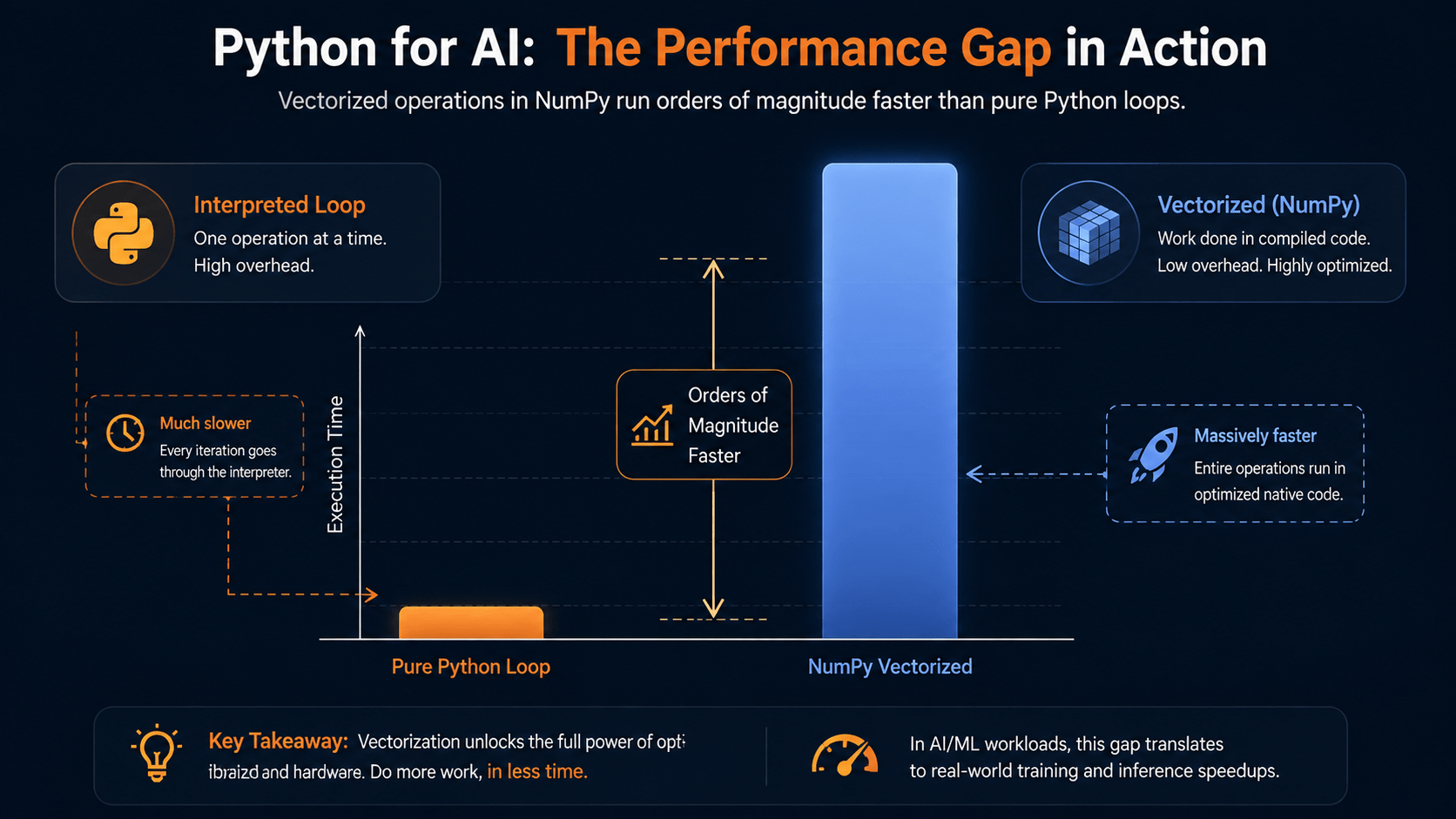
Here’s a small benchmark that shows why Python for AI relies on native vectorization rather than its own interpreter, using NumPy. It sums the squares of 10 million floating-point numbers two ways:
python
import time
import numpy as np

N = 10_000_000

# 1. Pure Python loop (interpreted bytecode)
pure_list = list(range(N))
start = time.perf_counter()
pure_sum = sum(x ** 2 for x in pure_list)
pure_time = time.perf_counter() - start

# 2. NumPy vectorized array (SIMD, C execution)
numpy_array = np.arange(N, dtype=np.float64)
start = time.perf_counter()
numpy_sum = np.sum(numpy_array ** 2)
numpy_time = time.perf_counter() - start

print(f"Pure Python loop: {pure_time:.4f}s")
print(f"NumPy vectorized: {numpy_time:.4f}s")
print(f"Speedup factor: {pure_time / numpy_time:.2f}x")
A typical run on ordinary hardware:
Pure Python loop: 0.8241s
NumPy vectorized: 0.0083s
Speedup factor: 99.29x
Move that same operation from CPU NumPy onto GPU PyTorch tensors, and the gap widens to somewhere between 1,000x and 10,000x, depending on the GPU and batch size. This benchmark is the whole argument for Python for AI in one number: the interpreter barely touches the actual math.
What This Means for Full-Stack JS/TS Engineers Choosing Python for AI
You don’t have to abandon Node.js or Next.js to use Python for AI work, and you don’t need to rewrite your frontend to benefit from it. The pattern most teams land on is a small polyglot split:
- Frontend / web tier (Next.js, React): rendering, UX, client state, streaming UI, and BFF routing.
- AI microservice tier (FastAPI): model inference, embeddings, vector database calls, and LLM orchestration through LangChain or LlamaIndex.
- Communication layer: REST, Server-Sent Events, or WebSockets connecting the two.
- Observability: once this is running in production, the same instrumentation approach from our Node.js observability guide Sentry, OpenTelemetry, structured logs applies just as well to the FastAPI side.
This is also the FastAPI setup covered in our Python frameworks comparison worth a read if you haven’t picked a backend for that service yet.
Frequently Asked Questions
Is Python for AI actually slow, then?
The interpreter is slow at raw loops, but almost none of an AI workload’s real computation runs in the interpreter. The heavy lifting happens in compiled C, C++, and CUDA code that Python calls into that’s the trade-off Python for AI makes on purpose.
Do I need to learn Python for AI if I already know JavaScript?
For model training, fine-tuning, or working directly with PyTorch and Hugging Face, yes the tooling and ecosystem are Python-first. For consuming a model through an API, your existing Next.js or Node.js skills are enough.
Can JavaScript run AI models at all?
Yes, through TensorFlow.js, ONNX Runtime Web, or WebGPU-backed libraries, but the ecosystem is smaller and mostly built for browser inference, not training Python for AI still owns the training side almost entirely.
Does the GIL limit PyTorch performance?
Not meaningfully. Heavy numerical work releases the GIL and runs on native threads or CUDA streams, so the GIL mostly affects pure-Python orchestration code, not the math itself.
Conclusion
Python for AI wins on architecture, not raw speed. CPython hands the actual computation to hand-tuned C, C++, and CUDA engines, releases its own GIL to let that work run in parallel, and sits on top of thirty years of scientific tooling that JavaScript and Java never had the same reason to build. If you’re a full-stack JS/TS developer, the practical move isn’t switching languages it’s pairing your existing Next.js frontend with a focused Python AI microservice.
That’s the practical case for Python for AI in production: use it where its ecosystem gives you an edge, and keep everything else in the stack you already know.
In Blog Post 41, we put this into practice by building an AI microservice for a Next.js frontend: a FastAPI backend with streaming LLM response endpoints, consumed by a Next.js App Router UI.