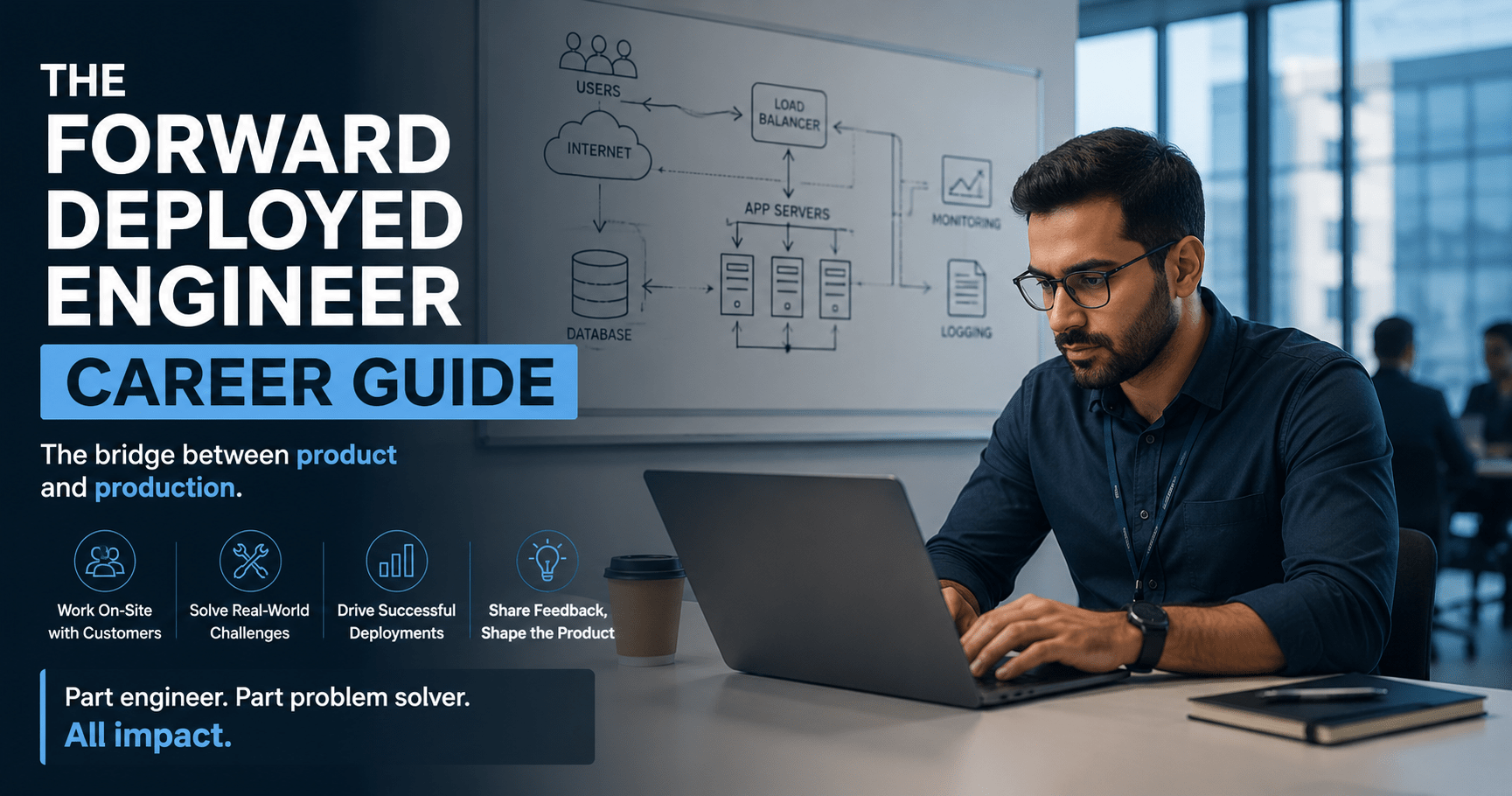

Forward Deployed Engineer, or FDE, is one of the most interesting engineering roles emerging from the rapid growth of AI and enterprise technology.
It is also a role that many software engineers have probably encountered without fully understanding what it means.
An FDE sits somewhere between a software engineer, solutions architect, AI engineer, technical consultant and customer-facing engineer.
But there is an important distinction.
A traditional software engineer might build a product that thousands or millions of users eventually consume.
A Forward Deployed Engineer often goes directly into a customer’s environment, understands a difficult technical or business problem, builds a solution, integrates it with existing systems and helps take that solution into production.
In other words:
A Forward Deployed Engineer does not just build software. They take technology into the real world and make it work.
The role has historically been strongly associated with companies such as Palantir, but it is now appearing across AI labs, enterprise software, defense technology, healthcare, financial services and other industries.
In 2026, companies such as OpenAI, Anthropic and Scale AI are actively building teams around this model. OpenAI’s current careers page, for example, lists FDE positions across healthcare, legal, government, general enterprise deployments and multiple international locations, alongside dedicated FDE management and technical deployment roles.
This makes Forward Deployed Engineering an increasingly interesting career option for software engineers who want to combine coding, architecture, AI, customers and business problems.
This guide explains what the role actually involves, who should pursue it, what skills are required, which tools matter, what industries are hiring, and how a beginner, junior, senior or lead engineer can move toward the role.
What Is a Forward Deployed Engineer?
The simplest definition is:
A Forward Deployed Engineer is an engineer who works closely with customers to design, build, integrate and deploy technical solutions for real-world problems.
The word “forward” is important.
Instead of waiting for requirements to travel from the customer through sales, product management and engineering, the engineer is positioned much closer to the customer.
A typical software development process might look like:
Customer → Sales → Product → Engineering → Product Release → Customer
A Forward Deployed Engineering process can look more like:
Customer → FDE → Prototype → Production → Customer feedback → Product/Platform
The FDE can move quickly because they are close to both sides of the problem.
They understand what the customer actually needs while also understanding what the company’s technology can realistically do.
OpenAI describes its FDE organization as operating at the intersection of customer delivery and core platform development. Its current roles emphasize discovery, technical scoping, system design, implementation and production rollout.
That is an important clue about where the role is heading.
FDE is not simply “customer support for engineers.”
It is engineering ownership at the customer boundary.
What Does a Forward Deployed Engineer Actually Do?
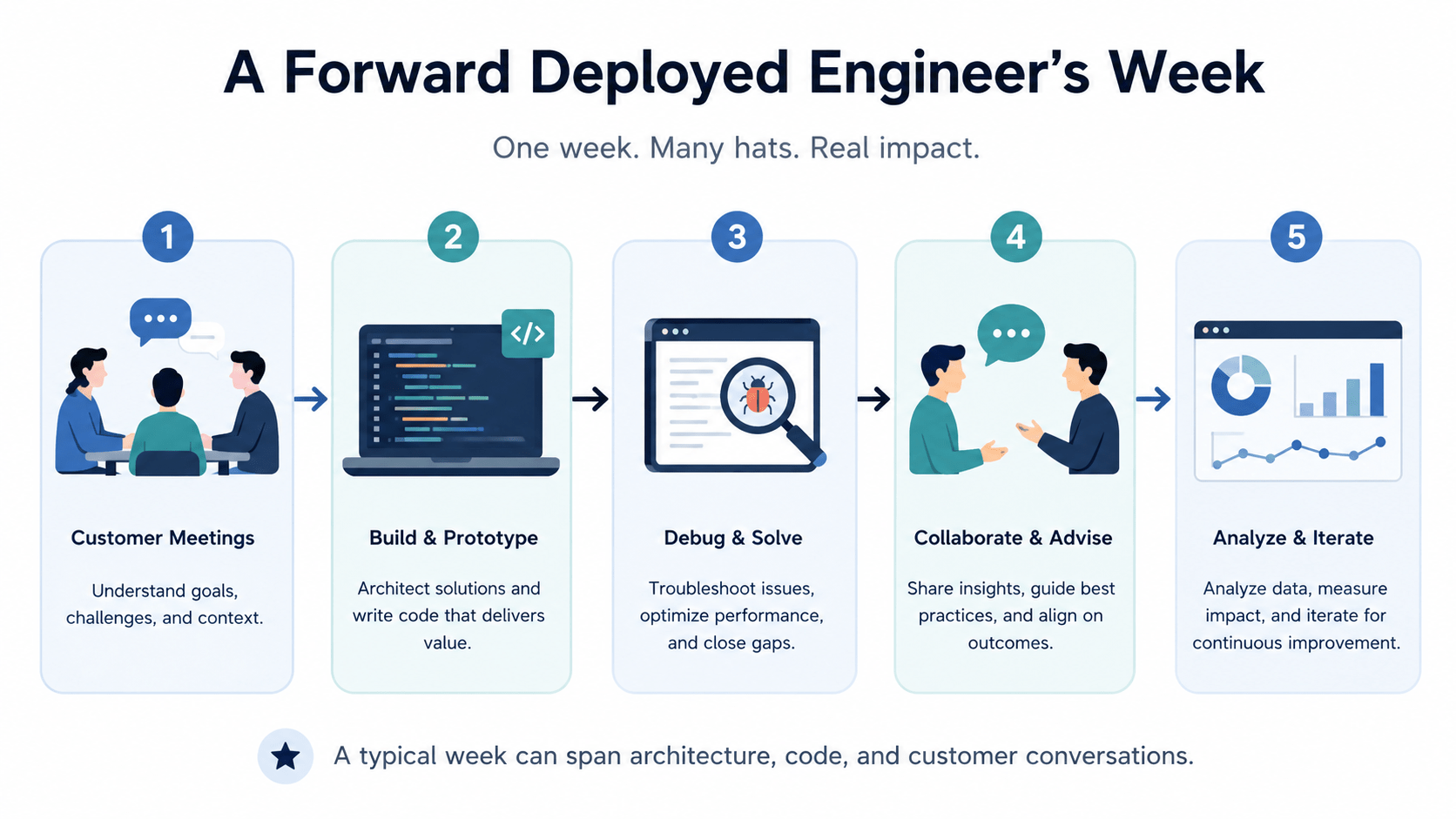
The exact job varies by company, but an FDE may spend a typical project doing the following:
- Meet the customer
- Understand the business problem
- Investigate the customer’s existing technology
- Identify useful data and systems
- Define the technical requirements
- Design an architecture
- Build a prototype
- Integrate APIs and enterprise systems
- Test and evaluate the solution
- Deploy it into production
- Monitor its performance
- Fix problems
- Measure business impact
- Feed lessons back to the product and engineering teams
That means an FDE may move between very different activities in the same week.
Monday could involve a technical architecture meeting.
Tuesday could involve writing Python.
Wednesday could involve debugging an API integration.
Thursday could involve talking to a customer’s CTO.
Friday could involve analyzing whether an AI system actually improved the customer’s workflow.
A Real-World Example
Imagine an AI company sells an enterprise AI platform to a large bank.
The bank says:
“We want to use AI to help employees analyze thousands of internal documents.”
That statement sounds simple.
The actual engineering problem isn’t.
The bank may have:
- Legacy databases
- Internal APIs
- Document management systems
- Private networks
- Strict identity requirements
- Sensitive information
- Compliance requirements
- Existing authentication infrastructure
- Multiple cloud environments
- Thousands of employees
Someone needs to figure out:
Where are the documents?
How can the AI access them?
How should users authenticate?
How do we prevent unauthorized information retrieval?
How should documents be indexed?
What happens when the AI doesn’t know the answer?
How do we evaluate the system?
How do we monitor it in production?
How do we prove that employees are actually saving time?
That person may be the Forward Deployed Engineer.
The FDE could build a retrieval-augmented generation system, connect it to the bank’s identity provider, integrate internal APIs, deploy the application, establish evaluation tests and work with employees to improve the workflow.
Also Read: How to Optimize Prompts to Reduce Token Usage and Cut LLM Costs in 2026
FDE Is Not Just Another Name for a Software Engineer
The biggest difference is ownership and environment.
A traditional software engineer is often given a relatively defined problem.
For example:
Build an API endpoint that returns customer account information.
An FDE may receive something closer to:
Our employees spend several hours every day searching through internal documents. Can your technology help?
That is not an engineering ticket.
The FDE has to turn an ambiguous problem into an engineering problem.
That requires:
Discovery → requirements → architecture → implementation → deployment → measurement
This ability to translate ambiguity into a working system is one of the defining characteristics of the role.
FDE vs Software Engineer
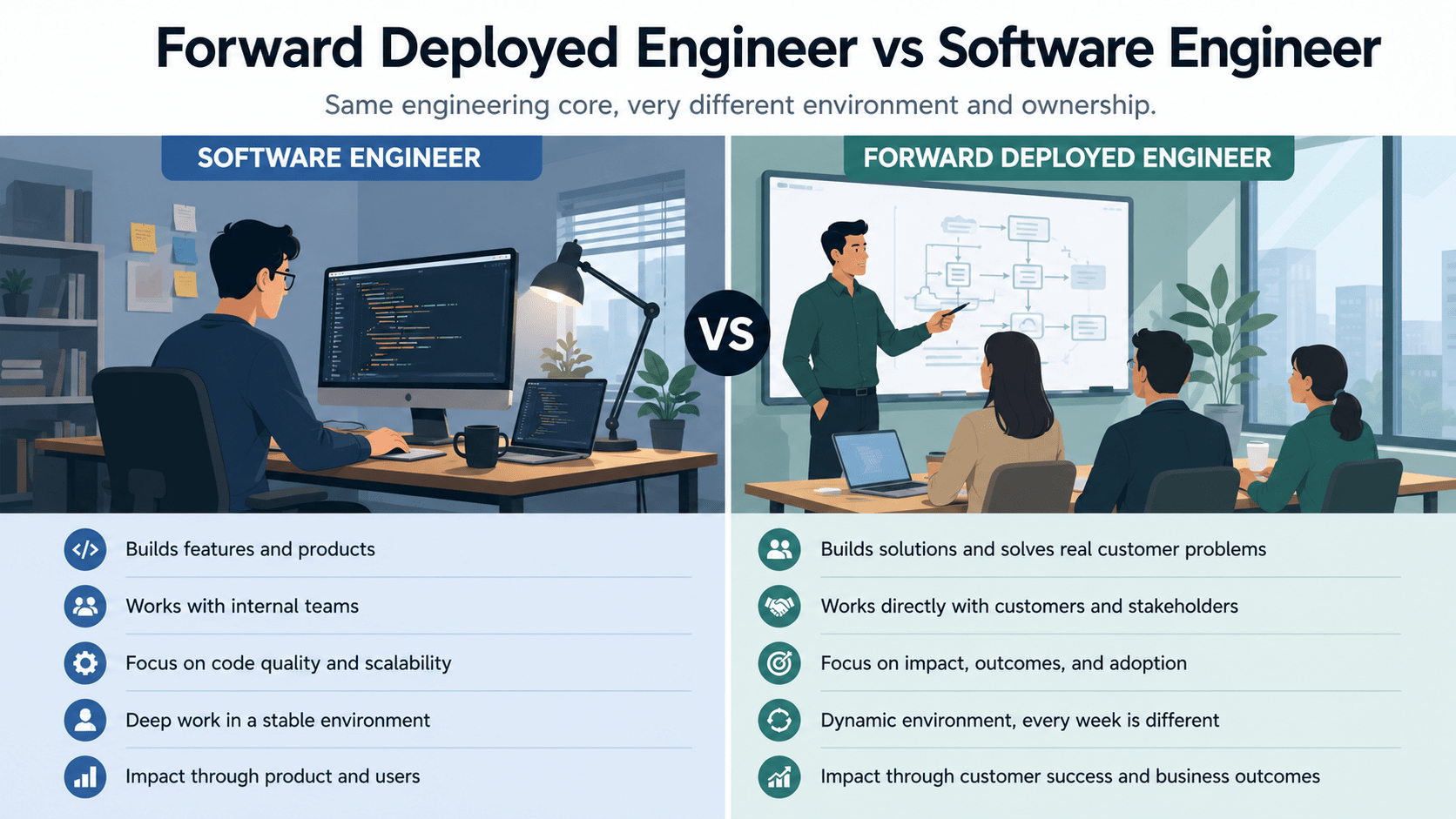
| Area | Software Engineer | Forward Deployed Engineer |
|---|---|---|
| Main focus | Building software/products | Solving customer problems |
| Customer interaction | Usually limited | Often frequent |
| Requirements | More defined | Often ambiguous |
| Environment | Company’s environment | Customer + company environment |
| Coding | Core responsibility | Core responsibility |
| Architecture | Product focused | Deployment/problem focused |
| Deployment | May be handled by platform teams | Often directly involved |
| Business understanding | Helpful | Essential |
| Communication | Important | Critical |
| Travel | Usually limited | Can be significant |
| Success | Technical/product metrics | Customer impact + technical success |
OpenAI’s current FDE roles illustrate this distinction clearly. The company expects FDEs to own deployments from discovery and technical scoping through system design, building and production rollout, while working directly with customer engineering and domain teams.
Also Read: Hugging Bay: The Pirate Bay for Open LLMs, Explained
FDE vs Solutions Engineer
There is significant overlap between these roles, but they are not identical.
A Solutions Engineer is often involved in:
- Product demonstrations
- Technical discovery
- Proofs of concept
- Architecture discussions
- Pre-sales
- Technical validation
An FDE generally goes deeper into implementation.
The FDE may actually:
- Write the code
- Build the application
- Connect the APIs
- Configure infrastructure
- Create evaluation systems
- Deploy the solution
- Debug production issues
So the distinction can be simplified as:
Solutions Engineer:
“Here is how our technology could solve your problem.”
Forward Deployed Engineer:
“Let’s build it, deploy it and prove that it works.”
FDE vs Solutions Architect
A Solutions Architect usually concentrates heavily on system architecture and technical design.
An FDE needs architecture skills too, but usually has a stronger hands-on implementation component.
A Solutions Architect might design:
Customer → API Gateway → Cloud → Database → AI Service
An FDE may design that architecture and then actually build it.
FDE vs Consultant
Consultants are generally strong at:
- Business analysis
- Strategy
- Process improvement
- Stakeholder management
- Transformation
FDEs share many of these skills.
But the FDE adds deep technical implementation.
That combination is what makes the role unusual.
An FDE can sit in a meeting with a business executive, understand the workflow, draw an architecture and then open a code editor to start implementing the solution.
Why Is FDE Becoming More Important?
AI is a major reason.
Modern AI models are becoming easier to access.
A developer can call a powerful model through an API in minutes.
But getting that model to create real enterprise value is much harder.
The difficult part may involve:
- Data integration
- Security
- Authentication
- Existing applications
- Enterprise workflows
- Model evaluation
- Reliability
- Cost control
- Compliance
- User adoption
- Production infrastructure
This creates a new problem:
The technology is becoming easier to access, but harder to deploy correctly at enterprise scale.
That is exactly the space where FDEs operate.
OpenAI’s current healthcare FDE role, for example, describes engineers owning technical discovery, architecture, implementation, evaluation and productionization while dealing with complex healthcare infrastructure and regulatory constraints.
The Growth of FDE in 2026
The role is no longer limited to one company or one industry.
Current hiring provides a useful snapshot.
OpenAI’s careers search currently shows FDE positions in:
- General enterprise
- Healthcare
- Legal
- Government
- Singapore
- Japan
- South Korea
- Australia
- United States
It also lists:
- Forward Deployed Software Engineers
- FDE Managers
- Technical Deployment Leads
Anthropic’s current careers listings similarly include Forward Deployed Engineer positions in New York, San Francisco, Seattle, Munich and Paris, along with a Manager, Forward Deployed Engineering role and Technical Deployment Lead positions.
Scale AI also advertises Forward Deployed Engineering roles around generative AI and enterprise AI deployments.
One 2026 industry analysis scanned 239,428 live job postings and identified 5,426 strict FDE or FDE-adjacent positions across 1,311 employers. This should be treated as an industry research estimate rather than an official government employment statistic, but it demonstrates how broadly the concept has spread.
Which Industries Need Forward Deployed Engineers?
FDE demand tends to be strongest when technology is:
Complex to integrate + highly valuable once deployed.
1. Artificial Intelligence
This is currently one of the most obvious areas.
Potential projects include:
- Enterprise AI assistants
- AI agents
- RAG systems
- AI workflow automation
- Coding agents
- Document intelligence
- Customer support automation
- Internal knowledge systems
- AI evaluation platforms
OpenAI and Anthropic are good examples of companies building FDE organizations around production AI deployments.
2. Healthcare
Healthcare has unusually complicated technical and regulatory environments.
FDE projects can involve:
- Electronic health records
- Clinical workflows
- Medical documentation
- Patient support
- Healthcare operations
- Claims
- Data interoperability
OpenAI’s healthcare FDE hiring specifically references healthcare organizations, production AI systems, regulated environments and interoperability technologies.
3. Financial Services
Banks and financial institutions have:
- Legacy systems
- Large datasets
- Strict security
- Compliance requirements
- Complex workflows
That creates strong demand for engineers who can bridge modern technology and existing infrastructure.
4. Government
Government technology can involve:
- Legacy systems
- Security restrictions
- Sensitive data
- Complex procurement environments
- Specialized infrastructure
- Mission-critical applications
OpenAI currently has dedicated government FDE positions alongside other government deployment roles.
5. Defense
Defense technology is another natural FDE environment.
Solutions may have to work across:
- Hardware
- Sensors
- Networks
- Field systems
- Command systems
- Secure environments
Companies such as Anduril have also used forward-deployment engineering roles for defense products.
6. Manufacturing
Potential applications include:
- Predictive maintenance
- Factory automation
- Computer vision
- Robotics
- Supply-chain optimization
- Industrial AI
7. Logistics
Large logistics organizations have complex:
- Fleet systems
- Warehouses
- Routing systems
- ERP platforms
- Supply-chain data
FDEs can connect modern software and AI systems to those environments.
8. Cybersecurity
Security products often require deep integration with a customer’s:
- Identity systems
- Networks
- Cloud infrastructure
- Endpoint systems
- Security operations
9. Enterprise SaaS
Large SaaS platforms frequently need customization and integration with:
- CRM
- ERP
- HR
- Finance
- Identity
- Data systems
That makes FDE-style engineering valuable even outside AI.
Who Can Become a Forward Deployed Engineer?
There is no single degree or career path.
Strong candidates can come from several backgrounds.
Software Engineer
Probably the most direct path.
Software Engineer → Senior Engineer → FDE
Useful existing skills include:
- Backend development
- APIs
- Databases
- Cloud
- System design
- Production debugging
Full-Stack Engineer
A strong fit because FDEs often need to move between:
Frontend → API → backend → database → cloud
Full-stack engineers already have much of this breadth.
AI/ML Engineer
Increasingly attractive as enterprise AI deployments grow.
Useful skills include:
- LLM APIs
- RAG
- Agents
- Evaluation
- AI infrastructure
- Data pipelines
Cloud/DevOps Engineer
A cloud engineer already understands:
- Infrastructure
- Networking
- Containers
- CI/CD
- Kubernetes
- Security
Adding application development and customer discovery can create a strong FDE profile.
Solutions Architect
Solutions Architects already understand:
- Customer environments
- Architecture
- Enterprise integration
- Technical communication
The major gap may be hands-on software development.
Technical Consultant
Consultants already understand:
- Customer discovery
- Business processes
- Stakeholders
- Delivery
Adding serious engineering skills can make this a powerful transition.
The Most Important FDE Skill
It isn’t Python.
It isn’t Kubernetes.
It isn’t AWS.
It isn’t even AI.
The core skill is:
Turning an ambiguous problem into a working technical solution.
Imagine a customer says:
“We want AI to automate our support operation.”
A weak technical response is:
“Which API should I call?”
A strong FDE starts asking:
- Which support workflow?
- Which employees?
- What systems are involved?
- What data is available?
- What should be automated?
- What should remain human-controlled?
- What happens when the model is uncertain?
- What security constraints exist?
- How will success be measured?
- What is the expected ROI?
Then the FDE converts the answers into:
Problem → Requirements → Architecture → Prototype → Evaluation → Production
The T-Shaped FDE
The best FDEs are generally T-shaped engineers.
They have broad technical knowledge but deep expertise in one or two areas.
             Broad technical knowledge

     Cloud   AI   APIs   Security   Data
       │      │     │       │        │
       │      │     │       │        │
       └──────┴─────┴───────┴────────┘
                    │
                    │
                    │
              Deep expertise
For example:
A person could have:
Broad: cloud + databases + APIs + AI + security
Deep: backend engineering
Another could have:
Broad: software + cloud + AI + enterprise
Deep: ML engineering
You do not need to master every technology.
Programming Skills
Python
Python is one of the most valuable languages for modern AI-focused FDE work.
Learn:
- Python fundamentals
- Object-oriented programming
- Async programming
- FastAPI
- Pydantic
- API clients
- Data processing
- AI SDKs
TypeScript / JavaScript
Useful for:
- React
- Next.js
- Node.js
- Full-stack applications
- AI interfaces
One Enterprise Language
Depending on your target market, understand at least one of:
- Java
- C#
- Go
You don’t need to become an expert in all three.
APIs and Integration
This is one of the most important FDE skill areas.
Understand:
- REST
- GraphQL
- Webhooks
- JSON
- OAuth
- OAuth 2.0
- OpenID Connect
- JWT
- API keys
- Rate limiting
- Pagination
- Error handling
A customer rarely lives inside one clean application.
Your solution will usually have to talk to several systems.
Databases
Understand at least one relational database deeply.
PostgreSQL is an excellent choice.
Learn:
- SQL
- Indexes
- Transactions
- Joins
- Query optimization
- Schema design
- Migrations
Also understand:
- Redis
- MongoDB
- DynamoDB
For AI applications, understand vector search and technologies such as:
- pgvector
- Pinecone
- Weaviate
- Milvus
- Elasticsearch/OpenSearch
Cloud Skills
You should understand at least one major cloud platform.
AWS
Learn:
- EC2
- S3
- RDS
- Lambda
- ECS
- EKS
- IAM
- VPC
- CloudWatch
- Secrets Manager
Azure
Especially useful for enterprise environments.
Learn:
- Azure Functions
- App Service
- AKS
- Azure Storage
- Azure SQL
- Entra ID
- Key Vault
- Azure AI services
Google Cloud
Learn:
- Cloud Run
- GKE
- Cloud Storage
- BigQuery
- IAM
- Vertex AI
You don’t need expert-level knowledge of all three.
A better strategy is:
Master one cloud. Understand the others.
Docker, Kubernetes and Infrastructure
An FDE should be comfortable taking software from a laptop into production.
Start with:
Git → Docker → CI/CD → Cloud
Then add:
Terraform → Kubernetes → Observability
Useful tools include:
- Docker
- Kubernetes
- Terraform
- GitHub Actions
- GitLab CI
- Argo CD
- Helm
You don’t need to memorize every Kubernetes command.
You need to understand how modern applications are deployed and operated.
AI Skills Every Modern FDE Should Understand
The rise of AI has significantly expanded the FDE skill set.
LLM Fundamentals
Understand:
- Tokens
- Context windows
- Embeddings
- Structured outputs
- Tool calling
- Function calling
- Temperature
- Model selection
- Latency
- Cost
RAG
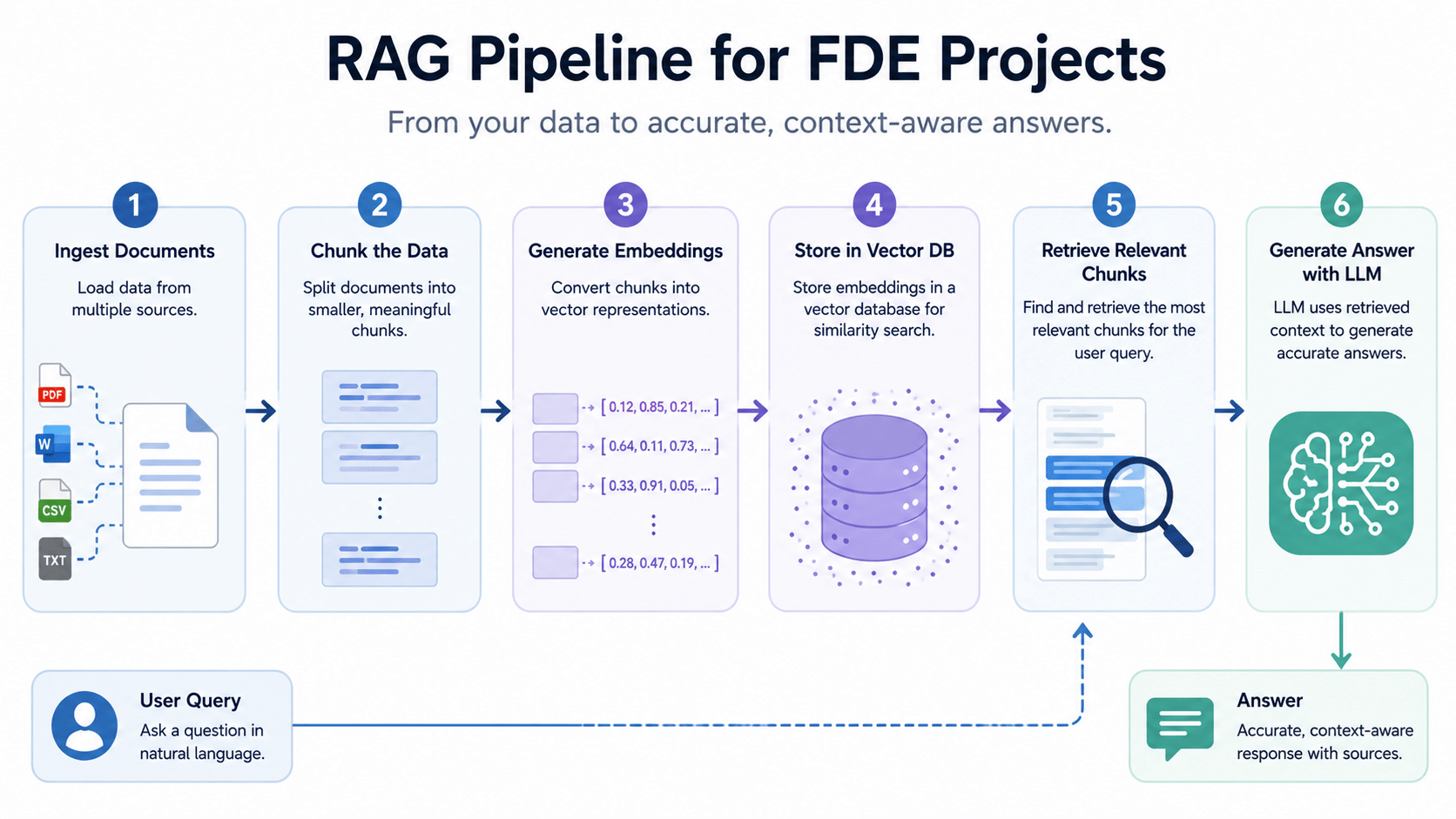
Understand the complete pipeline:
Documents
    ↓
Processing
    ↓
Chunking
    ↓
Embeddings
    ↓
Vector database
    ↓
Retrieval
    ↓
LLM
    ↓
Answer
You should understand why retrieval fails, how chunking affects results and how to evaluate the final output.
AI Agents
Modern FDEs increasingly need to understand:
- Tool use
- Agent loops
- Planning
- Memory
- Human-in-the-loop systems
- MCP
- Multi-agent architectures
- Agent evaluation
Anthropic’s current FDE organization is particularly representative of this direction, with its broader Applied AI organization combining FDE, AI architecture, engineering and deployment roles.
AI Evaluation
This is an underrated skill.
A production AI system cannot be evaluated with:
“It seems pretty good.”
You need measurable tests.
Understand:
- Evaluation datasets
- Accuracy
- Precision
- Recall
- Hallucination testing
- Groundedness
- Regression testing
- Latency
- Cost
- Safety
- Reliability
This is especially important for enterprise deployments.
The FDE needs to prove that the system creates value, not merely that the model produces impressive demos.
Enterprise Security
Enterprise customers will ask difficult security questions.
An FDE should understand:
- Authentication
- Authorization
- IAM
- OAuth
- OIDC
- SAML
- SSO
- RBAC
- Encryption
- TLS
- Secrets management
- Network segmentation
- Audit logging
- Data retention
- Data residency
For AI deployments, also understand:
- Prompt injection
- Data leakage
- Sensitive information
- PII
- Model access controls
- Human approval
- AI safety
Observability and Production Engineering
An FDE should know how to answer:
“The application worked yesterday. Why is it broken today?”
Learn:
- Logging
- Metrics
- Tracing
- Alerts
- Error tracking
- Performance monitoring
Useful technologies include:
- OpenTelemetry
- Prometheus
- Grafana
- CloudWatch
- Datadog
- Sentry
The exact product matters less than understanding the underlying concepts.
Enterprise Software Knowledge
You don’t have to become an expert in every enterprise platform.
But you should understand the role played by systems such as:
- Salesforce
- SAP
- ServiceNow
- Microsoft 365
- Google Workspace
- Jira
- Workday
- Oracle
- ERP systems
- CRM platforms
The goal is to become comfortable entering an unfamiliar customer environment.
Every enterprise has its own ecosystem.
A good FDE doesn’t panic when the architecture diagram looks like someone spilled spaghetti on it.
Communication Skills
Technical ability alone is not enough.
FDEs interact with:
- Developers
- Architects
- Product managers
- Operations teams
- Managers
- Executives
- Domain experts
You need to explain the same system differently to each audience.
For example:
Engineer
“We’ll use an event-driven architecture with asynchronous processing.”
Executive
“This lets us process requests reliably without slowing down the user’s workflow.”
Both describe the same architecture.
The FDE needs to communicate both versions.
Customer Discovery
One of the most important FDE skills is learning how to ask questions.
Instead of immediately building what the customer asks for, determine:
What problem are they actually trying to solve?
For example:
Customer:
“We need an AI chatbot.”
FDE:
“What are employees currently doing manually?”
That question might reveal that the actual problem isn’t a chatbot.
Maybe employees spend three hours searching internal documents.
The better solution might be a knowledge retrieval system rather than a chatbot.
This is why FDE work starts with discovery, not code.
The Forward Deployed Engineer Career Path
There isn’t one universal career ladder, but a practical path looks like:
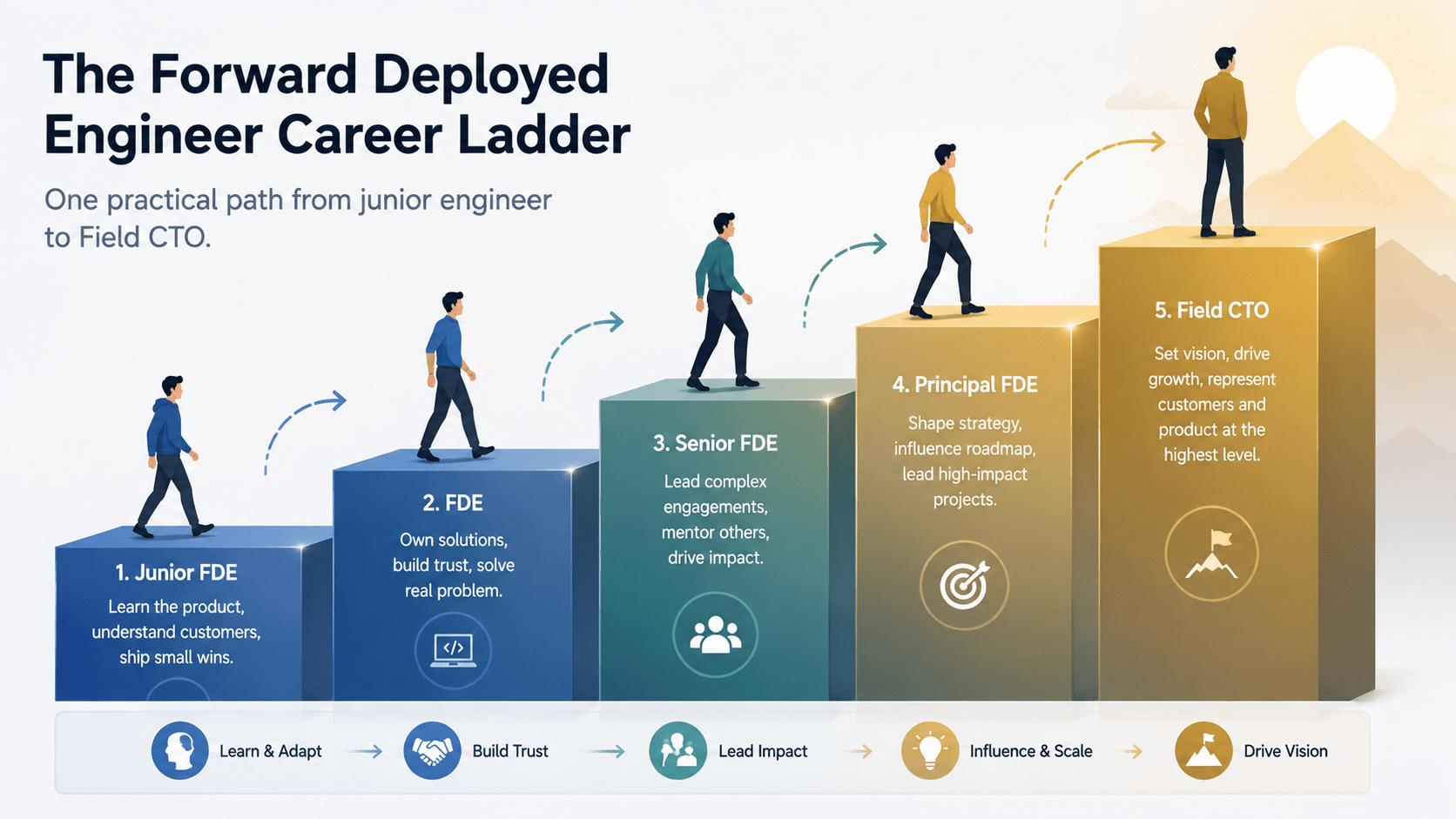
Junior Engineer
       ↓
Software Engineer
       ↓
Senior Engineer
       ↓
Forward Deployed Engineer
       ↓
Senior FDE
       ↓
Staff / Principal FDE
       ↓
Field Architect / Technical Lead
       ↓
Field CTO
There is also a management track:
Senior FDE
       ↓
FDE Lead
       ↓
FDE Manager
       ↓
Senior Manager
       ↓
Director
       ↓
Head / VP of FDE
Roadmap for Beginners
If you are starting from zero, don’t try to become an FDE immediately.
Build the foundation first.
Stage 1: Programming
Learn:
- Python
- Git
- Linux basics
- SQL
- HTTP
- APIs
Stage 2: Web Development
Learn:
- HTML
- CSS
- JavaScript
- TypeScript
- React
- Backend development
Stage 3: Cloud
Choose:
AWS or Azure
Learn deployment rather than simply watching cloud tutorials.
Stage 4: AI
Build:
- LLM applications
- RAG
- Tool-calling applications
- Simple agents
Stage 5: Production
Learn:
- Docker
- CI/CD
- Authentication
- Monitoring
- Cloud deployment
At this point, you’re becoming much more interesting to FDE-oriented employers.
Roadmap for Junior Engineers
If you already have 1 to 3 years of engineering experience, focus on breadth.
Add:
- Cloud
- Docker
- CI/CD
- APIs
- System design
- AI applications
- Security
- Enterprise integrations
Start volunteering for projects where you interact directly with users or customers.
The goal is to move from:
“I complete tickets.”
to:
“I own a technical problem.”
Roadmap for Senior Engineers
Senior engineers should not restart from beginner-level programming.
Instead, focus on the missing FDE dimensions:
Customer discovery
Learn to extract requirements from ambiguous conversations.
Architecture
Design complete systems rather than individual services.
Deployment
Own production.
AI
Understand modern AI application architecture.
Business impact
Measure whether the solution actually helped.
Communication
Become comfortable presenting technical decisions to senior stakeholders.
OpenAI’s current general FDE role, for example, emphasizes end-to-end deployment and customer-facing experience rather than simply coding ability.
Roadmap for Lead and Staff Engineers
For lead engineers, the next step isn’t simply:
“Learn more technologies.”
It is:
“Create leverage.”
Instead of solving one customer’s problem, build systems that help solve the next 100 customer problems.
Examples:
- Reusable deployment templates
- Internal SDKs
- Integration frameworks
- AI evaluation frameworks
- Monitoring systems
- Reference architectures
- Security patterns
- Deployment playbooks
- Automation
This is where an FDE can evolve from individual problem solver into technical leader.
What Is a Forward Deployed Engineering Manager?
The FDE Manager has a different responsibility.
An FDE asks:
“Can I make this deployment successful?”
An FDE Manager asks:
“Can my team repeatedly make deployments successful?”
That changes the job significantly.
An FDE Manager may be responsible for:
- Hiring
- Mentoring
- Team structure
- Customer allocation
- Project prioritization
- Technical quality
- Escalations
- Customer relationships
- Delivery metrics
- Product feedback
- Deployment processes
OpenAI’s current FDE management role describes managers leading teams through high-stakes, ambiguous customer deployments while owning technical and business outcomes and ensuring lessons from field work reach Product and Research.
FDE Manager vs Engineering Manager
There is overlap, but the environment is different.
| Engineering Manager | FDE Manager |
|---|---|
| Manages engineering team | Manages deployment engineering team |
| Product roadmap | Customer + product priorities |
| Internal stakeholders | Customers + internal stakeholders |
| Product delivery | Customer outcomes |
| Engineering quality | Engineering + deployment quality |
| Team development | Team + customer leadership |
| Usually product focused | Highly delivery focused |
An FDE Manager needs strong technical credibility but also needs to understand customer relationships and business outcomes.
Who Should Become an FDE?
This role is particularly attractive if you enjoy:
- Coding
- Architecture
- AI
- Solving ambiguous problems
- Talking to people
- Learning new industries
- Working with customers
- Fast-moving projects
- Production systems
- Business problems
It may be less attractive if you strongly prefer:
- Highly predictable work
- Narrow technical specialization
- Minimal customer interaction
- Long-term ownership of one product area
- Very stable requirements
What Tools Should an FDE Know?
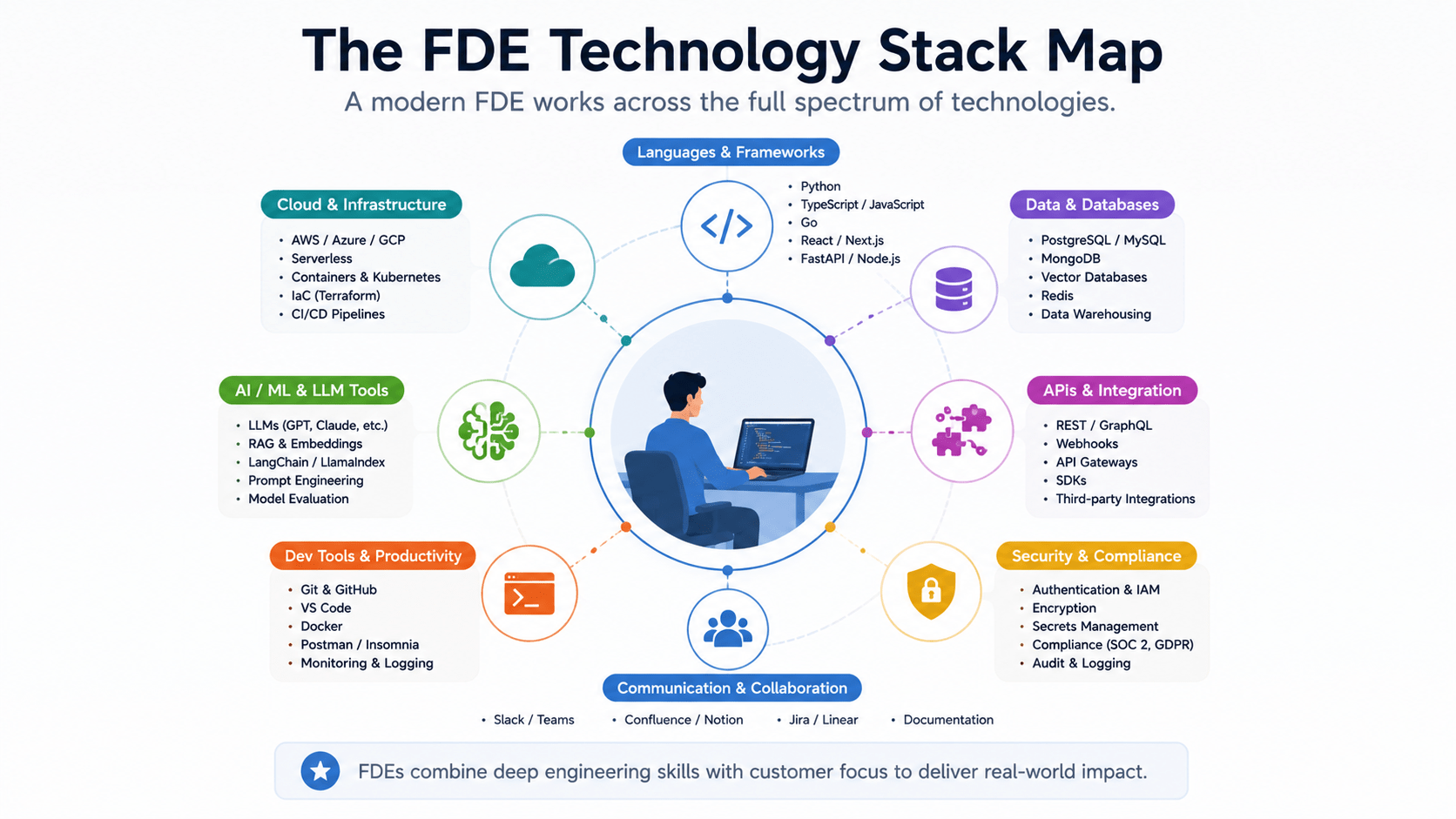
Think of the following as a technology map, not a mandatory checklist.
| Area | Technologies to Explore |
|---|---|
| Programming | Python, TypeScript, Java, Go, C# |
| Frontend | React, Next.js |
| Backend | FastAPI, Node.js |
| APIs | REST, GraphQL, OAuth, Webhooks |
| Databases | PostgreSQL, MySQL, Redis, MongoDB |
| Cloud | AWS, Azure, GCP |
| Containers | Docker |
| Orchestration | Kubernetes |
| Infrastructure | Terraform |
| CI/CD | GitHub Actions, GitLab CI |
| Observability | OpenTelemetry, Grafana, Prometheus |
| AI models | OpenAI, Anthropic, Gemini |
| AI frameworks | LangChain, LlamaIndex, LangGraph |
| Vector search | pgvector, Pinecone, Weaviate |
| Data | Kafka, Spark, BigQuery, Snowflake |
| Security | OAuth, OIDC, SAML, IAM |
| Enterprise | Salesforce, SAP, ServiceNow |
| Collaboration | GitHub, Jira, Slack |
| Architecture | Mermaid, Draw.io, Lucidchart |
The goal isn’t to memorize tools.
The goal is to understand the architecture behind the tools.
A Better FDE Learning Stack
If you want a practical learning order, use this:
Python
   ↓
SQL
   ↓
APIs
   ↓
TypeScript
   ↓
React
   ↓
Backend
   ↓
Docker
   ↓
Cloud
   ↓
CI/CD
   ↓
Terraform
   ↓
System Design
   ↓
LLM APIs
   ↓
RAG
   ↓
Agents
   ↓
AI Evaluation
   ↓
Security
   ↓
Kubernetes
   ↓
Enterprise Integration
You don’t need to become an expert in every layer.
You need enough knowledge to move confidently through the stack.
Three Projects That Can Help You Become FDE-Ready
A portfolio is much more useful when it demonstrates end-to-end deployment rather than another tutorial application.
Project 1: Enterprise Knowledge Assistant
Build:
Documents → Processing → Embeddings → Vector Database → RAG → LLM → Web Application
Add:
- Authentication
- User permissions
- Evaluation
- Logging
- Cloud deployment
Project 2: AI Customer Support System
Integrate:
- CRM
- Database
- LLM
- Ticketing system
Add:
- Human approval
- Tool calling
- Monitoring
- Evaluation
Now you are demonstrating integration rather than simply prompting an AI model.
Project 3: Production AI Agent
Build an agent that can:
- Search data
- Call APIs
- Perform actions
- Ask for human approval
- Record its actions
- Recover from failures
Deploy it using:
- Docker
- Cloud
- CI/CD
- Authentication
- Monitoring
This demonstrates the actual FDE mindset:
Discover → Build → Integrate → Deploy → Operate → Measure
How to Search for FDE Jobs
Don’t search only for:
“Forward Deployed Engineer.”
The market uses several titles.
Also search for:
- Forward Deployed Software Engineer
- Deployment Engineer
- AI Deployment Engineer
- Technical Deployment Lead
- Applied AI Engineer
- Customer Engineer
- Field Engineer
- Solutions Architect
- AI Solutions Architect
- Technical Delivery Engineer
- Forward Deployed Security Engineer
- Applied AI Architect
OpenAI’s current hiring is a good example of this variety, with FDE, Forward Deployed Software Engineer, Manager, FDE and Technical Deployment Lead positions appearing under its Forward Deployed Engineering organization.
Anthropic similarly combines FDE with Applied AI Architect, Applied AI Engineer and Technical Deployment Lead roles.
Companies and Organizations to Watch
The FDE ecosystem is expanding beyond the companies traditionally associated with the term.
Some companies worth watching include:
AI
- OpenAI
- Anthropic
- Scale AI
Defense and government technology
- Palantir
- Anduril
- Scale AI
- OpenAI for Government
Enterprise AI
- Databricks
- Microsoft
- AWS
- Salesforce
The title and organization structure vary considerably.
A company may have an FDE team without calling every member an “FDE.”
What Is the Future of Forward Deployed Engineering?
AI may actually make FDE more important rather than less important.
That sounds counterintuitive.
If AI makes software development faster, shouldn’t companies need fewer engineers?
For some types of development, perhaps.
But faster software development creates another bottleneck:
Deployment into the real world.
A company can now build an impressive AI prototype in a few days.
The hard questions begin afterward:
- Can it access enterprise data?
- Is it secure?
- Can users authenticate?
- Does it work reliably?
- Can its outputs be evaluated?
- Can it integrate with existing software?
- Can the company control costs?
- Can it comply with regulations?
- Can employees actually use it?
- Does it create measurable business value?
Those are deployment problems.
And deployment problems are exactly where FDEs operate.
The Future FDE May Be an AI Systems Engineer
The traditional image of an FDE is:
Software engineer who works directly with customers.
The emerging version may be:
AI systems engineer who can understand a business workflow, design an AI architecture, integrate enterprise data, deploy the system and measure its impact.
That requires a combination of:
Software Engineering
AI Engineering
Cloud
Enterprise Architecture
Security
Customer Discovery
Business Understanding
That combination is difficult to replace with a single specialist.
The FDE Mindset
The biggest shift is mental.
A traditional engineer might ask:
“What ticket should I work on?”
An FDE asks:
“What is preventing the customer from achieving the desired outcome?”
A traditional engineer might say:
“That’s outside the requirements.”
An FDE asks:
“Is solving this necessary for the deployment to succeed?”
A traditional engineer might optimize:
“How do I implement this correctly?”
An FDE also asks:
“Should we build this at all?”
That is the difference between implementation and technical ownership.
Final Skill Map
If the entire article had to be reduced to one checklist, it would look like this.
Engineering
Python + TypeScript + SQL
Software
Frontend + backend + APIs
Infrastructure
Cloud + Docker + CI/CD + Terraform
Systems
Databases + networking + system design
AI
LLMs + RAG + agents + evaluation
Enterprise
SSO + IAM + security + integrations
Production
Observability + reliability + debugging
Customer
Discovery + communication + requirements
Architecture
Trade-offs + scalability + system design
Leadership
Ownership + prioritization + mentoring
But there is one skill that ties everything together:
Take something from “interesting demo” to “working production system.”
That is the real FDE superpower.
Conclusion
Forward Deployed Engineering sits at an unusual intersection of modern technology careers.
It is not pure software engineering.
It is not consulting.
It is not solutions architecture.
It is not sales engineering.
It borrows something from all of them while retaining a strong engineering core.
The role is particularly relevant now because AI companies are moving from selling access to models toward helping organizations build production systems around those models.
OpenAI’s current FDE organization illustrates that shift particularly well. Its roles span general enterprise deployments, healthcare, legal, government, international markets, management and technical deployment leadership. Anthropic’s current hiring shows a similar expansion across FDE, Applied AI and deployment architecture.
For software engineers, that creates an interesting career path.
You don’t necessarily have to abandon engineering to become more business-facing.
You don’t have to become a consultant to work directly with customers.
And you don’t have to become a manager to move into technical leadership.
You can become the person who connects all three worlds:
Customer problem → Engineering → Production → Business outcome
That is what makes Forward Deployed Engineering one of the career paths worth watching as AI and enterprise software continue to evolve.