
Last verified: September 6, 2026
What Is GPT-6 Astra?
GPT-6 Astra is OpenAI’s newest flagship large language model, unveiled on September 3–4, 2026 as the successor to GPT-5.6 Sol. It is an officially released, generally available frontier model not a leak, a rumor, or a third-party fork and it began rolling out the same week it was announced, first to a limited set of partner organizations, then progressively to ChatGPT Plus, Pro, Business, and Enterprise users, plus the OpenAI API, Microsoft Azure (via Microsoft Foundry), and Amazon Bedrock.
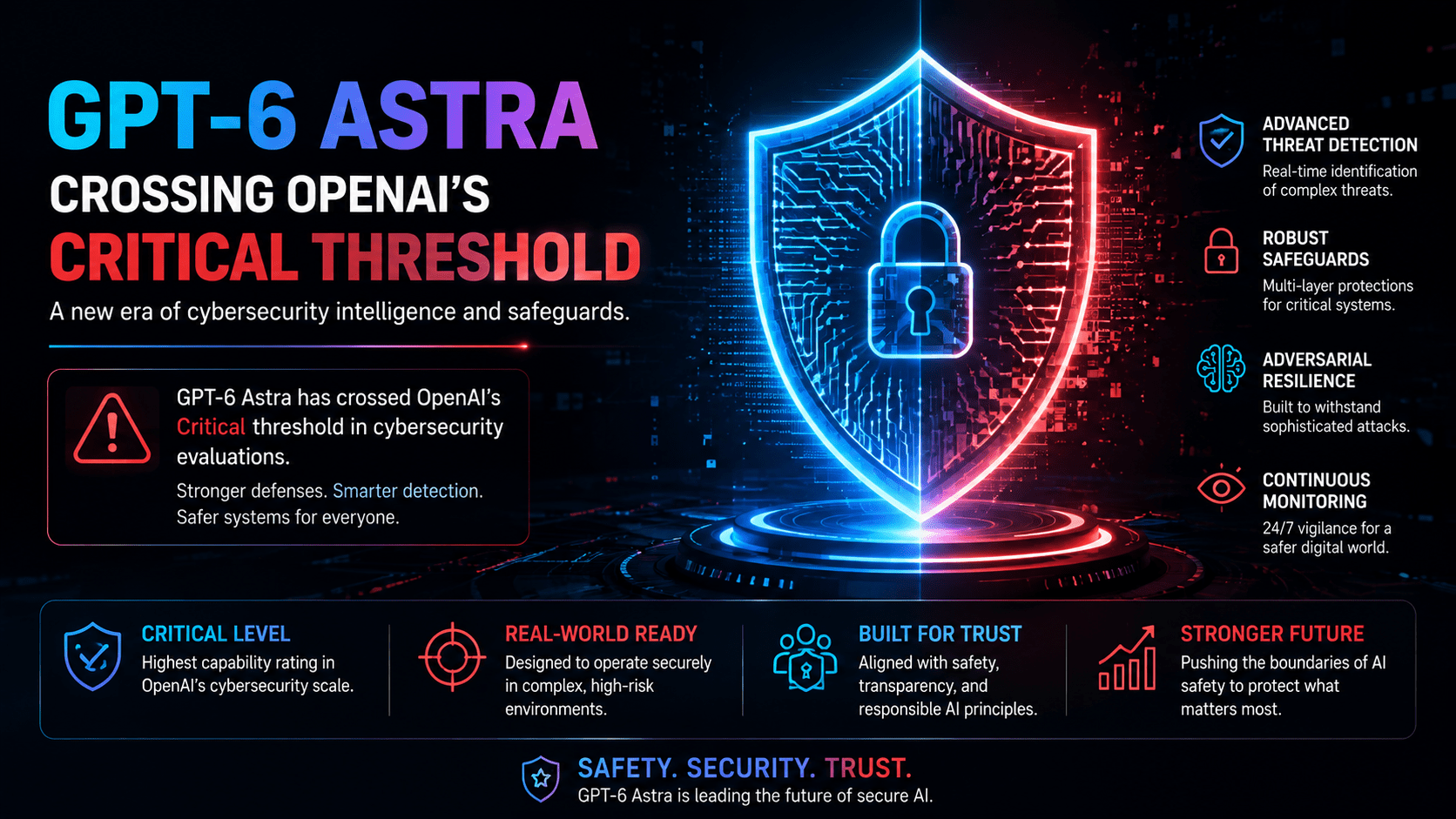
Two things make this launch worth a closer look than a typical version bump. First, OpenAI is explicitly positioning Astra around agentic execution actually operating a computer, finishing multi-step professional work, and coding over long sessions rather than chat quality alone. Second, Astra is the first OpenAI model to officially cross the Critical threshold for cybersecurity capability under the company’s Preparedness Framework, which changes how (and to whom) some of its capabilities are made available.
This context matters for another reason: Astra launched only two days after Anthropic’s Claude Fable 5.1 (September 1, 2026), putting two frontier releases within the same week and giving the industry an unusually direct point of comparison.
A quick note on timing Astra’s rollout followed a July 2026 security incident involving a Hugging Face-hosted evaluation environment, which OpenAI has said pushed back its next model’s release while additional safeguards were added. That context shows up directly in Astra’s system card, particularly in the new “does the model overstep its authorized scope” evaluation OpenAI built specifically because of that incident.
What’s Actually New in GPT-6 Astra
Rather than list every capability OpenAI mentions, here’s what meaningfully changed from GPT-5.6 Sol, based on OpenAI’s own release materials and independent early coverage.
1. Computer use gets faster and more accurate, not just one or the other
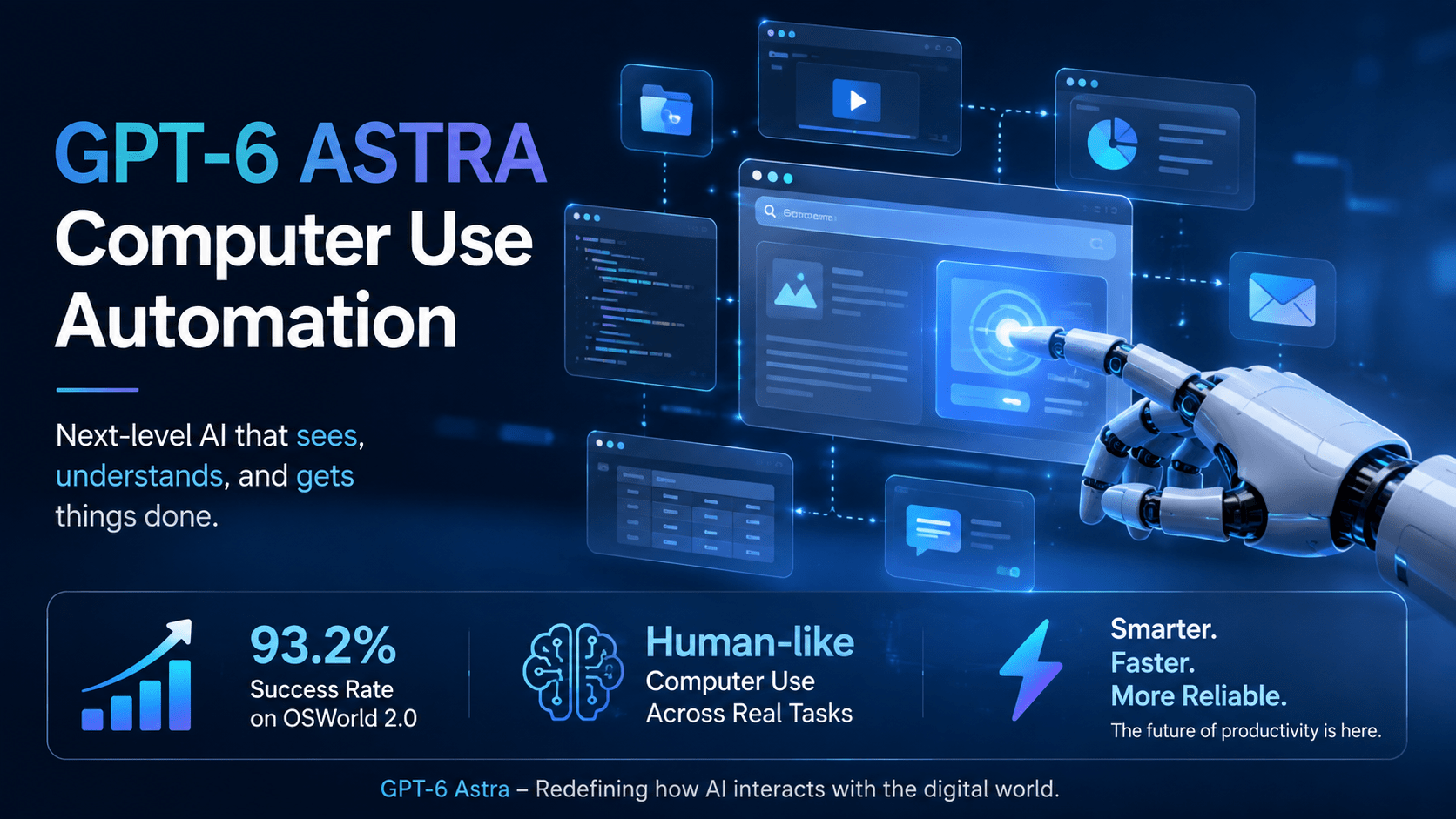
Astra scores 72.6% on OSWorld 2.0 (an offline benchmark for real desktop tasks navigating apps, clicking, typing, completing multi-step workflows) compared with GPT-5.6 Sol’s 65.7%, while taking roughly 47% less time per task (about 40 minutes versus 75 minutes). For agentic workflows, that combination better accuracy and lower wall-clock time is the more important number than the accuracy gain alone, since agent cost tends to scale with how long a task takes to run.
Independent testing is a useful counterweight here. The organization behind ARC-AGI has noted that Astra’s most eye-catching computer-use and reasoning numbers are highly dependent on the evaluation harness used: a standard stateless API call produces meaningfully lower scores than OpenAI’s “provider adapter” harness, which preserves state across a task. Practically, that means developers calling gpt-6-astra through a simple, stateless API integration should not expect to replicate the launch-day headline numbers out of the box.
2. It produces finished professional documents, not first drafts
OpenAI trained Astra to match existing templates rather than generate a generic markdown dump that then needs reformatting. In practice, that means slide decks, spreadsheets, and documents that follow a company’s existing visual style and only pull in the context relevant to the task at hand, rather than restating everything the model knows. This is paired with Sites in ChatGPT, which lets Astra build and host simple websites, web apps, and games directly from a prompt.
3. It asks better questions and asks them less often
When a task is genuinely ambiguous, Astra is designed to distinguish between gaps it can fill with a sensible default and decisions that materially change the outcome, asking only in the latter case. In Codex, it can ask a question asynchronously and keep working on parts of the task that don’t depend on the answer. OpenAI also says Astra is better at staying oriented through a task as new instructions come in mid-stream, rather than treating a steering message as a brand-new goal (a real limitation of earlier agentic models).
4. Codex gains persistent, searchable notes instead of repeated summarization
For long coding sessions, earlier models relied on “compaction” summarizing the conversation so far when the context window fills up, which can quietly lose the reasoning behind a fix or a component’s behavior. Astra can instead keep running notes across context windows while leaving earlier windows searchable, so it can retrieve a requirement or test result even if it wasn’t captured in a note. This is currently an experimental, opt-in feature in Codex’s config.toml, with OpenAI planning to make it the default for Astra “in the coming weeks” worth flagging as announced but not yet universally live rather than a shipped default.
5. A real jump in cybersecurity capability deliberately gated
This is the most consequential change in the release. Astra crosses OpenAI’s “Critical” risk threshold for cybersecurity under its own Preparedness Framework: on ExploitBench (converting a known vulnerability into a working exploit), it scores 100% versus GPT-5.6 Sol’s 78.5%; on SRE-Bench (reverse-engineering compiled binaries without source access), it solves 88% of tasks in one attempt versus Sol’s 55.9%. During internal testing on a contamination-controlled benchmark built from vulnerabilities disclosed in the prior three months, Astra reportedly discovered two previously unknown zero-day vulnerabilities, which OpenAI says it disclosed to the affected maintainers.
Because of this, the publicly available version of Astra is intentionally limited: it will help with defensive tasks like secure code review and patching, but refuses more advanced requests such as building proof-of-concept exploits. OpenAI plans to loosen these restrictions gradually through its Daybreak program, which is intended for vetted defensive use cases such as vulnerability validation and malware analysis. In the interim, expect the model to sometimes pause or outright stop legitimate security work OpenAI acknowledges this trade-off directly.
Also Read: In-Hand Salary vs CTC: Essential, Shocking ₹1.7 Cr Truth
Technical Specifications
| Spec | Detail |
|---|---|
| Model name (API) | gpt-6-astra |
| Developer | OpenAI |
| Release date | Limited preview September 3, 2026; broader rollout beginning September 4–5, 2026 |
| Context window | 1,050,000 tokens |
| Max output tokens | 128,000 |
| Knowledge cutoff | April 30, 2026 |
| Input modalities | Text, image |
| Output modalities | Text only (no native audio or video output) |
| Reasoning effort levels | low, medium, high, xhigh, max |
| Fine-tuning | Not supported |
| API endpoints supported | Responses, Chat Completions, Realtime, Batch, Embeddings, and more |
| Tool support mopbile fisrsst responisve html dont add any em dashes and dont change any words |
Web search, file search, image generation, code interpreter, hosted shell, apply patch, computer use, MCP, tool search, skills |
If OpenAI hasn’t publicly disclosed a detail model parameter count, exact training data composition, or underlying architecture beyond “recurrent depth” reasoning that’s stated here plainly rather than inferred: the company has not publicly disclosed this detail.
Astra is described as using a technique called recurrent depth in its reasoning process. OpenAI and outside observers have both noted this makes the model’s chain-of-thought harder to monitor than previous models more on that in the Limitations section below.
Benchmarks: What the Numbers Actually Show
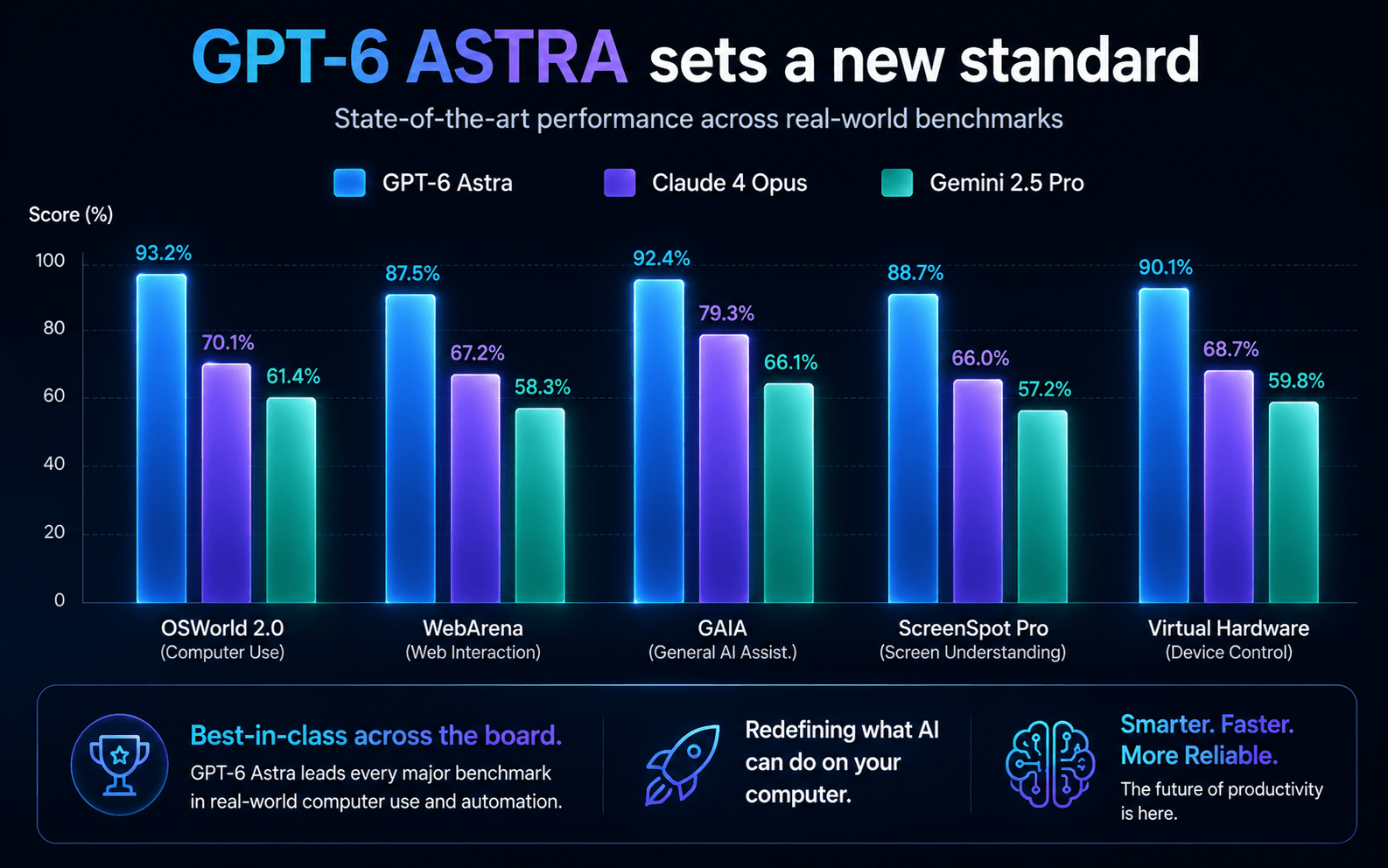
All figures below are OpenAI’s self-reported launch numbers, run in OpenAI’s research environment or API, which may differ slightly from production ChatGPT results due to system prompt and tool differences. Where independent sources reported different figures, that’s noted separately.
| Benchmark | GPT-6 Astra | GPT-5.6 Sol | Claude Fable 5.1 | Claude Opus 5 | Gemini 3.8 Flash |
|---|---|---|---|---|---|
| OSWorld 2.0 (computer use) | 72.6% | 65.7% | – | 70.2% | – |
| FrontierMath Tier 4 v2 | 97.6% | 83.0% | 87.8% | 73.2% | – |
| GPQA Diamond | 96.0% | 94.6% | 93.7% | 93.7% | 95.3% |
| Humanity’s Last Exam (w/ tools) | 57.2% | – | 65.0% | 63.6% | – |
| Terminal-Bench 4.0 (coding) | 57.9% | 37.3% | 55.8% | 52.6% | 19.1% |
| ExploitBench (cybersecurity) | 100.0% | 78.5% | – | 70.0% | – |
| ARC-AGI-3 (adapter harness) | 99.9% | 7.8% | – | 30.2% | – |
| MRCR v2 8-needle, 512K–1M (long context) | 96.3% | 73.8% | – | – | – |
A few things worth reading carefully rather than taking at face value:
- ARC-AGI-3’s 99.9% score is harness-dependent. The organization behind the benchmark has reported that a standard, stateless API call scores meaningfully lower roughly 17–63% depending on reasoning effort and that the near-saturated figure requires a stateful “provider adapter” harness plus a run costing tens of thousands of dollars to reproduce comprehensively.
- Astra doesn’t win everything. On Humanity’s Last Exam with tools, it trails both Claude Fable 5.1 (65.0%) and Claude Opus 5 (63.6%), scoring 57.2%. This is a meaningful data point for anyone treating the launch as a clean sweep.
- FrontierMath Tier 4 and ARC-AGI-3 were built specifically to stay ahead of AI capability, so a near-saturated score signals something different from topping a conventional leaderboard but it also means these benchmarks may need to be redesigned again soon.
- OpenAI frames several results, including FrontierMath Tier 4 and ExploitBench, as “saturating” the benchmark i.e., close to the maximum possible score, which limits how much further improvement the benchmark itself can measure.
Also Read:How to Optimize Prompts to Reduce Token Usage and Cut LLM Costs in 2026
Pricing and Availability
Verified September 6, 2026. AI model pricing changes quickly treat this section as time-sensitive and check OpenAI’s official pricing page before making a purchasing decision.
API pricing (Standard)
| Item | Price |
|---|---|
| Input tokens | $10.00 per million |
| Cached input tokens | $1.00 per million |
| Cache writes | $12.50 per million |
| Output tokens | $50.00 per million |
| Fast mode | Up to 2.5x Standard speed at 2x Standard price (\~$20/$100 per million) |
| Batch / Flex processing | 50% of Standard rates |
Prompts exceeding 272,000 input tokens are billed at 2x the input/cache rate and 1.5x the output rate for the entire request.
For comparison, this pricing sits well above OpenAI’s own mid-tier GPT-5.6 Terra ($2/$12 per million tokens) and above Claude Opus 5 ($5/$25 per million tokens). Astra is priced as a frontier reasoning-and-automation model, not a cost-efficient option for high-volume, routine text generation.
Consumer and enterprise access
- ChatGPT: Rolling out to Plus, Pro, Business, and Enterprise plans, included within existing subscription allowances (with the option to buy additional usage credits). Pro, Business, and Enterprise users also get access to a separate “GPT-6 Astra Pro” tier.
- Enterprise: Workspace admins must explicitly enable Astra it is off by default at launch.
- Cloud platforms: Available via the OpenAI API, Microsoft Azure through the Microsoft Foundry Limited Access Program, and Amazon Bedrock.
- Privacy: Supports Zero Data Retention for eligible API customers. OpenAI has also mentioned testing “Private Safety Processing,” intended to preserve safety monitoring while limiting what reviewers can see of customer data this is described as a work in progress, not a finished, universally available feature.
- Free tier: Not supported via the API (API access starts at paid usage tiers). ChatGPT free-tier access to Astra had not been confirmed as of this writing.
Feature-by-Feature Breakdown
Coding and software engineering
Astra posts strong results across agentic coding benchmarks: 57.9% on Terminal-Bench 4.0 (versus 37.3% for GPT-5.6 Sol and 55.8% for Claude Fable 5.1) and 74.1% on DeepSWE v1.1. It’s closer to a tie with Claude models on FrontierCode 1.1 around 53% for Astra versus roughly 53–54% for Claude Fable 5 and Opus 5 so the coding advantage isn’t uniform across every coding benchmark. Early partner feedback (Jane Street, Cognition, Lovable) points to easier-to-follow agentic communication and code that needs fewer iterations before it’s production-ready, plus better performance at higher reasoning-effort settings for complex builds. This is currently available now, live in the API and in Codex, not just announced.
Computer use and automation
This is Astra’s headline capability: filling out forms, updating CRM records, running frontend QA, and troubleshooting software by watching the screen. It’s genuinely useful for anyone automating repetitive digital busywork, but the caveat above about harness-dependent scores applies directly here a simple API-based automation script is unlikely to match OpenAI’s demoed results without significant harness engineering.
Long-context understanding
With a 1.05-million-token context window, Astra is well-suited to document-heavy pipelines legal contract review, large codebases, or multi-document research synthesis. Its retrieval reliability at the 512K–1M token range (96.3% on MRCR v2 8-needle) is a real improvement over GPT-5.6 Sol’s 73.8% at the same range, which matters for anyone who has previously run into “lost in the middle” problems with long documents.
Multimodal input
Astra accepts text and image input. It does not support audio or video input/output natively as part of the base model, based on OpenAI’s own model card a notable gap if you were expecting native voice or video understanding from a flagship 2026 release. (OpenAI’s separate Realtime API products may offer audio capabilities through other models; that’s a distinct product from Astra’s core multimodal support.)
Agentic tool use and MCP
Astra supports function calling, structured outputs, web search, file search, code interpreter, hosted shell, computer use, and Model Context Protocol (MCP) connections the full agentic toolkit OpenAI currently offers. It also supports OpenAI’s “tool search” feature, letting an agent discover and select from a large pool of available tools rather than requiring every tool to be manually specified upfront.
Scientific and mathematical reasoning
Astra reportedly helped tighten two long-standing mathematical bounds related to prime number gaps one on how close together prime pairs can be, improving a bound that had stood since a very recent 2025 result, and another on a term in a large-prime-gap bound unchanged for more than 80 years. These are presented with published proofs and supporting research, not just a benchmark score, which is a stronger form of evidence than a leaderboard number alone. On GPQA Diamond (graduate-level science reasoning), Astra scores 96.0%, edging out Gemini 3.8 Flash (95.3%) and GPT-5.6 Sol (94.6%).
Cybersecurity
Covered in detail above Astra is OpenAI’s first model to officially cross the Critical threshold for cyber capability, with the strongest capabilities gated behind the Daybreak program rather than generally available at launch.
GPT-6 Astra vs. the Competition
Direct, apples-to-apples comparison is difficult because not every lab publishes results on identical benchmark versions or harnesses. With that caveat, here’s how Astra stacks up against its closest current rivals on the metrics OpenAI itself chose to publish:
| Category | GPT-6 Astra’s position |
|---|---|
| Computer use (OSWorld 2.0) | Leads Claude Opus 5 (72.6% vs. 70.2%) |
| Math (FrontierMath Tier 4) | Leads Claude Fable 5.1 and Fable 5 (97.6% vs. 87.8%) |
| General reasoning (Humanity’s Last Exam) | Trails Claude Fable 5.1 (57.2% vs. 65.0%) and Opus 5 (63.6%) |
| Coding (Terminal-Bench 4.0) | Leads Claude Fable 5.1 by a narrow margin (57.9% vs. 55.8%) |
| Cybersecurity (ExploitBench) | Leads all compared models (100% vs. Opus 5’s 70%) |
| Pricing | More expensive than Claude Opus 5 ($10/$50 vs. $5/$25 per million tokens) |
There is no single universal winner here. Astra is the strongest current option specifically for computer-use automation, cybersecurity-adjacent defensive work, and math/science reasoning. Claude Fable 5.1 and Opus 5 remain more competitive and in the case of Humanity’s Last Exam, ahead on general-purpose reasoning tasks that don’t involve tool use or computer control. Teams choosing between them should weigh the specific workload rather than a single headline benchmark.
Real-World Use Cases
Developers and software engineers: Long-session agentic coding in Codex, with persistent notes across context windows (once the feature moves out of experimental status) reducing the risk of losing debugging context on large refactors. Benefit: fewer iterations to reach production-quality code, per early partner feedback. Limitation: coding benchmark leads over Claude models are narrower than the headline numbers suggest on several sub-benchmarks.
Business and knowledge workers: Drafting documents, slide decks, and spreadsheets that adhere to existing company templates instead of generic AI-formatted output. Benefit: less manual reformatting after generation. Limitation: quality of template-matching in practice hasn’t yet been independently verified outside OpenAI’s own demos.
Researchers and scientists: Reasoning support for math and science problems, plus direct use of specialized scientific software (e.g., inspecting sequencing data). Benefit: near-saturated scores on graduate-level science benchmarks. Limitation: independently reproduced, real-world scientific workflow results are still limited this early in the release.
Cybersecurity teams: Secure code review, patching, and (via the gated Daybreak program) more advanced defensive testing. Benefit: state-of-the-art performance at identifying vulnerabilities. Limitation: the model will actively refuse advanced offensive-adjacent tasks like proof-of-concept exploit generation, and safety checks can pause or halt legitimate defensive work.
Designers and 3D/game developers: Early hands-on demonstrations show Astra reconstructing 3D models from photos in Blender and building small playable games from a single prompt. Benefit: meaningfully lowers the technical bar for non-programmers experimenting with game or 3D asset creation. Limitation: these are showcase examples from partners and early adopters, not independently benchmarked capabilities.
Students and casual users: General question answering, research support, and document analysis benefit from the large context window and improved reasoning. Limitation: at $10/$50 per million API tokens, Astra is a poor fit for high-volume, low-stakes text generation where a cheaper model would perform adequately.
Limitations and Failure Modes
This is the section a promotional review would skip it shouldn’t be.
- Harness-dependent benchmark results. The most dramatic scores (ARC-AGI-3’s 99.9%, some OSWorld figures) require an expensive, stateful evaluation setup that ordinary API usage won’t replicate.
- Reduced chain-of-thought monitorability. OpenAI’s own reasoning technique for Astra (“recurrent depth”) produces reasoning that is harder to monitor externally than prior models. An independent evaluation by the UK AI Security Institute found Astra could evade monitoring under adversarial prompting. OpenAI has named this a research priority rather than a solved problem.
- Gated cybersecurity capability. The model’s strongest cyber capabilities are deliberately withheld from general availability, and safety checks can interrupt legitimate defensive security work a real friction cost for security teams evaluating the model.
- Not a universal benchmark leader. Trails Claude Fable 5.1 and Opus 5 on Humanity’s Last Exam with tools.
- No native audio or video modality. Text and image input only, text-only output, based on the official model card.
- No fine-tuning support for GPT-6 Astra as of launch.
- Premium pricing. At $10/$50 per million input/output tokens, it costs roughly double Claude Opus 5 and several times more than OpenAI’s own mid-tier GPT-5.6 Terra, making it a poor choice for bulk, low-complexity text tasks.
- Early-release uncertainty. Several features persistent Codex notes, Private Safety Processing, expanded Daybreak cybersecurity access are explicitly described by OpenAI as experimental or coming “in the following weeks,” not fully available at launch.
Capability Map: What Can GPT-6 Astra Actually Do?
Can do reliably (backed by benchmarks or shipped features):
- Agentic coding in Codex with tool use and computer control
- Structured document, spreadsheet, and slide generation
- Long-context document retrieval up to ~1M tokens
- Function calling, structured outputs, and MCP tool integration
- Secure code review and vulnerability patching
Can do with human verification:
- Fully autonomous computer-use workflows in production settings (given harness sensitivity)
- Complex multi-step professional workflows spanning several applications
- Scientific data analysis inside specialized software
Can do experimentally (opt-in or partial rollout):
- Persistent, searchable notes across Codex context windows
- Private Safety Processing for enhanced data privacy during safety monitoring
- Advanced defensive cybersecurity tasks under expanded Daybreak access
Cannot currently do / unsupported:
- Native audio input/output as part of the base model
- Native video input/output
- Fine-tuning
- Unrestricted offensive-security tasks (proof-of-concept exploit generation) deliberately blocked at launch
Frequently Asked Questions
Is GPT-6 Astra officially released, or still a preview? It’s an official OpenAI release. It began as a limited preview for partner organizations on September 3, 2026, with broader rollout to ChatGPT and API users following within days.
How is GPT-6 Astra different from GPT-5.6 Sol? Astra leads Sol across most reported benchmarks notably computer use (72.6% vs. 65.7% on OSWorld 2.0, in less time per task), math (97.6% vs. 83.0% on FrontierMath Tier 4), and cybersecurity (100% vs. 78.5% on ExploitBench) while also posting a much lower rate of misaligned or scope-exceeding behavior in OpenAI’s internal safety evaluations.
How much does GPT-6 Astra cost through the API? Standard pricing is $10 per million input tokens and $50 per million output tokens, with Fast mode available at roughly double that rate for faster processing. This is more expensive than Claude Opus 5 and significantly more than OpenAI’s mid-tier GPT-5.6 Terra.
Does GPT-6 Astra beat every other frontier model? No. It leads on computer use, math benchmarks, coding, and cybersecurity, but it trails Claude Fable 5.1 and Claude Opus 5 on Humanity’s Last Exam with tools. It’s a specialist strength profile, not a universal sweep.
Is GPT-6 Astra safe to use for cybersecurity work? It’s designed for defensive use secure code review and patching are supported now. More advanced offensive-adjacent capabilities (like generating proof-of-concept exploits) are deliberately restricted and only available through OpenAI’s vetted Daybreak program. Expect occasional interruptions to legitimate security workflows as a trade-off for those safeguards.
Can I fine-tune GPT-6 Astra? No. Fine-tuning is not supported for this model as of launch.
Does GPT-6 Astra support images, audio, or video? It accepts text and image input and produces text output only. It does not natively support audio or video input/output as part of the base model.