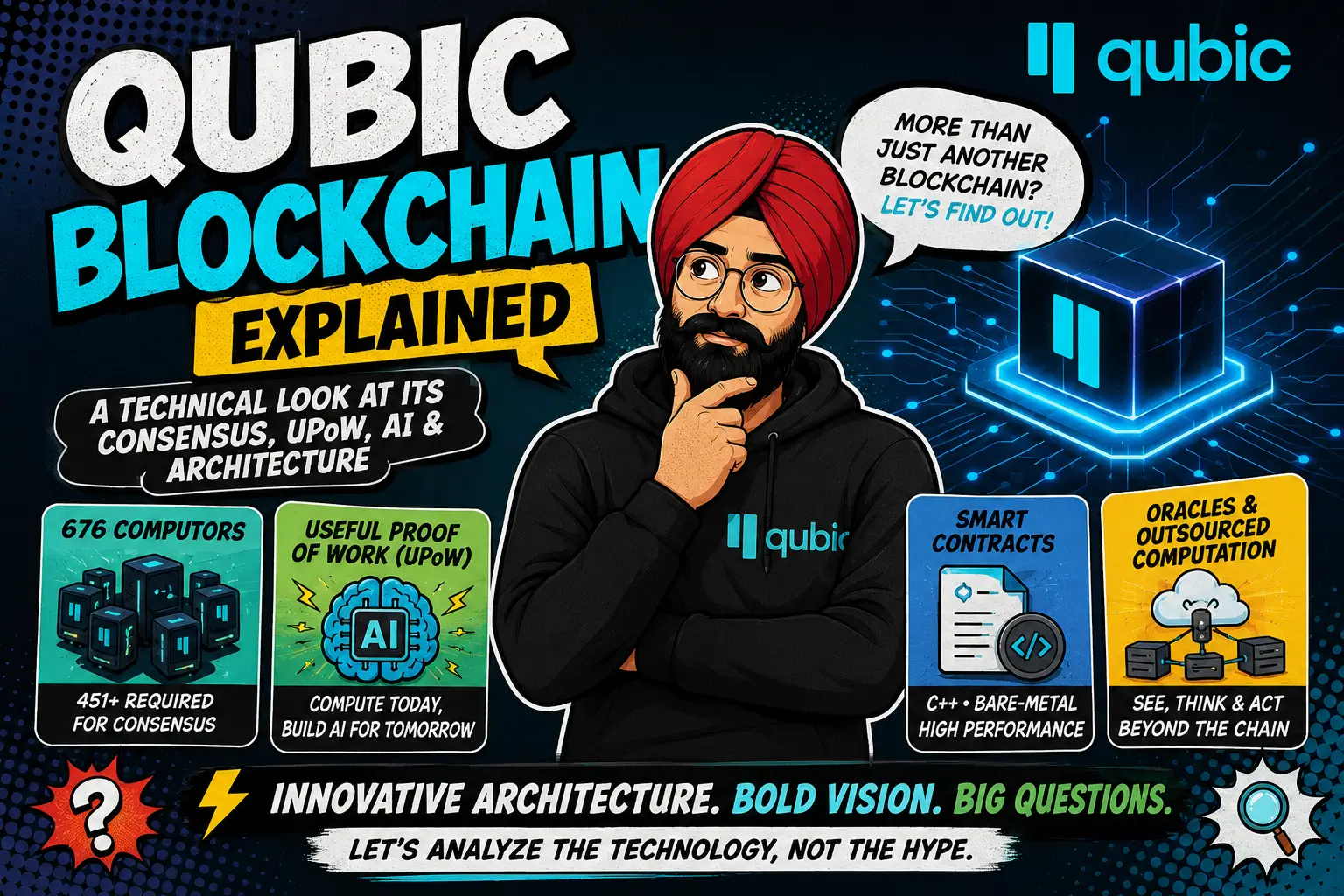

A beginner-friendly technical analysis of what Qubic is building, how its blockchain works, and where the interesting questions still remain.
There is no shortage of opinions about Qubic.Some people see it as one of the more interesting experiments happening at the intersection of blockchain, artificial intelligence and distributed computing.Others see a relatively young Layer 1 making some very ambitious claims.Both reactions are understandable.
The interesting part is that we don’t actually need to pick a side yet.Instead, let’s look at the technology.I went through Qubic’s current whitepaper, technical documentation and recent development updates to understand what the network is actually trying to build, how its architecture works, and which parts are established versus still evolving.
This isn’t a price prediction.It isn’t a “buy QUBIC” article.And it isn’t an attempt to convince anyone that Qubic will succeed.Think of this as the first part of a technical investigation.
What exactly is Qubic?
At its simplest, Qubic is a Layer 1 blockchain designed around quorum-based consensus, smart contracts and distributed computation.
But describing it simply as “another blockchain” misses the interesting part.
Qubic is trying to combine several things that normally live in separate systems:
- A blockchain network
- Smart contracts
- Distributed computation
- Useful Proof of Work
- AI-related computation
- Oracle infrastructure
- External computation through its newer outsourced-computation architecture
The current Qubic whitepaper describes the project as a Layer 1 designed for AI-driven applications. It specifically connects the network’s Useful Proof of Work, or UPoW, with distributed AI model training and validation through Aigarth.
That gives us the first important distinction.
Qubic isn’t simply trying to make transactions faster.
A large part of its design is about turning the computational resources supporting the network into something that can potentially have utility outside ordinary transaction processing.
Also Check Blockchain in Gaming Industry
That is the idea we need to examine.
How Qubic Differs From Bitcoin and Ethereum
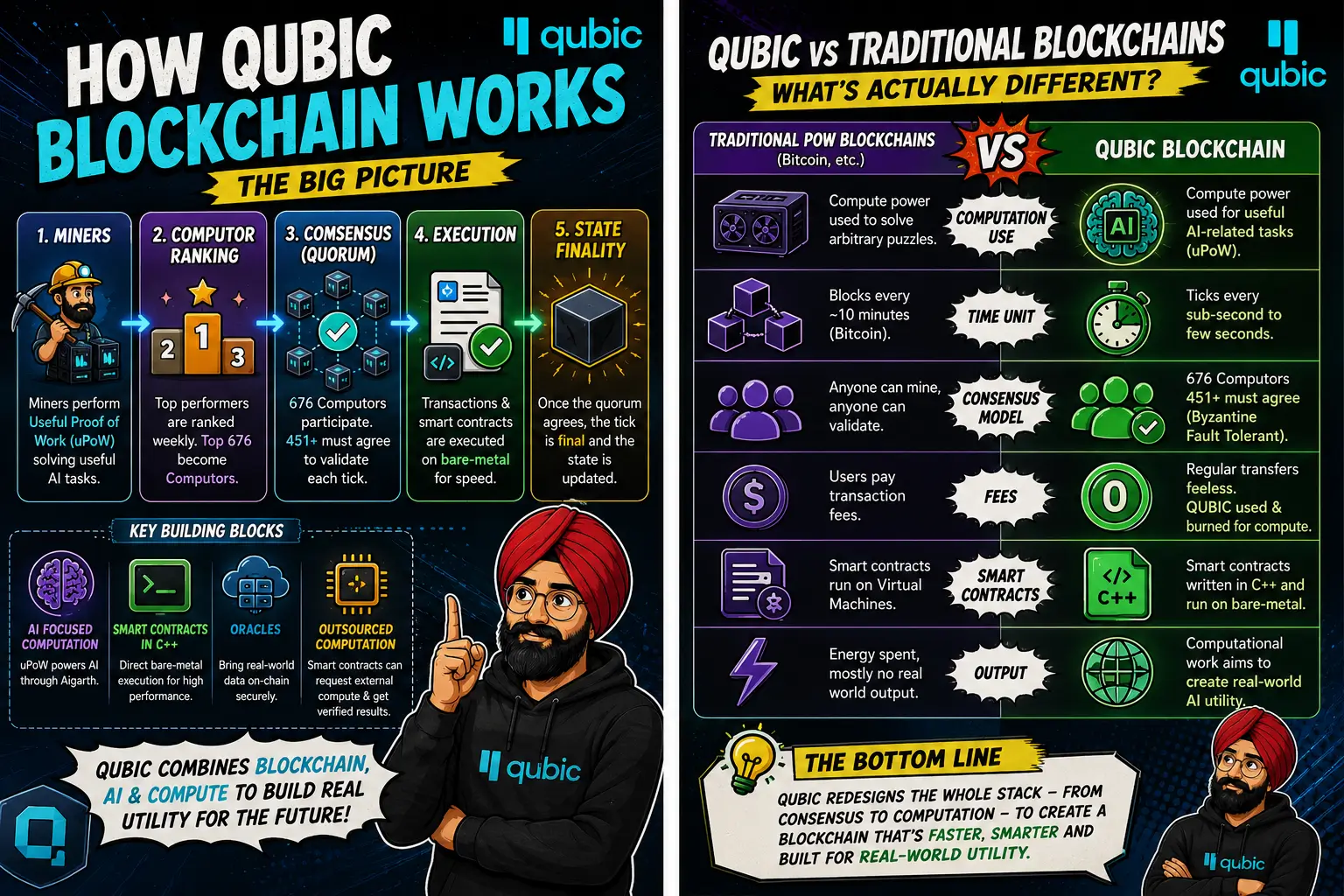
If you’ve used Bitcoin or Ethereum, you probably have a mental model that looks something like this:
Transaction → block → validation → confirmation
Qubic uses a different model.
Instead of traditional blocks, Qubic uses ticks as its basic unit of network state and execution.
A tick represents a network state snapshot containing transactions and their resulting effects. Qubic’s documentation describes ticks as occurring at sub-second to several-second intervals depending on network conditions and configuration.
This difference is more than terminology.
Qubic’s architecture schedules transactions for a future tick rather than simply placing them into a conventional mempool and waiting for the next block.
For example:
Current tick
↓
Transaction scheduled for a future tick
↓
Computors execute it
↓
Quorum agrees on the result
↓
State becomes final
This deterministic approach is one of the architectural decisions Qubic uses to target high throughput and predictable execution.
For a beginner, the easiest way to think about it is:
Bitcoin thinks in blocks. Qubic thinks in ticks.
That sounds like a small difference.
Architecturally, it isn’t.
So who validates Qubic?
This is where Qubic gets unusual.
Qubic has a fixed set of 676 Computors participating in the network’s consensus system.
A quorum requires 451 or more Computors, representing more than two-thirds of the 676.
The Computors execute transactions and smart contracts and participate in consensus decisions.
The simplified picture looks like this:
676 Computors
↓
451+ agreement
↓
Consensus
This is the part I find particularly interesting from an engineering perspective. The network doesn’t simply ask one machine to decide what happened.It asks a quorum of participating Computors to agree on the result.
Qubic’s documentation describes this as a Byzantine-fault-tolerant quorum-based system. The whitepaper also dedicates an entire section to its quorum consensus algorithm and BFT model. But there is an important question here.
Does having 676 Computors automatically make a network decentralized?
No.
The number is useful information, but it doesn’t answer the entire decentralization question.
We would also want to understand:
- Who operates those Computors?
- How many independent entities control them?
- How geographically distributed are they?
- How difficult is it to qualify?
- How concentrated is the underlying infrastructure?
- How does the Computor rotation mechanism behave over time?
Those are questions worth investigating separately.
And that’s an important distinction between describing a protocol and evaluating its real-world decentralization.
Computors and miners are not the same thing
This is another area where Qubic can be confusing for someone coming from Bitcoin.
Qubic has Computors and miners. They have different roles.
Computors participate directly in the network’s execution and consensus.
Miners contribute computational work that helps determine Computor rankings.
According to Qubic’s documentation, the network can have a much larger number of miners, while the number of active Computors is capped at 676. The performance of miners associated with Computor candidates contributes to the weekly ranking process.
So a simplified model is:
Miners
↓
Produce computational solutions
↓
Computor ranking
↓
Top 676 Computors
↓
Network execution + consensus
This is where Qubic’s Useful Proof of Work enters the picture.
What is Useful Proof of Work?

Traditional Proof of Work has a very simple concept. Machines perform enormous amounts of computation to solve a cryptographic puzzle.The work helps secure the network.But once the puzzle is solved, most of that computation has no use outside the consensus mechanism.
Qubic tries to take a different approach. Its Useful Proof of Work, or UPoW, directs computational resources toward AI-related workloads.
The current Qubic whitepaper describes UPoW as directing computational power toward productive tasks such as training and validating artificial neural networks associated with the Aigarth initiative.
In simple terms:
Traditional PoW
Compute
↓
Solve cryptographic problem
↓
Secure network
Qubic’s UPoW concept
Compute
↓
Solve computational task
↓
Contribute to AI-related workload
↓
Use the result for network-related purposes
That’s the idea.
And this is probably the single most important technical concept to understand before forming an opinion about Qubic.
But is UPoW automatically “green”?
This is where we need to be careful. You will sometimes see the argument:
“Qubic mining is useful, therefore its energy isn’t wasted.”
That’s too simplistic. Useful computation still consumes electricity.
A better statement is:
Qubic’s UPoW attempts to direct computational resources toward useful AI-related workloads instead of using computation solely to solve arbitrary PoW puzzles.
Whether the resulting computation provides enough real-world value to justify the resources consumed is a separate question.
That’s not a criticism of Qubic.
It’s simply the question that any useful-computation model eventually needs to answer.
And it is a much more interesting question than arguing about whether the word “useful” belongs in the name.
Where does AI enter the picture?
Qubic’s AI initiative is called Aigarth.
The current whitepaper describes Aigarth as a decentralized AI system running on top of Qubic, while also noting that a separate scientific publication on Qubic’s AI capabilities is intended to follow.
This distinction matters.
There are two different statements:
Statement A:
Qubic has designed its network so computational work can contribute to AI-related workloads.
That is documented.
Statement B:
Qubic will create commercially superior artificial general intelligence.
That is a much larger claim and cannot simply be treated as established fact.
The second requires evidence.
That evidence would include things such as:
- Published research
- Reproducible benchmarks
- Independent testing
- Real-world workloads
- Developer adoption
- Economic demand
This is one of the areas where I think crypto discussions often move too quickly from architecture to outcome.
A protocol can have an interesting architecture without guaranteeing that the resulting product wins its market.
Qubic’s bare-metal approach
Another interesting part of Qubic’s architecture is its focus on bare-metal execution. Traditional smart-contract platforms commonly execute contracts through virtual machines. Qubic takes a different approach.
Its documentation describes smart contracts written in C++ and executed directly on the underlying hardware rather than through a conventional virtual machine abstraction.
Why does that matter?
Because every abstraction layer can introduce overhead.
Qubic’s approach is essentially:
C++ smart contract
↓
Native execution
↓
Hardware
Instead of:
Smart contract
↓
Virtual machine
↓
Interpreter/runtime
↓
Hardware
The potential advantage is performance.
The trade-off is developer complexity.
A highly optimized system can be extremely fast, but developers generally need to understand more about the underlying environment.
That is why performance numbers alone aren’t enough.
A good Layer 1 needs both:
Performance
and
Developer accessibility
The second one is often harder.
Smart contracts on Qubic
Qubic supports smart contracts, but the model has some differences from Ethereum-style systems. Smart-contract proposals go through the Qubic quorum. According to the current documentation, 451 of 676 Computors need to participate for the vote to be valid, followed by the required approval process.
There is also an unusual IPO mechanism associated with smart contracts. A new contract goes through a Dutch-auction-style IPO involving contract shares. The resulting reserve is designed to fund future contract execution.
This is important because it connects smart-contract economics directly with the QUBIC token model.
Which brings us to one of the more misunderstood aspects of Qubic.
What does QUBIC actually do?
QUBIC isn’t simply a token sitting beside the network. According to Qubic’s documentation, QUBIC functions as an “energy” unit used for computational activity on the platform. For smart-contract execution and certain services, QUBIC is consumed and burned rather than simply transferred as a conventional transaction fee to validators.
Regular transfers are described as feeless. Smart-contract execution, however, has an associated commission mechanism. That commission is burned.
So the economic flow is different from a typical blockchain where:
User → transaction fee → validator
Qubic instead uses a model closer to:
Network activity → QUBIC consumed → QUBIC burned
while Computors receive protocol emissions through the network’s reward system.
That distinction is important when evaluating Qubic’s tokenomics.
The emission model
Qubic currently has a maximum supply of 200 trillion QUBIC, according to its documentation. That’s already a major change from the project’s earlier supply model. The current emission schedule is designed around successive reductions.
The first major halving occurred at Epoch 175, reducing net emissions from approximately 850 billion QUBIC per epoch to approximately 450 billion. The next scheduled phase targets roughly 240 billion QUBIC per epoch beginning at Epoch 227, according to the current documentation.
The important concept here isn’t simply:
“Halving = price goes up.”
That’s not how economics works.
A reduction in emissions can reduce new supply entering the market.
But price ultimately depends on the relationship between:
Supply
and
Demand
If demand doesn’t grow, lower emissions alone don’t guarantee appreciation.
That’s why I would treat the emission schedule as an important economic variable, not as a price prediction.
Qubic is also building beyond the basic blockchain layer
This is where recent development becomes particularly interesting.
Qubic has been developing three major pieces of infrastructure:
1. Smart Contracts
The on-chain logic developed by developers providing a functionality. For example Qubic Name service smart Contract is for crypto domains.
2. Oracle Machines
Oracle Machines in Qubic act as a bridge between smart contracts and real-world data. They enable smart contracts to interact with external information through the Qubic Protocol Interface (QPI). These oracles, functioning as software agents, fetch real-world information and feed it into the network. Understanding Oracle Machines is crucial for writing powerful smart contracts in Qubic.
3. Outsourced Computations
Allow smart contracts to request authorized computation outside the core chain and bring the result back.
Qubic itself describes these as three complementary pillars of its architecture.
The easiest way to understand the idea is:
Smart Contracts
= Think
↓
Oracle Machines
= See
↓
Outsourced Computation
= Act / Compute externally
That creates a much broader possibility than simply transferring tokens.
Imagine a smart contract needing:
- External market data
- A computation performed outside the chain
- A verified result
- Then an on-chain action
The architecture is designed to connect those pieces.
Outsourced computation is especially worth watching
This is one area where we should distinguish between architecture and adoption. Qubic announced that the first Outsourced Computation code reached mainnet in Epoch 223, with full production targeted for early-to-mid August 2026 at the time of its July 23 update.
That means this isn’t merely an idea sitting inside a whitepaper anymore.
But it also doesn’t mean we can already conclude that outsourced computation will become a major success.
The next questions are much more practical:
Who will use it?
What will they use it for?
How much computation will actually flow through it?
Will developers find it easier than competing infrastructure?
Will users create enough demand to make the system economically meaningful?
Those answers will matter far more than another impressive diagram.
What about Qubic’s performance?
Qubic has published extremely high throughput numbers. The project reports a CertiK-verified 15.52 million TPS benchmark, and its recent updates also describe significant improvements in real network tick speed and transaction capacity.That’s certainly interesting.
But there is an important rule when looking at blockchain performance:
A benchmark is not the same thing as organic network demand.
15 million TPS on a benchmark tells us something about what the architecture can achieve under the tested conditions. It doesn’t tell us that millions of users are currently generating that amount of activity.
So I would separate three things:
Benchmark performance
What the system can demonstrate under test conditions.
Network performance
What the live network is actually processing.
Economic demand
How much real activity developers and users actually want to put on the network. All three matter.Only the last one tells us whether the infrastructure is becoming economically useful.
One of the biggest things I would watch: adoption
This is where the technical analysis eventually leaves the laboratory.
A blockchain can have:
- Excellent consensus
- Fast execution
- Interesting tokenomics
- Sophisticated cryptography
- AI research
- High throughput
And still fail to attract users.
That’s why I wouldn’t evaluate Qubic purely by asking:
“Is the technology good?”
I’d ask:
“Is anyone building something people actually want?”
Watch:
- Developer activity
- Smart-contract deployments
- Active applications
- Transaction activity
- Stablecoin/liquidity growth
- Oracle usage
- Outsourced computation usage
- Wallet activity
- Exchange accessibility
- Independent developer participation
These indicators will tell us much more about adoption than social-media sentiment.
There are also real risks
A technical article about Qubic shouldn’t hide these.
The whitepaper itself discusses a broad set of attack vectors, including:
- Sybil attacks
- Forking attacks
- Collusion
- Replay attacks
- 51% attacks
- Eclipse attacks
- Smart-contract vulnerabilities
- Quantum-computing threats
- Malware and node compromise.
This doesn’t mean Qubic is insecure.
In fact, documenting attack vectors is exactly what we want from a serious protocol paper. But it reminds us that having a security model isn’t the same thing as having zero security risk. Every distributed system has trade-offs.
The real question is how those risks behave under actual network conditions.
The decentralization question deserves more attention
I think this is one of the most interesting areas for future Qubic research. The protocol uses a fixed set of 676 Computors. That has an obvious engineering advantage. A relatively small, known group can coordinate extremely quickly.
But there is a trade-off worth investigating:
How decentralized is the infrastructure behind those 676 participants?
Qubic separates the roles of the Quorum and Arbitrator. The project’s documentation says the Arbitrator manages tasks such as publishing Computor lists and resolving certain disputes, while the Quorum handles consensus and voting. The project specifically describes this separation as a protection against concentration of power.
That’s the protocol design. The next step is measuring how it works in practice.
And that’s an important distinction I want to maintain throughout this series:
Protocol design tells us what should happen. Network data tells us what actually happens.
Another thing I like about the architecture
One aspect of Qubic that I find genuinely interesting is that several components aren’t being designed independently.
The architecture has a fairly clear progression:
Compute
↓
Consensus
↓
Smart Contracts
↓
External Data
↓
External Computation
↓
Applications
The ambition is obvious. Qubic isn’t trying to be only a faster payment network. It’s trying to create an infrastructure layer where computation itself becomes part of the blockchain’s economic model.
Whether that becomes a meaningful advantage is still an open question. But technically, it’s an interesting problem to work on.
Where I remain cautious
There are several areas where I wouldn’t make strong conclusions yet.
AI
The decentralized AI thesis is interesting, but successful AI infrastructure requires more than distributed computation.
We need meaningful models, useful outputs, benchmarks, developers and users.
UPoW
The concept is clever.
But its long-term economic and practical value needs to be demonstrated through real workloads.
Decentralization
676 Computors is a concrete protocol parameter.
It isn’t, by itself, a complete measurement of decentralization.
Throughput
A very high benchmark is impressive.
Real-world application demand is more important.
Tokenomics
Reduced emissions and burns can affect supply dynamics.
They don’t create demand automatically.
Ecosystem
This may ultimately be the biggest variable.
Infrastructure becomes valuable when people build on it.
So, should you support Qubic?
I’m deliberately not going to answer that with a yes or no. That’s not the point of this article.
If you’re already a Qubic supporter, you should be able to understand the technology without needing someone to tell you that every part of it is perfect. If you’re skeptical, you should be able to examine the architecture without having to accept a marketing narrative.
And if you’re somewhere in the middle, that’s probably the healthiest place to start.
My current view is simple:
Qubic is technically interesting enough to deserve serious observation, but the biggest questions are no longer just about what the protocol can theoretically do. They are about adoption, decentralization in practice, economic sustainability and whether its computational infrastructure creates demand outside the existing community.
That’s where I would focus.
Not the next price target.
Not the next exchange listing.
Not another “QUBIC to the moon” prediction.
Show me the developers.
Show me the applications.
Show me the network usage.
Show me the computation being used.
Show me the economics.
Then we can make a better judgment.
What I will be watching next
For the next parts of this Qubic technical series, these are the areas I think deserve deeper investigation:
1. Qubic Consensus
How do 676 Computors and the 451 quorum actually reach agreement?
2. Useful Proof of Work
What does the mining computation actually do, and how useful are the results?
3. Qubic Tokenomics
Where does QUBIC come from, where does it go, and how do emissions and burns interact?
4. Qubic + AI
What exactly is Aigarth, what has been demonstrated, and what remains experimental?
5. Decentralization
Does the 676-Computor model provide meaningful decentralization in practice?
6. Smart Contracts
How does Qubic’s C++ and bare-metal model compare with conventional virtual-machine-based chains?
7. Oracles + Outsourced Computation
Can Qubic turn its blockchain into infrastructure that interacts with information and computation outside the chain?
8. Security
What happens when we move from protocol theory to real-world attack surfaces?
Final thought
Crypto has a strange habit of turning every technical project into a binary argument. You’re a believer. Or you’re a hater. I don’t think that helps anyone understand technology.
A better approach is to separate the facts, the project’s claims, the available evidence and our own interpretation. That’s what I’ll try to do throughout this series.
Qubic doesn’t need hype to be interesting. And it doesn’t need to be perfect to be worth studying.
Let’s look at the technology first. The market can come later.
Frequently Asked Questions
What is Qubic blockchain?
Qubic is a Layer 1 blockchain designed around quorum-based consensus, smart contracts and distributed computation, with Useful Proof of Work used for computational workloads related to AI.
What is Qubic uPoW?
uPoW stands for Useful Proof of Work. Qubic’s approach aims to direct computational resources toward useful AI-related workloads rather than using computation solely for conventional Proof of Work.
How many Computors does Qubic have?
Qubic’s consensus system uses 676 Computors, with a quorum requiring 451 or more Computors to agree.
Is Qubic a Proof of Work blockchain?
Qubic uses a computational mining mechanism called Useful Proof of Work (uPoW), but its overall consensus architecture is different from traditional Bitcoin-style Proof of Work.
What is Aigarth?
Aigarth is Qubic’s decentralized AI initiative, designed to make use of computational resources within the Qubic ecosystem.
Does Qubic have smart contracts?
Yes. Qubic supports smart contracts, including contracts written in C++ and executed using its native execution architecture.
Is Qubic decentralized?
Qubic uses a quorum-based network of 676 Computors. However, the number of Computors alone doesn’t fully determine real-world decentralization, so infrastructure ownership and distribution are important factors to examine.
Is Qubic a good investment?
This article doesn’t make an investment recommendation. Qubic is an actively developing blockchain project, and potential investors should evaluate its technology, adoption, economics, competition and risks independently.
That last answer is particularly useful because it prevents the article from accidentally becoming an investment recommendation.
Sources
- Qubic Whitepaper, Version 1
- Qubic Documentation
- Qubic Consensus Documentation
- Qubic Tokenomics Documentation
- Qubic Smart Contracts Documentation
- Qubic Node Types
- Qubic: Three Pillars of the Architecture
- Qubic July 2026 Technical Update
Disclaimer: This article is for educational and technical-analysis purposes only. It is not financial or investment advice. Qubic is an actively developing project, and technical documentation, network parameters and implementation details can change. Always verify current information and do your own research before making financial decisions.