
With the hunger of code, are you forgetting the hunger of food?
You’ve been stuck on the same bug for forty-five minutes. Your coffee’s gone cold. Your stomach growled twenty minutes ago and you told it to wait “just one more function.” If that sounds familiar, your developer snacks habits are probably whatever’s within arm’s reach of the keyboard and that’s quietly wrecking your focus, your memory, and your ability to spot the bug that’s been staring at you the whole time.
Here’s the irony. You spend your whole day optimizing applications, fine-tuning databases, and shaving off milliseconds from your API responses. Yet, the system that you never profile, never debug and optimize, is the system where it all runs on your body. Your brain is the CPU. Your food is the power supply. Right now, many developers run on a power supply that browns out every two hours.
This is not an article about diets. This is an article about coding performance. The lack of proper nutrition while coding shows itself in the form of brain fog, difficulty debugging code, lack of attention and focus and that 4PM period when you keep reading the same line again and again and still it does not make any sense. In case when left unchecked for years, those poor nutrition habits manifest themselves in the forms of weight gain, glucose metabolism issues and cardiovascular diseases – the stereotypical path of a sedentary developer health. Proper developer snacks won’t replace sleep and proper management, but will get you through 90% of fatigue problems.
Why Developers Crave Sugar Instead of Reaching for Developer Snacks
Programming is cognitively demanding. Maintaining a model of the source base, managing state variables, and making inferences about side-effects all drain glucose from your brain far more quickly than almost any other cognitive activity. Glucose levels drop, your brain seeks a quick solution, and refined carbohydrate treats give a nearly instant hit of glucose. This is the reason behind the 3 PM cookie break; it is not a failure of willpower, it is a resource crisis your brain needs to address.
It is a familiar pattern of poor system design; an immediate fix creates problems down the line. Blood glucose spikes, then insulin overcompensates, dropping glucose levels below where they were to start with. In twenty minutes, you are feeling less focused than you would have been without the treat in the first place. The classic ‘cache-and-crash’ scenario, and the reason that most programmers are caught in the cycle is simply that proper programmer snacks are not available.
Provision of better snacks for developers ahead of time will break this cycle before it gets started. If the easy choice at 3 PM is a jar of nuts rather than a vending machine, then the choice almost picks itself.
This is all made worse by stress. Stress hormones like cortisol increase appetite, but more specifically they increase appetite for foods high in sugar and fat your body recognizing this as an emergency state and seeking quick energy. It can help to realize that your body isn’t telling you that you’re hungry, it’s telling you that you’re stressed.
Your Brain Runs on Glucose, and the Right Developer Snacks Keep It Steady
Rather than viewing the glucose system as a battery, consider it as a construction pipeline that must receive a constant supply of energy but cannot be charged all at once. The food with a high glycemic index, including white bread, sweet beverages, and most biscuits, leads to a quick peak in glucose levels and rapid fall. The food with a low-to-medium glycemic index, such as oatmeal, nuts, legumes, and natural fruits, leads to a gradual rise in glucose levels and can maintain it within certain limits for several hours.
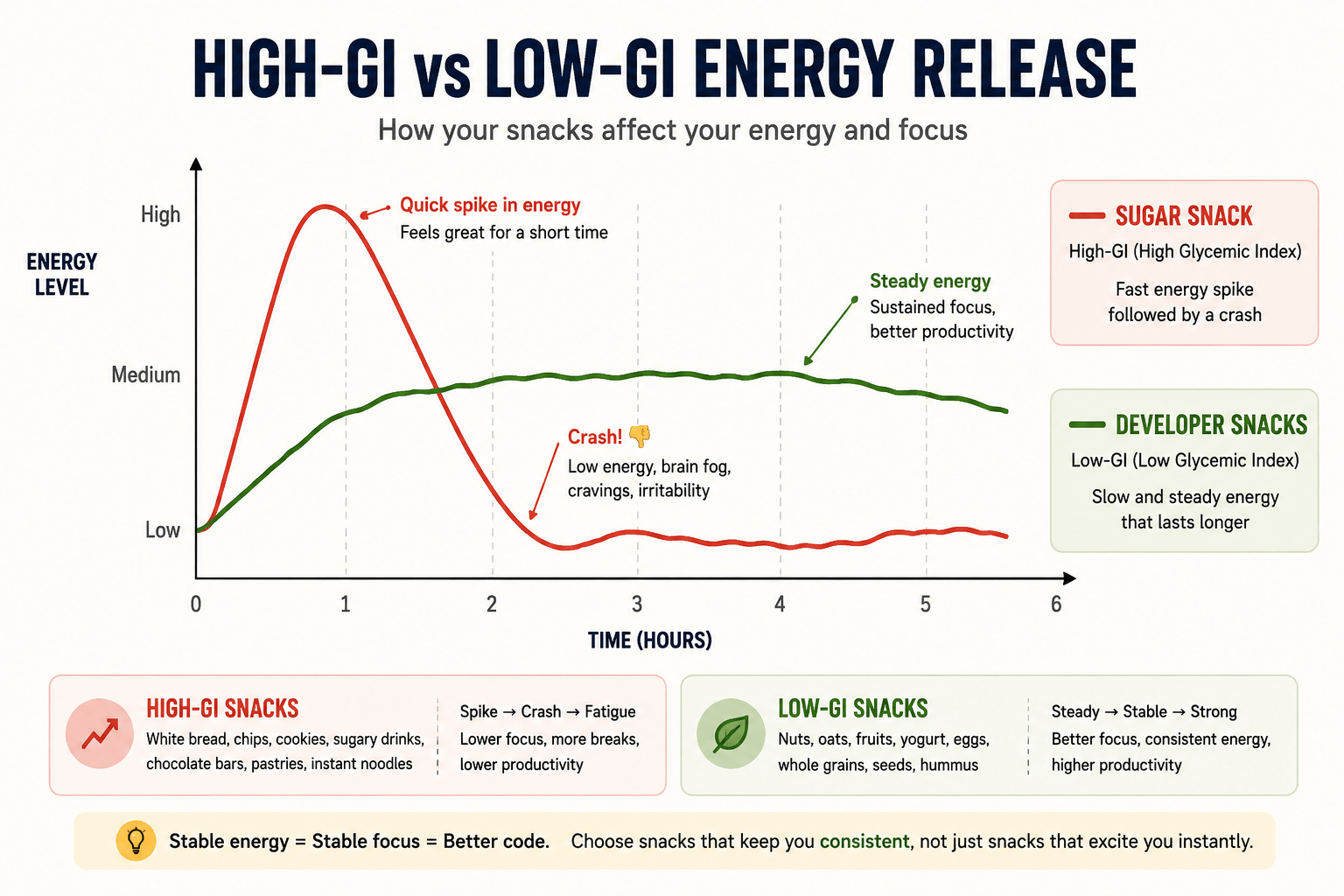
It is essential for programming more than any other occupation. Debugging and systems architecture require long-term use of the working memory maintaining multiple variables and their connections in the mind simultaneously. The research into the glycemic balance gives the following results: meals with a low glycemic index show better effects concerning sustained attention and memory recall compared to high-GI food meals of equal calorie content, though there is some disagreement among researchers about the general significance of these results. Anyhow, appropriate snacks of a programmer keep glucose flat, meaning being in the zone for longer than every 90 minutes.
Also Read: smart work from home tools india
Coffee and Energy Drinks Are Not a Substitute for Real Developer Snacks
Caffeine blocks adenosine, the substance that causes drowsiness, making coffee feel like focus in a liquid form. However, caffeine does not provide any fuel for the body it only puts off the feeling of low energy until its effects wear out. Skipping the meals and relying on coffee throughout a programming session means dealing with the lack of glucose by masking it rather than resolving the issue.
In case of energy drinks, the situation becomes even worse. Along with caffeine, energy drinks provide a massive sugar rush that causes a person to become highly attentive and then face an even harsher crash than one caused by caffeine after about 90 minutes. When using energy drinks for studying all night before the deadline, one takes borrowed attention from the future self.
None of this means quitting coffee. It means treating caffeine as a supplement to real food, not a substitute for it. A coffee with a healthy snack for developers alongside it nuts, yogurt, a piece of fruit outperforms a coffee on an empty stomach almost every time.
Hydration Matters as Much as Developer Snacks for Cognitive Performance
Even mild dehydration as little as 1–2% of body water lost is linked in several studies to reduced concentration, slower reaction time, and increased perceived difficulty of mental tasks, though results vary by study and by gender. Most developers hit this threshold without noticing, because you don’t feel “thirsty” the way you feel “hungry”; you just feel foggy, irritable, or oddly tired mid-session.
A practical fix: keep a large water bottle at your desk and treat refilling it as a natural break point, the same way you’d step away after pushing a commit. If plain water feels boring during a long session, add a slice of lemon or a few mint leaves no sugar, still hydrating, and it gives your hands something to do besides reaching for chips.
The Long-Term Cost Sedentary Developers Rarely Talk About
In the short term, neglecting to eat the right kinds of snacks leads to fog and tiredness. In the long term, the typical profile of someone that sits in front of a computer all day snacking on lots of sugar, eating irregularly, and doing little physical activity has been correlated with obesity, type 2 diabetes, and heart disease. Low levels of vitamin D and B12 are also commonly seen in those that sit for long periods indoors and snack instead of having regular meals.
None of this is meant to frighten you into starving yourself. It is meant to get you to think about snacking as part of the infrastructure of your job, rather than something to tack on later. If you release an application and don’t measure the resources it uses, you’ll have problems. If you don’t measure your body’s resources, you will too.
Also Read: master react
The Best Developer Snacks for Focused Coding Sessions
The goal with any good developer snack is slow, steady energy release plus specific nutrients your brain uses heavily during focused work mainly glucose stability, omega-3 fats, protein, and B vitamins. Here’s what to reach for, and why each one earns its place on your desk among your go-to developer snacks.
Nuts and Seeds One of the Easiest Developer Snacks to Keep Stocked
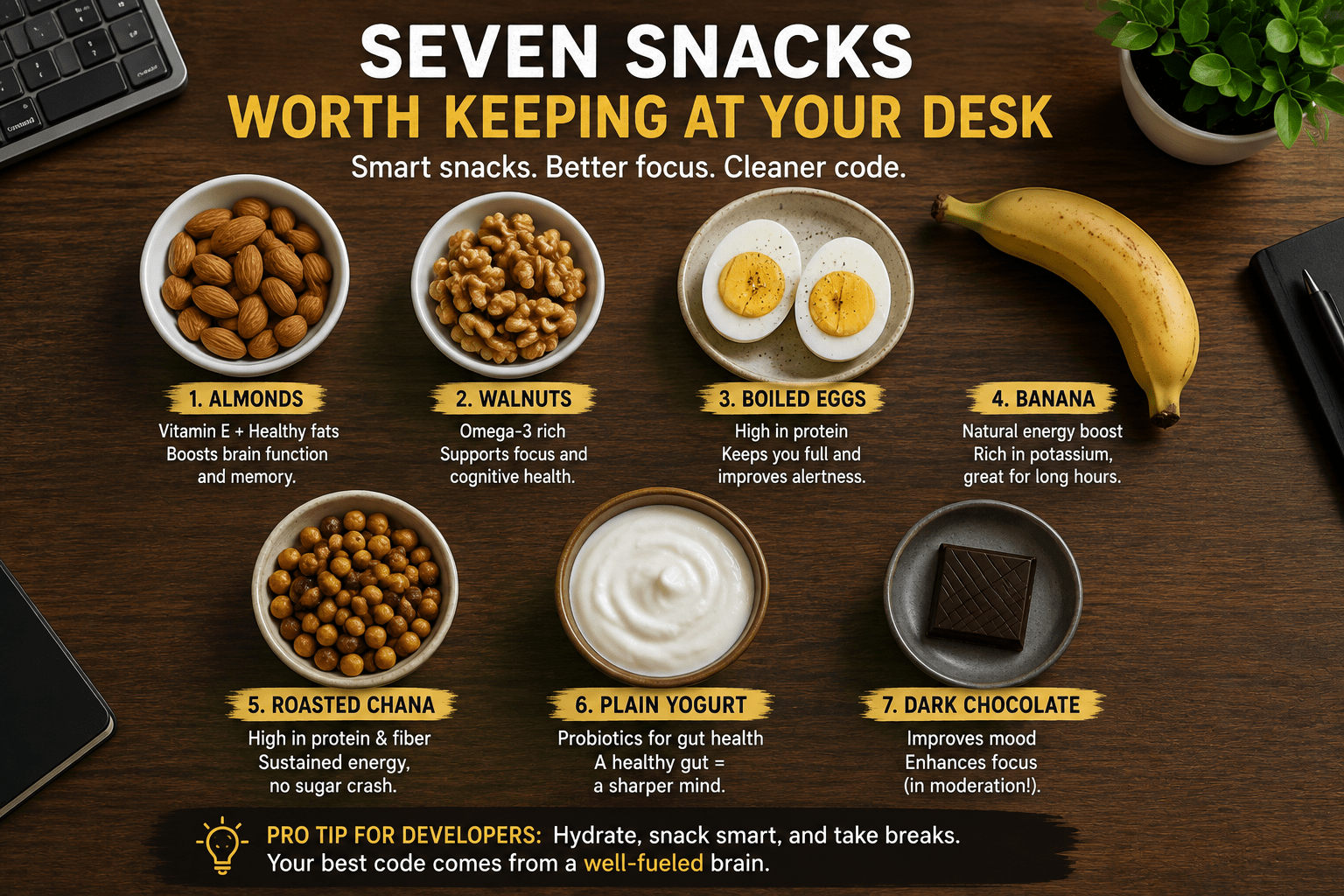
A small handful of almonds, walnuts, or mixed seeds delivers protein, fiber, and healthy fats together, which slows digestion and keeps glucose release steady for hours. Walnuts specifically contain omega-3 fatty acids linked to memory and cognitive function in multiple nutrition studies. Best eaten mid-morning or mid-afternoon, about 20–30 minutes before you expect a focus dip, not after you’re already crashing.
Roasted Chickpeas or Peanuts (Best Budget-Friendly Developer Snacks)
Roasted chana or peanuts are cheap, widely available, and pack plant protein and fiber into a snack that costs a fraction of packaged chips. The protein-fiber combination slows the glucose release compared to a carb-only snack of the same size. Keep a jar at your desk it’s shelf-stable for weeks and doesn’t need refrigeration.
Greek Yogurt or Curd (Best for Sustained Focus During Long Sessions)
Protein content in Greek yogurt or plain curd is significantly higher than regular yogurt, and protein slows the rate at which any carbs you eat alongside it hit your bloodstream. Add a few berries or a drizzle of honey if you want sweetness without a straight sugar spike. Best eaten as a proper mid-session snack, not a dessert think 4 PM, not 9 PM.
Whole Fruit (Best for a Quick, Real Sugar Fix)
Fruit contains natural sugar, but the fiber in the whole fruit slows absorption compared to juice or dried-fruit snacks with added sugar. A banana, apple, or orange gives you real glucose plus potassium and vitamin C, without the crash that follows a candy bar. Eat it when the craving is genuinely for something sweet fighting that craving with willpower alone rarely wins by 6 PM.
Boiled Eggs (Best for Protein Without Prep Time)
Two boiled eggs deliver complete protein and choline, a nutrient directly involved in memory and neurotransmitter production. They take under ten minutes to prepare in a batch of six and keep in the fridge for days, making them one of the lowest-effort high-value healthy snacks for developers available. Best eaten alongside your first coffee of the day, not as a late-night snack.
Oats or Overnight Oats (Best Before a Long Coding Block)
Oats have a low glycemic index and a high fiber content, which means the glucose they release stays steady for three to four hours rather than spiking and crashing. Prepping overnight oats the night before takes five minutes and removes the “too tired to cook” excuse on a heavy sprint day. Best eaten 30–60 minutes before a coding block you expect to run long.
Dark Chocolate, 70%+ Cocoa (Best for the Sweet Craving That Won’t Quit)
Dark chocolate at 70% cocoa or higher has meaningfully less sugar than milk chocolate and contains flavonoids linked in some studies to improved blood flow, including to the brain. It’s not a health food, but as a craving-management tool it beats a candy bar or a second cookie. One or two small squares, not the whole bar treat it as a controlled release, not an all-you-can-eat buffer.
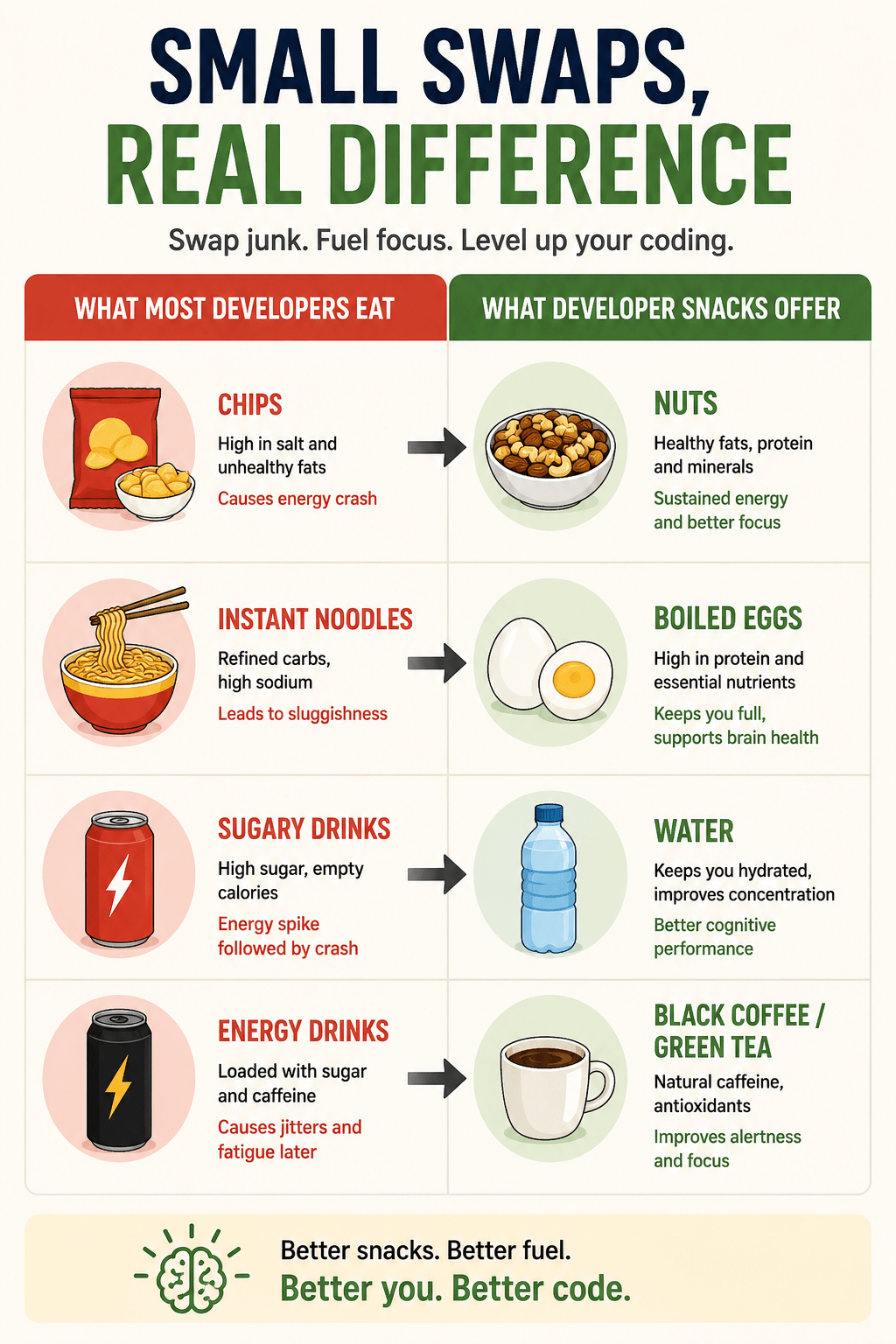
Swapping Out the Usual Coding-Session Junk Food
You don’t need to overhaul your whole diet overnight. Small, repeatable swaps that turn the junk food near your keyboard into real developer snacks do most of the work.
Healthy Food Swaps
| Instead Of | Try This | Why It Works |
|---|---|---|
| Potato chips | Roasted chickpeas or makhana (fox nuts) | Similar crunch, far less refined fat and sodium, more fiber. |
| Instant noodles | Boiled eggs + whole-grain toast | Real protein instead of mostly refined carbs and sodium. |
| Sugary biscuits | Dark chocolate (70%+) or a banana | Controlled sugar and fiber instead of a fast spike-and-crash. |
| Soft drinks / cola | Water with lemon, or unsweetened buttermilk (chaas) | Hydration without the sugar load, still refreshing. |
| Energy drinks | Coffee + a handful of nuts | Caffeine paired with real fuel instead of caffeine plus sugar. |
Developer Snacks Setups for Every Kind of Coder
Office developers usually have a fridge and a microwave nearby, so boiled eggs, Greek yogurt, and pre-cut fruit are realistic developer snacks even on a packed meeting day. Keep a jar of roasted nuts or chana in your desk drawer for the moments a vending machine looks tempting.
Remote workers have the advantage of a full kitchen but the disadvantage of zero commute-based structure to force a break. Set a recurring reminder the same way you’d set one for a stand-up to actually get up and prepare real developer snacks at least twice per work session.
Students are often working with the tightest budget and the least kitchen access. Roasted chana, peanuts, bananas, and boiled eggs are all cheap, need no cooking equipment beyond a small pot, and travel well to a library or a lab.
Late-night coders face the hardest version of this problem, because most “convenient” late-night food is also the most sugar- and fat-heavy. Keeping simple developer snacks like a small bowl of oats, a boiled egg, or a piece of fruit ready an hour before a late session keeps you sharper than instant noodles or a soda run, without the 2 AM sugar crash that makes the next hour worse than the one before it.
Building a Simple Developer Snacks Stack (Not a Diet Plan)
You don’t need a nutrition plan any more complex than the tools you already use daily. Keep this simple, repeatable setup on hand and you’ll cover most coding sessions without thinking hard about it:
- Base layer (always stocked): nuts, roasted chana, or peanuts in a jar at your desk
- Protein layer (weekly prep): a batch of six boiled eggs or a tub of Greek yogurt/curd
- Quick-carb layer (buy fresh, twice a week): bananas, apples, or whatever fruit is in season
- Craving-management layer (one bar, portioned): 70%+ dark chocolate, kept out of easy reach so grabbing it is a decision, not a reflex
- Hydration layer (always running): a full water bottle at your desk, refilled at natural break points
Think of it the way you’d think of a default config file set your developer snacks up once, and the stack quietly does its job without needing daily decisions.
9. FAQ
Is coffee bad for developers who code long hours?
Coffee itself isn’t the problem coffee as a meal replacement is. Caffeine delays tiredness without adding fuel, so pairing it with real developer snacks works far better than relying on coffee alone through a long session.
What are the best developer snacks for late-night coding?
Oats, a boiled egg, or a piece of fruit eaten about an hour before the session starts. All three release energy slowly, unlike instant noodles or sugary snacks, which spike and crash within an hour or two.
How much water should a developer drink during a coding session?
There’s no universal number, but a simple practical marker works well: if you haven’t refilled a full water bottle in the last two to three hours at your desk, you’re probably behind.
Are energy drinks ever okay for developers?
Occasionally, and better than nothing before a genuine deadline crunch but they’re not a substitute for food, and relying on them regularly tends to make crashes worse, not better.
What are cheap, healthy snacks for developers on a student budget?
Roasted chana, peanuts, bananas, and boiled eggs are all inexpensive, widely available, and need little to no preparation, making them realistic even on a tight budget.
Conclusion
Your coding skills depend on more than the frameworks you know and the algorithms you can recite they depend on how well you fuel the brain and body producing all of it. Developer snacks aren’t a wellness trend; they’re infrastructure against coding fatigue, the same way a stable power supply is infrastructure for the machine you code on. Start with one swap this week even just trading the soft drink for water or the chips for roasted chana and let your next debugging session be the proof.
Also Read: prompt-engineering-techniques