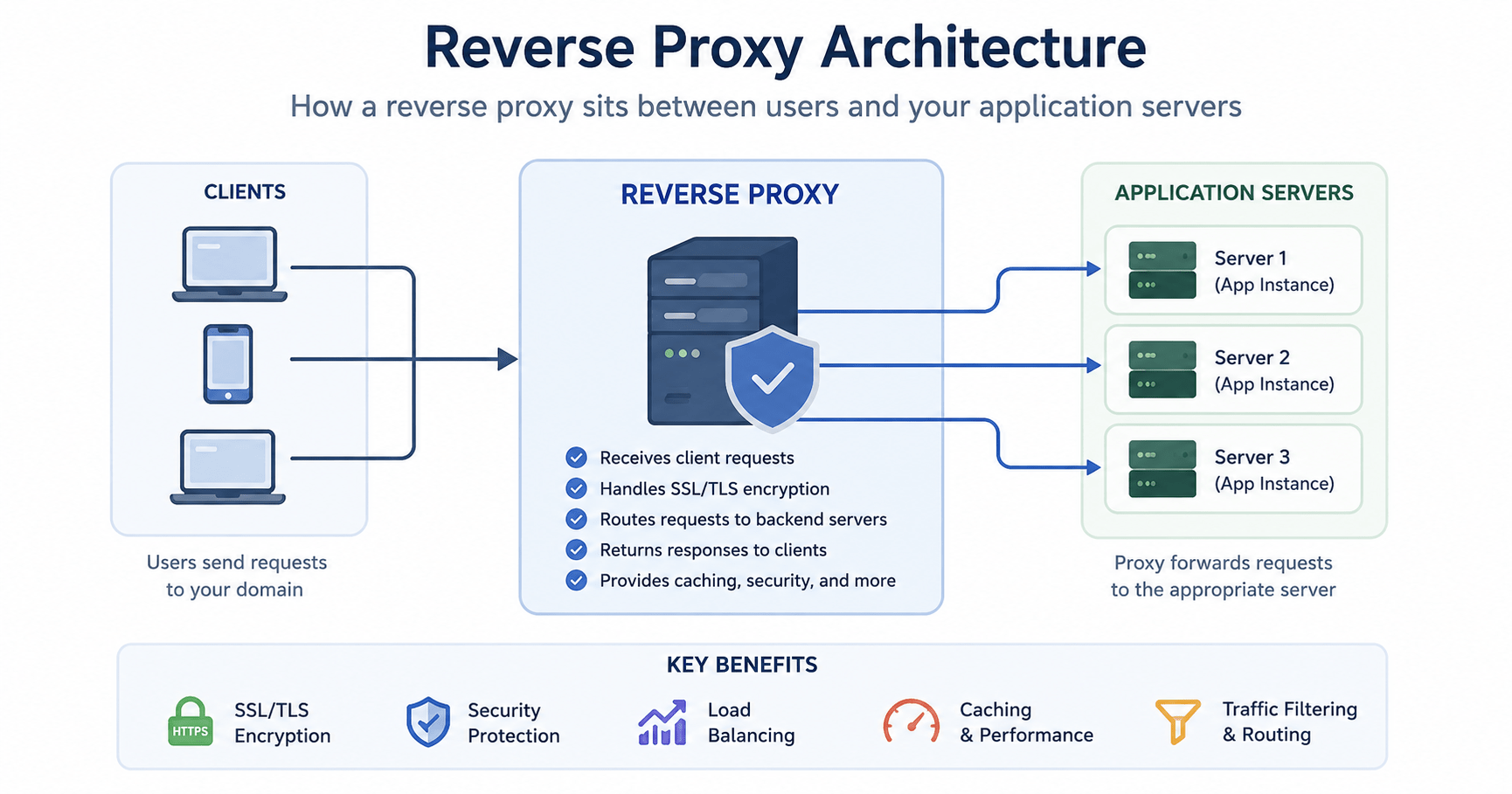

Every reverse proxy you’ll ever deploy has one job: stand between the internet and your application code, and decide what happens to each request before it gets there. Whether you’re running a Node.js API, a Next.js frontend, or a NestJS microservice, the request almost never hits your app directly. It hits a reverse proxy first.
What a Reverse Proxy Actually Does
A reverse proxy sits at the edge of your infrastructure and handles the jobs your application shouldn’t have to worry about:
- TLS/SSL Termination – decrypting HTTPS traffic before forwarding it to your upstream servers
- Load Balancing – spreading incoming requests across multiple backend instances
- Static File Serving – delivering HTML, CSS, images, and JS bundles without waking up your app runtime
- Security & Compression – rate limiting, security headers, gzip/brotli compression, and Web Application Firewall (WAF) filtering
For over two decades, Nginx has been the default reverse proxy for most of the internet. But developer experience expectations have shifted. Automatic TLS, memory safety, and programmable routing are no longer nice-to-haves, and that’s driven the rise of Caddy and Rust-based proxies like Pingora.
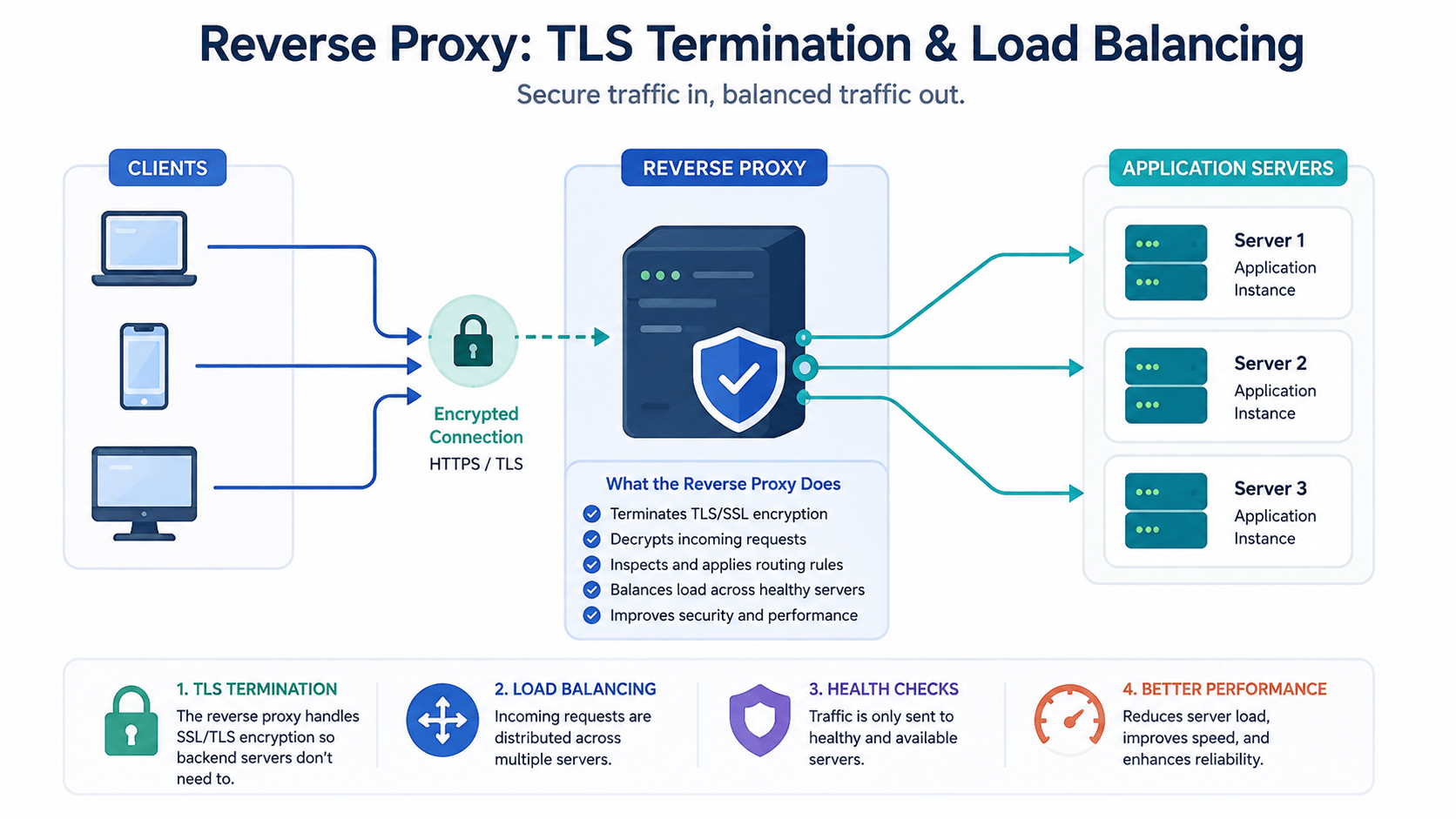
This guide compares three reverse proxy options Nginx, Caddy, and Pingora walks through how each one handles SSL certificates, and helps you pick the right one for your edge architecture.
Also Read: Micro-Frontends Architecture: 4 Proven Strategies
Nginx: The Battle-Tested Reverse Proxy
Nginx was released in 2004 to solve the C10K problem handling 10,000 concurrent connections on a single machine. Written in C, it uses an asynchronous, event-driven, process-per-worker model that delivers strong throughput on minimal hardware.
Strengths:
- Unrivaled battle-testing across two decades of production use
- Near-universal hosting support every VPS provider and most Kubernetes clusters ship an Nginx option
- Extremely low resource consumption per request
Weaknesses:
- Written in memory-unsafe C, so a flawed module can introduce buffer overflow vulnerabilities
- Needs external tooling like Certbot for SSL certificate automation
- Uses static configuration files that require a process reload for routing changes
If you already run a standard Linux server stack with existing Ansible playbooks and Certbot cron jobs, Nginx as your reverse proxy is the path of least resistance. It’s also the reverse proxy most hosting providers assume you’re using when they write their own setup docs.
Caddy: The Reverse Proxy Built for Developer Experience
Caddy is written in Go and designed around modern web defaults. Its standout feature is Automatic HTTPS: Caddy provisions, configures, and renews TLS certificates on its own, without a third-party script or a cron job.
Strengths:
- Zero-config TLS auto-renewal out of the box
- Clean, readable Caddyfile syntax
- Memory-safe Go runtime
- HTTP/3 support by default
- A dynamic REST API for configuration changes without restarts
Weaknesses:
- Higher memory consumption than Nginx or Pingora, due to Go’s garbage collector
- Slightly lower raw throughput under extreme peak traffic
For indie developers and small SaaS teams, Caddy as a reverse proxy removes an entire category of ops work: nobody has to remember to renew a certificate again. Swapping an existing Nginx reverse proxy setup for Caddy is often the single fastest way to eliminate an entire class of expired-certificate outages.
Pingora: The Rust-Based Reverse Proxy Built for Scale
In 2022, Cloudflare announced it had replaced its core Nginx infrastructure with Pingora, an asynchronous Rust framework for building proxies. According to Cloudflare, the switch delivered a 70% reduction in CPU usage and a 67% reduction in memory footprint compared to the Nginx setup it replaced, at a scale of over 40 million requests per second.
Unlike Nginx or Caddy, Pingora isn’t a pre-compiled executable you configure with a text file it’s a programmable Rust library. Teams either write custom proxy logic directly against Pingora, or use a pre-built proxy layered on top of it, such as Pingap.
Strengths:
- Memory safety guaranteed at compile time no use-after-free or buffer overflow bugs
- Lock-free connection pooling shared safely across threads
- Zero-downtime hot-reloading for routing changes
- Full programmability write authentication, routing, and middleware logic in Rust
Weaknesses:
- A steeper learning curve than a Caddyfile or nginx.conf
- Requires compiling a Rust binary or adopting a wrapper like Pingap rather than editing a plain-text config
A Rust-based reverse proxy like Pingora makes the most sense once you’re operating at a scale where CPU efficiency has a real line-item cost, or when you need custom logic baked directly into the proxy layer. Most teams will never need to write their own reverse proxy from scratch, but it’s worth knowing the option exists once Nginx or Caddy stop being enough.
SSL/TLS Certificate Providers for Your Reverse Proxy
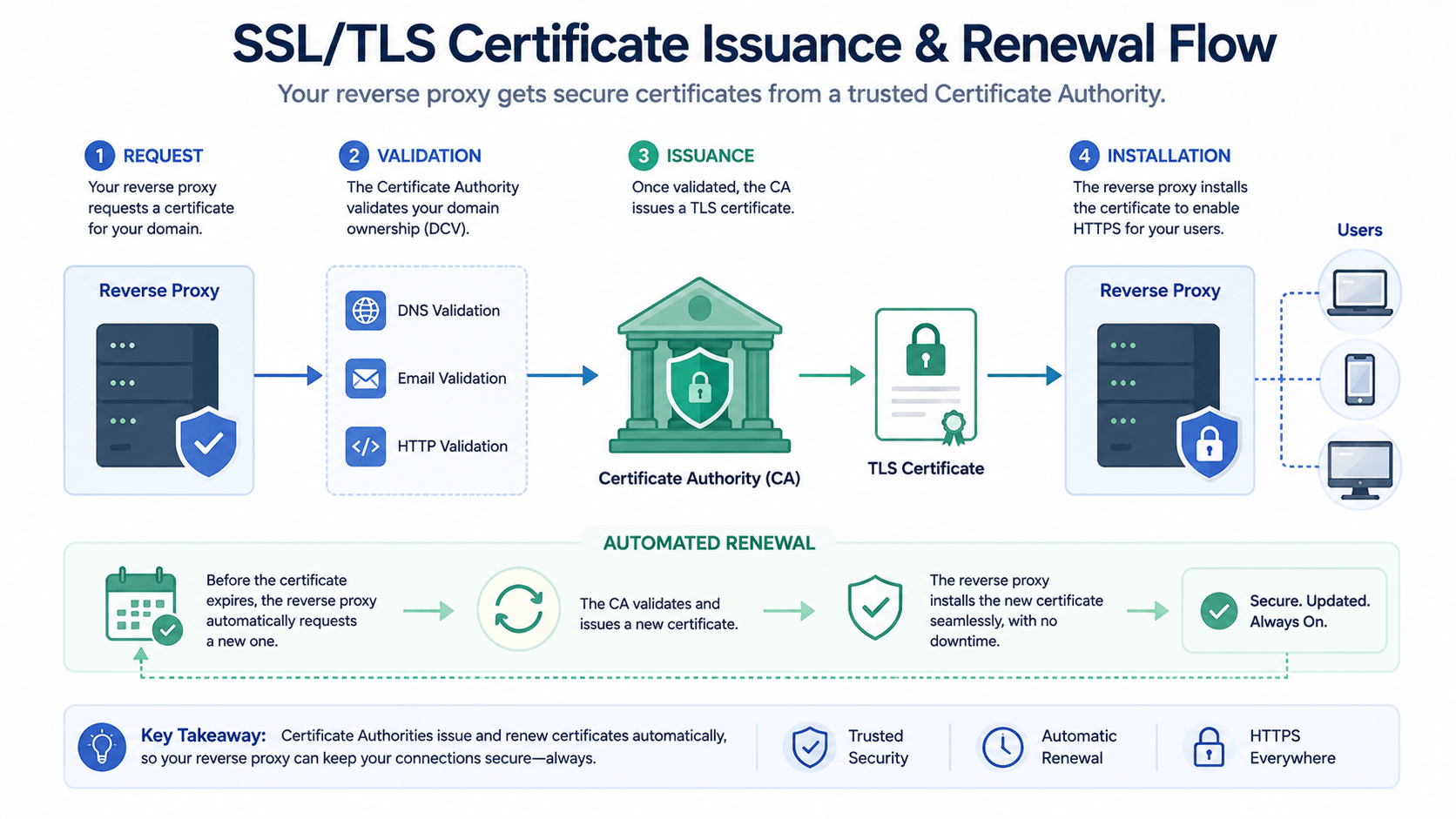
Every reverse proxy setup eventually needs an answer to the same question: who issues and renews your certificates? Here’s how the main options compare.
Matching a Certificate Provider to Your Reverse Proxy
1. Let’s Encrypt (ACME Standard)
The world’s largest free, automated Certificate Authority, built on the ACME protocol. It supports HTTP-01 challenges (validated by serving a file on port 80) and DNS-01 challenges (validated via a DNS TXT record, required for wildcard certificates). Certificates last 90 days, which is a deliberate design choice that forces full automation rather than manual renewal.
2. ZeroSSL
A major ACME-compliant alternative to Let’s Encrypt. It’s most useful as a fallback: if Let’s Encrypt hits its API rate limits during a mass deployment, a reverse proxy like Caddy can automatically fail over to ZeroSSL using EAB (External Account Binding) credentials.
3. Commercial and Cloud Certificates
AWS ACM, Cloudflare Origin CA, and Sectigo fall into this category cloud-managed or organizationally validated certificates. A common pattern is Cloudflare terminating public-facing TLS and issuing a private Origin Certificate to your reverse proxy for the connection between Cloudflare and your origin server.
4. Internal Private CAs
Tools like HashiCorp Vault and Smallstep’s step-ca issue internal certificates for mTLS (mutual TLS) between microservices. This matters in zero-trust environments where every internal connection not just the public-facing one needs to be authenticated and encrypted.
How SSL Automation Compares Across Reverse Proxies
| Capability | Nginx | Caddy | Pingora / Pingap |
|---|---|---|---|
| ACME automation | External Certbot cron/systemd required. Manual integration. | Native Built-in. Zero config. Automatic on first launch. | Native Via Rust ACME crates or the Pingap CLI. |
| Multi-CA failover | Manual Scripting required. No built-in fallback logic. | Automatic Let’s Encrypt → ZeroSSL fallback out of the box. | Configurable Via ACME challenge plugins. Bring-your-own logic. |
| Wildcard support | Manual DNS API scripts required for DNS-01 challenge. | Native DNS provider plugins for Cloudflare, Route53, etc. | Programmatic DNS-01 handling via code / config. Fully flexible. |
| Zero-downtime renewal |
Reload
Requires nginx -s reload. Brief worker spin-up.
|
Hot Swap Seamless in-memory certificate rotation. No reload. | Hot Swap Seamless in-memory hot swap. No process restart. |
Configuration Examples
Here’s the same basic setup proxying api.example.com to a local app on port 3000 in all three.
Nginx (nginx.conf + Certbot):
nginx
server {
    listen 80;
    server_name api.example.com;
    return 301 https://$host$request_uri;
}

server {
    listen 443 ssl http2;
    server_name api.example.com;

    ssl_certificate /etc/letsencrypt/live/api.example.com/fullchain.pem;
    ssl_certificate_key /etc/letsencrypt/live/api.example.com/privkey.pem;

    location / {
        proxy_pass http://127.0.0.1:3000;
        proxy_set_header Host $host;
        proxy_set_header X-Real-IP $remote_addr;
    }
}
Caddy (Caddyfile):
api.example.com {
    # Caddy provisions and renews the TLS certificate automatically
    reverse_proxy 127.0.0.1:3000
}
Notice what’s missing compared to the Nginx block: no certificate paths, no separate redirect server, no Certbot dependency. That’s the entire pitch for Caddy as a reverse proxy.
Pingora (Rust):
rust
use async_trait::async_trait;
use pingora_core::server::Server;
use pingora_proxy::{ProxyHttp, Session, HttpPeer};

pub struct MyProxy;

#[async_trait]
impl ProxyHttp for MyProxy {
    type CTX = ();
    fn new_ctx(&self) -> Self::CTX { () }

    async fn upstream_peer(&self, _session: &mut Session, _ctx: &mut Self::CTX) -> pingora_core::Result<Box<HttpPeer>> {
        let peer = Box::new(HttpPeer::new("127.0.0.1:3000", false, "".to_string()));
        Ok(peer)
    }
}

fn main() {
    let mut server = Server::new(None).unwrap();
    server.bootstrap();
    let mut proxy = pingora_proxy::http_proxy_service(&server.configuration, MyProxy);
    proxy.add_tcp("0.0.0.0:8080");
    server.add_service(proxy);
    server.run_forever();
}
This is the trade-off in one comparison: a handful of lines of Rust versus a few lines of Caddyfile versus a well-understood nginx.conf block. Each one is “correct” they just optimize for different things.
Feature and Performance Comparison
Reverse Proxy Architecture Comparison
Nginx vs Caddy vs Pingora (Rust) — language, safety, concurrency, and operational ergonomics.
| Metric | Nginx | Caddy | Pingora (Rust) |
|---|---|---|---|
| Language | C Mature, battle-tested systems language. Manual memory management. | Go Modern, productive, garbage-collected. Strong standard library. | Rust Zero-cost abstractions. Ownership model eliminates data races. |
| Memory safety | Manual Manual allocation (unsafe). Vulnerabilities historically common. | GC Garbage collected. Safe from use-after-free, but pause-the-world possible. | Compile-time Compile-time guaranteed. No borrow checker escapes at runtime. |
| TLS automation | External Certbot or similar required. External cron/systemd dependency. | Built in Fully automatic ACME. On by default with zero configuration. | Programmable Rust ACME crates or Pingap plugins. Bring-your-own logic. |
| Concurrency model | Process-per-worker Forked workers handle connections. Shared-nothing architecture. | Goroutines Lightweight M:N scheduling. Millions of concurrent green threads. | Async, lock-free Async, lock-free thread pools. Epoll/kqueue/IO_uring ready. |
| Hot reloading | Worker restart Graceful worker process restart. Brief connection churn. | Dynamic API Dynamic API / Caddyfile reloads without dropping connections. | Thread hot swap Zero-downtime thread hot swap. Config updates in-place. |
| Custom extensibility | C modules / Lua C modules or OpenResty Lua. Steep learning curve, crash risk. | Go plugins Go plugins or Caddyfile directives. Rich module ecosystem. | Rust libraries Native Rust libraries and traits. Type-safe, composable middleware. |
| Best fit | Traditional Traditional Linux servers, VPS hosting, shared hosting panels. | Developer-friendly Developer-friendly apps, SaaS edge, rapid prototyping. | Enterprise Enterprise high-throughput, custom gateways, CDN edge. |
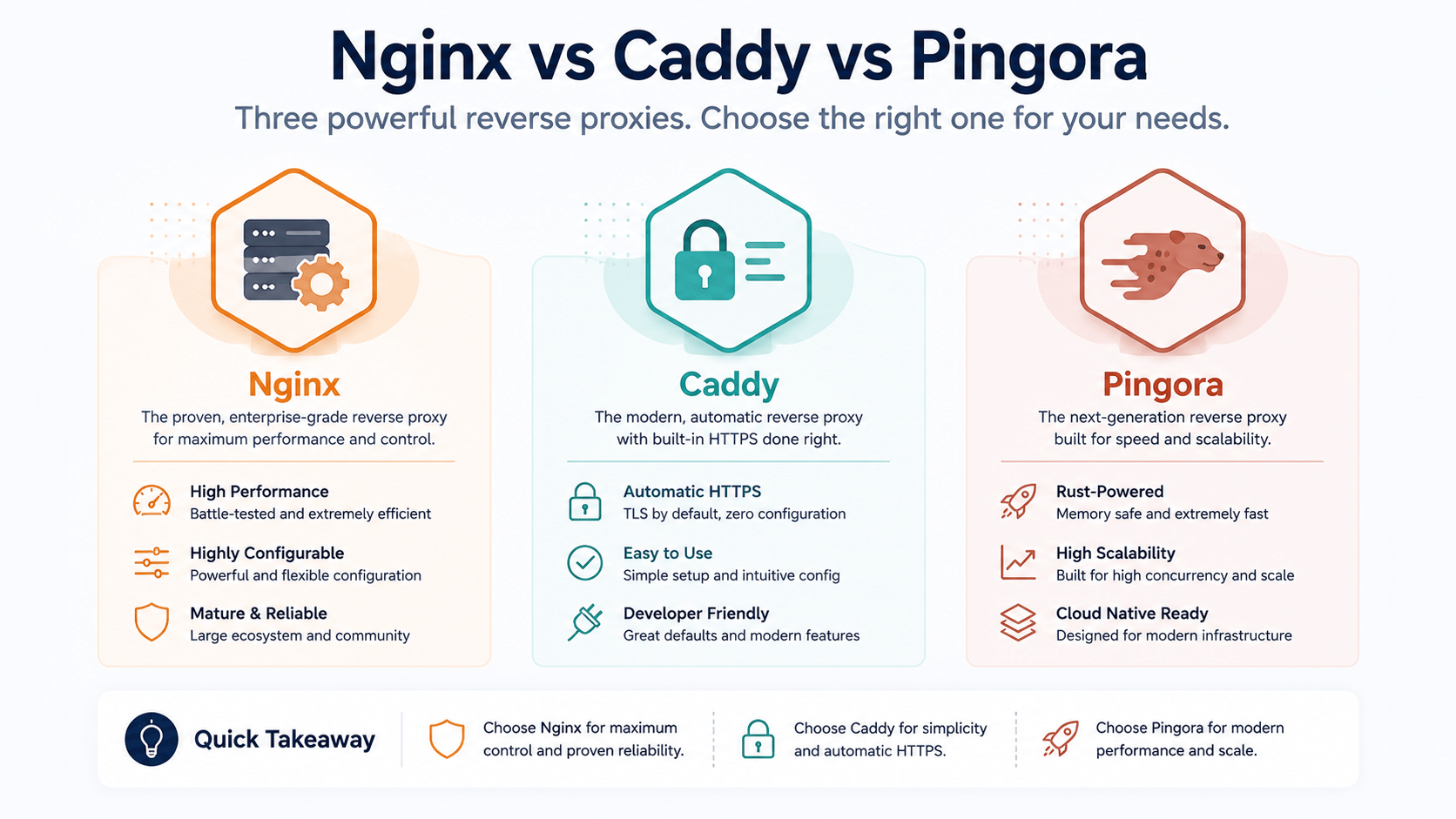
Which Reverse Proxy Should You Actually Use?
Choose Caddy if:
- You want production-ready HTTPS on a custom domain in under two minutes
- You’re an indie developer or small SaaS team and manual certificate management is overhead you don’t need
- You want a lightweight sidecar in a containerized environment that handles HTTP/3 and renewal on its own
Choose Nginx if:
- Your team already has established deployment pipelines, Ansible scripts, and Certbot automation
- You’re serving large volumes of static assets off Linux disk cache and want minimal overhead
- You need something supported natively on every cloud VPS and every Kubernetes Ingress Controller
Choose Pingora (or a Rust-based proxy) if:
- You’re processing tens of thousands of requests per second per node, and CPU efficiency translates directly into cloud cost savings
- You’re building zero-trust infrastructure where memory-safety guarantees actually matter
- You need custom authentication, routing, or header logic running directly at the network layer
Frequently Asked Questions
Is Caddy a good reverse proxy replacement for Nginx in production?
For small to mid-sized deployments, yes Caddy’s automatic HTTPS and simpler config remove a real category of operational risk. For very high-throughput or highly customized setups, Nginx or Pingora may still be the better reverse proxy choice.
Do I need to know Rust to use Pingora?
Not necessarily. You can use a pre-built proxy like Pingap that’s built on Pingora without writing Rust yourself. Writing custom logic directly against the Pingora library does require Rust.
Can Nginx auto-renew SSL certificates like Caddy does?
Not natively. Nginx relies on external tooling most commonly Certbot — running on a cron job or systemd timer to renew Let’s Encrypt certificates and reload Nginx afterward.
Which reverse proxy has the best raw performance?
Pingora, by Cloudflare’s own published numbers, though the gap only matters at genuinely high request volumes. For most self-hosted apps, Nginx and Caddy are both fast enough that the bottleneck will be somewhere else in the stack.
Conclusion
All three of these tools are a reverse proxy solving the same core problem in different ways, and picking the right reverse proxy comes down to what you’re optimizing for. Nginx remains the reliable, battle-tested default. Caddy trades a small amount of raw performance for automatic TLS and a dramatically simpler setup. Pingora trades configuration simplicity for compile-time memory safety and enterprise-scale throughput.
If you’re deploying a small project this week, start with Caddy. If you’re maintaining infrastructure your team already understands, stay with Nginx. If you’re operating at Cloudflare-adjacent scale, it’s worth evaluating a Rust-based reverse proxy like Pingora.