
Game Dev Series
Learning game development in public, one idea at a time
Jump to: Roles Industry data Engines Skills First code Learning path FAQ
Almost every developer I know has had this thought at least once. What if I made games instead of dashboards, APIs and login pages? I have had it many times. I have modded games, I have vibe coded a few small ones with AI help, and I enjoy every minute of it. But I am not a game developer yet, and this Game Dev Series is me learning in public and writing down what I find on the way.
In the first post of the series we looked at how game maps work, with tiles, layers and chunks. This time I want to step back and ask the bigger question. Is a game development career actually a good path, what does the job look like, and how would someone like me, a working developer, really get started? I will keep it honest, which means sharing the hard numbers too, and I will finish with the first bits of code every beginner should write.
Also Read: Game Dev Series: How Do Game Maps Work? Tiles, Layers, Chunks and Noise
Also Read: Game Dev Series: What Is Cloud Gaming and Is It Really Good or Just Too Early?
What does a game development career actually look like?
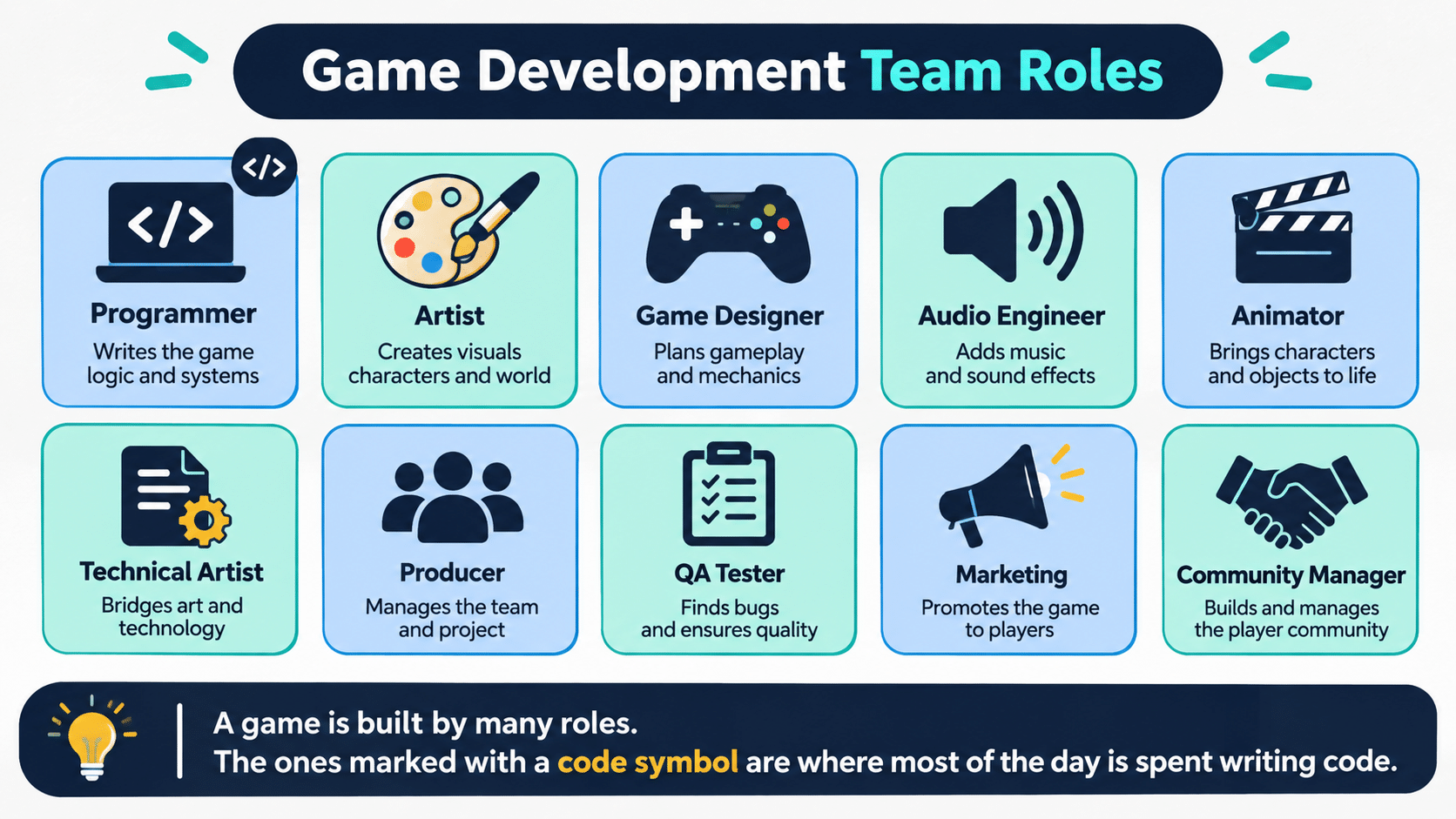
The phrase game developer sounds like one job, but it is really a whole team of jobs. When people imagine it, they picture someone writing the code that makes a character jump. That person exists, and they are usually called a gameplay programmer. Around them sit engine and tools developers who build the systems the rest of the team uses, technical artists who sit between art and code, designers who decide how the game should feel, artists and animators, sound designers, writers, QA testers, producers, and backend developers who run servers, stores and live events for online games.
Gameplay programmer
Writes the code that makes a character jump.
</> codeEngine and tools developer
Builds the systems the rest of the team uses.
</> codeTechnical artist
Sits between art and code.
Designer
Decides how the game should feel.
Artist and animator
Makes the look and the motion.
Sound designer
Builds what the game sounds like.
Writer
Shapes the story and the words.
QA tester
Finds problems before players do.
Producer
Keeps the team and the plan moving.
Backend developer
Runs servers, stores and live events for online games.
</> codeA game is built by many roles. The ones marked with the code symbol are where most of the day is spent writing code.
This was the first thing that changed my thinking. As a web or backend developer you do not have to throw away your skills. Multiplayer games need servers, matchmaking, leaderboards, payments and analytics, which is the same kind of work many of us already do. Tools programmers write editors and pipelines, and that feels a lot like internal tooling at any software company. So the door into games is wider than it looks from outside.
Is game development a good career right now?
I wanted to answer this with real data instead of feelings, so I read the GDC 2026 State of the Game Industry report. GDC surveyed more than 2,300 game industry professionals for it, and the picture is mixed. Games are still a huge creative field with a lot of demand from players, but the last few years have been rough for the people making them.
What do the layoff numbers say?
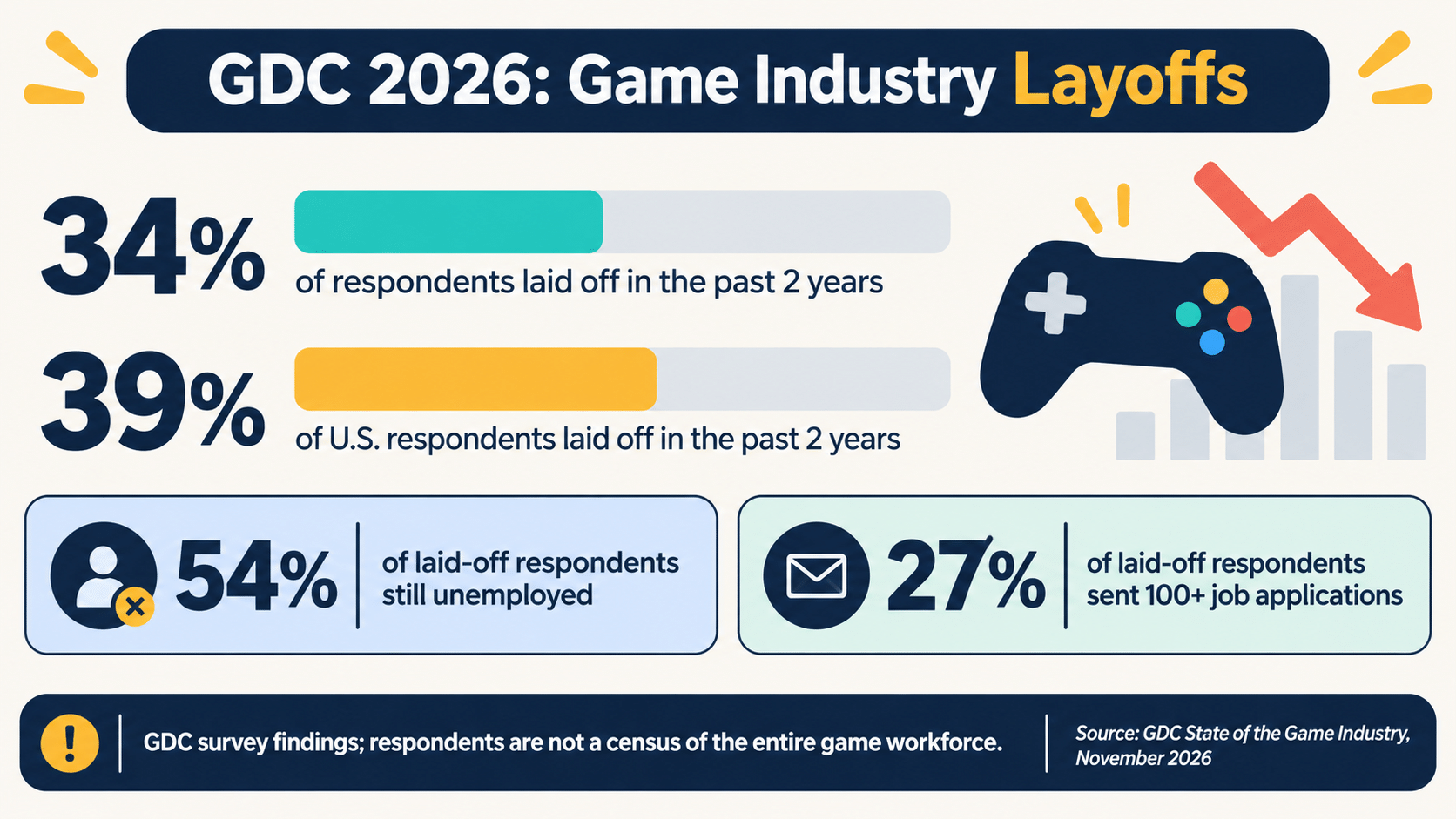
According to the report, 28% of respondents were laid off in the past two years, rising to 33% for people in the United States. Half said their current or most recent employer had layoffs in the past 12 months, and two thirds of people at AAA studios said their companies had cut jobs. The smaller student survey in the same report found that 74% of students are worried about their job prospects in games, mostly because of fewer entry level roles and more competition from experienced people who were laid off.
The GDC 2026 survey numbers on layoffs. Not a happy chart, but an important one before you plan a career move.
I am not sharing this to scare anyone away. I am sharing it because most career posts skip it, and I would rather go in with open eyes. If you are a working developer with a stable job, it tells me one thing clearly. Do not quit your job to chase a studio role. Learn on the side, build things, and move when you have proof of skill.
What about the game industry in India?
For readers in India there is some good news. The Lumikai State of India Interactive Media Report 2025 says India’s free to play games market grew 17% year on year to about $1.5 billion in calendar year 2025, with around 555 million mobile game users and one in four of them paying. Lumikai projects it to reach $3.2 billion by 2030. A projection is not a promise, but a growing player base usually means more studios, more publishing deals and more jobs around them, especially in mobile.
Which game engine should a beginner learn first?
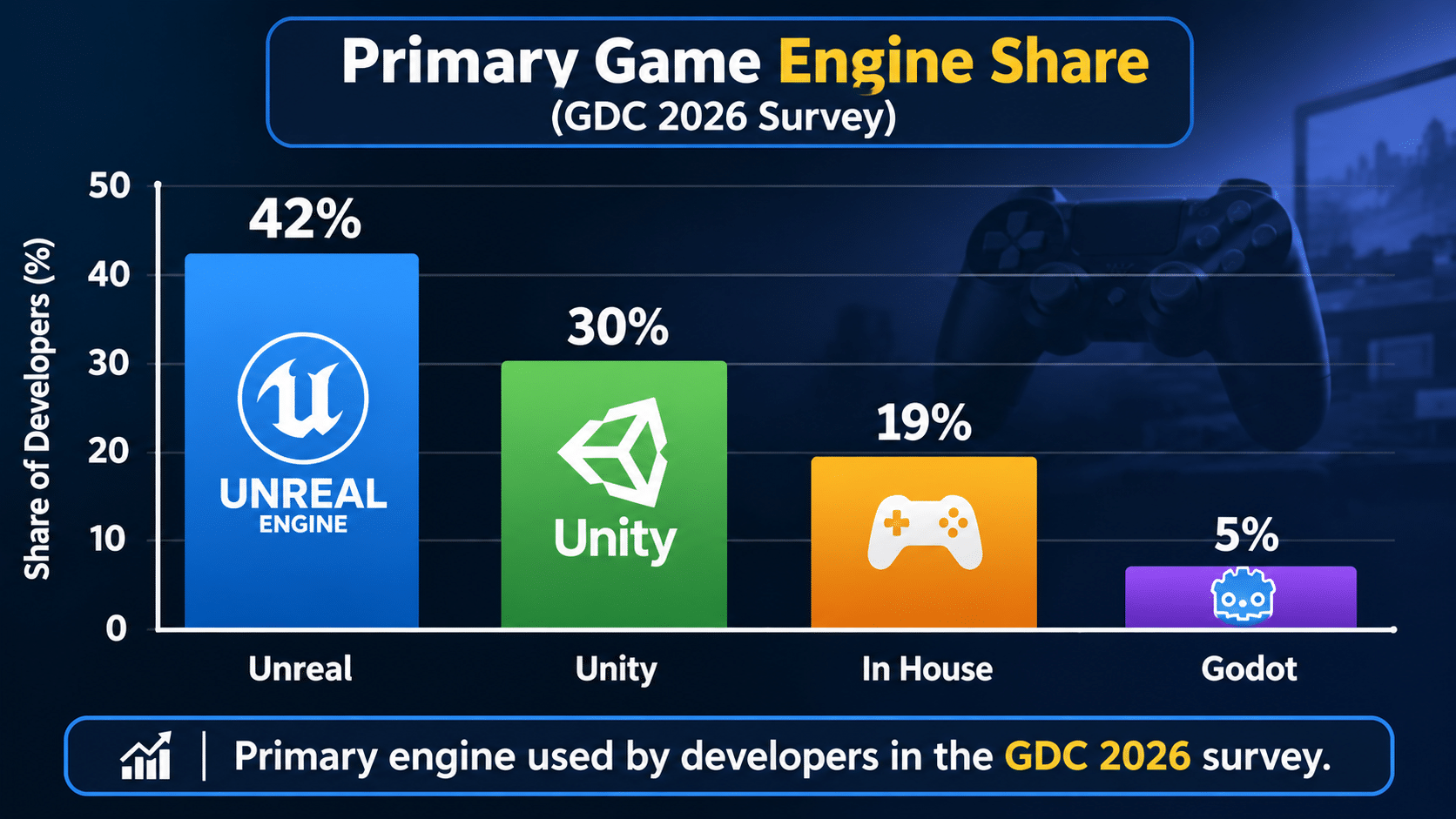
A game engine is the big toolbox that handles drawing, physics, sound and input so you can focus on the game itself. The GDC 2026 report asked developers about their primary engine, and Unreal Engine came out on top at 42%, with Unity at 30%, in house or proprietary engines at 19% and Godot at 5%. Unreal is more common at AA and AAA studios, while 54% of developers at older indie studios still use Unity, and Godot is picking up with newer indie teams at 11%.
Primary engine used by developers in the GDC 2026 survey.
For a beginner, cost matters too, and the good news is that all three are free to start.
Unity Personal
Free for individuals and small teams with less than $200K USD of revenue and funding in the last 12 months. Unity says it takes no royalties.
no royaltiesUnreal Engine
Free for game developers until a product passes $1 million USD in lifetime gross revenue, after which a 5% royalty applies to the revenue above that first million.
5% above $1MMy own plan is simple. I will start with Godot for small 2D experiments because it is light and quick to open on any laptop, and later try Unity because so many mobile and indie jobs ask for it. If your dream is big 3D games at large studios, Unreal and C++ are worth the steeper climb. There is no wrong first pick. The logic you learn, like loops, maps, physics and cameras, carries over to every engine.
What skills do you need to start game development?
Here is what kept coming up when I read job posts, engine docs and developer talks. None of it is magic, and a lot of it you may already have.
One programming language, properly
C# for Unity, C++ or Blueprints for Unreal, GDScript or C# for Godot. If you already write Java or TypeScript, C# will feel familiar.
array: [C#, C++, GDScript]Basic maths for games
Vectors, angles, a little trigonometry, and how speed and time relate. You do not need a maths degree, just enough to move things on a screen.
Data structures
Grids, queues, graphs and hash maps show up everywhere in games, from tile maps to pathfinding.
grid · queue · graph · hash mapGame logic
The game loop, collisions, cameras, input and state. This whole series is about these pieces one at a time.
Finishing
This sounds silly, but every experienced developer says the same. Shipping a small finished game teaches more than ten half built big ones.
Also Read: The data structures cheat sheet from our DSA series is a good refresher, and time and space complexity explained simply helps a lot once you care about frame rate.
What is the very first code every game developer writes?
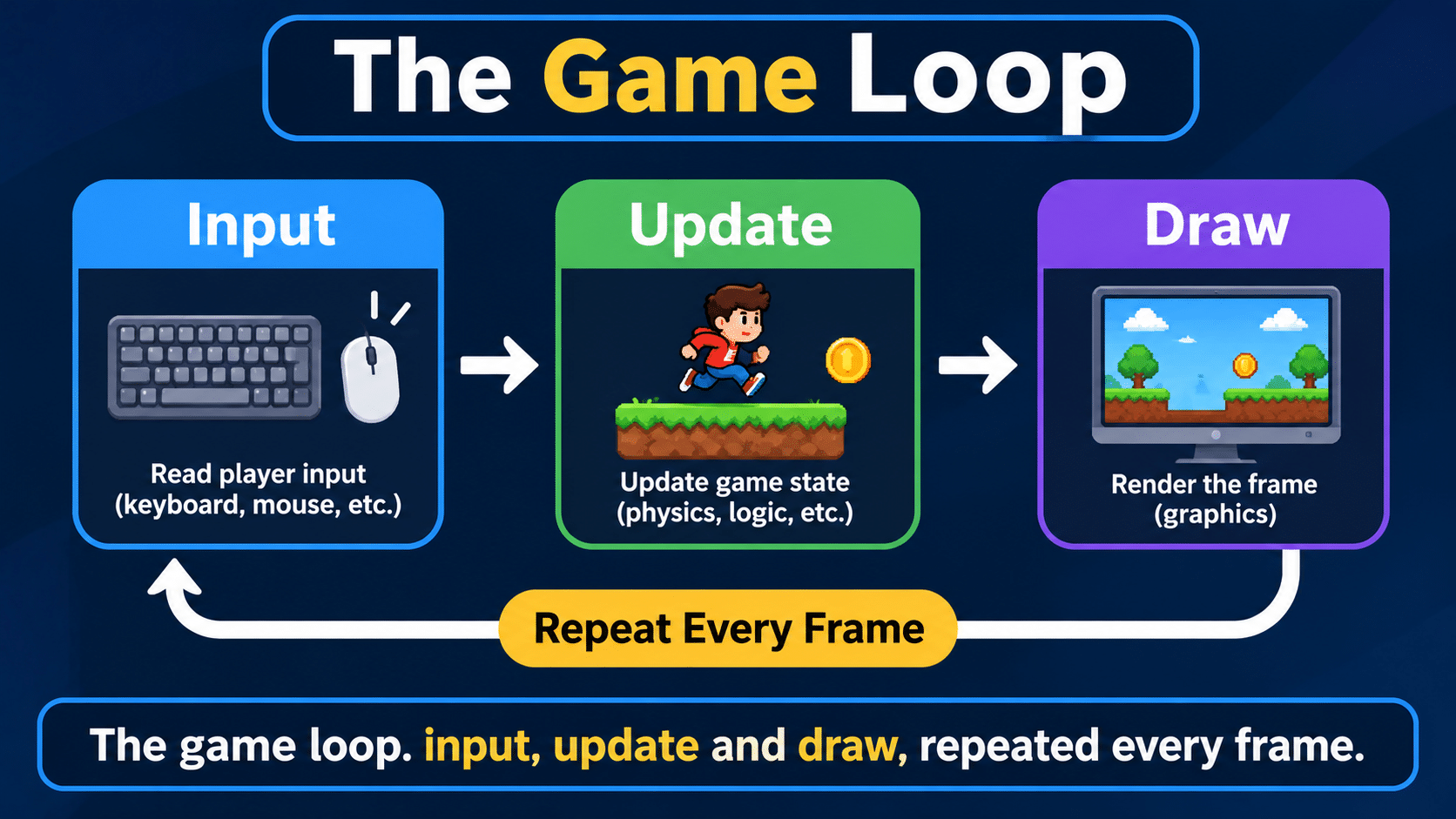
Every game, from Pong to the biggest open world, runs on a game loop. Each frame it reads input, updates the world, and draws the result, again and again, usually around 60 times a second. When I modded games I was always poking at the update part without knowing it had a name. For a deeper read, Game Programming Patterns has a free chapter on the game loop.
1. Input
Read what the player pressed.
2. Update
Move the world: physics, enemies, score.
3. Draw
Paint the result on screen.
Repeated every frame, usually around 60 times a second.
Why do games update in fixed steps?
Frames do not always take the same time. A busy scene or a slow laptop can make a frame take longer. If you move a character by a fixed amount per frame, it moves slower on a slow machine. So most games use a fixed timestep (Fix Your Timestep is the classic explanation). They keep a bucket of real time that has passed, and they run the physics update in equal small steps until the bucket is empty. Here is a tiny version in plain Python, with a bouncing ball and a laggy patch in the middle.
# A fixed timestep game loop: the heartbeat of almost every game.
# The world updates in equal steps (1/60 s) no matter how fast frames are drawn.
STEP = 1 / 60          # seconds per physics update
GRAVITY = -9.8         # metres per second squared
BOUNCE = 0.6           # keep 60% of speed after hitting the floor

def update(ball, dt):
    ball["vy"] += GRAVITY * dt
    ball["y"] += ball["vy"] * dt
    if ball["y"] < 0:                # hit the floor
        ball["y"] = 0
        ball["vy"] = -ball["vy"] * BOUNCE

def run(frame_times):
    ball = {"y": 5.0, "vy": 0.0}
    acc = 0.0
    updates = 0
    for frame, ft in enumerate(frame_times, 1):
        acc += ft                    # real time that passed this frame
        while acc >= STEP:           # catch up in fixed steps
            update(ball, STEP)
            acc -= STEP
            updates += 1
        if frame % 10 == 0:
            print(f"frame {frame:2d}  took {ft*1000:5.1f} ms  updates so far {updates:3d}  ball y = {ball['y']:.2f} m")
    return ball, updates

if __name__ == "__main__":
    # a smooth machine (16.7 ms frames) then a laggy patch (50 ms frames)
    frames = [1/60] * 30 + [0.05] * 10 + [1/60] * 20
    ball, n = run(frames)
    total = sum(frames)
    print(f"\n{total:.2f} s of real time gave {n} updates, about {n/total:.0f} per second even with lag")
Running it gives this output. Notice how the 50 ms frames trigger three updates each, so the game still gets about 60 updates per second of real time.
frame 10  took  16.7 ms  updates so far  10  ball y = 4.85 m
frame 20  took  16.7 ms  updates so far  20  ball y = 4.43 m
frame 30  took  16.7 ms  updates so far  30  ball y = 3.73 m
frame 40  took  50.0 ms  updates so far  60  ball y = 0.02 m
frame 50  took  16.7 ms  updates so far  70  ball y = 0.77 m
frame 60  took  16.7 ms  updates so far  80  ball y = 1.38 m
1.33 s of real time gave 80 updates, about 60 per second even with lag
Can you build a tiny game without any engine?
Yes, and I think it is the best first exercise. This small catch the coins game prints to the terminal and has no graphics library. A pretend player walks towards the falling coins, and the code is split into the same three jobs as the loop above. The random generator is seeded, so it plays out the same way every time you run it.
# A tiny "catch the coins" game with no graphics library.
# It shows the three jobs every game does each frame: read input, update, draw.
import random

W = 9  # width of the play area

def read_input(state, rng):
    # A pretend player that walks towards the nearest coin, with a little randomness
    target = min(state["coins"], key=lambda c: c[1], default=None)
    if target is None or rng.random() < 0.2:
        return rng.choice([-1, 0, 1])
    return (target[0] > state["x"]) - (target[0] < state["x"])

def update(state, move, rng):
    state["x"] = max(0, min(W - 1, state["x"] + move))
    if rng.random() < 0.5:
        state["coins"].append([rng.randrange(W), 0])
    for c in state["coins"]:
        c[1] += 1
    caught = [c for c in state["coins"] if c[1] == 4 and c[0] == state["x"]]
    missed = [c for c in state["coins"] if c[1] >= 4 and c not in caught]
    state["score"] += len(caught)
    state["missed"] += len(missed)
    state["coins"] = [c for c in state["coins"] if c[1] < 4]

def draw(state, frame):
    rows = [["." for _ in range(W)] for _ in range(4)]
    for x, y in state["coins"]:
        rows[y][x] = "o"
    rows[3][state["x"]] = "U"
    print(f"frame {frame}  score {state['score']}  missed {state['missed']}")
    print("\n".join("".join(r) for r in rows) + "\n")

def main(frames=8, seed=34):
    rng = random.Random(seed)            # seeded so the run is the same every time
    state = {"x": 4, "coins": [], "score": 0, "missed": 0}
    for frame in range(1, frames + 1):
        move = read_input(state, rng)
        update(state, move, rng)
        draw(state, frame)
    return state

if __name__ == "__main__":
    main()
These are the last few frames of the run. U is the player and o is a coin.
frame 6  score 1  missed 1
.........
.........
.........
.U.......

frame 7  score 2  missed 1
.........
.........
.........
.U.......

frame 8  score 2  missed 1
.........
.........
.........
U........
Both files run with plain Python 3 and need nothing to install. Try changing the gravity, the bounce, or how often coins appear, and watch how the feel of the game changes. That small loop of changing a number and seeing the effect is honestly what got me hooked on game logic in the first place.
How do you start a game dev career step by step?
This is the path I am following myself. It is built for someone who already has a job and limited evenings, so every step ends with something you can show.
- Pick one engineStick with it for three months. Jumping between engines feels productive but resets you every time.
- Clone a classicPong, Snake, Breakout or Flappy Bird. The design is already solved, so you only fight the code.
- Learn one piece of game logic at a timeMaps, cameras, physics, weapons and sound, the same order this series follows.
- Join a game jamJams like Ludum Dare, Global Game Jam and the many jams on itch.io give you a theme and a short deadline, which forces you to finish.
- Ship something smallPut it on itch.io or the Play Store, even if only ten people play it. Real players find problems you never will.
- Show your workA short devlog, a GitHub repo and a playable build say more in an interview than any certificate.
If you prefer a long term job outside a studio first, contract and freelance work is another way in. Many studios hire contractors for tools, ports and backend work, and our post on why contract jobs are replacing permanent roles explains how that market looks in 2026. You can also browse more guides in the Developer Guide section or follow the Career Roadmaps.
What tips and tricks make learning game dev easier?
Copy the feel, not the art
Recreate how Mario jumps or how a Tetris piece drops. Matching the feel teaches more game logic than any tutorial.
Keep a scope list
Write the three features your game needs, and put every other idea on a later list.
Use placeholder art
Coloured boxes are fine. Many famous prototypes looked terrible at first.
Read other people’s code
Open source games and engine demo projects show how real developers structure things.
Use AI as a tutor, not a crutch
Vibe coding got me moving fast, but I learned the most when I asked the AI to explain why its code worked.
Play your game every day
Five minutes of playing finds more problems than an hour of reading your own code.
What common mistakes should beginners avoid?
Starting with a huge open world or MMO dream as the first project.
Quitting a stable job before you have shipped anything.
Watching tutorials for months without building something of your own.
Ignoring the business side, like store pages, trailers and wishlists, until launch day.
Comparing your first game with games made by teams of hundreds.
Frequently asked questions
Is game development a good career in 2026?
Which game engine should I learn first as a beginner?
Do I need to be good at maths to make games?
Can a web or backend developer move into game development?
Is Unity or Unreal Engine free to use?
That is my honest look at game development as a career. Next in the Game Dev Series we open up game engines themselves and see why Unity, Godot and Unreal exist at all, then carry on with cameras, physics, weapons, sound and enemy AI, one idea at a time.