
The open-weight AI model Kimi K2.6 has developers wondering why they should pay premium API pricing when a near-frontier model is only little more expensive. When Kimi K2.6 was published on April 20, 2026, by Moonshot AI, the Beijing-based firm that created the Kimi series, it quickly established the benchmark for pricing.
This article explains what the model is, how it compares to Claude and GPT-5.5, and if it merits a place in your toolchain if you’ve been quoted API costs that eat into your project budget or if you’re simply sick of rationing tokens on a paid Claude or GPT plan.
Also Read: What Are Tokens in Large Language Models? Simple Explanation with Examples
What Is Kimi K2.6?
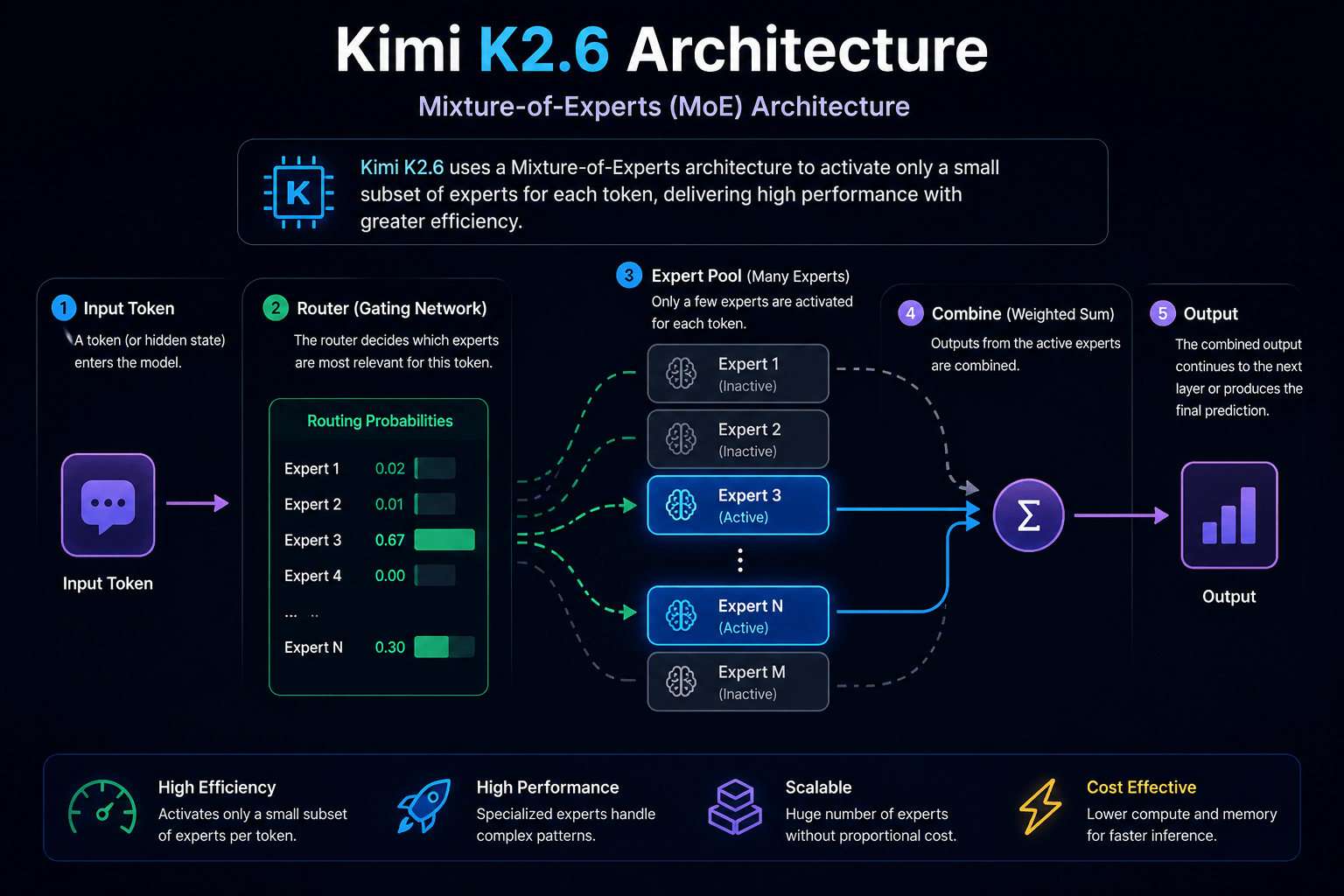
Built on a 1-trillion-parameter Mixture-of-Experts (MoE) architecture that activates about 1 trillion parameters every token, it is Moonshot AI’s flagship big language model. The majority of developers and entrepreneurs can self-host, alter, and commercialize it with virtually no limitations because it is published as open weights under a Modified MIT License.
Because it is a native multimodal model, it does not rely on a separate vision module but rather manages text, graphics, and video inside a single architecture. K2.6 was created by Moonshot especially for long-horizon coding and agentic work tasks that require a model to maintain its plan across thousands of steps, operate for hours, and span numerous files.
It is distributed via a number of channels, including the Moonshot API, the Kimi Code CLI, the Kimi mobile applications, the Kimi.com web app, and downloadable weights on Hugging Face. Moonshot’s own K2.6 release notes cover the full technical specs if you want the vendor’s original writeup.
K2.6 Specs: Architecture and Context Window
The majority of the differences between K2.6 and the previous model may be explained by a few numbers.
Context window: With its support for up to 262,144 tokens, K2.6 can accommodate a huge codebase or a lengthy text in a single run.
Parameter count: 1 trillion total parameters, with roughly 32 billion active per forward pass across 384 experts (8 activated per token). This is the same MoE backbone the K2 family has used since mid-2025, refined rather than replaced.
Coding stamina: Moonshot says K2.6 can sustain coding sessions for up to 13 hours without losing track of a task, which matters for anyone using it as an autonomous coding agent rather than a chat assistant.
Agent Swarm: K2.6’s standout feature is its ability to coordinate up to 300 sub-agents working in parallel across roughly 4,000 collaborative steps in a single run, up from 100 sub-agents in the previous K2.5 release. Each sub-agent can specialize in a domain (testing, refactoring, documentation) while a coordinator layer keeps the overall task on track.
Also Read: How Token Limits and Context Windows Actually Work in 2026
K2.6 Benchmarks: How It Compares to Claude and GPT
Benchmark numbers move fast in 2026, so treat any single score as a snapshot, not a permanent ranking. Based on vendor-published results as of this writing, here’s roughly where K2.6 lands against the closed frontier models it gets compared to most.
Kimi K2.6 Benchmark Results
Performance across industry-standard evaluation suites
| Benchmark | Kimi K2.6 | What it measures |
|---|---|---|
|
01
SWE-Bench Pro
|
~58.6% | Real-world software engineering fixes on a harder, less contaminated test set |
|
02
Humanity’s Last Exam
|
~54.0% | Agentic reasoning using external tools, not memorized knowledge |
|
03
AIME 2026
|
~96.4% | Competition-level math reasoning |
|
04
GPQA-Diamond
|
~90.5% | Graduate-level science reasoning |
K2.6 has actually outperformed certain closed rivals on the tool-using reasoning benchmark (HLE with tools), which is noteworthy for an open-weight model. It lags somewhat below the best closed models in terms of reasoning based only on math and science. Different write-ups indicate different winners on challenging software engineering jobs since the specific model version being compared and the configuration of “thinking mode” affect the outcome.
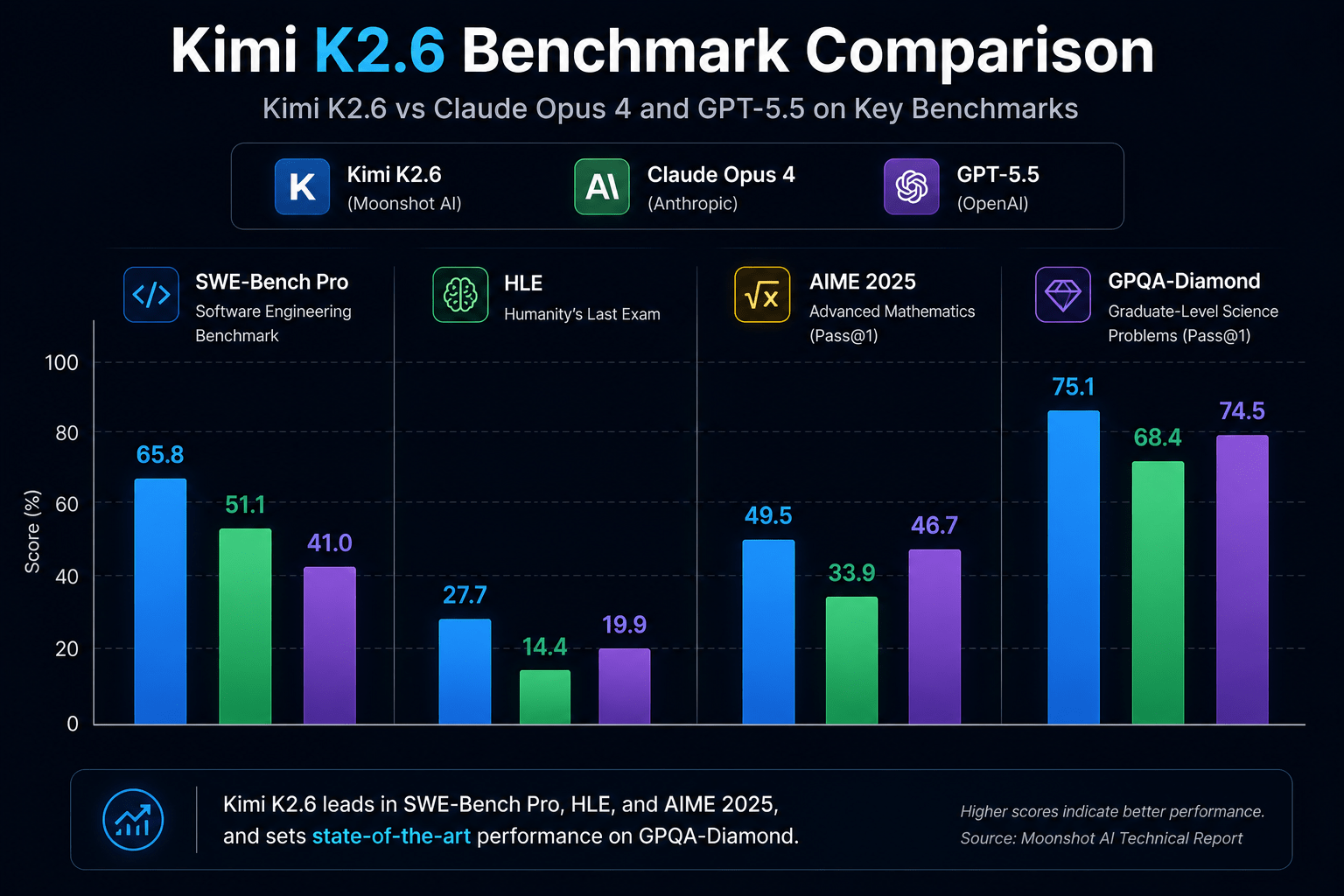
In all honesty, K2.6 isn’t the best model on every test, but it’s close enough on the majority of them that, for many actual workloads, the price difference becomes the determining factor.
K2.6 Pricing: Why It’s So Cheap
This is where Kimi K2.6 pricing actually separates it from the competition.
Kimi K2.6 API Pricing
Depending on the precise tier and cache configuration, vendor-published API cost ranges from $0.60 to $1 per million input tokens and around $4 per million output tokens. Cached input tokens are considerably more affordable typically 70–75% less expensive than conventional input pricing and are useful for teams executing lengthy system commands or repeated prompts.
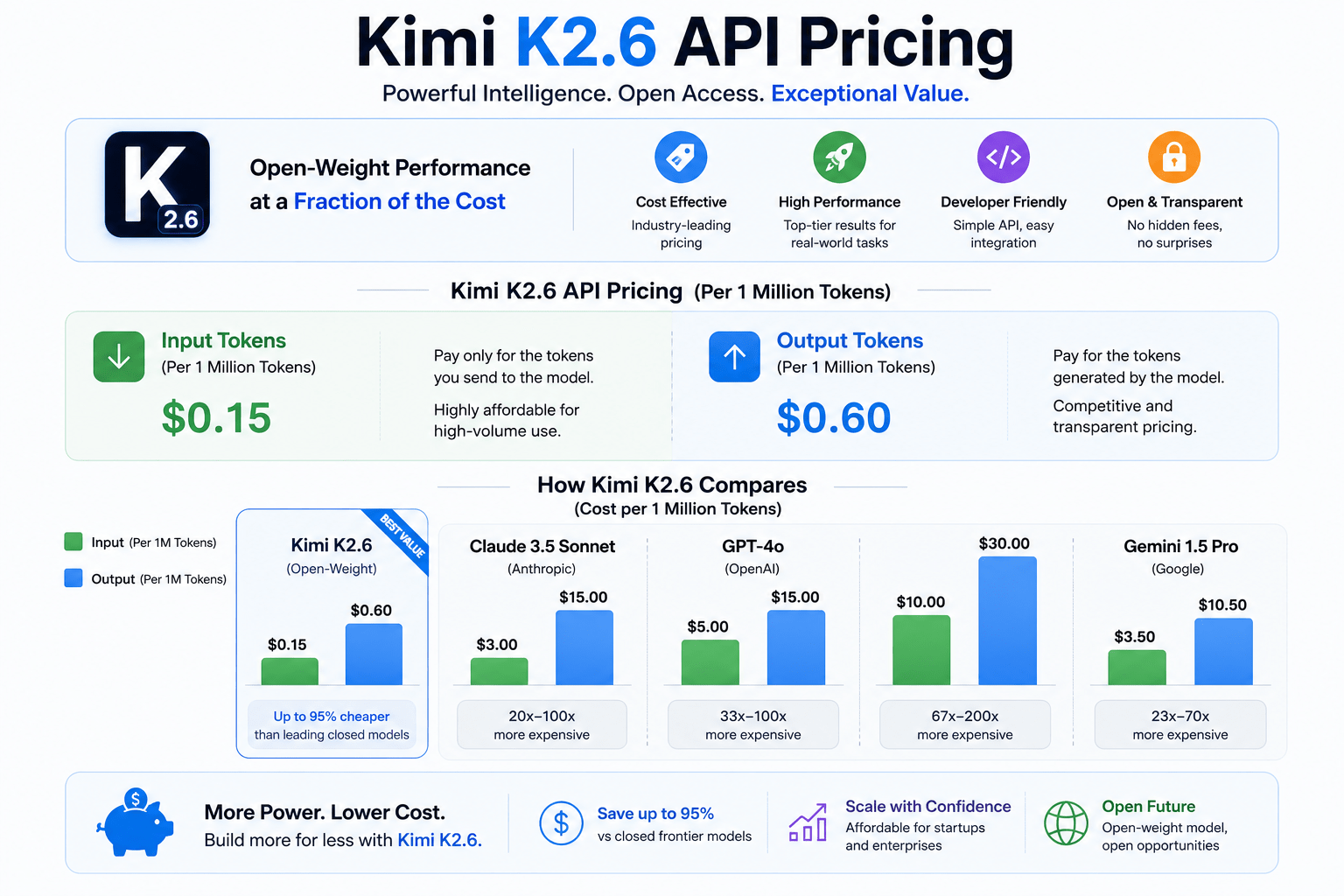
This paradigm has an approximately 5x to 10x advantage over closed frontier models, which charge $3 to $5 per million input tokens and $15 to $30 per million output tokens.
Self-Hosting for Free
Due to its open-weight nature, self-hosting is a whole different cost option. If you show “Kimi K2” attribution in your product, you can run K2.6 on your own infrastructure with no per-token API fee below specific use criteria (100 million monthly active users or $20 million in monthly sales, according to Moonshot’s licensing conditions). This works similarly to a typical permissive license for the majority of lone developers and small teams: complete commercial usage, modification, and redistribution rights.
That cost difference adds up to actual monthly savings, not just a little reduction, if your team performs thousands of API requests every day.
K2.6’s Agent Swarm: What Makes It Different
One question, one response is the most common application of chat-style AI. Agent Swarm is designed for a different pattern: give the model a big, multi-part work, and allow it to divide it up into smaller tasks, each of which is assigned to a sub-agent and executed in parallel.
In actuality, this looks like this: a coordinator agent organizes the overall strategy, then launches specialized sub-agents to write code, run tests, hunt for regressions, and produce documentation all of which operate simultaneously rather than sequentially. According to Moonshot, in a single autonomous run, K2.6 can handle up to 300 of these sub-agents throughout about 4,000 coordinated steps.
This is interoperable with widely used agent frameworks, which is important if you want to avoid rebuilding your workflow around a single vendor’s tooling and are already developing on an agent stack.
It’s important to understand the trade-off: the Kimi platform’s membership levels allot a certain amount of API calls each five-hour session with a concurrency restriction. That’s acceptable for standard development work, but if you’re planning large, ongoing nighttime batch tasks, it’s a serious limitation.
Kimi K2.6 vs Claude vs GPT-5.5: Which Should You Use?
Kimi K2.6 vs. Claude vs. GPT-5.5
How the leading models stack up across key dimensions
| Feature | Kimi K2.6 | Claude (Anthropic) | GPT-5.5 (OpenAI) |
|---|---|---|---|
|
01
Access
|
Open weights, self-hostable | Closed, API/app only | Closed, API/app only |
|
02
Cost per million tokens
|
Lowest of the three | Premium | Premium |
|
03
Context window
|
262,144 tokens | Varies by model | Up to 1M tokens |
|
04
Best for
|
High-volume workloads, cost-sensitive teams, self-hosting | Complex, multi-file agentic coding reliability | Large-document workflows, mature ecosystem |
|
05
Knowledge cutoff freshness
|
Competitive | Competitive | Competitive |
Pick it if you’re cost-sensitive, running high call volumes, or need to keep everything inside your own infrastructure for privacy or compliance reasons. Pick a closed frontier model if you need the highest ceiling on the hardest, most complex agentic coding tasks, or if your team is already deep in one vendor’s ecosystem and switching costs outweigh the savings.
Plenty of teams end up running both: K2.6 for routine, high-volume work, and a closed model reserved for the tasks where getting it right matters more than saving money.
Also Read: What Is Prompt Engineering? A Practical Guide for Developers Who Use AI Daily
How to Get Started with K2.6
- Try it free first. Kimi.com and the Kimi mobile apps let you test the model in chat and agent mode without writing code.
- Get an API key. Sign up at Moonshot AI’s developer platform to access K2.6 through the API for programmatic use.
- Use the Kimi Code CLI if you want an agentic coding workflow similar to other CLI-based coding assistants.
- Download the weights from Hugging Face if you want to self-host, fine-tune, or run K2.6 fully offline.
- Watch your quota if you’re on a subscription tier rather than pay-as-you-go API pricing the call limits per time window are real for automated pipelines.
K2.6 Limitations You Should Know
It isn’t a universal upgrade over every closed model, and being clear about the gaps matters more than hyping the wins.
- Pure math and science reasoning still favors some closed competitors by a few points on benchmarks like AIME and GPQA-Diamond.
- Native computer-use features (desktop and browser automation as a first-party capability) are less mature than what some closed competitors offer.
- Ecosystem maturity for enterprise tooling, support, and integrations still generally favors the established closed-model vendors.
- Subscription quota limits can bottleneck heavy, continuous automated workloads if you’re not on metered API pricing.
None of these are dealbreakers for most individual developers or small teams, but they matter if you’re evaluating K2.6 for a large enterprise deployment.
FAQ
Is Kimi K2.6 free to use? Yes, for chat and agent mode through Kimi.com and the mobile apps, with usage limits. API access is metered separately, and self-hosting the open weights is free below Moonshot’s usage thresholds.
Is Kimi K2.6 better than Claude? It depends on the task. K2.6 leads on some agentic and tool-use benchmarks and costs far less per token, but closed models still hold an edge on certain reasoning and enterprise-tooling fronts. For high-volume, cost-sensitive work, K2.6 is usually the more practical pick.
Can I self-host Kimi K2.6? Yes. The weights are published on Hugging Face under a Modified MIT License, and self-hosting is free for most developers and startups below the license’s usage thresholds.
What is Agent Swarm in Kimi K2.6? It’s the model’s multi-agent execution system, coordinating up to 300 sub-agents across roughly 4,000 steps to handle large, multi-part tasks in parallel instead of one step at a time.
Does Kimi K2.6 support long documents and codebases? Yes, its context window goes up to 262,144 tokens, enough for most large codebases or lengthy documents in a single pass.
Conclusion
On actual benchmarks, Kimi K2.6 demonstrates that an open-weight model may sit within striking distance of the closed frontier at a fraction of the expense. Although it won’t win every category and the subscription quota system requires planning for extensive automatic usage, it’s currently one of the best solutions for teams with tight budgets, high workloads, or anybody who wants control over self-hosting. Start with the free Kimi.com trial to see how it manages your real workload before committing if money is your primary concern.
Also Read: hugging bay verified ai model registry