
There is a noticeable change happening inside software companies, IT services organizations, startups and increasingly traditional businesses one that is quietly creating a new kind of professional: the AI-native engineer. AI is no longer discussed only as a future technology that might eventually transform the workplace it is being placed directly inside everyday work, in the IDE where a developer writes code, the pull request where an engineer asks for a review, the documentation system where a technical proposal is created, and the testing workflow where test cases get generated.
A developer may now open an AI coding agent such as GitHub Copilot, Claude Code or Codex and ask it to understand an existing repository, create a UI component, write a stored procedure, generate an API around that procedure, produce unit tests, investigate a failing test, review a pull request, and update the documentation. Instead of opening ten browser tabs and manually building a proof-of-concept document before starting implementation, the engineer can increasingly delegate much of that preparatory work and review the result. This is exactly the shift that is turning today’s developers into the AI-native engineer someone who directs AI rather than competing with it.
That doesn’t mean software engineers have become unnecessary, or that every AI-generated line of code is correct. Current developer research shows the opposite tension: adoption is extremely high, but trust remains limited. Stack Overflow’s 2025 Developer Survey found that 84% of respondents were using or planning to use AI tools in development, with 51% of professional developers using AI daily while 46% said they distrust the accuracy of AI output, versus 33% who trust it. The same survey found 66% of developers were frustrated by AI solutions that were “almost right but not quite,” and 45% said debugging AI-generated code could be more time-consuming than writing it themselves.
This is the important part of the story: the workplace isn’t moving toward a world where humans stop working and AI does everything. It’s moving toward a world where the unit of work itself is changing. Instead of personally completing every small step, the engineer increasingly becomes the person who defines the task, provides context, gives the AI the right tools and skills, reviews the output, corrects mistakes, makes architectural decisions, and takes responsibility for the final result.
The question is no longer simply “Will AI replace my job?” A far more useful question is: what happens to my job when the person sitting next to me can use AI to do five times more work?
The Big Shift: From AI Assistant to AI Worker
The first generation of workplace AI was largely an assistant. You opened ChatGPT, asked a question, copied the answer, and pasted it back into your work. That workflow was useful, but it had a fundamental limitation the AI lived outside the work environment.
The newer generation is different. AI is increasingly connected directly to code repositories, IDEs, GitHub, databases, APIs, documentation, ticketing systems, cloud infrastructure, testing frameworks, and CI/CD pipelines. Once AI can see the repository, inspect files, run tests and interact with development tools, the interaction changes from “tell me how to do this” to “do this in the repository and show me what you changed.”
Anthropic’s analysis of 500,000 coding-related interactions found that 79% of Claude Code conversations were classified as automation rather than augmentation, compared with 49% of Claude.ai conversations evidence that AI coding agents are moving beyond answering programming questions toward directly performing chains of development tasks. This is why tools like GitHub Copilot, Claude Code and Codex are attracting so much attention: they aren’t simply better autocomplete. They’re becoming the interface through which engineers delegate parts of software development.
Also Read: Best AI Coding Assistant 2026: GitHub Copilot vs Cursor vs Codeium a hands-on breakdown of which agent fits which stage of your career.
Why Companies Are Pushing AI So Aggressively
The simplest explanation is productivity, but that alone doesn’t explain the scale of the movement. Companies are under pressure to produce more software, serve more customers, and compete against organizations that are themselves adopting AI. AI provides a new form of leverage.
Imagine a ten-person software team. Without AI, each engineer spends significant time searching documentation, writing repetitive code, creating tests, writing SQL, reviewing pull requests, updating documentation and debugging. Much of this work is necessary, but not all of it requires the same level of human judgment. If AI reduces the time spent here, the company can:
- Produce the same amount of software with fewer hours
- Produce more software with the same team
- Free engineers to spend more time on difficult problems
- Reduce development bottlenecks
- Or combine all of the above
Microsoft’s 2025 Work Trend Index describes this broader transition as a move toward “intelligence on tap” and human-agent teams. Covering 31,000 workers across 31 countries, it found that 82% of leaders considered 2025 a pivotal year for rethinking strategy, and 81% expected agents to be moderately or extensively integrated into their company’s AI strategy within 12–18 months. The underlying business logic is simple: human intelligence is expensive and constrained by working hours; software-based intelligence can increasingly be made available on demand.
The Real Competition Isn’t Human vs AI
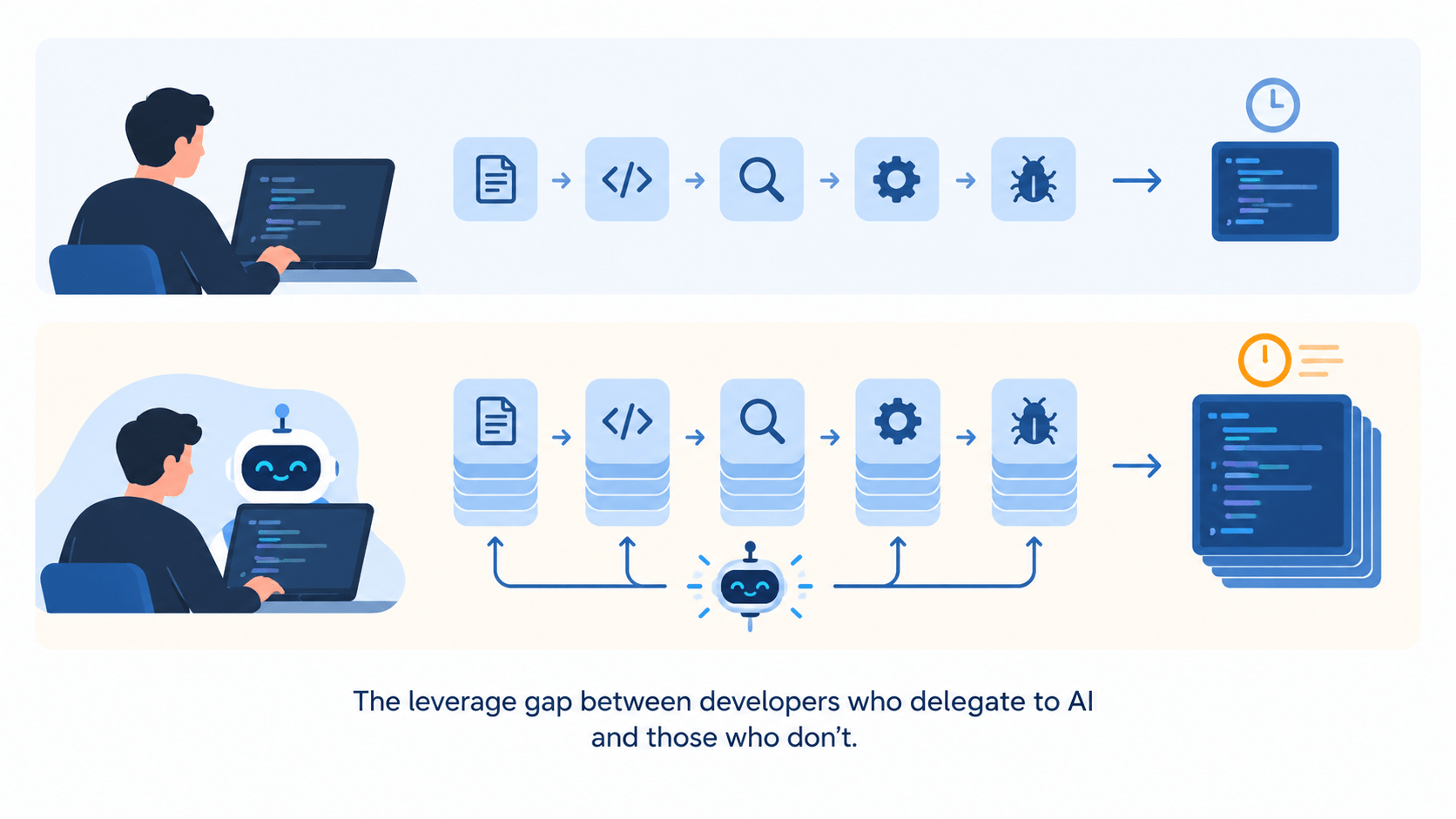
There’s a common misunderstanding about workplace AI. The competition isn’t Engineer vs AI. Increasingly, it’s Engineer with AI vs Engineer without AI.
Suppose two developers have similar experience. Developer A spends an hour manually creating test cases. Developer B, already working like an AI-native engineer, gives repository context to an AI coding agent, has it draft the important test scenarios, reviews them, and spends the saved time investigating an architectural problem. Both developers still hold engineering responsibility but their effective output can look very different. Multiply that gap across an organization of hundreds or thousands of employees, and the company doesn’t simply gain an AI tool. It gains a different operating model.
The New Software Development Workflow
Consider a traditional feature request: “Build a customer profile page.” The traditional workflow looks like reading the ticket, inspecting the existing UI, searching documentation, writing code, writing tests, fixing failures, creating a PR, and updating documentation often many hours of work hidden inside a seemingly simple ticket.
Now consider the AI-assisted version. The engineer gives an AI coding agent repository access, project instructions, architecture documentation, design requirements, and existing component patterns, then asks it to build the page following the existing architecture, add unit and integration tests, run the suite, fix failures, and prepare the PR description. The AI performs a large share of the mechanical work. The engineer becomes responsible for defining constraints, supervising implementation, reviewing the result, validating behavior, and approving the change. That is a very different job and it’s the job description of an AI-native engineer.
Case Studies: Where an AI-Native Engineer Actually Delegates Work
Building a UI Component
Traditionally, a developer building a “Customer Profile Card” would search the repository for similar components, inspect the design system, check API-call structure, and determine the state-management approach before implementing anything. With an AI coding agent, the developer can hand over the repository and let the agent identify existing conventions type definitions, styling patterns, API hooks, accessibility conventions, test patterns and generate the first implementation. The bigger change isn’t that AI wrote the JSX; it’s that AI now performs the repository exploration that used to consume human attention. The engineer’s role shifts toward judging whether the generated implementation actually belongs in the architecture.
Writing SQL Queries
A developer can provide schema context and ask AI to generate a first-draft query for example, one that returns customers with unpaid orders older than 30 days. The AI can generate that query, but the engineer still has to check: Is the join correct? Could this create duplicate rows? Will it use the right indexes? Does the business definition of “unpaid” match the database state? This illustrates a core principle of AI-assisted engineering the easier it becomes to generate code, the more important it becomes to understand what the code actually means.
Stored Procedures and the SP-to-API Pattern
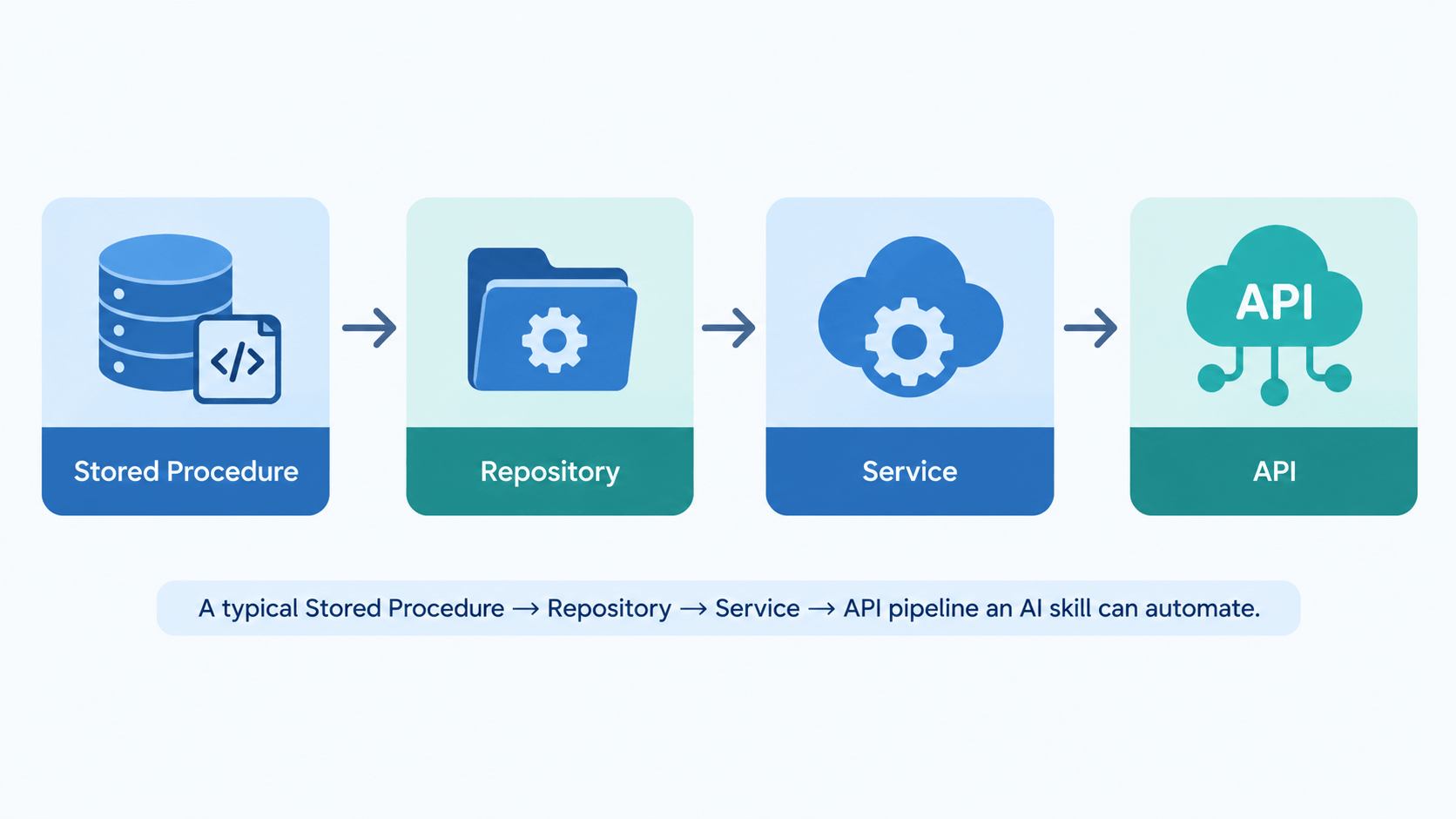
For legacy systems, a developer can provide the schema, an existing stored-procedure pattern, and the business requirement, and let AI draft the procedure definition, parameters, SQL logic, error handling and documentation. Teams following a Stored Procedure → Repository → Service → REST API architecture can go further by building a reusable internal AI skill that encodes their naming conventions, parameter mapping, and validation rules so a request like “create an API for GetCustomerOrders using our standard SP-to-API pattern” produces organization-specific code, not generic boilerplate.
What Are AI Skills (and Why They Matter More Than Prompts)
An AI skill is a reusable set of instructions, knowledge and procedures that teaches an AI system how to perform a class of work in a particular environment the equivalent of the weeks a new developer would otherwise spend learning coding standards, architecture, naming conventions and PR conventions. A prompt like “write a React component” tells the AI very little. A reusable UI skill that specifies the design system, naming convention, query hooks, accessibility requirements and testing framework contains actual organizational knowledge.
Common examples teams are building include a UI Component Skill, Stored Procedure Skill, SP-to-API Skill, Test Generation Skill, PR Review Skill, and PR Description Skill. This is the real value proposition: AI learning how your organization builds software, not just how to write generic code and building that library is one of the most practical habits an aspiring AI-native engineer can start today.
Also Read: Reusable Prompt Templates for Developers and Prompt Engineering Techniques for Consistent AI Results start building your own skill library from these.
Automated Testing, PR Review and Documentation
AI can inspect a new service and generate an initial test suite covering normal behavior, invalid input, authorization failures and boundary conditions though it may simply confirm the implementation rather than test the intended behavior, which is why understanding requirements still matters more, not less. The same logic applies to PR review: AI can flag missing tests and obvious bugs before a human reviewer opens the PR, so the human spends less time hunting for obvious issues and more time on architecture and business logic. AI can also inspect a diff and draft the PR description automatically a small saving per PR that compounds across hundreds of pull requests.
From Chat to Agents: Why the Interaction Model Is Changing
A chatbot waits for you. An agent can act. Asking a chatbot “how do I create an API from this stored procedure?” still leaves the work to you. An agent can inspect the procedure, find similar APIs, generate the repository, service and controller code, generate and run tests, fix failures, prepare the PR, and ask for human approval. That’s no longer a chatbot it’s an engineering workflow agent, and directing one instead of merely chatting with it is exactly what separates an AI-native engineer from an occasional AI user. It maps to Microsoft’s broader progression from AI assistants to digital colleagues to agents running entire workflows under human direction.
Also Read: WebMCP Explained: 7 Critical Risks Before You Go AI-Ready what happens when agents get direct tool access to your systems.
But AI Does Not Mean “Trust Everything”
The productivity story becomes dangerous when organizations confuse fast generation with correct software. Stack Overflow’s research on developer frustration with near-correct AI output is one warning sign. Another comes from a randomized controlled trial by METR, which found experienced open-source developers using early-2025 AI tools took 19% longer on study tasks a result the researchers explicitly framed as a snapshot of that generation of tools, not a permanent verdict.
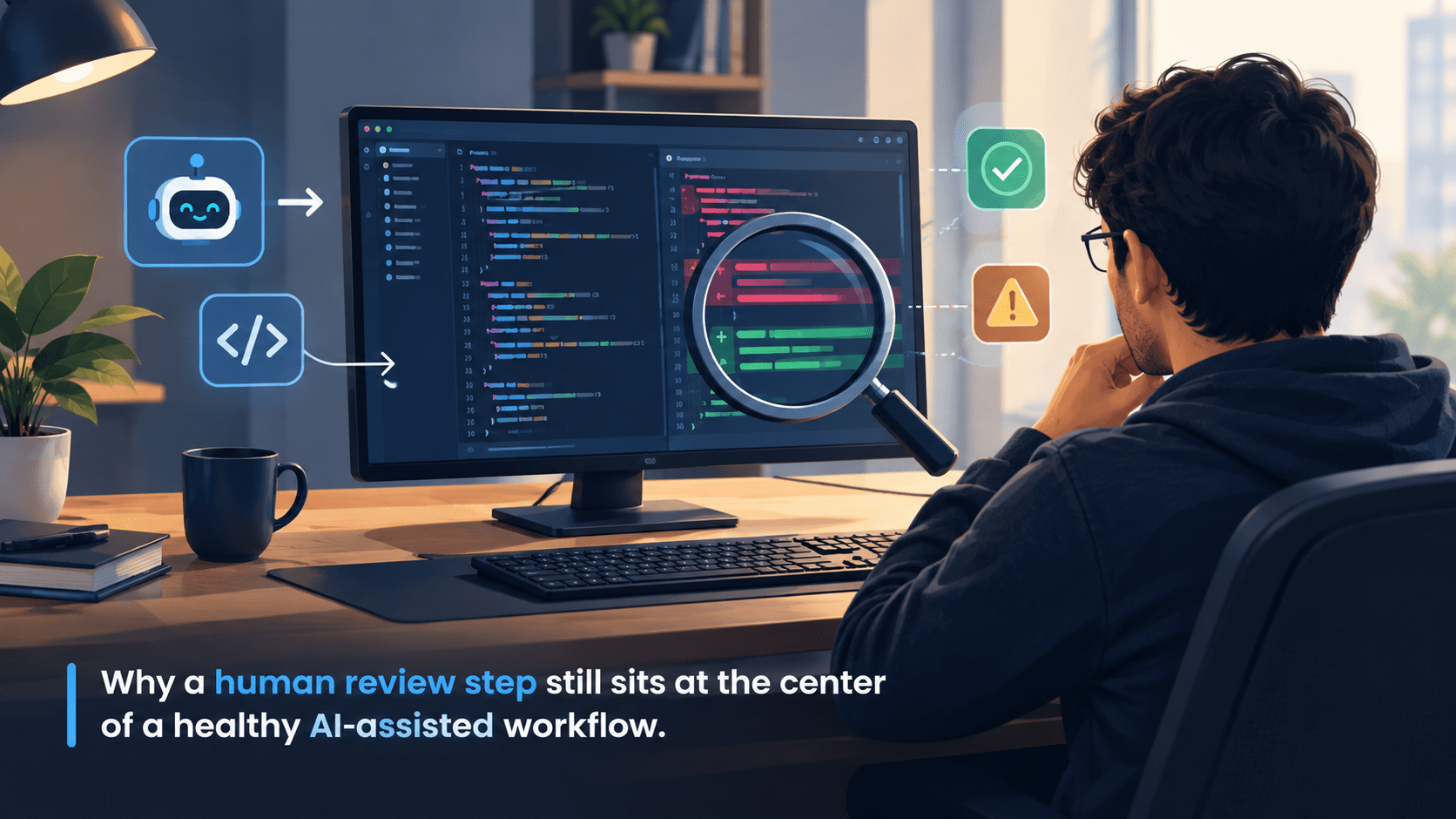
DORA’s 2025 research describes AI as an amplifier that magnifies an organization’s existing strengths and weaknesses, rather than automatically creating productivity. Teams with strong architecture, tests and review processes benefit; teams with weak processes just produce more output and more problems, faster. A mature AI workflow looks like: AI generates → AI tests → AI reviews → human verifies → human approves never AI generates → merge. The human stays accountable for architecture, security, business logic, correctness and compliance this is precisely where an AI-native engineer earns their title, by refusing to skip the verification step.
What Happens to Junior, Mid-Level, and Senior Developers
Junior developers get a real trade-off. AI can make them more productive faster explanations, faster exploration of unfamiliar technology but it can also remove the repetitive CRUD-and-boilerplate work through which juniors historically learned. The rule that follows: AI can accelerate a beginner only if the beginner is learning while using it. A junior who says “I know React” faces stronger competition than one who can say they use AI coding agents responsibly, review AI-generated code, write tests, debug production issues, and explain their architectural choices.
Mid-level engineers may see the biggest change, since they perform much of the implementation work AI increasingly accelerates. The opportunity is to move upward toward architecture, requirements, debugging, system design, and technical leadership so the engineer’s value shifts from “how much code can I write” toward “how much useful software can I responsibly deliver.”
Senior engineers, arguably the clearest example of the AI-native engineer in practice, have an advantage AI doesn’t automatically replicate: organizational context. They know why systems were designed a certain way, which shortcuts are dangerous, and which business rules are hidden inside legacy code. That makes them particularly valuable as reviewers, architects and AI orchestrators elegating “create the implementation,” then “generate the tests,” then “review for security problems,” then reviewing the entire chain themselves.
Becoming an AI-Native Engineer: The Skill Stack
This is the phrase worth sitting with: as code generation gets cheaper, context becomes more valuable. Anyone can ask AI to “write an API.” The engineer who knows which database to use, which architecture pattern applies, which security policy exists, and which API contract must stay backward-compatible can guide the AI far more effectively. Engineering knowledge doesn’t disappear it moves from writing every line toward knowing which lines should exist.
An AI-native engineer isn’t someone who asks AI to write everything, and it isn’t someone who refuses to use AI either. They understand what to delegate, what not to delegate, how to provide context, how to build reusable skills, how to verify results, and – critically – how to recognize when the machine is confidently wrong.
The 5-Skill Stack of an AI-Native Engineer
Five capabilities build that profile:
- Learn an AI coding assistant deeply – GitHub Copilot, Claude Code, Codex or Cursor. Learn to provide context, inspect changes, and delegate multi-step tasks, not just autocomplete.
- Learn to create reusable AI skills for UI components, SQL, stored procedures, API generation, testing, documentation and code review – this is where personal productivity becomes team productivity.
- Learn repository-aware AI development – how AI works with Git, branches, pull requests and tests, inside the repository rather than in a separate browser tab.
- Learn evaluation – automated tests, static analysis, security scanning, and regression testing, so you can tell whether AI-generated output is actually correct.
- Learn system design – APIs, databases, distributed systems, cloud, security and observability. The better you understand systems, the better you can direct AI.
Also Read: Tekraze Career Roadmaps step-by-step paths for building these skills whether you’re starting out or upgrading.
What This Means for Job Security and Job Seekers
If your current job consists largely of repetitive tasks AI can increasingly perform, pretending nothing is changing isn’t a strategy but panic isn’t useful either. The better response is moving upward on the value chain. If you write SQL, learn database architecture and query optimization. If you build UI, learn frontend architecture and design systems. If you build APIs, learn system design and security. If you write tests, learn test architecture and quality engineering. In every case, the strategy isn’t “become faster at the task AI already performs” it’s “move toward the decisions surrounding the task.”
If you’re changing jobs, “experienced with ChatGPT” no longer signals that you work like an AI-native engineer it’s now too generic. Show something like: “Built an AI-assisted development workflow that generates React components according to project conventions, creates tests, performs static analysis, and prepares pull requests.” If you’re looking for your first job, don’t compete only on “I know Java” or “I know React” build a project where AI helps you generate UI, backend code, SQL, tests and documentation, but where the architecture and final decisions stay under your control, and document that process publicly.
The Bigger Picture
The transformation happening inside companies isn’t really about Copilot, Claude or Codex individually those are tools. It’s about how organizations produce knowledge work. The old model was human thinks → researches → creates → reviews → delivers. The emerging model is human defines → AI researches → AI creates → AI tests → AI reviews → human validates → system delivers and eventually, human sets the objective → AI agents perform the workflow → human handles exceptions and decisions.
The most important lesson for employees, job seekers and students isn’t that AI will replace everyone. It’s that the value of individual tasks is changing. Writing a standard SQL query, generating a basic UI component, creating boilerplate APIs, and producing a first draft of documentation are all becoming easier. That doesn’t mean engineering disappears it means the engineer needs to move toward understanding the problem, knowing the architecture, making trade-offs, checking correctness, managing security, and taking responsibility for production.
The future engineer is unlikely to be the person who refuses to use AI. It’s also unlikely to be the person who blindly accepts everything AI generates. The valuable engineer sits between the two enough of an AI-native engineer to let AI do the repetitive work, enough of a skeptic to recognize when the machine is confidently wrong, and enough of a systems thinker to build workflows that let AI do useful work repeatedly.
Don’t try to make yourself AI-proof. Become AI-capable, AI-supervising, and AI-leveraged because the next competitive advantage may not belong to the person who writes the most code. It may belong to the person who can direct the most useful work through a combination of human expertise, software, and AI.