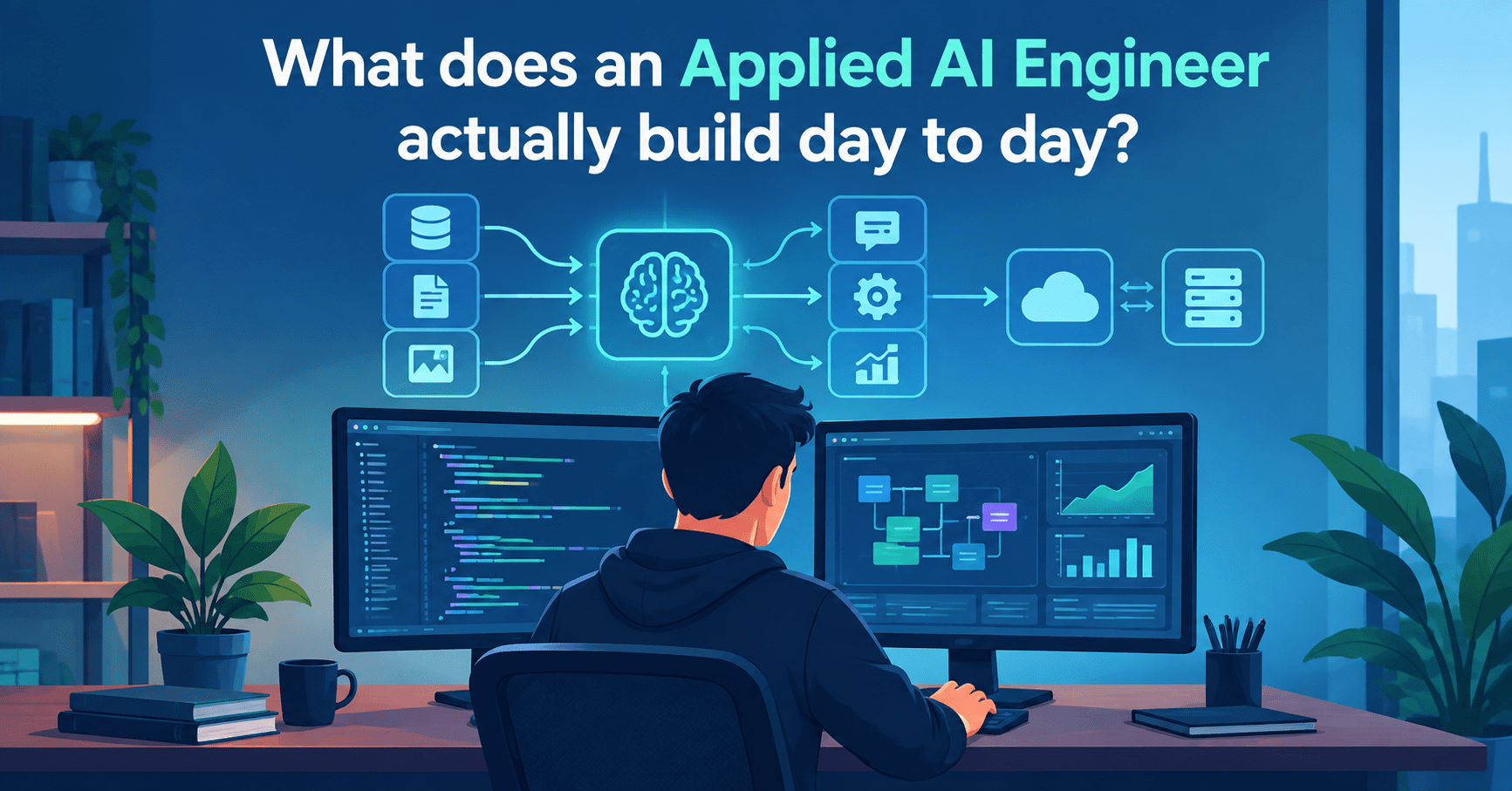

The Applied AI Engineer is one of the most interesting new roles in modern technology, and it exists because AI has created a category of engineering work that doesn’t fit neatly into software engineering, machine learning engineering, or data science. Companies are no longer interested only in building models or experimenting with large language models in notebooks. They increasingly need engineers who can take those capabilities and turn them into useful, reliable, and measurable features inside real products and business workflows.
An Applied AI Engineer sits close to the point where artificial intelligence becomes an actual product.
They might take a foundation model and turn it into an AI assistant, build a retrieval-augmented generation system over company data, create an AI agent capable of using business tools, develop evaluation systems for LLM outputs, integrate AI into an existing application, optimize inference costs, or work with product teams to determine whether an AI capability is genuinely useful in the first place.
The role is therefore less about inventing a new machine-learning algorithm and more about answering a different question: how do we take what AI can do today and turn it into something people can actually use? That distinction is becoming increasingly important.
Current hiring provides a strong indication of how the role is evolving. OpenAI’s careers page currently lists Applied AI Engineer positions across locations including Delhi, Mumbai, Sydney, Seoul, Tokyo, and several US locations, with specializations spanning enterprise, startups, cybersecurity, agent enablement, integrations, and core agent engineering.
Anthropic’s current Applied AI organization similarly includes Applied AI Engineers working across enterprise technology, life sciences, and other deployments. One of its current job descriptions describes the engineer as a technical Product Engineer who helps customers ship products powered by Claude, advises on architecture, develops evaluation frameworks, and guides implementation of advanced LLM patterns.
Apple has also advertised an Applied AI Engineer role focused on building and operating AI solutions using LLMs and agentic workflows to solve measurable business problems, showing that the role isn’t restricted to AI labs or startups.
This article explains what an Applied AI Engineer actually does, how the role differs from an AI Engineer, ML Engineer, Software Engineer, FDE, and AI Solutions Architect, the skills and tools worth learning, which industries are hiring, what projects can help build a portfolio, and how beginners, junior developers, senior engineers, and technical leads can move into Applied AI Engineering.
Also Read: GPT-6 Astra: Everything You Need to Know About OpenAI’s New Frontier Model
What Is an Applied AI Engineer?
An Applied AI Engineer is a software engineer who specializes in applying artificial intelligence capabilities to real products, applications, and business problems. The word “applied” is the key.
A research scientist may ask: “Can we develop a new technique that improves reasoning performance?” An ML engineer may ask: “How can we train and serve this model efficiently?” An Applied AI Engineer asks something different: “How can we use the capabilities available today to build a reliable system that solves this customer’s or user’s problem?”
The answer could involve an LLM, an existing machine-learning model, a retrieval system, an AI agent, traditional software, or a combination of all of them. This means Applied AI Engineering is fundamentally about integration and application.
The engineer takes AI capabilities and combines them with software, data, APIs, cloud infrastructure, user interfaces, business workflows, security, evaluation, and monitoring. The result isn’t simply an AI model. It’s a working product or production system.
A Simple Example
Imagine a company wants to build an AI assistant for its employees. The assistant should answer questions about company policies, retrieve information from internal documents, and perform certain actions through enterprise systems.
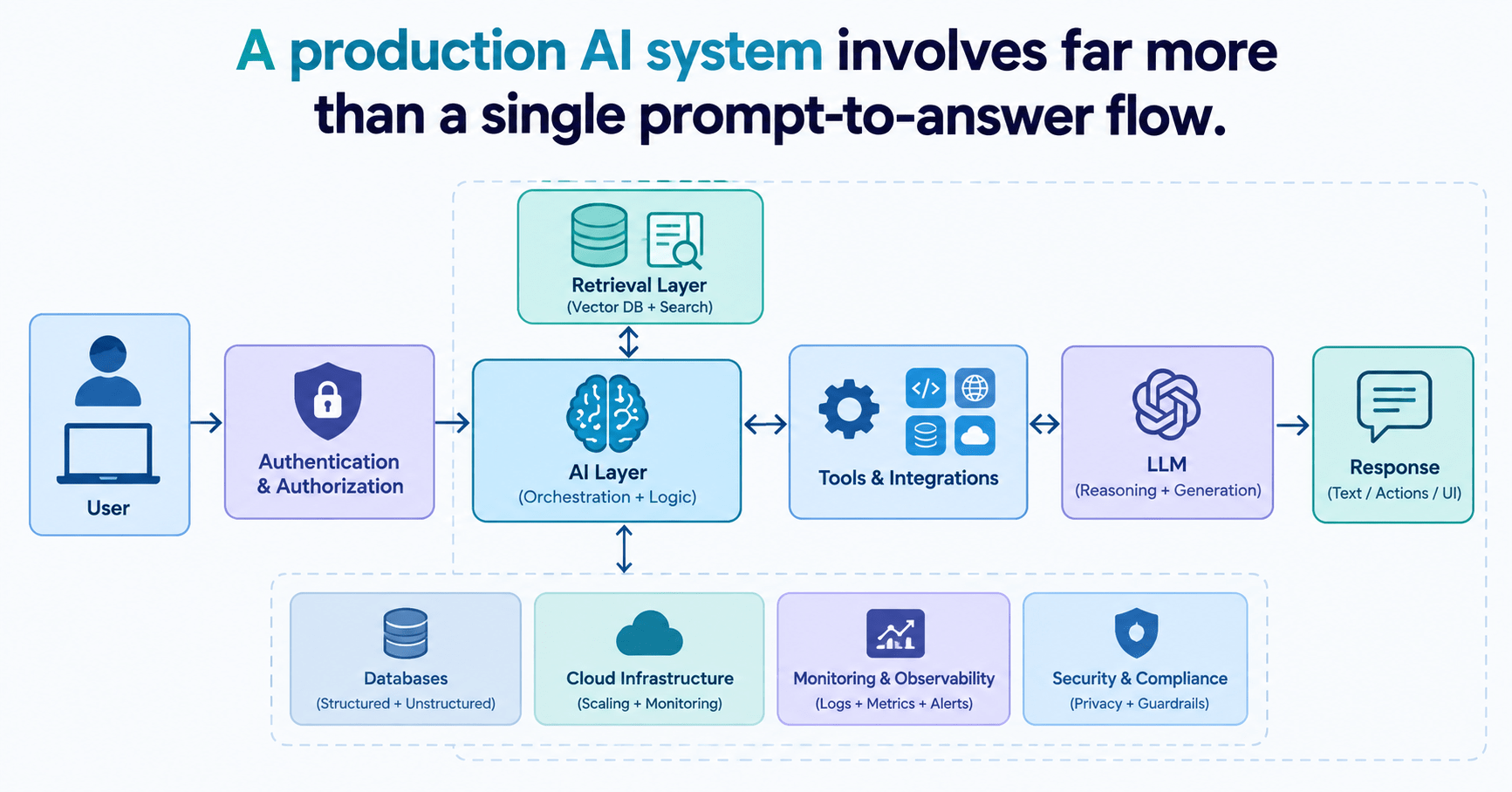
A basic prototype is easy to demonstrate: a user sends a prompt, the LLM processes it, and an answer comes back.
A production application looks nothing like that. It starts with the employee, moves through a web application, then through SSO and IAM, then into an AI layer that splits into retrieval, tools, and the LLM. Retrieval connects to a vector database, tools connect to APIs, and both feed back into the model to produce a response or action. That response then passes through evaluation and logging before reaching monitoring.
The Applied AI Engineer may be responsible for building a significant portion of this system. They might write the backend, integrate the model API, build the retrieval pipeline, implement tool calling, create evaluation tests, connect enterprise APIs, and deploy the application.
This is why Applied AI Engineering is much closer to production software engineering with AI as a core component than simply “prompt engineering.”
Why Does the Applied AI Engineer Role Exist?
Traditional software engineering was built around deterministic systems. If a function receives the same input, it should generally produce the same output.
AI systems introduce probabilistic behavior. An LLM can produce different responses to similar inputs. An AI agent may choose different tools depending on context. A retrieval system may return different information depending on ranking. A model can perform extremely well on one class of tasks and poorly on another.
This creates an engineering problem. You can’t simply write “call the model and display the answer.” You have to build the surrounding system that makes AI useful prompting, retrieval, tools, validation, evaluation, monitoring, fallback, and user experience, all working together.
The Applied AI Engineer exists to solve this “last mile” problem between model capability and product capability. With that “why” established, it’s worth untangling how this role actually differs from the adjacent titles it constantly gets confused with.
Applied AI Engineer vs AI Engineer
The titles overlap considerably, and different companies use them differently. In many organizations, an AI Engineer and Applied AI Engineer are effectively the same job.
Where a distinction exists, an AI Engineer can have a broader focus across machine learning and AI systems, while an Applied AI Engineer tends to emphasize shipping AI capabilities into products and workflows.
An AI Engineer might work on model integration, ML pipelines, AI infrastructure, model serving, RAG, agents, and evaluation. An Applied AI Engineer is particularly focused on product integration, user experience, business problems, AI-powered features, production applications, customer requirements, and iteration based on real-world usage.
The boundary is blurry, which matters when you’re searching for jobs and trying to figure out what a listing actually wants from you.
Applied AI Engineer vs ML Engineer
This distinction is more straightforward. An ML Engineer is typically concerned with the machine-learning lifecycle: training, data pipelines, model serving, experimentation, and model operations.
An Applied AI Engineer may never train a foundation model. Instead, they take an existing model and build a product around it. For example, an ML Engineer might build and optimize the inference infrastructure for a model, while an Applied AI Engineer might build a customer-support system using that model, connect it to the company’s knowledge base, integrate the ticketing system, evaluate the responses, and deploy it.
Both are important. They simply operate at different layers.
Applied AI Engineer vs Software Engineer
An Applied AI Engineer is still fundamentally an engineer. The difference is that AI becomes one of the core architectural components.
A traditional software engineer might build a frontend, an API, and a database. An Applied AI Engineer might build a frontend, an API, an agent, a retrieval layer, a model, tools, and a database.
The software engineering fundamentals remain extremely important. In fact, poor software engineering becomes particularly dangerous when AI is involved, because the system already carries additional uncertainty. A strong Applied AI Engineer needs software engineering first and AI engineering second, not the other way around.
Applied AI Engineer vs Forward Deployed Engineer
A Forward Deployed Engineer is generally embedded closer to customers and is often responsible for discovering problems and deploying customized solutions in customer environments.
An Applied AI Engineer may work more directly on building AI capabilities into products or customer implementations. In practice, though, the roles increasingly overlap.
OpenAI’s current Applied AI Engineering organization explicitly describes engineers as working with customer executives, product and engineering teams, security leaders, and transformation teams to identify opportunities and deploy production AI systems. Anthropic’s current Applied AI Engineer role similarly involves working directly with customer product and engineering teams while building and shipping LLM-powered products.
The simplest distinction: a Forward Deployed Engineer says “let’s understand your problem and deploy a solution in your environment,” while an Applied AI Engineer says “let’s build and ship an AI-powered product or capability that solves the problem.” In real companies, that boundary may disappear entirely.
Applied AI Engineer vs AI Solutions Architect
The AI Solutions Architect usually thinks at a broader system level. They decide which models should be used, how the data architecture should work, how security should be implemented, how the AI system integrates with enterprise infrastructure, and how the overall architecture scales.
The Applied AI Engineer then turns much of that design into working software. Put simply: the AI Solutions Architect designs the system, and the Applied AI Engineer builds and ships the AI capability.
Strong senior Applied AI Engineers will still perform architecture work, and strong AI Solutions Architects should understand implementation deeply the two roles lean on each other constantly.
Also Read: In-Hand Salary vs CTC: Essential, Shocking ₹1.7 Cr Truth
What Does an Applied AI Engineer Do?
The actual job varies significantly between companies. A typical project moves through problem discovery, technical design, a prototype, AI integration, evaluation, product integration, deployment, monitoring, and iteration.
An Applied AI Engineer might spend one day writing Python, another debugging an agent, another designing an evaluation framework, and another working with product managers on a new AI feature. That variety is part of the appeal of the role.
Building AI Features
One of the most common responsibilities is adding AI capabilities to existing software. A CRM might add an AI assistant. A cybersecurity platform might add an AI investigation agent. A developer tool might add code generation. A healthcare application might add document summarization. A financial application might add intelligent analysis.
The Applied AI Engineer needs to determine how AI should actually fit into the product, rather than simply adding a chatbot because “every product needs AI.”
Building RAG Systems
Retrieval-Augmented Generation remains one of the most practical enterprise AI architectures. The basic flow moves from documents to processing, chunking, embeddings, a vector store, retrieval, the LLM, and finally a response.
But production RAG involves many additional engineering decisions. The engineer needs to determine how documents are processed, how they’re chunked, which embedding model is appropriate, which database should store embeddings, how retrieval works, whether hybrid search is necessary, whether reranking is needed, how permissions are enforced, how stale documents are handled, and how retrieval quality gets evaluated.
This is a software engineering problem with AI components, not simply a prompting exercise.
Building AI Agents
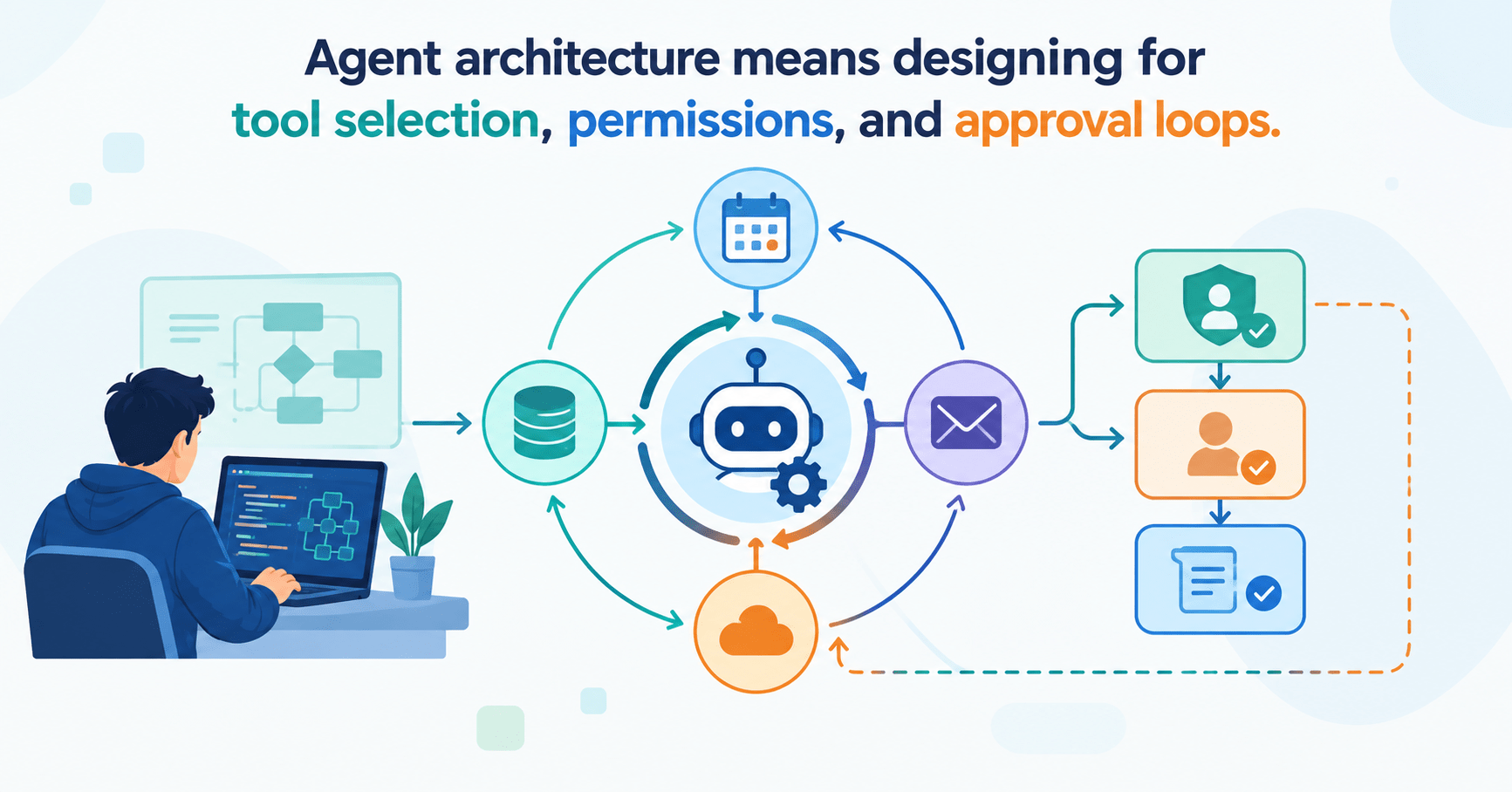
Agentic AI is another major area for Applied AI Engineers. An agent can understand a goal, select tools, retrieve information, perform actions, inspect results, and continue or ask for approval.
A simple agent architecture moves from the user to the agent, which reasons about the task, selects a tool, calls an API, inspects the result, and then either continues or asks for approval before completing the task.
This creates a new class of engineering problems. The engineer needs to decide which tools are available, which permissions the agent receives, which actions require approval, how tool errors are handled, how agent loops are prevented, how actions are logged, how agent performance is evaluated, and how costs are controlled.
OpenAI currently lists an Applied AI Engineer role specifically focused on Agent Enablement, while Anthropic’s Applied AI organization includes engineering and architecture roles focused on enterprise AI deployments.
Prompt Engineering Is Only One Part of the Job
Prompting is useful, but an Applied AI Engineer needs to think much beyond prompts. A production AI system may involve a prompt, context, retrieval, tools, the model, validation, evaluation, and monitoring, all working together.
A beautifully written prompt can’t compensate for bad data or a poorly designed system. This is why modern Applied AI Engineering is increasingly a systems discipline rather than a prompt-writing discipline.
AI Evaluation
One of the most important Applied AI skills is evaluation. Traditional software can often be tested with deterministic assertions, where the input 2 + 2 should always produce the expected output of 4.
AI systems are different. A response can be correct, partially correct, incorrect, well written but unsupported, technically correct but irrelevant, safe, unsafe, useful, or unhelpful.
Applied AI Engineers therefore need evaluation systems: golden datasets, human evaluation, automated evaluation, LLM-as-judge approaches, regression testing, retrieval evaluation, agent evaluation, and safety testing. The goal is to move from “the demo looks good” to “we have evidence that the system performs reliably on the tasks that matter.”
AI Observability
Production AI needs more than ordinary application logs. An engineer may need to know which model was used, how many tokens were consumed, how long inference took, which documents were retrieved, which tools were called, whether the agent failed, what the final response was, how much the request cost, and whether quality has changed over time. This is why AI observability is becoming part of the Applied AI engineering stack.
Cost Optimization
AI can become expensive surprisingly quickly. Suppose an application makes millions of requests if every request uses an expensive reasoning model, the architecture can become economically impractical.
An Applied AI Engineer may implement a small model for simple tasks, a large model for difficult tasks, caching for repeated requests, retrieval to avoid unnecessary context, and model routing to choose the appropriate model for each job. This means AI engineering also involves inference economics.
Reliability
AI applications can’t be treated as prototypes once they’re live. Production systems need timeouts, retries, rate limiting, fallbacks, caching, error handling, circuit breakers, monitoring, and human escalation.
An AI model can fail. An API can fail. A retrieval system can fail. A tool can fail. The Applied AI Engineer has to design the system so that one failure doesn’t destroy the entire user experience.
Security
AI applications create new security concerns. An Applied AI Engineer should understand authentication, authorization, secrets, API security, data privacy, access control, prompt injection, data leakage, tool permissions, and agent security.
Consider an AI agent that has access to a company’s email system. Giving the agent permission to read email is one thing. Giving it permission to send email is another. Giving it permission to delete email is another entirely. Agent architecture needs permission boundaries just like traditional applications do.
Skills and Tools an Applied AI Engineer Needs
Programming Skills
The most important programming language for modern Applied AI Engineering is arguably Python. It’s widely used across AI APIs, machine learning, data processing, backend development, evaluation, and automation. Important Python technologies include FastAPI, Pydantic, PyTorch, Transformers, NumPy, Pandas, and async programming.
TypeScript is increasingly valuable too, because many AI applications require full-stack development. Learning TypeScript, React, Next.js, Node.js, and API integration is particularly useful for engineers building AI features directly into web applications.
SQL and Databases
AI systems still depend heavily on traditional data infrastructure. Learn SQL, PostgreSQL, MySQL, Redis, and MongoDB. For AI applications specifically, also understand vector databases, embeddings, similarity search, and hybrid search. PostgreSQL with pgvector is an especially useful combination, since it lets teams keep traditional relational data and vector search within one ecosystem.
Cloud
A production Applied AI Engineer should understand at least one major cloud platform AWS, Azure, or Google Cloud. Important concepts include compute, storage, networking, IAM, containers, serverless, databases, monitoring, and secrets. The goal isn’t to memorize every cloud service; it’s to understand how applications actually run.
Docker and Kubernetes
Docker is highly useful because AI applications need reproducible environments. Kubernetes becomes useful as systems grow and require scaling, service management, GPU workloads, deployment automation, and high availability. Beginners should learn Docker first Kubernetes can come later.
APIs and Integration
Applied AI is heavily dependent on integration. You should understand REST, GraphQL, webhooks, OAuth, OAuth 2.0, OpenID Connect, JWT, API keys, and rate limiting. An AI application rarely operates alone it needs to communicate with other software.
AI APIs and Model Platforms
An Applied AI Engineer should understand how to work with multiple model providers rather than tying their entire knowledge to one API. Useful ecosystems include OpenAI, Anthropic, Google Gemini, Amazon Bedrock, Microsoft Azure AI, and Google Vertex AI. The important skill is understanding model capabilities, limitations, latency, cost, context, and reliability not memorizing SDK syntax.
AI Frameworks
Useful frameworks include LangChain, LangGraph, LlamaIndex, Semantic Kernel, OpenAI Agents SDK, and Microsoft Agent Framework. Frameworks shouldn’t become a substitute for understanding the underlying architecture, though. If you understand agents, tools, retrieval, state, and workflows, learning another framework is relatively straightforward. If you only know one framework’s API, changing frameworks can be painful.
Vector Search
An Applied AI Engineer should understand embeddings, vector similarity, approximate nearest-neighbor search, metadata filtering, hybrid search, and reranking. Tools include pgvector, Pinecone, Weaviate, Milvus, Elasticsearch, and OpenSearch. Again, the underlying concepts matter more than the brand name.
AI Evaluation and Observability Tools
Useful tools include LangSmith, Arize, MLflow, Weights & Biases, and OpenTelemetry. Different organizations use different stacks, so understanding the concepts is more valuable than becoming dependent on a single product.
Enterprise Integration
Applied AI Engineers working in larger organizations should get comfortable with enterprise systems like Salesforce, SAP, ServiceNow, Workday, Microsoft 365, Google Workspace, Oracle, and Jira. The AI feature may need to retrieve information from one system and perform an action in another this is where ordinary software engineering becomes extremely important.
The Applied AI Engineer Skill Stack
A practical skill model divides into three pillars that all feed into production: software, AI, and product. Software covers Python, TypeScript, SQL, and APIs. AI covers LLMs, RAG, agents, and evaluation. Product covers UX, APIs, workflows, and business metrics. All three pillars then connect to production, which depends on cloud, security, and observability working together.
The important point is that the role is T-shaped. You need broad knowledge across the system and deeper expertise in one or two areas.
What Should a Beginner Learn?
Someone starting from zero shouldn’t try to learn every AI framework immediately. A much better sequence follows seven stages.
- Software engineering – learn Python, Git, Linux, SQL, HTTP, and APIs, then build ordinary applications first.
- Backend and web – learn FastAPI, React, TypeScript, and PostgreSQL, then build full-stack applications.
- Cloud – choose AWS, Azure, or GCP, and deploy something. Don’t just watch cloud tutorials.
- AI APIs – learn how to call LLM APIs, handle streaming, use structured output, use tool calling, manage context, and handle errors.
- RAG – build a complete RAG system and understand why retrieval succeeds and fails.
- Agents – learn tools, state, workflows, permissions, human approval, and agent evaluation.
- Production – add authentication, Docker, CI/CD, monitoring, evaluation, logging, and cost tracking.
At that point, you’re beginning to look like an Applied AI Engineer rather than someone who’s simply completed an LLM course.
Career Roadmaps by Experience Level
Roadmap for Junior Developers
If you already have one to three years of software engineering experience, focus on adding AI rather than abandoning your existing skills. Learn LLMs, then RAG, then agents, then evaluation, then cloud deployment, then AI security. Then look for projects where AI needs to be integrated into an existing application.
For example, instead of building “a chatbot,” build “an authenticated enterprise knowledge assistant that retrieves authorized documents, cites its sources, evaluates responses, and runs in production.” The second project demonstrates substantially more engineering ability.
Roadmap for Mid-Level Engineers
At the mid-level, focus on system ownership. Learn to take an AI feature from idea to architecture to prototype to evaluation to implementation to deployment to monitoring.
You should also become comfortable explaining why you chose one model over another, RAG over fine-tuning, one vector database over another, one cloud architecture over another, and an agent workflow over deterministic automation. This is where engineering judgment starts to matter as much as coding.
Roadmap for Senior Engineers
Senior software engineers often already have most of the required foundation backend systems, APIs, databases, cloud, distributed systems, security, and production engineering. The biggest new areas are usually LLM architecture, RAG, agents, AI evaluation, inference economics, AI security, and product thinking. A senior engineer can transition into Applied AI Engineering without starting over.
Roadmap for Lead and Staff Engineers
For technical leads and staff engineers, the focus shifts from implementing one AI feature to creating reusable AI engineering capabilities: shared AI gateways, model routing systems, evaluation frameworks, agent platforms, retrieval infrastructure, AI observability, security patterns, AI development standards, and reusable enterprise integrations.
The staff-level Applied AI Engineer is increasingly thinking about how to make it easier and safer for fifty engineering teams to build AI features, rather than how to build one AI feature.
Projects That Can Build an Applied AI Portfolio
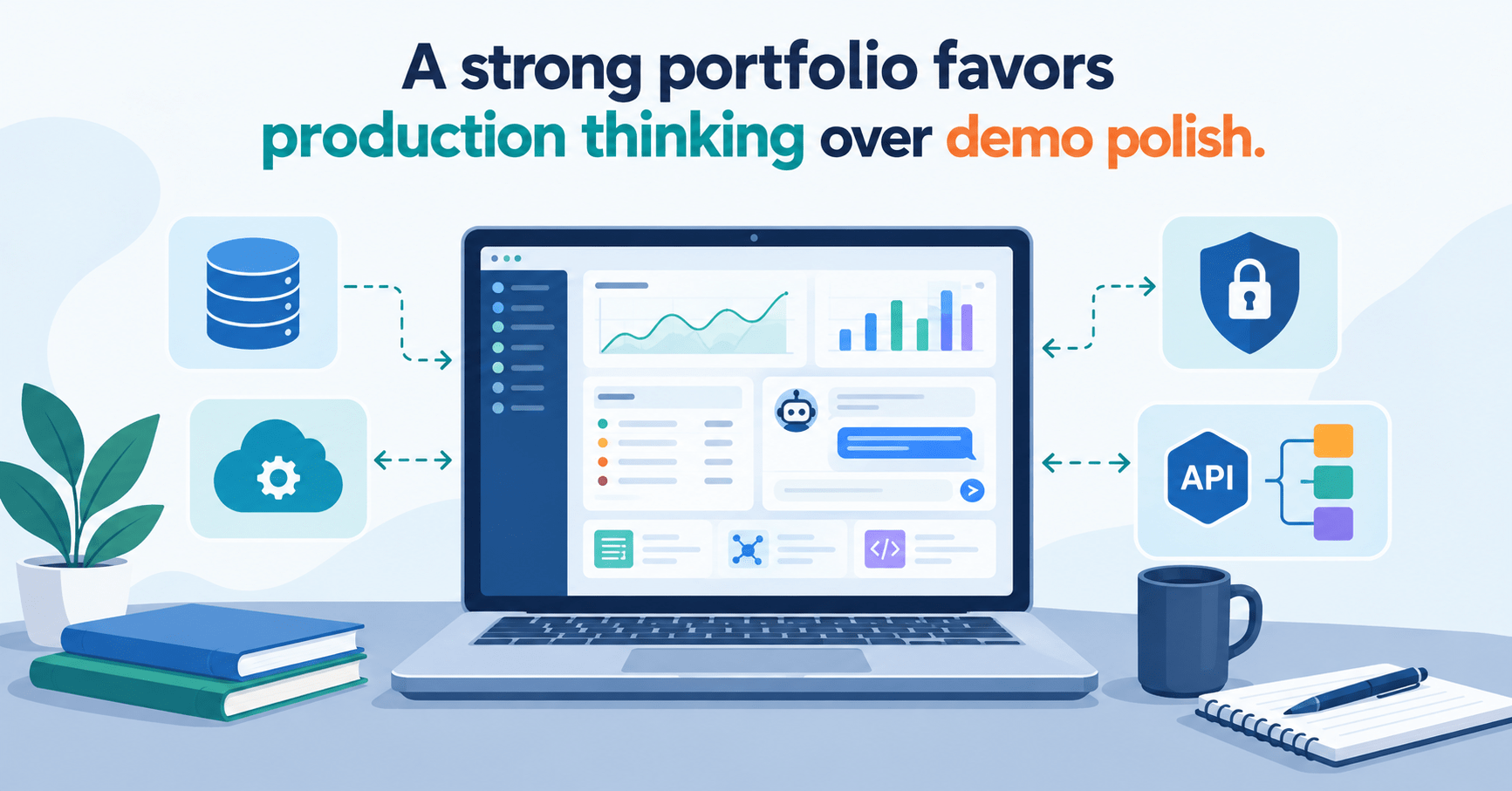
A strong portfolio should demonstrate production thinking, not just demo polish.
Project 1: Enterprise RAG Application
Build a system that lets users ask questions about a document collection. Include document ingestion, chunking, embeddings, vector search, RAG, authentication, citations, evaluation, and monitoring. Deploy it publicly or document the architecture thoroughly.
Project 2: AI Agent
Build an agent that can interact with multiple tools a user talking to an agent that connects to a calendar API, an email API, and a database. Add permission controls and human approval for sensitive actions. This demonstrates that you understand agent architecture rather than merely prompting a model.
Project 3: AI Customer Support Platform
Build a system where a user talks to a support AI that draws on a knowledge base, connects to a CRM, and files tickets. Add RAG, tool calling, human escalation, evaluation, analytics, and cost tracking. Now you’re demonstrating a realistic enterprise AI workflow.
Project 4: Multi-Model Router
Create an application that chooses between models based on task complexity, latency, cost, and capability routing simple classification to a smaller model, complex reasoning to a larger model, and images to a vision model. This demonstrates practical AI infrastructure thinking.
What Companies Are Hiring Applied AI Engineers?
The role is appearing across several categories.
AI Labs
Companies such as OpenAI and Anthropic have large Applied AI organizations. OpenAI’s current listings include Applied AI Engineer positions covering enterprise, startups, cybersecurity, integrations, agent enablement, and core engineering, with India-based opportunities including Delhi and Mumbai. Anthropic’s Applied AI organization currently includes engineers and architects across enterprise technology, life sciences, partnerships, and other industry-focused areas, with India-based Applied AI Architect roles also listed.
Large Technology Companies
Applied AI roles are also emerging within established technology companies. Apple’s 2026 Applied AI Engineer posting, for example, focuses on developing and operating LLM and agentic AI solutions with measurable impact on business operations.
Enterprise Technology
Companies building enterprise software increasingly need engineers who can add AI capabilities to CRM, ERP, analytics, security, productivity, customer service, and developer tools.
Consulting and IT Services
Large technology consulting organizations are also creating AI architecture and engineering positions, because customers need help implementing AI rather than simply purchasing access to models.
Industries That Need Applied AI Engineers
The role can exist in almost every industry:
- Financial services – fraud analysis, customer service, financial research, document processing, risk analysis, compliance assistance
- Healthcare – clinical documentation, patient support, medical information retrieval, administrative automation, healthcare analytics
- Cybersecurity -security investigation assistants, alert summarization, threat analysis, automated investigation agents
- Software develo-pment– coding assistants, code review, test generation, documentation, developer agents, repository search
- Retail – shopping assistants, personalization, customer service, product discovery, inventory intelligence
- Manufacturing – industrial assistants, predictive maintenance, quality control, factory analytics
- Media and marketing – content workflows, personalization, research, campaign automation, creative assistance
The Most Important Applied AI Skill
It’s tempting to think the most important skill is knowing the latest model. It isn’t. Models change. Frameworks change. Vector databases change. Cloud AI services change.
The fundamental skill is knowing how to turn uncertain AI capabilities into reliable software. That requires understanding what happens when the model is wrong, when retrieval fails, when the API is unavailable, when an agent chooses the wrong tool, when a user provides malicious instructions, when the system suddenly becomes ten times more expensive, or when the model provider changes its behavior. The Applied AI Engineer has to design for those realities.
The Demo vs Production Test
A useful way to understand Applied AI Engineering is to compare a demo with production.
A demo is simply a prompt going into an LLM and producing an answer. Production looks very different: a user authenticates into the application, the input gets validated, context gets retrieved, permissions get filtered, a prompt gets constructed, the request gets routed to a model, the LLM responds, tool calls happen, results get validated, safety checks run, a response goes back to the user, and the whole exchange gets logged, evaluated, and monitored.
The difference between these two systems is essentially the difference between AI experimentation and Applied AI Engineering.
Do You Need a Machine Learning Degree?
Not necessarily, and this is an important distinction to make early. If you want to become a research scientist developing new machine-learning algorithms, advanced mathematics and formal ML education can be extremely important.
Applied AI Engineering is different. A strong software engineer with programming, system design, cloud, APIs, databases, LLM, RAG, agent, and evaluation skills can become highly effective in this field without becoming a research scientist.
That doesn’t mean ML knowledge is useless. Understanding neural networks, transformers, embeddings, attention, and fine-tuning is valuable. But you don’t necessarily need to train a frontier model from scratch.
Certifications vs Projects
Certifications can demonstrate structured learning, particularly in cloud platforms. But an Applied AI portfolio should demonstrate something more important: can you build?
A project with an architecture diagram, source code, production deployment, evaluation dataset, monitoring, cost analysis, and security considerations is often a much stronger demonstration of Applied AI capability than a collection of course-completion certificates.
How to Prepare for an Applied AI Interview
Expect interviews to go beyond basic Python questions. Depending on the company, you may encounter:
- Coding – Python or TypeScript exercises
- System design – designing an AI application from scratch
- AI architecture – explaining RAG, agents, model routing, and evaluation
- Debugging – diagnosing why an AI system isn’t behaving correctly
- Product thinking – deciding whether an AI feature is actually useful
- Behavioral – handling ambiguity and changing requirements
- Customer communication – explaining complex AI systems to non-technical stakeholders
Anthropic explicitly emphasizes communication in its Applied AI Engineer hiring, describing engineers as technical advisors who work with customer product and engineering teams while explaining complex solutions to technical and non-technical audiences.
What Does an Applied AI Engineer’s Career Look Like?
A possible progression moves from Junior Software Engineer, to Software Engineer, to AI Engineer or Applied AI Engineer, to Senior Applied AI Engineer, to Staff Applied AI Engineer, to Principal Applied AI Engineer, to AI Architect or Technical Lead, and eventually to Head of Applied AI or AI Engineering.
There’s also a management path that moves from Senior Applied AI Engineer to Engineering Manager, to Senior Manager, to Director of Applied AI, and to VP or Head of AI Engineering.
What Can You Become After Applied AI Engineering?
The role opens several directions: AI Architecture, AI Infrastructure, AI Product Engineering, Forward Deployed Engineering, AI Security, AI Platform Engineering, Technical Leadership, AI Product Management, AI Consulting, or Startup and Entrepreneurship. This flexibility is one of the strongest reasons to consider Applied AI Engineering as a career foundation.
The Future of Applied AI Engineering
The role will probably keep changing rapidly. Today’s Applied AI Engineer may spend significant time integrating LLM APIs. Tomorrow’s engineer may spend more time building AI agents, multi-agent systems, AI-native applications, model-routing systems, AI operating layers, autonomous workflows, evaluation infrastructure, and AI security systems.
The tools will change. The underlying engineering problems will remain: how do we make AI useful, reliable, safe, fast, affordable, and measurable? Those questions will keep requiring engineers.
AI Will Change the Applied AI Engineer’s Job Too
AI coding tools are already making implementation faster. That doesn’t necessarily make Applied AI Engineers less important – instead, the bottleneck moves upward.
If an AI coding assistant can generate a working prototype in an hour, the harder questions become: what should we build, is the architecture correct, is the data trustworthy, is the AI actually useful, how do we evaluate it, how do we make it safe, how do we deploy it, and how do we know it creates value? Applied AI Engineering therefore increasingly rewards judgment, not just typing speed.
A Practical Applied AI Learning Path
For anyone serious about entering this field, this sequence is a practical starting point:
- Foundation: Python, Git, Linux, SQL, HTTP, APIs
- Software: FastAPI, TypeScript, React, PostgreSQL
- Infrastructure: Docker, Cloud, CI/CD
- AI: LLM APIs, embeddings, RAG, tool calling, agents
- Production AI: evaluation, observability, security, cost optimization
- Advanced: Kubernetes, Terraform, model routing, AI gateways, multi-agent systems, enterprise integration
Also Read: If you want to get hands-on with the AI layer of this stack before touching production concerns, our guide on prompt engineering fundamentals for developers is the natural next stop.
Final Applied AI Engineer Skill Map
Condensed into one framework, the role comes down to ten things: software engineering (building reliable applications), AI engineering (integrating models, retrieval, and agents), data (knowing how information enters and moves through the system), cloud (knowing how the system runs at scale), security (protecting users and data), evaluation (measuring AI quality), observability (knowing what the system is doing in production), product (knowing whether the feature solves a real problem), communication (explaining technical decisions), and business (knowing whether the solution creates measurable value).
Conclusion
The Applied AI Engineer is emerging as one of the most practical engineering careers created by the current AI wave, because the role focuses on the part of AI that businesses ultimately care about most: turning capability into useful software.
Research labs can build increasingly powerful models, cloud companies can provide increasingly sophisticated AI infrastructure, and startups can produce impressive demonstrations but none of that automatically creates a successful product. Someone still needs to connect the model to the application, the application to the data, the data to the business workflow, and the entire system to the users. That person is increasingly the Applied AI Engineer.
The current hiring landscape supports this direction. OpenAI has Applied AI Engineer roles spanning enterprise, startups, cybersecurity, agent enablement, integrations, and core engineering, including positions in India. Anthropic has built a substantial Applied AI organization with engineers and architects working across enterprise technology, life sciences, partnerships, and other industries. Apple has also advertised an Applied AI Engineer position centered on building and operating LLM and agentic AI solutions with measurable business impact.
For software engineers, perhaps the most attractive part of this career is that you don’t need to abandon what you already know. You still need programming, databases, APIs, cloud infrastructure, and system design. You simply add a new layer: AI. And that layer changes the way applications get designed.
The most useful mental model is this: an Applied AI Engineer isn’t someone who merely knows how to use AI. It’s an engineer who knows how to make AI work inside real software, real products, and real-world constraints. That distinction will only become more important as the industry moves from the era of impressive demos into the much harder era of production AI.
Start with one stage from the beginner roadmap above, build one real project around it, and you’ll already be ahead of most people talking about this role instead of doing it.