
If you want to solve DSA problems without cramming a mental database of a thousand answers, you’re in the right place. If you have ever stared at a new DSA problem and thought “I don’t remember seeing this exact question before,” you are not behind. The developers who look fast in interviews are just faster at one thing: recognizing the pattern underneath the problem.
Let us break down how that actually works, step by step, so you can start using it on your next problem instead of your next hundred problems.
Why Memorizing Solutions Doesn’t Work
Competitive coding platforms host tens of thousands of problems. You cannot store that many solutions in your head, and you shouldn’t try. What you can store is a much shorter list: the 10 or so patterns that most problems are built from.
Once you recognize the pattern, the actual code almost writes itself. This is the same reason experienced developers debug faster. They are not smarter line by line. They have just seen the shape of the bug before.
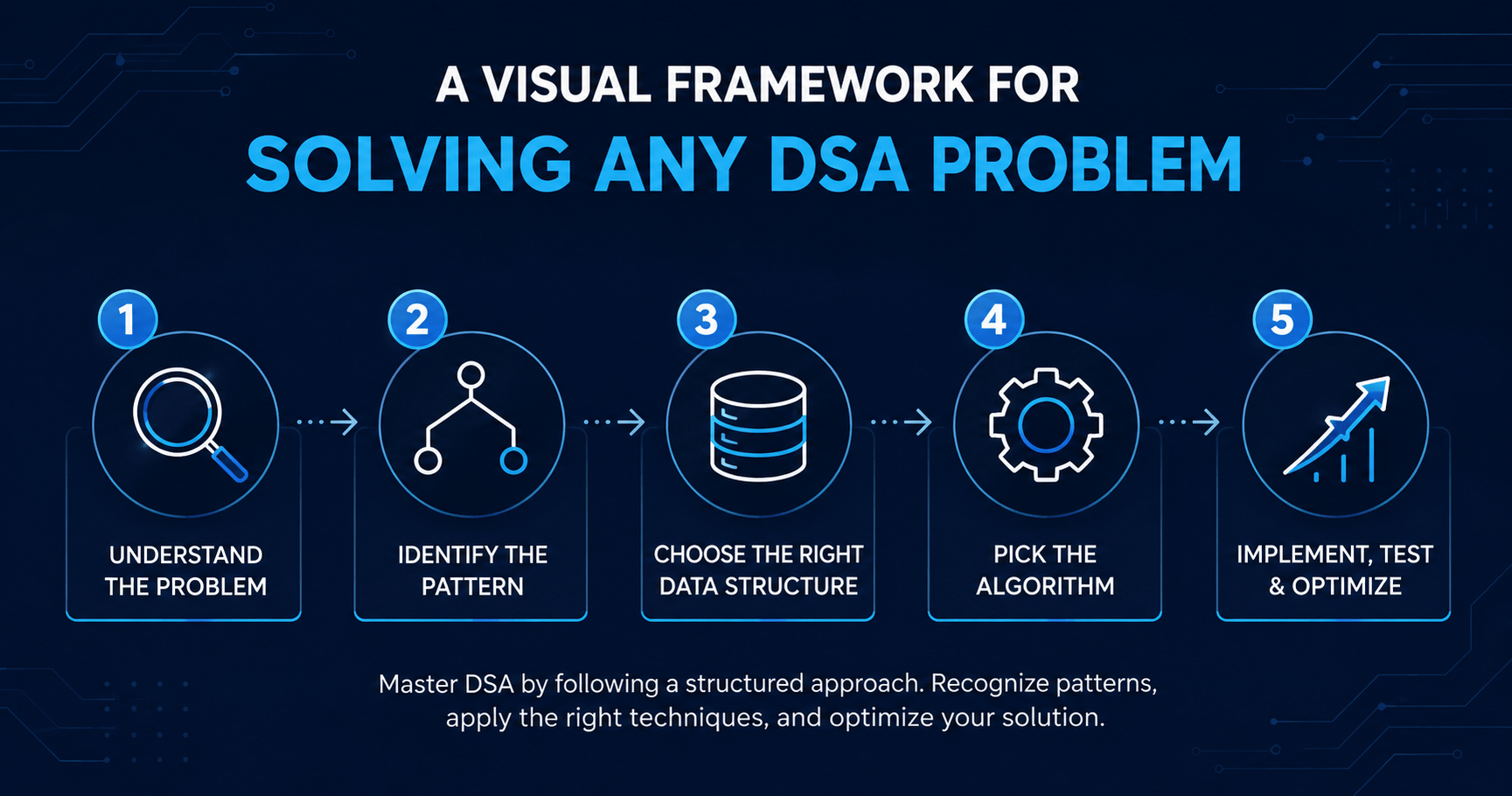
The Five-Step Framework to Solve DSA Problems
Here is the process, and it works whether you are on LeetCode, in a technical interview, or debugging a slow production query.
Step 1: Understand the Problem
Read the problem twice before writing anything. Identify the input, the output, and any constraints on size or value range. A surprising number of wrong answers come from misreading the problem, not from a bad algorithm.
Step 2: Identify the Pattern to Solve DSA Problems Faster
Ask what the problem is really testing. Is it about order? Frequency? Relationships between elements? This single question does more work than any other step.
Step 3: Choose the Data Structure
Once you know the pattern, the data structure usually follows automatically. Fast lookups point to a hash map. Sorted input points to two pointers or binary search.
Step 4: Solve It
Write the brute-force version first if you’re stuck. A working O(n²) solution beats a broken O(n) solution every time, and it often reveals the optimization naturally.
Step 5: Optimize
Ask what work you’re repeating. Can a hash map, prefix sum, or memoization cache replace a nested loop? This is usually where O(n²) becomes O(n).
Quick Pattern Guide

Use this as a lookup table when you’re stuck on where to even start.
DSA Problem Pattern Cheat Sheet
Match common coding interview signals to the right algorithmic pattern. A quick-reference guide for LeetCode, coding rounds, and technical interviews.
| Signal in the Problem | Pattern to Reach For |
|---|---|
| Need fast lookup | HashMap / HashSet |
| Sorted data | Binary Search / Two Pointers |
| Subarray or substring | Sliding Window / Prefix Sum |
| Next greater or smaller element | Monotonic Stack |
| Tree traversal | DFS / BFS |
| Shortest path | BFS / Dijkstra |
| Repeated subproblems | Dynamic Programming |
| Try every possible choice | Backtracking |
| Need the top K elements | Heap / Priority Queue |
| Interval scheduling | Sort + Greedy |
| Task dependencies | Graph + Topological Sort |
Best For: Developers prepping for interviews, students working through a DSA course, and anyone who wants a mental checklist instead of a memorized answer key.
A Worked Example: Two Sum
Abstract advice only sticks once you see it applied. Take the classic “Two Sum” problem: given an array of numbers and a target, find two numbers that add up to it.
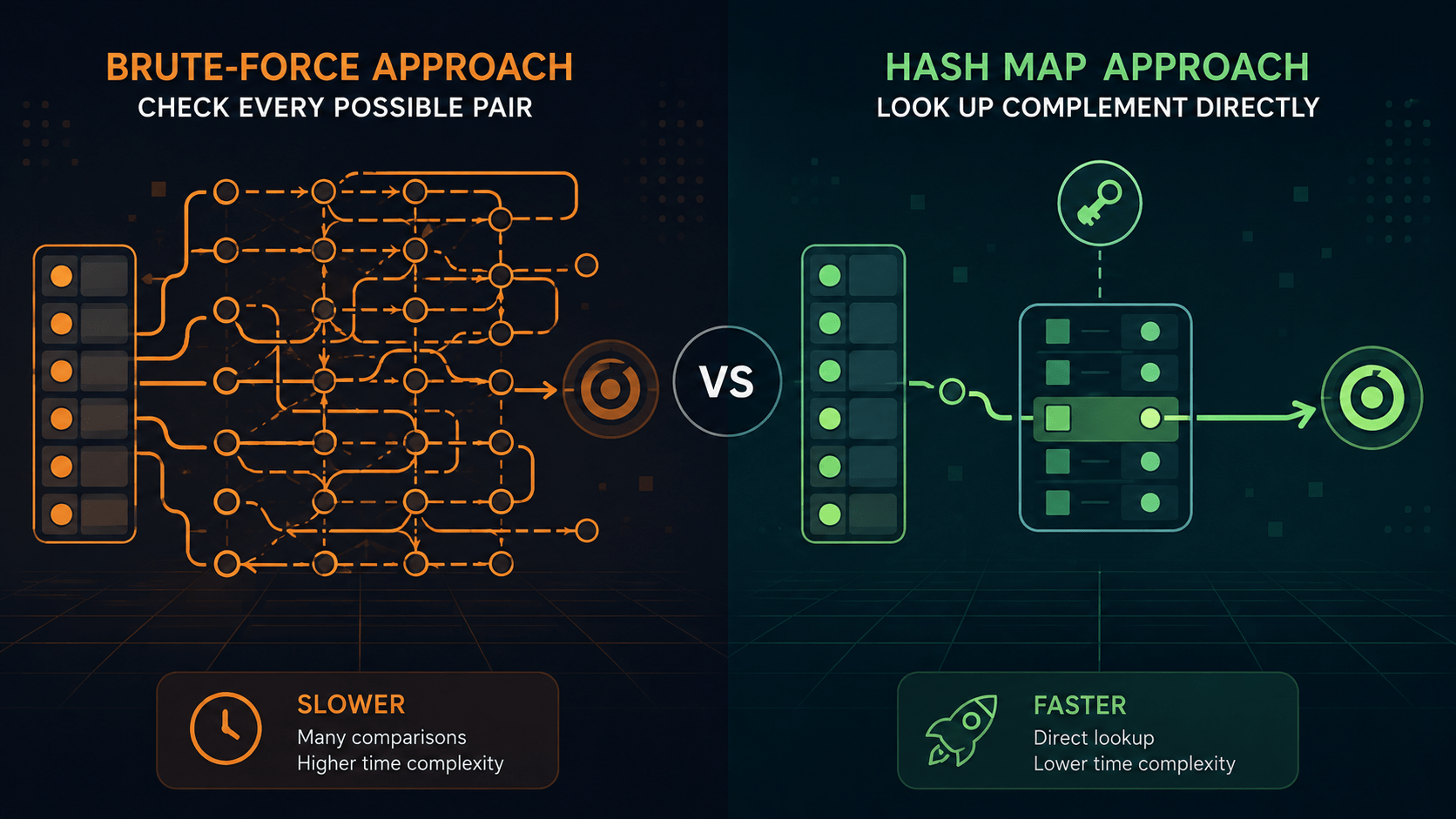
The brute-force approach checks every pair, which is O(n²):
python
def two_sum_brute(nums, target):
    for i in range(len(nums)):
        for j in range(i + 1, len(nums)):
            if nums[i] + nums[j] == target:
                return [i, j]
    return []
Now apply the framework. The signal is “need fast lookup” for a value we’ve already seen. That points straight to a hash map:
python
def two_sum(nums, target):
    seen = {}
    for i, num in enumerate(nums):
        complement = target - num
        if complement in seen:
            return [seen[complement], i]
        seen[num] = i
    return []
Same problem, O(n) instead of O(n²), because we stopped re-scanning the array on every iteration and started remembering what we’d already seen.
When You Get Stuck: Four Questions to Ask
If the pattern isn’t obvious right away, run through these in order.
- Can I reduce O(n²) to O(n)? Reach for a hash map, a set, two pointers, or a sliding window.
- Am I recalculating something? A prefix sum or a memoization cache usually fixes this.
- Can I eliminate half the search space at once? That’s binary search, and it only works on sorted or monotonic data.
- Can I process each element once instead of revisiting it? Stacks, queues, and two-pointer techniques are built for exactly this.
Reading the Constraints Before You Code
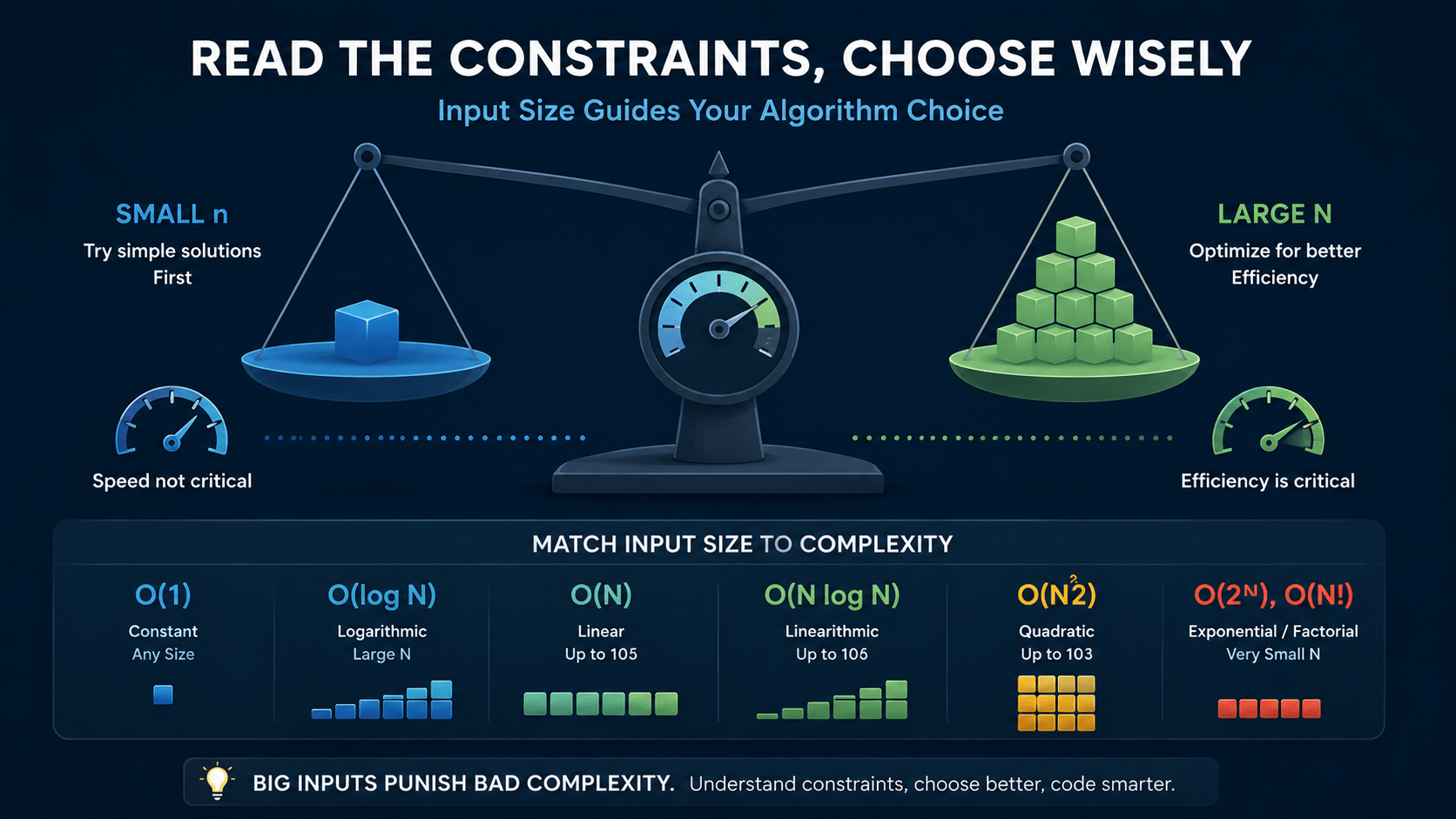
The constraints in a problem statement are a hint the problem is handing you for free, and most people skip reading them closely.
- n is 20 or smaller: Recursion or backtracking is usually fine, even at exponential time complexity.
- n is around 10,000: An O(n²) solution will likely still pass.
- n is 100,000 or larger: O(n²) is probably too slow. You need O(n log n) or better.
Checking this before you start coding saves you from optimizing a solution that never needed optimizing, and from submitting one that was always going to time out.
Also Read: Prompt Engineering Techniques That Deliver Consistent Results in 2026
Don’t Forget to Test Edge Cases
Before you consider a solution done, run it against the inputs most likely to break it: an empty array, a single element, duplicate values, negative numbers, data that’s already sorted, and the largest values the constraints allow. Most “it works on my machine” DSA bugs live in one of these six categories.
The Real Skill Behind DSA
The actual skill isn’t memorizing that “this problem uses this exact code.” It’s memorizing a chain: problem → pattern → data structure → algorithm → complexity.
Once that chain becomes automatic, most “new” problems stop looking new. They start looking like a pattern you’ve already solved wearing a different costume, and you’ll find you can solve DSA problems you’ve never seen before almost as fast as ones you have.
Frequently Asked Questions
Do I need to memorize any code at all? A small amount, yes. Knowing how to implement a hash map lookup, a sliding window, or a basic DFS from memory saves time. What you shouldn’t memorize is full solutions to specific problems.
How many patterns do I actually need to know? Around 10 to 15 cover the large majority of problems you’ll see in interviews and on most coding platforms, including the ones listed in the pattern guide above. That’s a short enough list to actually solve DSA problems from memory once you’ve drilled each one a few times.
What if I identify the wrong pattern at first? That’s normal and part of the process. Start coding your best guess, and if the approach starts feeling forced, come back to the “identify the pattern” step rather than pushing through.
Is brute force ever the right final answer? Sometimes, yes. If the constraints are small enough that a brute-force approach runs fast enough, optimizing further adds complexity without adding value.
Conclusion
You don’t need a mental database of a thousand solutions to get good at DSA. You need one framework you run every time: understand the problem, identify the pattern, pick the data structure, solve it, then optimize. Start applying this five-step process on the next problem you attempt, even if you already know the answer, so the habit sticks before you actually need it under pressure.
In the next post, we’ll walk through dynamic programming specifically, since it’s the pattern most developers say trips them up the longest.