
If you already build backends with Express or NestJS, picking between Python frameworks can feel like starting over. It isn’t. FastAPI, Flask, and Django each map to something you already know from the Node.js world, and once you see the parallels, the learning curve gets a lot shorter.
Python frameworks have become impossible to ignore for full-stack JavaScript and TypeScript developers. AI features, ML inference endpoints, and data pipelines increasingly live on Python backends, even when the frontend is still React or Next.js. Knowing which of these Python frameworks fits your project saves you weeks of rework later.
In this guide, we compare the three Python frameworks most full-stack teams actually reach for, contrast synchronous WSGI with asynchronous ASGI, walk through the same API endpoint built three different ways, and end with a simple decision matrix so you know which framework to pick for your next project.
Also Read: New to Python coming from JavaScript? Start with our Python for JavaScript Developers guide before diving into frameworks.
Python Frameworks at a Glance
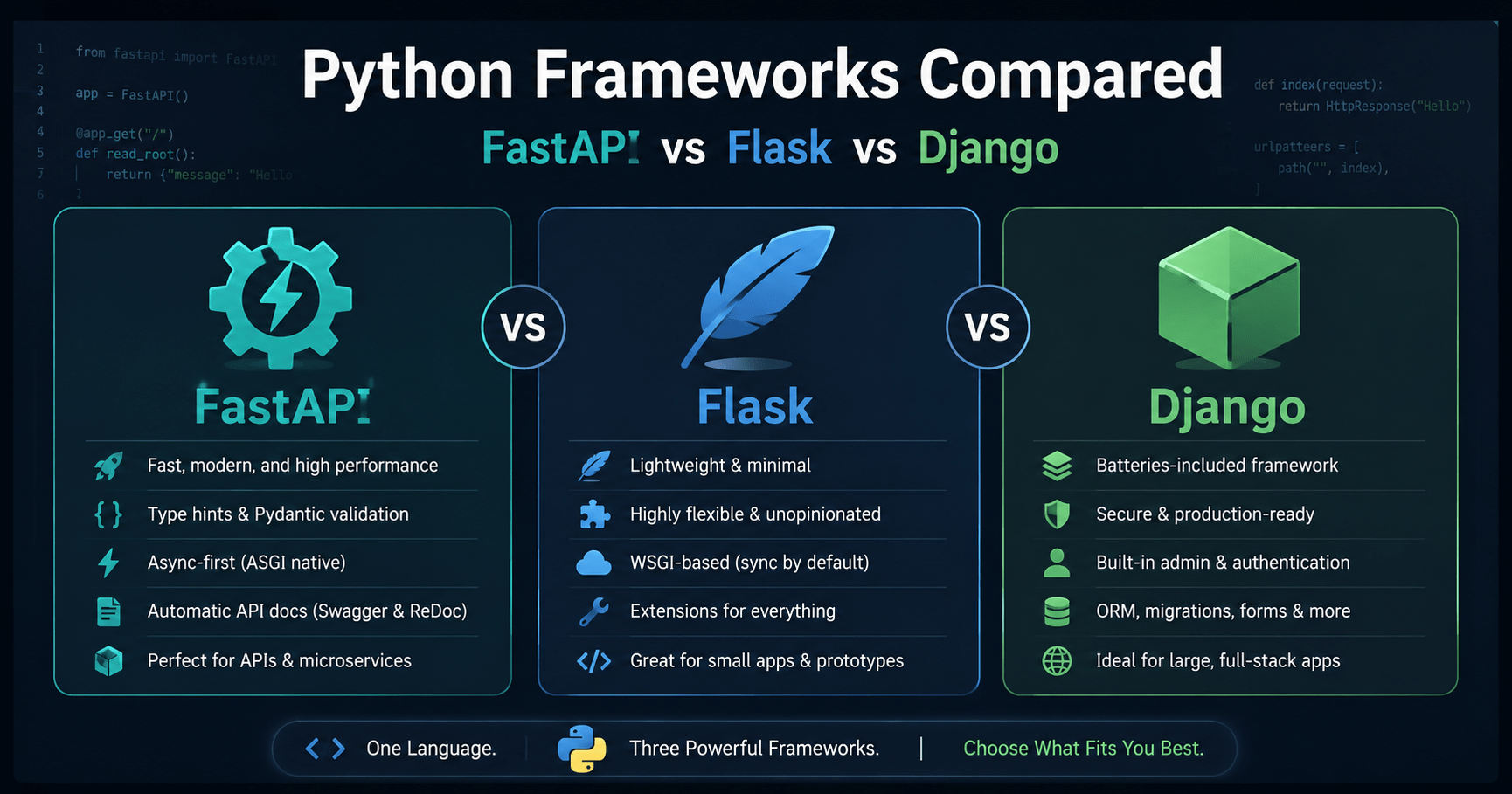
Each of these Python frameworks represents a different philosophy on structure, performance, and how much the framework decides for you.
| Feature | FastAPI | Flask | Django |
|---|---|---|---|
| Philosophy | Fast, type-safe, API-first, async-friendly | Minimal, flexible, unopinionated | Batteries-included, convention-driven |
| Architecture | ASGI, async-native | WSGI, sync-oriented | WSGI + ASGI support |
| Validation | Pydantic | Extension/library required | Django Forms / DRF serializers |
| API docs | Automatic OpenAPI + Swagger UI + ReDoc | Manual/extension setup | Usually DRF + schema tooling |
| Admin panel | None built in | None built in | Built in |
| ORM | Not built in | Not built in | Django ORM |
| Authentication | Libraries / building blocks | Extensions required | Built in |
| Best for | APIs, microservices, ML/AI backends | Small apps, APIs, prototypes | Large full-featured web applications |
| Node.js equivalent | NestJS + Fastify | Express.js | NestJS / AdonisJS |
Of the three Python frameworks, FastAPI is the newest and the one growing fastest among teams pairing a Python backend with a React or Next.js frontend, largely because it feels familiar to anyone who has used NestJS.
WSGI vs ASGI: How Python Frameworks Handle Requests
Before comparing code, it helps to understand the two server gateway standards that sit underneath these Python frameworks.
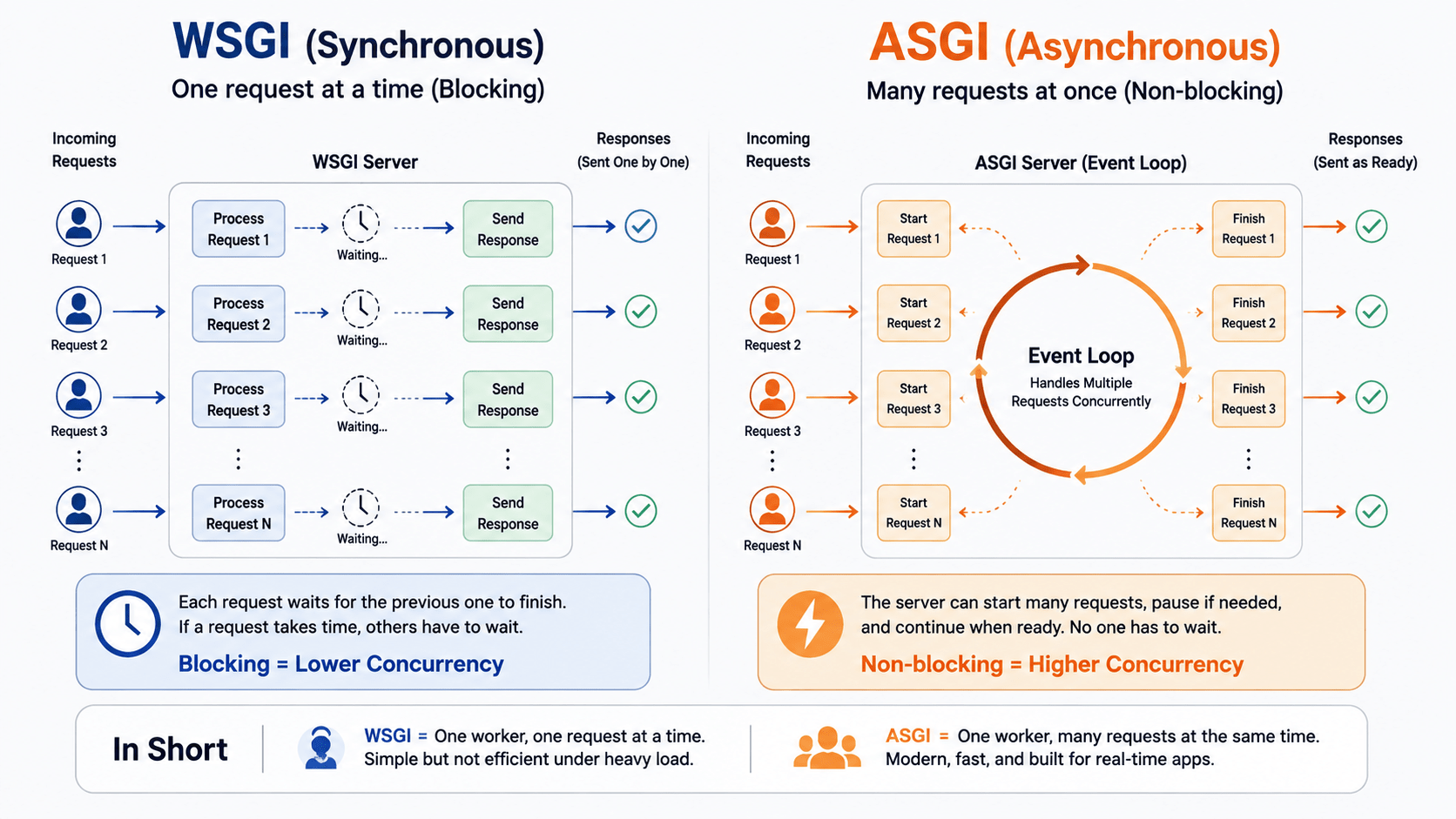
WSGI: One Request, One Blocked Worker
WSGI (Web Server Gateway Interface) is synchronous. Every incoming request ties up a worker thread or process until that request finishes, including any time spent waiting on a database query or a downstream API call. Flask and traditional Django both run on WSGI. It works fine for typical CRUD traffic, but it struggles with WebSockets, long-polling, and high-concurrency I/O.
ASGI: One Event Loop, Thousands of Requests
ASGI (Asynchronous Server Gateway Interface) is built on Python’s asyncio. A single event loop, usually run by Uvicorn, handles thousands of concurrent requests without blocking a thread for each one. FastAPI, Starlette, and modern Django (via Channels) all support ASGI. If you have used async/await in Node.js, the mental model transfers almost directly. This is exactly why ASGI-based Python frameworks are the default choice for streaming responses and ML inference endpoints.
Building the Same Endpoint in All Three Python Frameworks
Numbers and diagrams only get you so far. Here is the same user-creation endpoint built with each of these Python frameworks, so you can see the developer experience directly.
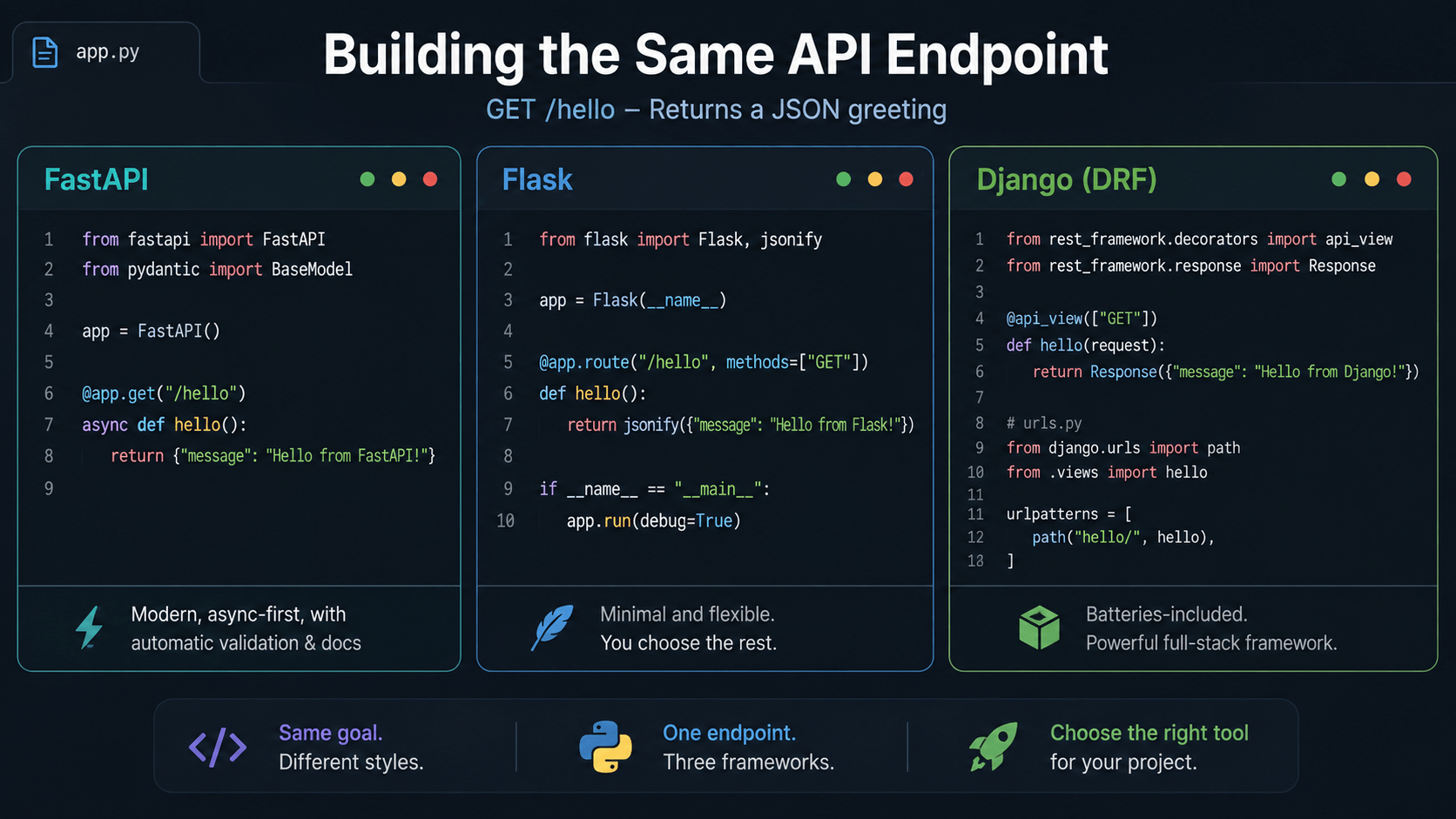
FastAPI: How This Python Framework Handles Validation
FastAPI uses native Python type hints and Pydantic models to validate the request body and generate documentation automatically.
python
from fastapi import FastAPI, HTTPException, status
from pydantic import BaseModel, EmailStr, Field

app = FastAPI(title="DevPulse API", version="1.0.0")

class UserCreate(BaseModel):
    username: str = Field(min_length=3, max_length=50)
    email: EmailStr
    age: int = Field(ge=18, le=120)

class UserResponse(BaseModel):
    id: str
    username: str
    email: EmailStr
    status: str = "active"

@app.post("/api/v1/users", response_model=UserResponse, status_code=status.HTTP_201_CREATED)
async def create_user(payload: UserCreate):
    if payload.username == "admin":
        raise HTTPException(status_code=400, detail="Username 'admin' is reserved")
    return UserResponse(id="usr_9921", username=payload.username, email=payload.email)
Run it with uv run uvicorn main:app --reload and Swagger UI appears at /docs with zero extra setup, no YAML required.
Flask: You Validate Everything Yourself
Flask hands you a blank canvas. Validation, error responses, and JSON parsing are all manual unless you add an extension.
python
from flask import Flask, request, jsonify

app = Flask(__name__)

@app.route("/api/v1/users", methods=["POST"])
def create_user():
    data = request.get_json() or {}
    username = data.get("username")
    email = data.get("email")

    if not username or len(username) < 3:
        return jsonify({"error": "Invalid username"}), 400
    if not email or "@" not in email:
        return jsonify({"error": "Invalid email"}), 400
    if username == "admin":
        return jsonify({"error": "Username 'admin' is reserved"}), 400

    return jsonify({"id": "usr_9921", "username": username, "email": email, "status": "active"}), 201
Among the three Python frameworks covered here, Flask gives you the least out of the box, and that’s the point. You choose your own ORM, your own validation library, your own project structure.
Django REST Framework: Serializers and Class-Based Views
Django splits the same logic into a serializer and a class-based view, which will feel familiar if you have used NestJS DTOs and controllers.
python
# serializers.py
from rest_framework import serializers

class UserCreateSerializer(serializers.Serializer):
    username = serializers.CharField(min_length=3, max_length=50)
    email = serializers.EmailField()
    age = serializers.IntegerField(min_value=18, max_value=120)

    def validate_username(self, value):
        if value == "admin":
            raise serializers.ValidationError("Username 'admin' is reserved")
        return value

# views.py
from rest_framework.views import APIView
from rest_framework.response import Response
from rest_framework import status

class UserCreateView(APIView):
    def post(self, request):
        serializer = UserCreateSerializer(data=request.data)
        if serializer.is_valid():
            return Response({"id": "usr_9921", **serializer.validated_data, "status": "active"}, status=status.HTTP_201_CREATED)
        return Response(serializer.errors, status=status.HTTP_400_BAD_REQUEST)
Django’s built-in admin panel, auth system, and ORM migrations are the real draw here. Of the three Python frameworks, Django gets you a working back office for free.
Also Read: If NestJS’s dependency injection and decorators feel like home, our NestJS backend series walks through the same patterns on the Node.js side.
Dependency Injection: FastAPI vs NestJS
For developers coming from NestJS, FastAPI’s Depends() system will look immediately familiar. Both let you compose small, reusable pieces (auth checks, database sessions) and inject them straight into a route handler.
python
from typing import Annotated
from fastapi import FastAPI, Depends, Header, HTTPException, status

app = FastAPI()

async def get_db():
    db = {"session_id": "db_session_9941"}
    try:
        yield db
    finally:
        print("Database session closed gracefully.")

async def verify_token(x_token: Annotated[str | None, Header()] = None):
    if x_token != "super-secret-token":
        raise HTTPException(status_code=status.HTTP_401_UNAUTHORIZED, detail="X-Token header invalid or missing")
    return {"user_id": "usr_1001", "role": "admin"}

@app.get("/api/v1/protected-data")
async def get_protected_data(
    current_user: Annotated[dict, Depends(verify_token)],
    db: Annotated[dict, Depends(get_db)],
):
    return {"message": "Authorized access granted", "user": current_user, "database_ref": db["session_id"]}
Where NestJS wires dependencies through decorators and a module system, FastAPI wires them through plain function calls passed to Depends(). Less ceremony, same underlying idea: pull the messy setup logic out of the route handler and let the framework hand it to you already resolved.
Also Read: Once your Python backend is live, don’t ship it blind. Our Node.js observability guide covers the same monitoring principles (structured logs, tracing, error capture) that apply just as well to a FastAPI or Django service.
Which of These Python Frameworks Should You Choose?
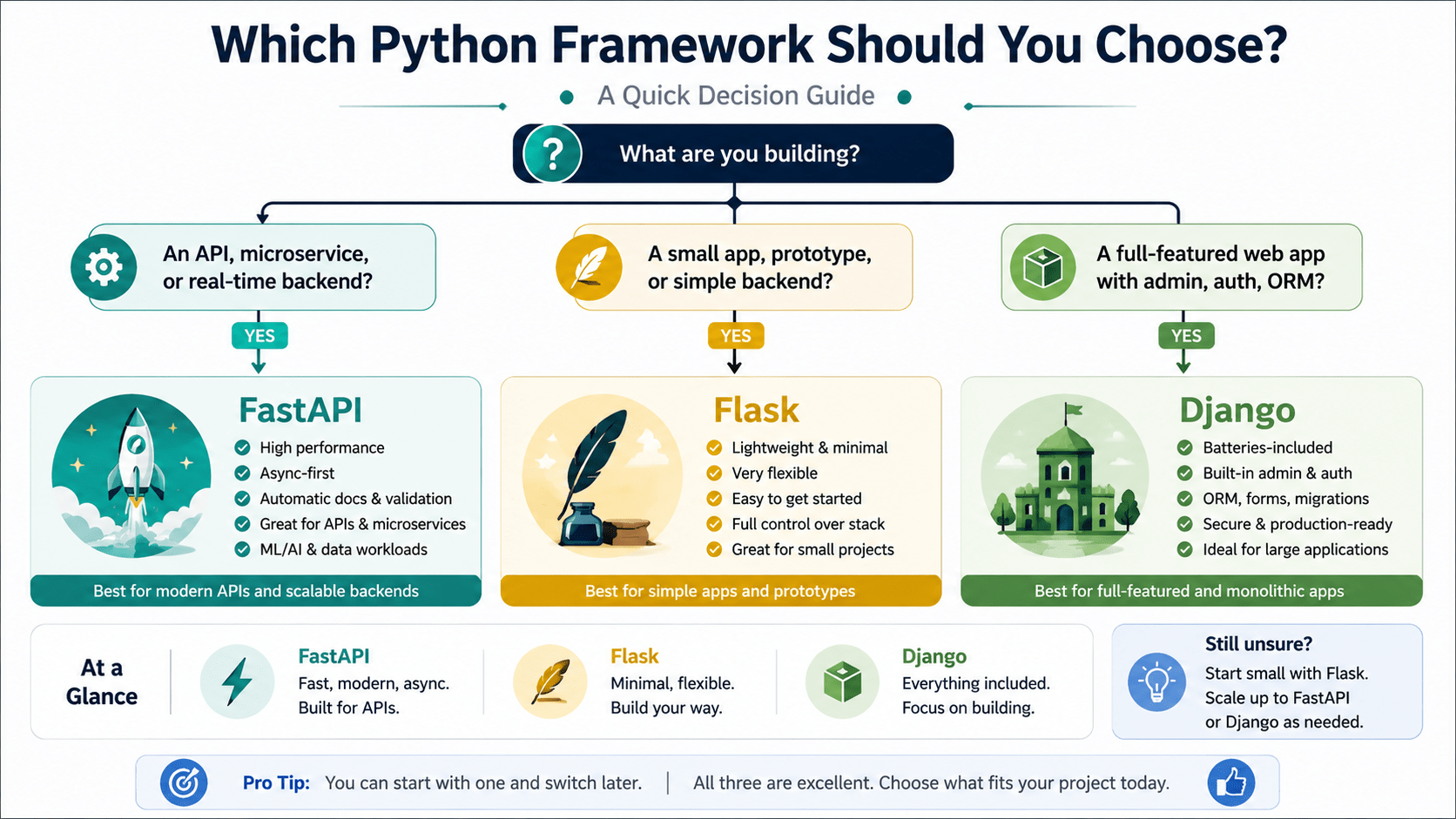
Choose FastAPI if you’re building an AI or ML microservice, a streaming endpoint, or anything consumed by a React or Next.js frontend that benefits from automatic OpenAPI docs and Pydantic validation.
Choose Flask if you need a small internal tool or a single-file script and don’t want a framework making decisions for you.
Choose Django if you’re building a full monolithic application that needs a working admin panel, built-in auth, and ORM migrations on day one.
A rough rule of thumb: if you’d reach for NestJS on the Node.js side, reach for FastAPI on the Python side. If you’d reach for Express, reach for Flask. If you want Next.js-plus-Prisma levels of batteries-included, that’s Django.
FAQ
Is FastAPI faster than Flask?
FastAPI’s ASGI foundation handles concurrent I/O-bound requests (database calls, API calls) far better than Flask’s default WSGI setup, especially under load. For CPU-bound work, the gap narrows.
Can Flask run asynchronously too?
Yes, recent Flask versions support async def route handlers, but Flask still runs on WSGI underneath by default, so you don’t get the same concurrency model as FastAPI without extra configuration.
Do I need Django REST Framework to build APIs in Django?
Not strictly, but without it you’re writing a lot of the validation and serialization logic that DRF, FastAPI, and even Flask extensions already handle for you.
Which of these Python frameworks pairs best with a React or Next.js frontend?
FastAPI is the most common pairing right now, mainly because of automatic OpenAPI generation, which tools can use to generate a typed frontend client automatically.
Conclusion
FastAPI, Flask, and Django solve overlapping problems in different ways, and none of them is the “wrong” choice. Pick FastAPI for async, type-safe APIs that feel close to NestJS. Pick Flask when you want full control over a small service. Pick Django when you need a complete application, admin panel included, out of the box.
In the next post, we look at why Python dominates AI and ML work over JavaScript and Java, including CUDA acceleration and the scientific computing ecosystem it’s built on.