
An AI Solutions Architect is quickly becoming one of the most important technical roles in enterprise tech, and for good reason. Artificial intelligence is moving through an important transition. For several years, the focus was largely on building better models, experimenting with machine learning and creating impressive generative AI demonstrations.
In 2026, however, the harder problem for many organizations is no longer simply accessing an AI model. The challenge is figuring out how AI should actually be designed, integrated, secured, deployed and operated inside a real organization.
That is where the AI Solutions Architect comes in.
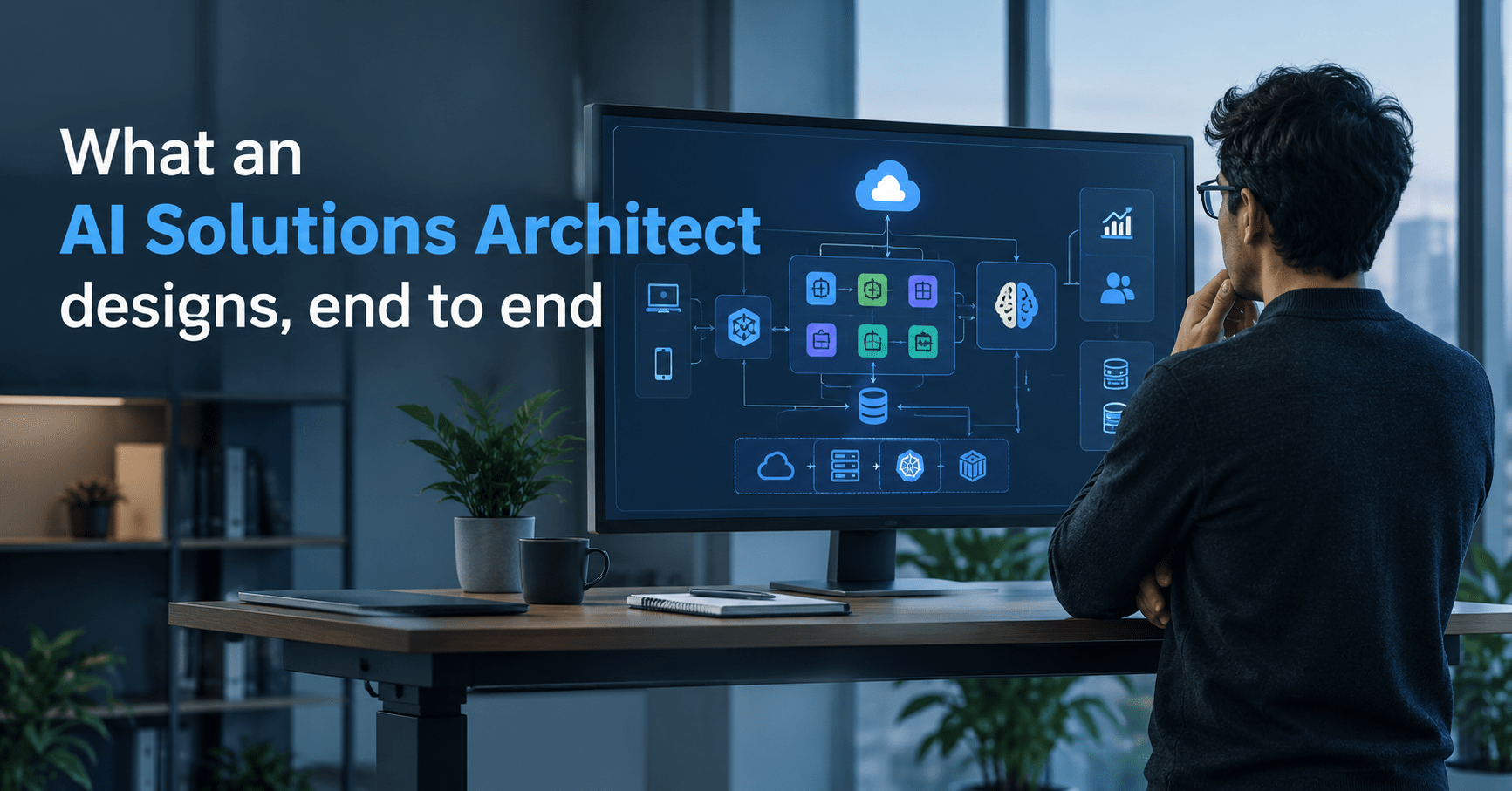
An AI Solutions Architect is responsible for turning a business requirement or organizational AI strategy into a technical architecture that can actually work in production. The role sits at the intersection of artificial intelligence, software engineering, cloud infrastructure, data engineering, cybersecurity, enterprise architecture and business strategy.
Instead of asking only “Which AI model should we use?”, an AI Solutions Architect asks a much larger set of questions. What problem are we solving? What data is available? Which model or models are appropriate? Should we use an API, an open-source model, or a combination of models? Where should inference happen? How will the AI connect to existing applications?
How will users authenticate? How will sensitive information be protected? How will we evaluate the system? What happens when an AI agent makes a mistake? What will the system cost at scale? How will it be monitored after deployment? And, perhaps most importantly, how will we know that the AI solution actually created business value?
The role is therefore becoming increasingly important as companies move from AI experimentation to production.
Current 2026 hiring illustrates this shift. HCLTech describes its AI Solution Architect role as responsible for designing end-to-end AI, data, cloud and enterprise workflow architectures while addressing security, performance, compliance, Responsible AI and delivery feasibility. Cognizant is hiring Generative AI Architects to design and scale enterprise GenAI and agentic AI ecosystems, while Finastra describes its AI Solutions Architect as part of an AI Center of Excellence responsible for technical blueprints and standards.
This article explains what an AI Solutions Architect actually does, how the role differs from an AI Engineer, Solutions Architect, ML Engineer and Forward Deployed Engineer, the skills and tools required, which industries are hiring, how beginners and experienced engineers can reach the role, and what the future of AI architecture may look like.
Also Read: New to the underlying AI concepts this role depends on? Start with our how tokens and context windows actually work guide before diving into the architecture layer.
What Is an AI Solutions Architect?
An AI Solutions Architect designs the complete technical solution around artificial intelligence rather than focusing on only one component of the system.
A useful way to think about the role is this: an AI Engineer builds AI components. An AI Solutions Architect decides how those components, data, software, infrastructure and business processes should fit together into a production system.
For example, suppose a company wants to build an AI assistant that allows employees to search internal documents, retrieve information from enterprise databases and perform actions through existing business applications.
- An AI engineer might build the RAG pipeline, develop the prompts, implement tool calling and integrate the model.
- A cloud engineer might create the infrastructure.
- A security engineer might implement identity and access controls.
- A data engineer might build the data pipelines.
- A software engineer might build the application.
The AI Solutions Architect has to understand how all of those pieces fit together and decide what the overall system should look like.
The architect’s responsibility is not necessarily to personally write every line of code in this system. Instead, they need enough technical depth to determine whether the architecture is appropriate, explain the trade-offs, guide implementation teams and make sure the final solution can survive production.
Why Does the AI Solutions Architect Role Exist?
The traditional cloud Solutions Architect already existed before generative AI became popular. That architect designed systems involving applications, databases, networks, APIs, security and cloud infrastructure.
AI introduces another layer of complexity. Now the architecture may also contain foundation models, embedding models, vector databases, retrieval pipelines, prompt management, AI agents, tool calling, model gateways, model evaluation, guardrails, AI observability, human-in-the-loop workflows, model monitoring and AI governance.
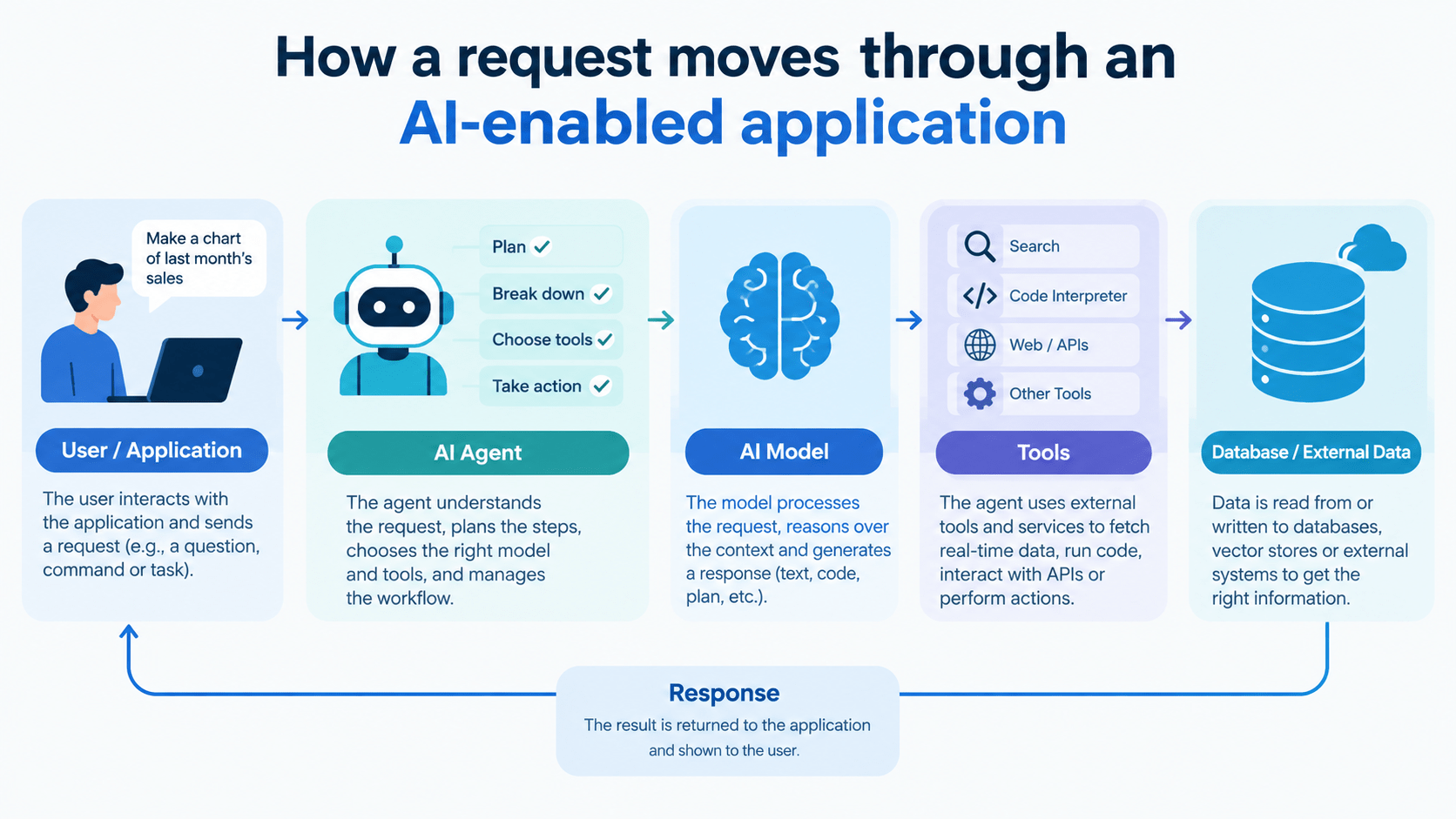
The architect therefore has to understand not only where software runs, but also how intelligence flows through the system. An ordinary application may have a predictable path: User to API to Database to Response. An AI application might have: User to Application to Agent to Retrieval to Model to Tool to Enterprise API to Database to Model to Safety check to Response.
Every additional step introduces new architectural questions:
- Who controls access to the retrieved data?
- What happens if the model selects the wrong tool?
- What happens if the tool fails?
- How do we prevent an agent from executing an unauthorized action?
- How do we evaluate the model’s response?
- How do we trace a failure across several model calls?
- How do we control token and inference costs?
These are architecture problems.
AI Solutions Architect vs Traditional Solutions Architect
A traditional Solutions Architect may specialize in cloud architecture, application architecture, databases, networking, integration, security and infrastructure.
An AI Solutions Architect needs those foundations while adding AI-specific architecture, including LLMs, RAG, agents, model evaluation, AI governance, AI cost optimization and AI observability — all of which are essential rather than optional for this role.
The AI Solutions Architect is therefore not simply a traditional architect who knows how to call an LLM API. The role requires understanding how AI changes the architecture itself.
AI Solutions Architect vs AI Engineer
These roles overlap heavily, and companies do not always use the titles consistently.
An AI Engineer is generally more implementation-focused. They build AI-powered applications, integrate models, develop RAG pipelines, create agents, work with data and improve model behavior.
An AI Solutions Architect is more system-oriented. They decide how those components should fit into the larger enterprise architecture.
A simple distinction: an AI Engineer asks “How do we build this AI capability?” An AI Solutions Architect asks “How should the entire AI solution be designed so that it works securely, reliably and economically inside this organization?”
In practice, strong AI Solutions Architects are often highly hands-on engineers themselves. This is particularly visible in current hiring. HCLTech’s AI Solution Architect position calls for a strong foundation in enterprise and system architecture alongside significant depth in Generative AI and Agentic AI application development. It describes the architect as the technical authority working with GenAI developers, software engineers and business stakeholders.
AI Solutions Architect vs ML Engineer
An ML Engineer typically focuses on building and operating machine learning systems. Their work may include training models, feature engineering, model pipelines, model serving, MLOps, experimentation and model performance.
The AI Solutions Architect needs to understand these concepts but is generally responsible for a larger system. For example, an ML Engineer might build the model serving infrastructure. The architect decides whether that model should be used at all, how it fits into the application, how it interacts with other models, how the data reaches it, how users access the result and how the overall system should operate.
AI Solutions Architect vs Forward Deployed Engineer
This is particularly important because AI Solutions Architect and FDE roles are increasingly overlapping.
A Forward Deployed Engineer (FDE) is generally closer to customer implementation and delivery. An AI Solutions Architect is generally closer to system architecture and technical design.
An FDE might say: “The customer needs this workflow working in production. I will help discover the problem, build the solution and deploy it.” An AI Solutions Architect might say: “Here is the architecture we should use to solve this problem across this customer’s environment, including the model layer, data layer, infrastructure, security and integration strategy.”
In practice, a senior FDE may perform architecture work and an AI Solutions Architect may work directly with customers. This is why career paths between the two roles can intersect.
What Does an AI Solutions Architect Do?
The exact responsibilities vary by company, but the job generally begins before the first line of implementation code is written.
The architect needs to understand the business objective, examine the existing technology environment, identify constraints and then design a solution that balances technical capability with cost, security, scalability and business value.
A typical project may therefore move through business discovery, technical requirements, current-state assessment, architecture, technology selection, proof of concept, implementation guidance, deployment, monitoring and optimization.
This is why architecture is not simply drawing diagrams. The diagram is the output. The thinking behind the diagram is the actual job.
1. Understand the Business Problem
A company may say: “We want an AI chatbot.” That isn’t enough information to architect anything meaningful.
The architect needs to determine why. Perhaps employees spend hours searching documents. Perhaps customers are waiting too long for support. Perhaps analysts are manually processing thousands of records. Perhaps developers are spending too much time searching internal documentation. Perhaps an organization wants AI agents to automate a multi-step business process.
The correct architecture depends heavily on the underlying problem. This is why AI Solutions Architects need business understanding, not just technical knowledge.
2. Understand the Existing Environment
Before designing something new, the architect needs to understand what already exists. That could include applications, databases, APIs, cloud infrastructure, identity providers, data warehouses, enterprise SaaS, networking, security controls, legacy systems and compliance requirements.
Enterprise AI rarely starts from an empty repository. More often, it starts in an environment that has been evolving for ten or twenty years. The architect’s challenge is therefore often: how do we introduce AI without breaking everything that already works?
3. Select the AI Architecture
There may be several possible approaches. For example, a document intelligence system could use a hosted foundation model, a cloud-hosted model, a self-hosted open-source model, or a multi-model architecture.
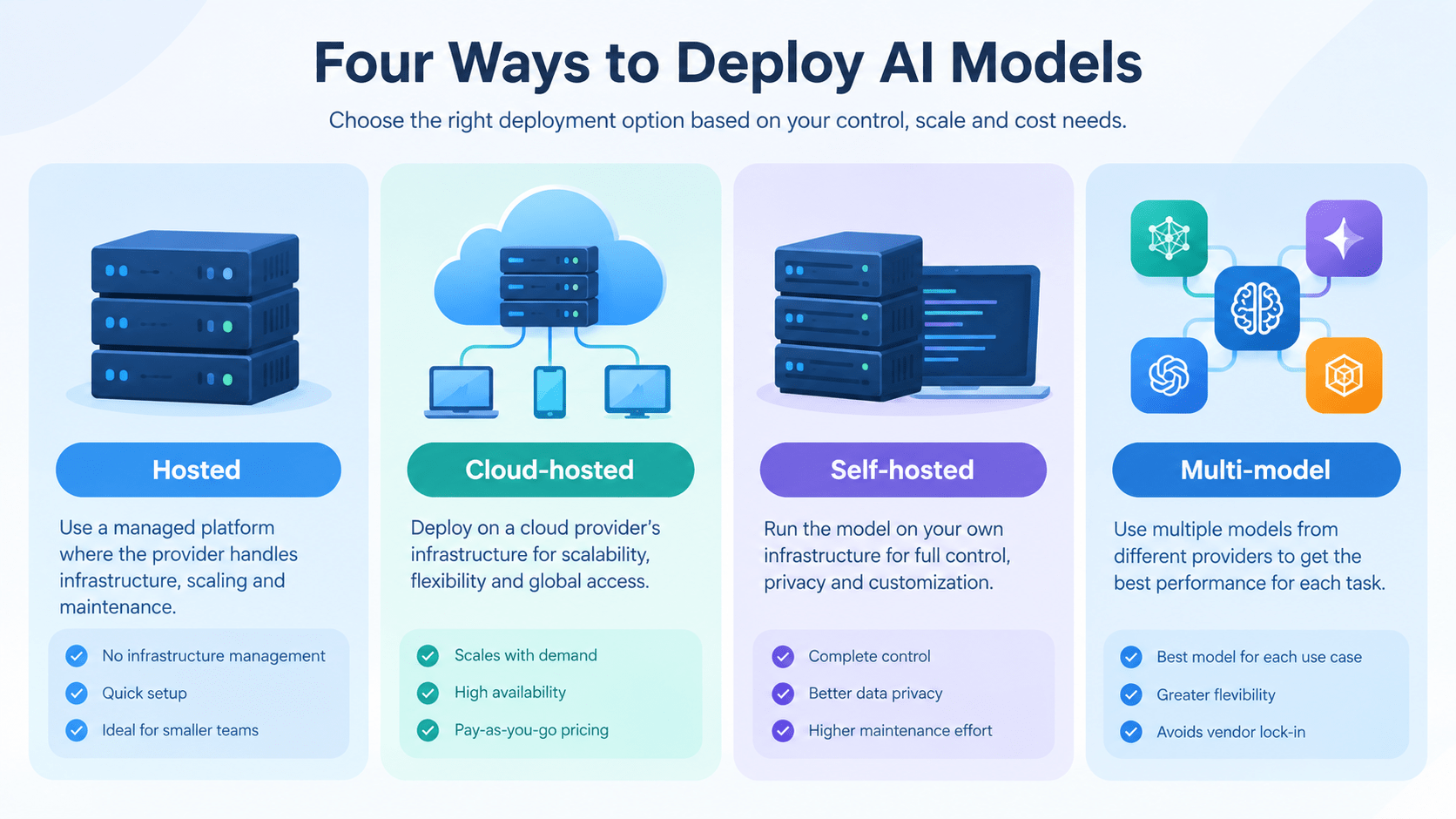
- Option A — Hosted foundation model: Uses an API from a model provider, offering rapid development and access to powerful models.
- Option B — Cloud-hosted model: Uses services from AWS, Azure or Google Cloud, which may simplify integration with existing enterprise infrastructure and governance.
- Option C — Self-hosted open-source model: Runs an open model within the company’s own environment, providing more control but introducing infrastructure and operational complexity.
- Option D — Multi-model architecture: Uses different models for different tasks — a small model for classification, a large model for reasoning, a specialized model for embeddings, and a vision model for images.
The architect needs to evaluate these options rather than automatically selecting the newest or most powerful model.
4. Design the Data Architecture
AI is only as useful as the data surrounding it. The architect needs to understand where the data lives, who owns it, how it is accessed, how frequently it changes, how it should be indexed, how permissions are enforced, how data is transformed, how it is stored and how it reaches the AI system.
For a RAG (Retrieval-Augmented Generation) system, this could mean designing a pipeline that moves from data source to ingestion, parsing, chunking, embeddings, vector database, retrieval, and finally the model.
But enterprise RAG adds another problem: permissions. If Employee A cannot access a document in the company’s existing system, the AI system should not accidentally retrieve that document for Employee A. That means authorization must become part of the AI architecture.
5. Design the Application Architecture
The AI model is rarely the entire application. The system might also require a frontend, backend, API gateway, authentication, databases, queues, caches, an AI gateway, model routing, tool servers and monitoring.
The architect decides how these components communicate and where responsibilities belong.
6. Design Agentic AI Systems
This is becoming one of the most important emerging areas. An agentic system might move from understanding user intent, to retrieving information, selecting a tool, calling an enterprise system, checking the result, reasoning about the next step, asking for approval if required, and finally executing the action and returning a result.
This introduces architectural questions that traditional applications did not have. How many agents should exist? Should the system use one agent or several specialized agents? Which tools can each agent access? Can an agent execute actions automatically? Which actions require human approval? How are agent decisions logged? How do we prevent loops? How do we evaluate the system? How do we control cost?
Current enterprise hiring increasingly reflects this shift. Deloitte’s 2026 AI Solutions Architect posting in India describes production-grade multi-agent systems using LangGraph and Claude, including RAG, multi-tenancy and integration with enterprise HR systems such as Workday, SAP and Oracle HCM.
Also Read: Want the deeper dive into RAG specifically? Our prompt engineering guide for developers covers the techniques an AI Solutions Architect needs when designing the retrieval and reasoning layer.
7. Security and Governance
AI architecture without security is incomplete architecture. An AI Solutions Architect needs to understand authentication, authorization, IAM, SSO, OAuth, OIDC, SAML, RBAC, encryption, secrets management, network security, data protection and audit logging.
AI introduces additional risks, including prompt injection, sensitive data exposure, data poisoning, unauthorized tool usage, model hallucination, excessive agent permissions and cross-tenant data leakage.
The architect therefore needs to design security into the system rather than adding it after implementation. HCLTech’s current AI Solution Architect role explicitly includes security, compliance and Responsible AI as part of the architecture responsibility.
8. Observability
Traditional software monitoring tells you things such as CPU usage, memory usage and API latency.
AI systems require additional measurements, including model latency, token usage, cost per request, retrieval quality, prompt failures, tool failures, model output quality, hallucination rates, evaluation scores and agent traces.
An AI Solutions Architect therefore needs to understand AI observability and evaluation rather than treating the model as a black box.
9. Cost Architecture
This is an increasingly important skill. A prototype might cost almost nothing. A production application with millions of requests can become extremely expensive.
The architect needs to consider model pricing, token usage, inference infrastructure, embedding costs, vector database costs, storage, network traffic, GPU requirements, caching and model routing.
For example, a system might use an expensive reasoning model for every request. That may work technically. But a better architecture could route simple requests to a smaller model and reserve the expensive model for difficult cases. Architecture is therefore also cost engineering.
The Core Skills of an AI Solutions Architect
The skill profile is broad because the role connects several engineering disciplines. The strongest architects are not necessarily world-class specialists in every category. Instead, they have enough breadth to understand the entire system and enough depth to make difficult decisions.
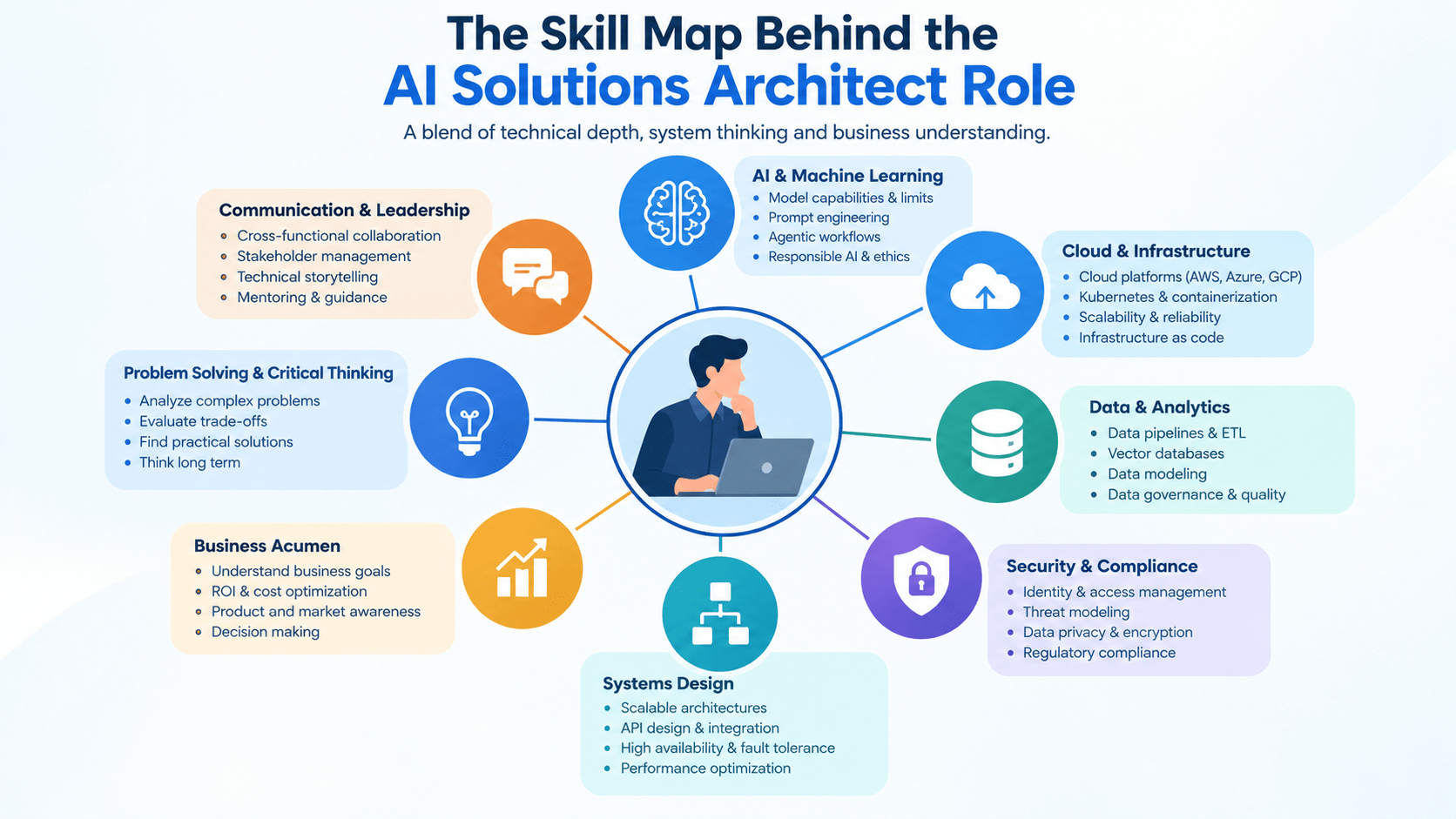
Programming Skills
An AI Solutions Architect should generally remain hands-on enough to understand implementation.
Python is arguably the most useful language for AI architecture because it sits across AI APIs, machine learning, data processing, backend services, automation and evaluation. Useful technologies include FastAPI, Pydantic, PyTorch, Transformers and SDKs for model providers.
TypeScript is highly useful for React, Next.js, Node.js, full-stack AI applications, agent interfaces and enterprise applications.
Depending on the organization, familiarity with Java, C# or Go can be valuable, especially when integrating with existing enterprise systems.
Cloud Architecture
At least one cloud platform should be deeply understood. The major choices remain AWS, Microsoft Azure and Google Cloud.
The most important thing is not memorizing every service. You need to understand compute, networking, storage, databases, IAM, containers, Kubernetes, serverless, monitoring, secrets and AI services.
For enterprise AI, Azure is particularly relevant in organizations heavily invested in Microsoft ecosystems, while AWS and Google Cloud have their own AI infrastructure and model services.
AI Platforms
Modern AI Solutions Architects should understand the major cloud AI ecosystems, including Amazon Bedrock, Microsoft Azure AI / Microsoft Foundry, Google Vertex AI, OpenAI APIs, Anthropic APIs and Gemini APIs.
The architect should understand not only how to call these services but also when each approach makes sense.
LLM Architecture
You should understand the architecture of modern LLM applications, including context windows, tokenization, embeddings, prompt design, structured output, function calling, tool calling, streaming, model routing, fine-tuning, retrieval and guardrails.
The architect should also understand the difference between using a model directly and building a system around the model.
RAG Architecture
Retrieval-Augmented Generation (RAG) remains one of the most useful enterprise AI patterns. A basic system moves from enterprise documents through document processing, chunking, embeddings, a vector store, a retriever, the LLM, and finally an answer.
But a production architect must go further. They need to think about metadata, access control, hybrid search, reranking, chunking, embedding selection, retrieval evaluation, freshness, document updates, citation, latency and cost.
Agent Architecture
Modern AI Solutions Architects increasingly need to understand agentic systems, including tool calling, agent loops, planning, memory, multi-agent systems, human-in-the-loop, MCP, agent permissions, agent evaluation and long-running workflows.
Frameworks may include LangGraph, LangChain, Semantic Kernel, OpenAI Agents SDK, Microsoft Agent Framework and other emerging agent platforms.
Current HCLTech hiring specifically lists frameworks such as Microsoft Foundry Agent Service, Semantic Kernel, Microsoft Agent Framework, LangGraph, LangChain and OpenAI Agents SDK as relevant experience for its Generative AI Architect role.
Data Engineering
AI architects need to understand data even if they are not full-time data engineers. Important concepts include ETL, ELT, data lakes, data warehouses, streaming, event-driven systems, data quality, data lineage and data governance.
Useful technologies include Kafka, Spark, Snowflake, Databricks, BigQuery and PostgreSQL. The goal is to understand how data enters the AI system and how reliable that data is.
MLOps and LLMOps
Traditional ML systems use MLOps practices for training, experiment tracking, model deployment, model monitoring and versioning.
Generative AI introduces related concerns around prompt versioning, model versioning, evaluation, tracing, retrieval quality, agent behavior and cost monitoring.
Useful technologies include MLflow, Weights & Biases, LangSmith, Arize and OpenTelemetry. You don’t need to become an expert in every platform. Understanding the principles is more important.
Enterprise Integration
One of the most underrated AI architecture skills is understanding enterprise integration. Real organizations use systems such as Salesforce, SAP, ServiceNow, Workday, Oracle, Microsoft 365, Google Workspace, Jira and internal APIs.
An AI solution may need to read information from one system and perform an action in another. The AI model is only one component. The difficult part is making the entire workflow safe and reliable.
Architecture Documentation
A good architect needs to communicate architecture clearly. Useful tools include Draw.io, Lucidchart, Mermaid, Microsoft Visio and Miro.
You should be able to produce system architecture diagrams, data-flow diagrams, sequence diagrams, deployment diagrams, security diagrams and API integration diagrams. However, architecture diagrams are only useful if they communicate decisions. A diagram with 200 boxes is not automatically a good architecture.
Business and Communication Skills
This is where many technically strong engineers struggle. An architect may need to present a solution to CTOs, CIOs, CEOs, engineering leaders, security teams, data teams, developers and business stakeholders.
The architect therefore needs to translate technical decisions into business consequences. Instead of saying “We’ll introduce a model gateway with intelligent routing,” they should also be able to explain that this allows the company to use smaller models for routine requests and reserve larger models for complex reasoning — reducing infrastructure and inference costs while keeping quality high. That is architecture communication.
Architecture Trade-Offs
An architect’s job is rarely about finding the perfect technology. There usually isn’t one. Instead, the job is about making trade-offs.
A hosted model offers faster implementation and less infrastructure, but potential vendor dependency. A self-hosted model offers greater control and potentially more customization, but more operational complexity.
RAG is easier to update and good for changing knowledge, but requires retrieval infrastructure. Fine-tuning can modify model behavior and is more specialized, but doesn’t automatically solve knowledge retrieval.
A single agent is simpler and easier to debug. A multi-agent system is more specialized, but potentially more complex and more difficult to evaluate. A good architect knows when complexity is justified.
AI Governance
As organizations move AI into sensitive workflows, governance becomes part of architecture. Important areas include data privacy, model risk, access control, auditability, explainability, human oversight, regulatory compliance, model evaluation and data retention.
Industries such as banking, healthcare, insurance and government are particularly sensitive to these concerns. This is one reason AI architecture increasingly overlaps with cybersecurity, compliance and enterprise architecture.
Industries Hiring AI Solutions Architects
AI Solutions Architects can work across nearly any industry adopting significant AI systems.
Financial Services. Banks and financial institutions have large amounts of data, complicated technology environments and strict regulatory requirements. Potential applications include customer service, fraud detection, risk analysis, document processing, internal knowledge systems, AI coding and financial analysis.
Healthcare. Healthcare combines valuable data with complex systems and strict privacy requirements. AI architecture can involve clinical workflows, medical documentation, patient support, healthcare operations, EHR integration and medical knowledge systems.
Retail. Potential applications include recommendation systems, customer support, personalization, inventory optimization, demand forecasting and AI shopping assistants.
Manufacturing. AI architects may work on predictive maintenance, computer vision, robotics, industrial analytics and supply-chain optimization.
Telecommunications. Potential applications include network optimization, customer support, AIOps, predictive maintenance and automated troubleshooting.
Government and Defense. These environments introduce additional challenges involving security, sensitive data, specialized networks, compliance and mission-critical systems. This makes architecture particularly important.
AI Solutions Architect Career Path
There isn’t a single route into the role.
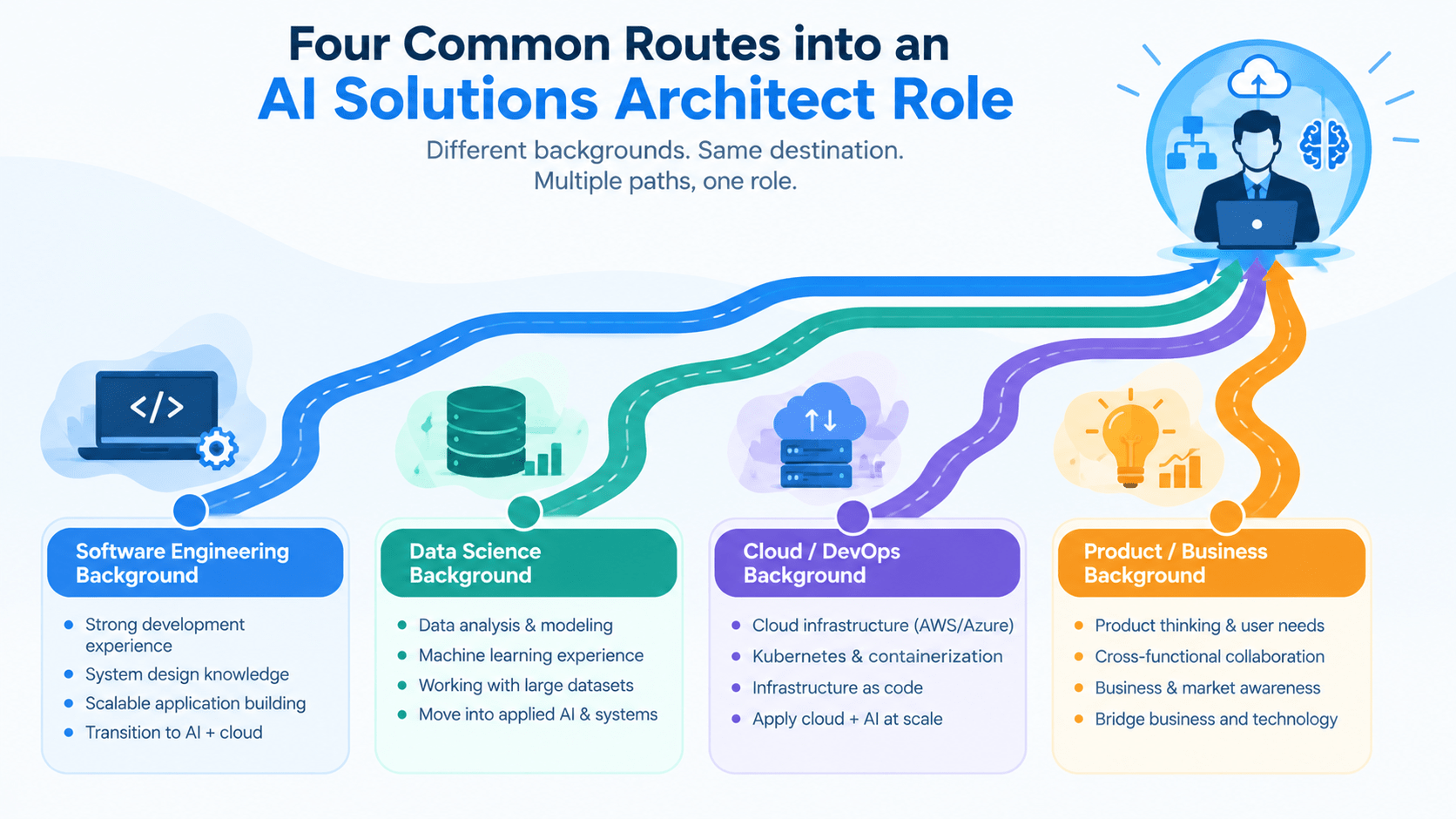
A common path moves from Software Engineer to Senior Software Engineer, to Cloud or Solutions Architect, to AI Solutions Architect, to Principal AI Architect, to Enterprise AI Architect, and eventually to Chief Architect or AI Architecture Leader.
Another route moves from Data Scientist to ML Engineer, to Senior ML Engineer, to ML or AI Architect, and then to AI Solutions Architect.
And another moves from Solutions Architect to Cloud Architect, into AI specialization, and then to AI Solutions Architect.
There is also a consulting path, moving from Technical Consultant to Senior Consultant, to AI Solution Architect, and then to Principal or Director.
Current Indian hiring shows that companies are not restricting the role to one background. HCLTech, for example, has AI architecture positions ranging from engagement-level architecture through senior enterprise AI architecture, while Deloitte’s current India role combines AI architecture, agentic systems and enterprise integration.
Also Read: If you’re mapping out your own path into tech, check our career roadmaps hub for structured tracks across different engineering specializations.
Can a Beginner Become an AI Solutions Architect?
Technically yes. Practically, it is usually not the best first job target.
Architecture requires experience because many architecture decisions only make sense after you have seen systems fail. A beginner can learn the skills, but they still need experience with production systems, technical debt, security failures, scaling problems, cloud costs, deployment failures, difficult stakeholders, legacy systems and changing requirements.
A better beginner path is Software Engineer, then AI Engineer or Cloud Engineer, then Senior Engineer, then Architect. That does not mean a beginner should ignore architecture — they should start learning it from the beginning.
Roadmap for Beginners
Start with software engineering fundamentals: Python, SQL, HTTP and APIs, Git and Linux.
Then learn backend development, React or frontend basics, and databases. Then AWS, Azure or GCP. Then Docker and CI/CD. Then system design. Then LLM APIs. Then RAG. Then agents. Then AI evaluation and security.
The important thing is to build complete systems rather than collecting certificates.
Roadmap for Junior Engineers
A junior engineer should focus on becoming a strong implementation engineer. Learn how to build APIs, work with databases, deploy applications, use cloud services, integrate AI models, build RAG applications, use authentication and monitor applications.
Then start studying system design. The goal is to understand not only how to build this, but also why the system should be designed this way.
Roadmap for Senior Engineers
For senior engineers, the path can be significantly shorter because many foundations are already present. The focus should shift toward architecture, AI systems, cloud architecture, enterprise integration, security, governance, cost optimization, customer discovery and technical leadership.
A senior backend engineer, for example, may already understand APIs, databases, distributed systems and production engineering. They may only need to add AI architecture, cloud architecture, enterprise AI governance and customer-facing solution design. That can be a powerful transition.
Roadmap for Lead and Staff Engineers
Lead and Staff engineers should focus on architecture at organizational scale. Instead of designing one application, learn to design platforms, reference architectures, reusable AI services, enterprise AI standards, governance frameworks, model gateways, evaluation platforms and shared infrastructure.
At this level, the architect’s job becomes less about drawing one system and more about establishing patterns that allow hundreds of engineers to build systems consistently.
Certifications: Are They Necessary?
Certifications can help, particularly when moving into cloud architecture or consulting organizations, but they are not a substitute for experience.
Useful certification categories include AWS Solutions Architect certifications and AI/ML-oriented credentials, Microsoft Azure architecture and AI certifications, and Google Cloud architecture and machine learning certifications.
The more important question is whether you can actually design and explain a production system. Someone with five cloud certifications who cannot explain how authentication, data flow, model routing and observability work together will struggle in a serious architecture interview. A strong portfolio and production experience are usually more convincing.
Projects to Build
If you want to demonstrate AI architecture skills, don’t build another basic chatbot. Build something that forces you to make architectural decisions.
Project 1: Enterprise RAG Platform. Build a complete system involving documents, ingestion, embeddings, a vector database, retrieval, an LLM, authentication, evaluation and monitoring. Then document why you selected each component — that architecture document may be more valuable than the application itself.
Project 2: Enterprise AI Agent. Build an agent capable of interacting with several systems — for example, an AI agent connected to a CRM, a database and a ticketing system. Add authentication, authorization, human approval, audit logs, evaluation and monitoring. Now you are demonstrating architecture rather than prompting.
Project 3: Multi-Model AI Platform. Design a system where a simple request goes to a small model, complex reasoning goes to a larger model, an image request goes to a vision model and an embedding request goes to an embedding model. Then add a model gateway, cost tracking, logging, evaluation and fallbacks. This demonstrates one of the most important architect skills: model selection and routing.
Tools an AI Solutions Architect Should Know
A useful technology map includes:
| Category | Tools / Technologies |
|---|---|
| Programming | Python, TypeScript, Java, C#, Go |
| Cloud | AWS, Azure, GCP |
| AI Platforms | OpenAI, Bedrock, Vertex AI, Azure AI / Microsoft Foundry |
| LLM Frameworks | LangChain, LangGraph, Semantic Kernel |
| Agent Frameworks | OpenAI Agents SDK, Microsoft Agent Framework, LangGraph |
| Vector Databases | pgvector, Pinecone, Weaviate, Milvus |
| Databases | PostgreSQL, MySQL, MongoDB, Redis |
| Data | Kafka, Spark, Snowflake, Databricks, BigQuery |
| Containers / Orchestration | Docker, Kubernetes |
| IaC / CI/CD | Terraform, GitHub Actions, GitLab CI, Argo CD |
| Observability | OpenTelemetry, Prometheus, Grafana |
| AI Observability | LangSmith, Arize, MLflow, W&B |
| Architecture Docs | Draw.io, Lucidchart, Mermaid |
| Enterprise | SAP, Salesforce, ServiceNow, Workday |
| Security | OAuth, OIDC, SAML, IAM |
| APIs | REST, GraphQL, Webhooks |
This should not be treated as a “learn everything” checklist. The strongest approach is to choose a core stack and understand the alternatives.
A Practical AI Architect Stack in 2026
For someone starting today, a practical stack could move from Python to FastAPI, to PostgreSQL, to React or Next.js, to Docker, to AWS or Azure, to Terraform, to LLM APIs, to RAG with pgvector, to LangGraph or another agent framework, to OpenTelemetry, to AI evaluation, to Kubernetes and to enterprise security.
This stack provides enough exposure to understand the majority of architecture conversations without requiring mastery of every technology in the ecosystem.
What Does an AI Solutions Architect Do Every Day?
One reason the role is difficult to describe is that there may be no “typical day.” An architect might spend the morning reviewing an enterprise architecture document, then meet a customer to understand a business requirement, spend the afternoon evaluating model choices, work with security on identity architecture, review a prototype with engineers and finish the day writing a technical proposal.
The work can move between strategy and implementation very quickly. A typical week might contain architecture workshops, technical discovery, system design, customer meetings, code reviews, proof-of-concept development, security reviews, cloud architecture, AI model evaluation, cost analysis, technical presentations, documentation and engineering leadership.
The Most Important Architecture Skill: Trade-Offs
A junior engineer often asks: “What is the best technology?” An architect asks: “What is the best technology for this particular situation?”
Those are completely different questions. There is no universally best model, no universally best database, no universally best cloud, and no universally best agent framework.
The architect must understand the constraints. For one organization, the best solution might be Azure because the company already has Microsoft identity, networking and governance infrastructure. For another, AWS may be the better choice. For another, a private deployment may be necessary.
For a rapidly changing knowledge system, RAG might be better than fine-tuning. For a stable specialized task, fine-tuning may make sense. Architecture is therefore the discipline of making context-aware decisions.
AI Architecture Is Becoming a New Layer of Enterprise Architecture
Traditional enterprise architecture often dealt with applications, data, infrastructure and security. AI architecture adds models, retrieval, agents, evaluation and AI governance.
This is why AI Solutions Architecture is becoming its own specialization rather than simply another feature of cloud architecture.
What Makes a Great AI Solutions Architect?
The strongest architects tend to combine several characteristics. They understand enough engineering to know when an architecture will fail. They understand enough AI to know what models can and cannot realistically do. They understand enough cloud to design scalable infrastructure. They understand enough security to prevent dangerous architectures. They understand enough business to identify which problems are worth solving.
And they can communicate all of this clearly enough that engineers can implement the system and executives can understand why the investment is worthwhile.
That combination is rare. It is also why experienced AI architects are becoming valuable.
The Future of AI Solutions Architecture
The role is likely to evolve rapidly over the next several years. AI itself will increasingly help architects with generating architecture diagrams, creating infrastructure code, comparing cloud services, analyzing requirements, producing technical documentation, reviewing APIs, generating prototypes, finding architecture risks, estimating costs and creating evaluation plans.
This does not necessarily make the architect obsolete. Instead, it changes where the architect creates value.
If AI can generate ten possible architectures in seconds, the architect’s job becomes deciding which architecture to trust, which assumptions are wrong, what risks are hidden, which option fits the organization’s constraints, and what should be built versus avoided. The architect becomes less of a diagram creator and more of a technical decision maker.
AI Solutions Architect vs AI Automation
Another important change is the rise of AI agents. Traditional automation usually follows a simple rule: if X happens, do Y.
AI agents can operate with more flexibility: understand the goal, inspect the available information, choose a tool, perform an action, evaluate the result, and continue or request approval.
That flexibility creates enormous opportunities but also architectural risks. A future AI Solutions Architect may therefore spend significant time designing agent permissions, tool access, agent boundaries, human approval, memory, multi-agent coordination, evaluation, auditability and failure recovery. This makes agent architecture one of the most important areas to watch.
Salary and Demand
AI Solutions Architect compensation varies enormously depending on experience, geography, company, industry and whether the position is primarily architecture, consulting, sales engineering or hands-on engineering.
Current India job postings demonstrate a wide range of seniority. For example, a current AI Solutions Architect posting in Noida advertises a compensation range around ₹50–51 lakh per year for a senior enterprise AI architecture position, while other roles are targeted at candidates with 10 to 17-plus years of experience.
Some salary aggregators report significantly lower averages because they combine different roles and experience levels under the same title, so headline “average salary” numbers should be treated cautiously.
For someone evaluating this career, the better approach is to look at experience, technical depth, architecture ownership, industry, company and location, rather than assuming that every AI Solutions Architect job pays the same.
Is AI Solutions Architect a Good Career?
For engineers who enjoy both technology and systems thinking, it can be an excellent career path. It is particularly attractive if you enjoy asking how all these technologies should fit together, rather than only how to implement this individual component.
The role also provides a path into senior technical leadership without requiring a move directly into people management. An experienced AI architect can eventually move toward Principal Architect, Enterprise Architect, AI Platform Architect, Chief Architect, Head of AI Architecture, CTO, Technical Strategy or AI Consulting Leadership.
Final Career Roadmap
A practical long-term roadmap could move from Beginner through Software Engineering Fundamentals, Junior Software Engineer, Cloud plus Backend plus Data, AI Engineer or ML Engineer or Cloud Engineer, Senior Engineer, System Design plus Enterprise Architecture, AI Architecture, AI Solutions Architect, Principal AI Architect, Enterprise AI Architect, and finally AI Architecture Leadership.
For someone who already has substantial software engineering experience, several stages can be compressed. A senior engineer who already understands backend systems, databases, cloud infrastructure and system design may primarily need to add generative AI, agentic AI, AI evaluation, AI security, enterprise AI governance and customer-facing solution design.
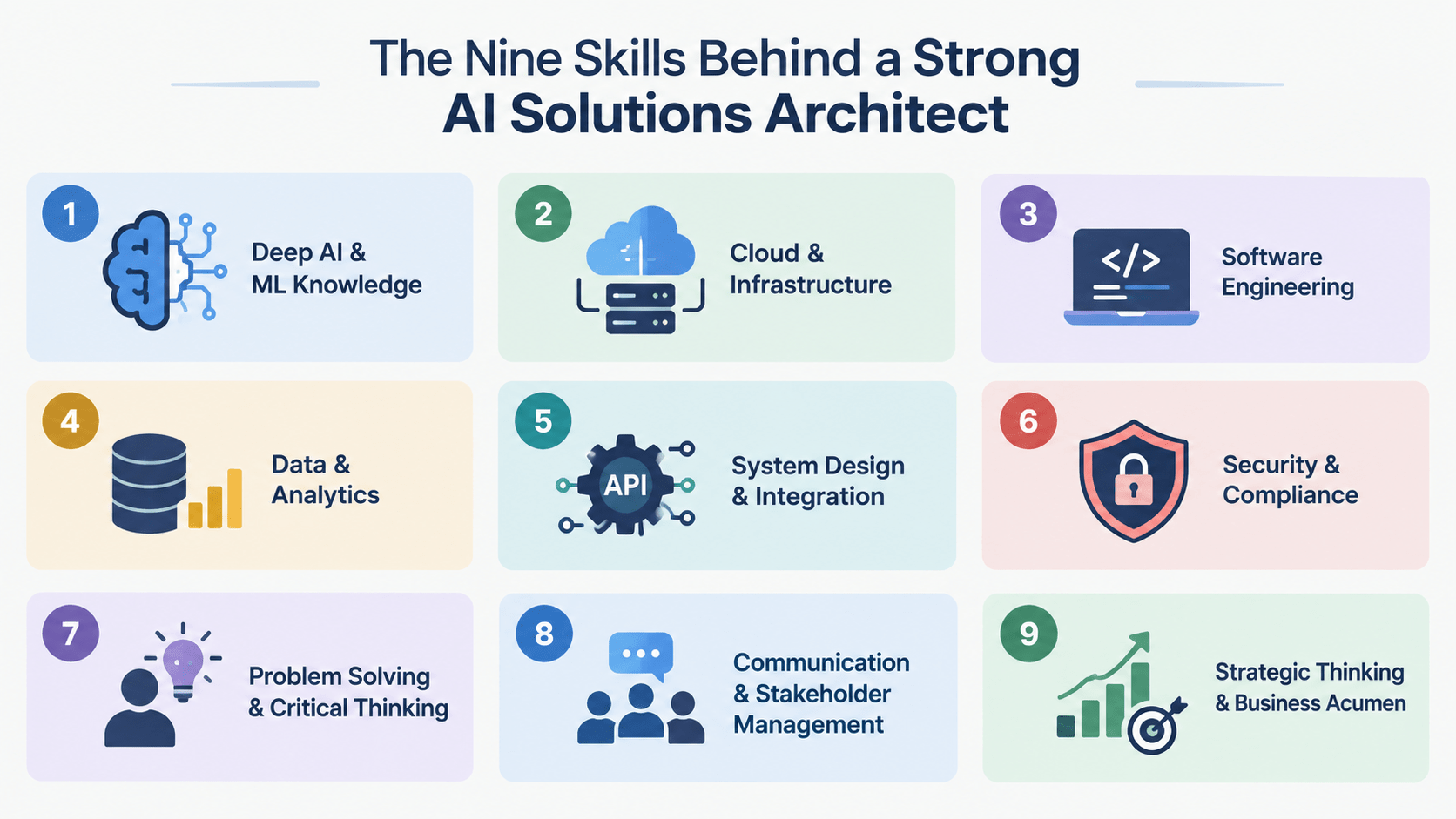
Final AI Solutions Architect Skill Map
If you want to reduce the entire career to a single map, think of it this way:
- Software Engineering — understanding how production applications are built
- Cloud — understanding where applications and AI systems run
- Data — understanding where information comes from and how it moves
- AI — understanding models, RAG, agents and evaluation
- Security — understanding identity, permissions, privacy and threat models
- Architecture — understanding how everything fits together
- Business — understanding why the system needs to exist
- Communication — understanding how to explain the architecture to engineers and executives
- Leadership — understanding how to guide teams from architecture to production
Also Read: Already comfortable with the Python side of this stack? See our piece on Why Python Dominates AI/ML over JavaScript & Java for the language foundation this role leans on daily.
Conclusion
The AI Solutions Architect is becoming one of the key technical roles in the transition from AI experimentation to enterprise AI.
The reason is straightforward: companies can now access powerful AI models relatively easily, but access to a model is not the same thing as having a production AI system. A production system needs data, applications, APIs, infrastructure, identity, security, governance, monitoring, evaluation and a clear business purpose. Someone needs to connect all of those pieces. That is the AI Solutions Architect.
The role is therefore best understood not as “the person who knows the most AI tools,” but as the engineer or technical leader who understands how AI should fit into a larger system and can make that architecture real.
Current hiring supports this broader definition. HCLTech is looking for architects who combine enterprise architecture with Generative and Agentic AI, Cognizant is hiring architects to design and scale enterprise AI ecosystems, Deloitte’s current India role focuses on production multi-agent architectures and enterprise integrations, while Finastra’s AI architecture function emphasizes technical blueprints and standards.
For software engineers considering their next career move, this makes AI Solutions Architecture particularly interesting because it doesn’t require abandoning engineering. Instead, it represents an expansion of engineering responsibility.
You move from building a component to designing the system. You move from solving a technical problem to understanding the business problem behind it. You move from choosing a technology because it is interesting to choosing it because it is appropriate. And eventually, you move from designing one application to establishing the architecture patterns that allow an entire organization to build AI safely and effectively.
The central skill is therefore simple to describe, even if it takes years to develop: understand the problem, understand the technology, understand the constraints, and design a system that can survive the real world.
That is the work of an AI Solutions Architect.
FAQ
Is AI Solutions Architect a coding job? It’s hands-on enough to require real engineering depth, but the core deliverable is the system design, not day-to-day feature code. Many architects stay close to implementation even after moving into the role.
Do I need a Master’s degree to become an AI Solutions Architect? No. Most current hiring emphasizes production experience, a strong portfolio and demonstrated system-design ability over specific degrees.
Is AI Solutions Architect the same as AI Engineer? No. An AI Engineer builds AI components. An AI Solutions Architect decides how those components, data, infrastructure and business processes fit together into one production system.
How long does it take to become an AI Solutions Architect? There’s no fixed timeline, but most architects arrive after several years as a software, cloud, or ML engineer — architecture decisions tend to require having seen systems succeed and fail firsthand.
Which cloud should I learn first for this role? Any of AWS, Azure, or Google Cloud is a reasonable starting point. Azure tends to matter more in Microsoft-heavy enterprises; pick based on the industry you want to work in, then learn the others’ AI services as needed.