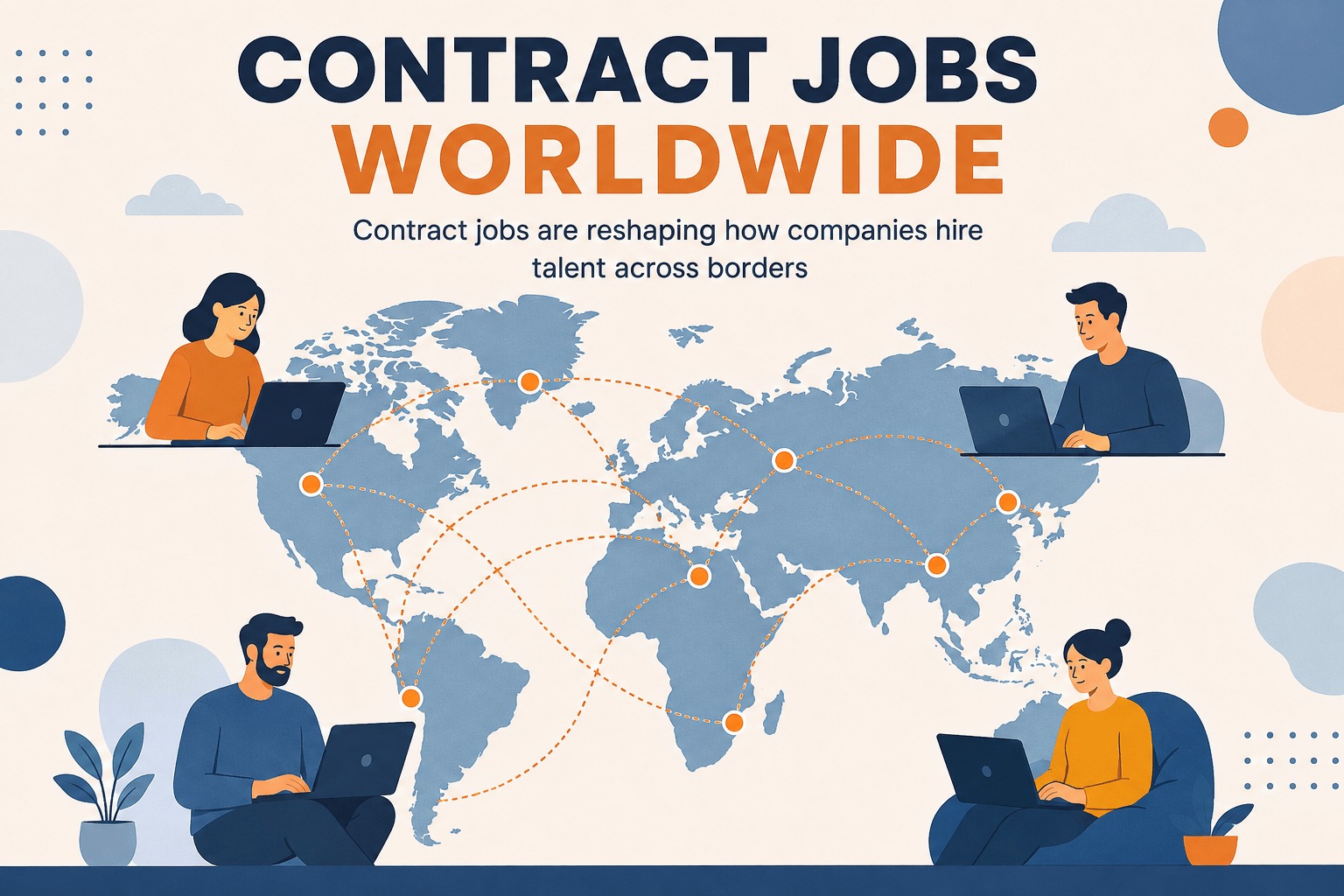

Contract jobs are having a moment everywhere, not just in one country’s tech scene. From Bangalore to Berlin to the Bay Area, companies are leaning harder on freelancers, consultants, fixed-term staff, and remote contractors instead of building out permanent teams. If you’re a developer, that shift probably isn’t news to you it’s the reason your last three job offers looked different from the ones your senior colleagues got a decade ago.
The easy explanation is that companies use contract jobs to dodge employee rights. That’s too simple, and it’s also not quite true. What a company actually owes a worker in contract jobs paid leave, benefits, notice periods, retirement contributions depends on classification and on which country’s law applies, and that varies enormously. What’s consistent everywhere is this: companies are optimizing for flexibility, and in the U.S. tech industry specifically, immigration policy has just made that optimization a lot more urgent.
This piece looks at why contract jobs are growing globally, what companies gain and lose by choosing them, how the 2025–2026 H-1B overhaul is reshaping hiring decisions at U.S. tech companies, and whether “permanent jobs are disappearing” actually holds up against the data.
Why Companies Everywhere Are Choosing Contract Jobs
Lower fixed costs with contract jobs
A permanent hire is a standing monthly commitment regardless of how a project performs. Contract jobs convert that into a cost tied to actual output when the project ends, so does the spend.
Faster hiring
Sourcing, interviewing, and onboarding a permanent employee takes weeks to months almost everywhere. A contractor engagement, especially through a freelance platform or staffing partner, can start in days.
Access to specialized, short-lived skills
A company migrating to a new cloud provider or shipping an AI feature might need a specific skill set for one quarter, not indefinitely. Contract jobs let a company rent that expertise for exactly as long as it’s needed.
Easier scaling in both directions
Headcount is sticky reducing a permanent team involves severance, notice periods, and reputational cost in most jurisdictions. Scaling a contractor bench up or down is comparatively simple.
Global, remote access to talent
Freelance platforms and remote-first hiring mean a company in San Francisco can engage a developer in Warsaw or Lagos without opening a local entity, something that would be far more complex for a permanent hire.
Economic uncertainty
When demand is unpredictable as it has been across tech through layoff cycles in 2025 and 2026 contract jobs let companies staff up for specific initiatives without the long-term liability of permanent headcount.
Technology is the industry where all of this compounds hardest, because technical skills shift faster than most professions and because remote-capable work is easier to route through contract jobs than physical, location-bound work is.
Also Read : How to Optimize Prompts to Reduce Token Usage and Cut LLM Costs in 2026
What Companies May Actually Avoid and What They Don’t
This is where headlines oversimplify. Classification, not the word “contractor,” decides what a company owes a worker, and the specifics differ by country.
For a genuine independent contractor engaged through a real commercial agreement, a company in most jurisdictions doesn’t owe employer-side retirement contributions, paid holidays, sick leave, statutory notice periods, severance, or health insurance contributions. The contractor typically handles their own taxes and benefits.
For workers in contract jobs who are actually employees in substance fixed-term staff, agency workers, or misclassified “contractors” who function like employees most of that list applies anyway, because the legal test looks at the relationship, not the label attached to the contract jobs in question.
A UK contractor caught by IR35 rules, a U.S. worker who meets the “economic realities” test under federal labor law, or an EU platform worker presumed to be an employee under the new EU Platform Work Directive can all end up entitled to employee-level protections despite a “contractor” agreement on paper.
The honest summary: companies genuinely reduce statutory obligations with real independent contractors in contract jobs. They don’t automatically reduce anything by relabeling someone who is functionally an employee that’s the subject of the next section, and it’s the single biggest legal risk in the contract jobs space right now.
A Contract Doesn’t Always Make Someone a Contractor
Authorities in nearly every major jurisdiction look past the paperwork to the actual working relationship. The specific legal tests differ by country, but they converge on similar questions:
- Who controls how the work gets done hours, methods, tools, process versus just the outcome?
- Is the person integrated into the company internal email, reporting lines, team meetings or operating as an outside service provider?
- Economic dependence does the person rely on one company for essentially all their income over a long period, or do they genuinely serve multiple clients?
- Who supplies equipment and absorbs financial risk of a bad engagement?
- Exclusivity can the worker take on other clients, or is the arrangement functionally full-time?
The consequences of getting this wrong are real and expanding. The EU’s Platform Work Directive, which member states must adopt by December 2026, flips the burden of proof for platform workers: if a worker looks like an employee, the platform must prove otherwise, not the other way around.
The Netherlands ended its enforcement pause on “bogus self-employment” in January 2025 and now presumes employment status for work paid below roughly €38 an hour, with fines possible from 2026 for deliberate misclassification. Estimates put the EU’s misclassified platform workforce as high as 5.5 million people, with billions in unpaid tax and social contributions at stake if reclassification proceeds at scale.
In the U.S., misclassification exposes a company to back pay, unpaid payroll tax liability, penalties, and potential class-action wage claims federal and state agencies both enforce this, and the tests they use (control, economic dependence, integration) overlap heavily with what courts elsewhere apply to contract jobs. The pattern is consistent worldwide: contract jobs are legal, disguised employment labeled as a contract job is not, and governments are actively tightening enforcement of contract jobs rather than loosening it.
Also Read :v Understanding LLM Tokens, Context Windows, and Prompt Engineering: A Complete Practical Guide for Developers in 2026
Why Technology Is Accelerating the Global Shift
Tech leads this shift for structural reasons. Product cycles are short. Technical skills age fast a framework in high demand this year can be a maintenance skill in three. Remote work removed the geographic constraint that used to force permanent local hiring. And AI is changing which skills companies need faster than most permanent hiring processes can keep up with.
None of that means “AI is replacing permanent jobs” in a direct sense the more defensible read is that AI-driven skill volatility makes companies more cautious about locking in permanent headcount for capabilities that might look different in eighteen months, which pushes more incremental hiring toward contract jobs, freelance platforms, and staff augmentation instead of new permanent roles.
Global outsourcing and staff augmentation long-standing practices in IT services have scaled alongside the growth of contract jobs generally. Companies increasingly treat “where is this person physically located, and what’s their employment status” as two separate, flexible variables rather than a fixed package, which sets up the immigration angle directly.
The H-1B Problem: When Immigration Policy Changes Hiring Decisions
No discussion of contract jobs in tech is complete without the H-1B program, because 2025–2026 has been the most disruptive stretch in its history.
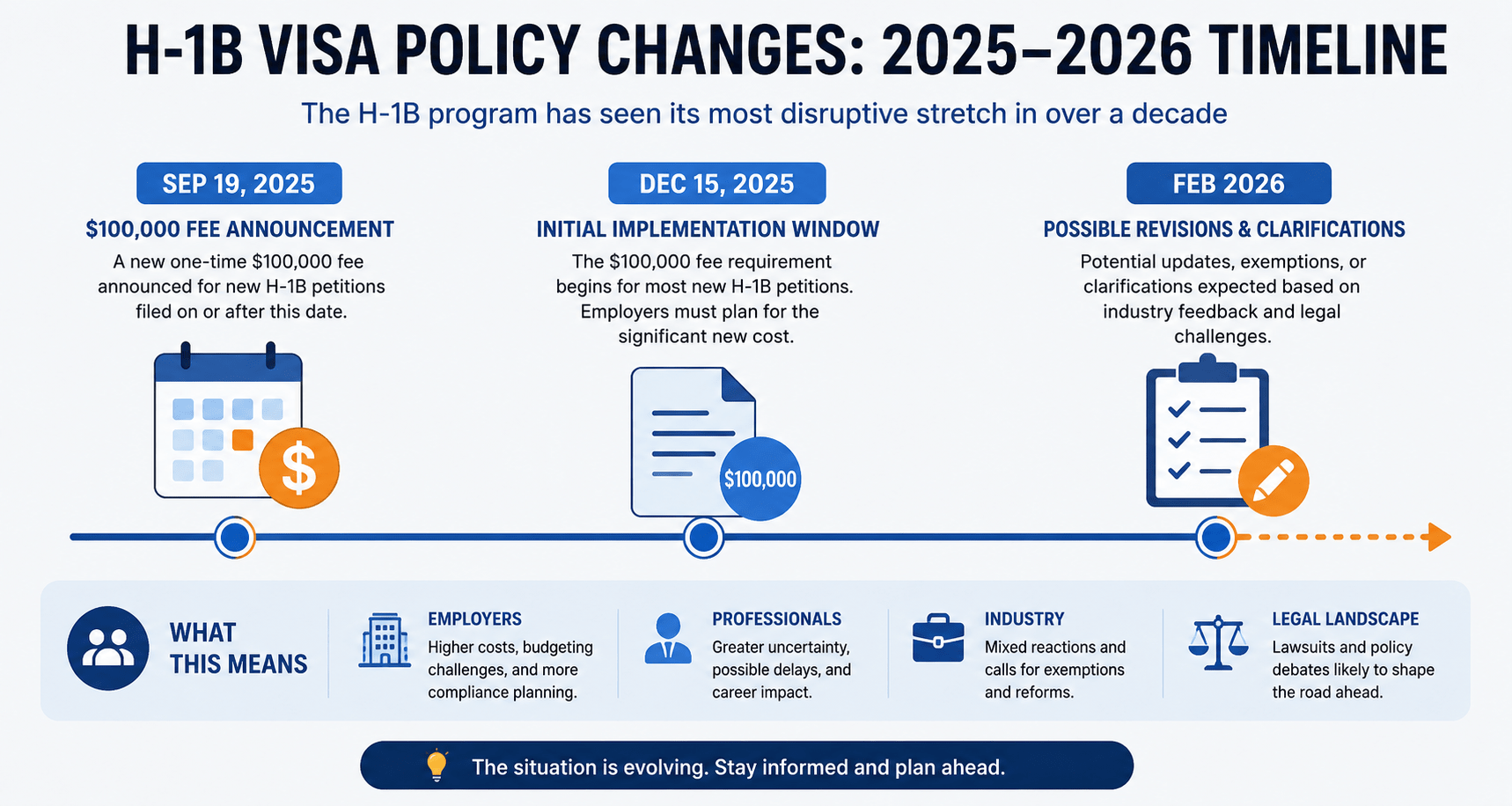
On September 19, 2025, a presidential proclamation imposed a $100,000 fee on new H-1B petitions for workers based outside the United States, effective September 21, 2025. The fee doesn’t apply to current H-1B holders extending status domestically, and employers are legally barred from passing the cost to workers but for a new hire abroad, it stacks on top of existing legal and relocation costs.
On December 29, 2025, the Department of Homeland Security finalized a rule replacing part of the H-1B lottery with a wage-weighted selection system that favors higher-paid, higher-skilled applicants, effective February 27, 2026. Alongside this came expanded wage audits, broader employment-history reviews, social media screening, and doubled site visits from USCIS fraud investigators. As of mid-2026, litigation over the fee is ongoing and courts haven’t blocked it; the underlying proclamation is tied to a one-year window that expires in September 2026 unless extended.
The measurable effect: H-1B filings for workers abroad dropped sharply through early 2026. Immigration attorneys tracking the shift describe employer caution companies aren’t necessarily valuing global talent less, they’re avoiding the compliance and cost risk of getting a filing wrong. Large tech employers have responded by shifting more work to offshore hubs including India, Canada, and Singapore, leaning more on domestic hiring, and notably continuing to sponsor H-1Bs where the role justifies the cost, since large firms can absorb a $100,000 fee more easily than startups can.
This is the key nuance the brief for this piece specifically asked for: don’t claim the fee is causing companies to swap employees for contractors. The direct evidence supports something narrower the fee and added scrutiny raise the cost and risk of new U.S.-based sponsorship specifically, which makes offshore hiring, remote contracting, and staff augmentation through overseas entities comparatively more attractive for the same role. Whether a given company chooses “hire the same role overseas through contract jobs” versus “hire the same role overseas as a full employee of a local entity” is a separate decision that international contract jobs don’t automatically solve see the next section.
Visa Delays and Travel Risk Are Reshaping How Tech Companies Deploy Talent
Beyond the fee itself, immigration-related travel risk has become a real operational issue for tech employers in 2026. A presidential proclamation effective January 1, 2026 expanded U.S. entry restrictions covering nationals of 39 countries, with a “full ban” applying to most nonimmigrant visa categories for some countries and a “partial ban” limited mainly to visitor, student, and exchange visas for others H-1B and O-1 workers are largely carved out of the partial-ban list, but the broader climate of scrutiny has spilled into H-1B processing regardless.
Visa stamping delays at U.S. consulates abroad have stretched up to several months in some cases through 2025–2026, driven by expanded vetting and social media screening. Google and Apple both issued internal guidance in 2026 advising some employees on H-1B, H-4, F, and J visas to avoid non-essential international travel, warning that renewal delays could leave staff stranded outside the U.S. for months. Separately, reports through early 2026 describe U.S. Customs and Border Protection preclearance officers at some overseas facilities denying boarding or cancelling visas for H-1B holders over issues like remote work performed abroad for more than 30 days described by immigration attorneys as inconsistent application of existing rules rather than a formal new policy, but disruptive regardless.
This is the credible version of the mobility angle: it’s not that passport issuance policy is driving contract-job growth there’s no clear evidence for that specific claim but that visa stamping delays, travel bans, and unpredictable border screening make employment tied to a specific visa status materially riskier for both the worker and the employer than it was two years ago. That risk is a real input into why companies are more interested in structuring roles through remote contracting, offshore entities, contract jobs, or employer-of-record arrangements in ways that don’t depend on one worker successfully re-entering the U.S. on schedule.
Government Policy Is Reshaping the Future of Work, Beyond Immigration
Immigration is the sharpest example right now, but it’s one input in a broader pattern: government policy → employer cost and risk → hiring strategy → worker opportunity.
- Worker classification rules (the EU Platform Work Directive, U.S. state and federal misclassification enforcement) raise the cost of disguising employment as contract jobs, which cuts against pure cost-cutting motives while leaving genuine flexibility motives intact.
- Payroll tax and social security design affects how expensive a permanent hire is relative to contract jobs in a given country this varies enormously, from high-payroll-tax European economies to lower-friction markets.
- Remote-work and cross-border employment rules, including the rise of employer-of-record services, are making it easier for a company to hire someone as a full employee in another country without opening a local entity which, notably, can substitute for contract jobs rather than expand them, since EOR employment technically comes with the target country’s local employee protections.
- Minimum wage and severance requirements shape how much risk a permanent role carries in a given jurisdiction, directly influencing how attractive contract jobs look by comparison.
The net effect isn’t uniform. In some markets, policy is making contract jobs riskier (misclassification enforcement). In others, it’s making cross-border permanent employment easier (EOR growth). Both trends are real and pulling in different directions at once which is exactly why “companies are replacing permanent jobs with contract jobs” is too clean a story for what’s actually happening.
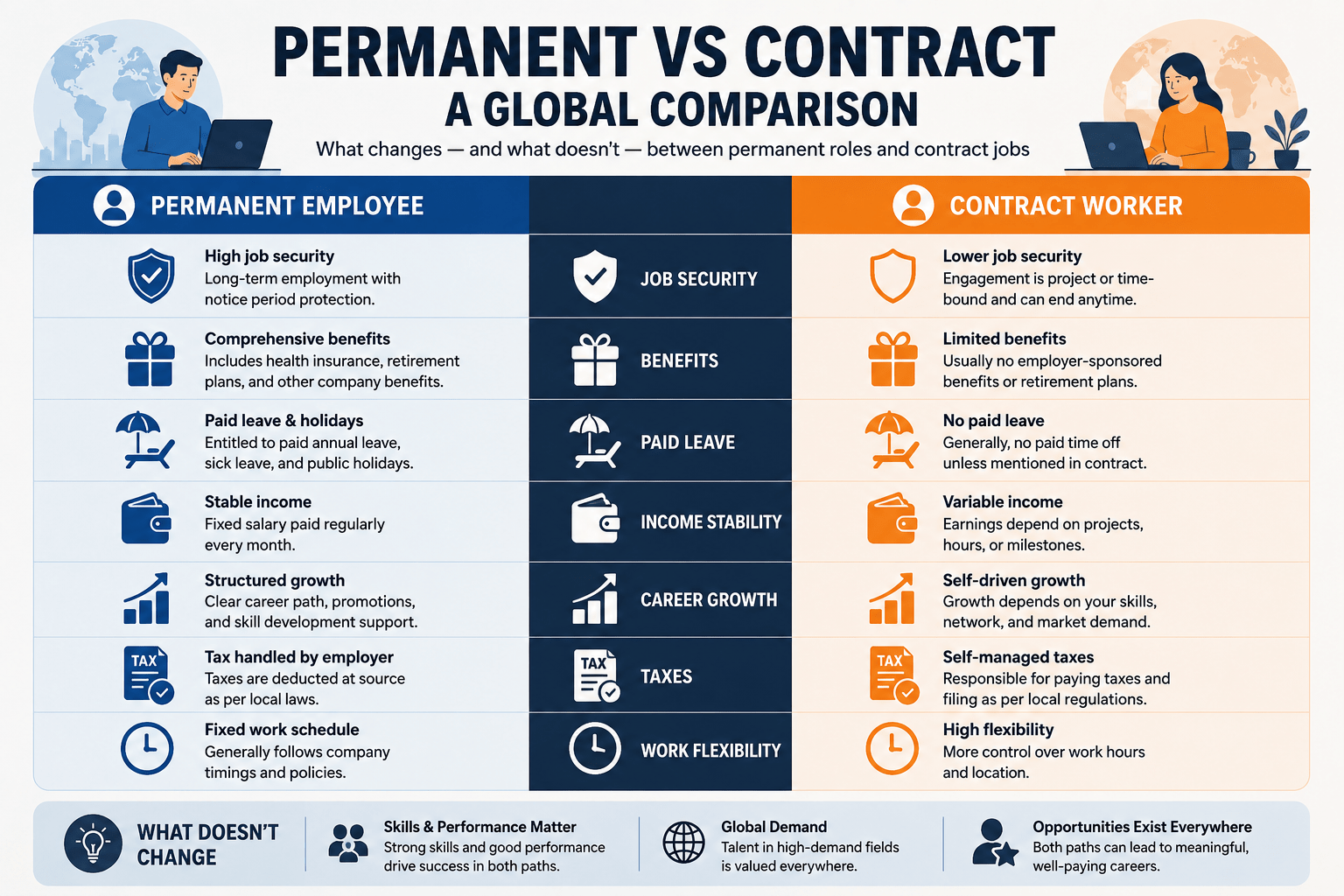
Permanent vs Contract Jobs: A Global Comparison
Permanent Employee vs Contract Worker: Key Differences
A side-by-side comparison of job security, income, benefits, taxes, and flexibility for permanent employees and independent contractors.
| Factor | Permanent Employee | Contract Worker |
|---|---|---|
| Job security | Ongoing, subject to local termination law | Ends when the engagement ends |
| Income stability | Predictable, fixed salary | Variable, tied to invoicing/project flow |
| Paid leave | Statutory in most countries | Not applicable to genuine contractors |
| Employee benefits | Health, retirement, insurance where mandated | Self-funded by default |
| Severance | Often legally required, varies by country | Governed by contract terms, not labor law |
| Employer contributions | Social security/payroll tax, varies widely | Not applicable for genuine contractors |
| Tax responsibility | Employer withholds | Contractor self-files |
| Flexibility | Lower — typically one employer | Higher — can serve multiple clients |
| Multiple clients | Generally not applicable | Core feature of genuine contracting |
| Career progression | Structured, internal | Self-directed, market-negotiated |
| Immigration / work authorization | Tied to employer sponsorship in many countries | Varies dramatically — often harder, not easier, for cross-border work |
That last row matters more than it looks. Work authorization rules vary so much by country that “contract work” doesn’t uniformly solve immigration problems in the U.S. specifically, it often complicates them, which the next section covers directly.
What Workers Gain From Contract Jobs
Workers aren’t uniformly worse off in contract jobs. Skilled professionals especially in tech, design, and consulting often choose contract jobs deliberately, for higher project-based rates than an equivalent salaried role, the ability to work with international clients, schedule flexibility, freedom to pick projects, faster exposure to different companies and stacks, and the option to run multiple client relationships instead of depending on one employer.
What Workers Lose
The trade-off in contract jobs is real: no guaranteed continuity, income that varies with the project pipeline, no statutory paid leave by default, full personal responsibility for taxes and retirement planning, no employer-sponsored insurance, and critically for internationally employed tech workers no automatic path to work authorization or immigration stability, since most contractor arrangements don’t come with visa sponsorship at all.
The H-1B and Contract Work Connection
Here’s the part worth being precise about, because it’s tempting to assume contract jobs are an easy workaround for immigration friction. They generally aren’t.
Converting an H-1B employee into an independent contractor doesn’t resolve U.S. work authorization requirements a person still needs valid status to legally work in the U.S. regardless of whether they’re paid as a W-2 employee or a 1099 contractor. Independent contracting doesn’t come with its own visa category; a worker would still need an appropriate work-authorized status (or to be physically outside the U.S. working for a foreign or remote entity) to do the work legally. So “just move them into contract jobs” doesn’t sidestep immigration law it can create a new compliance problem if a company assumes contractor status resolves an authorization issue it doesn’t.
What immigration friction does plausibly encourage is: hiring the same skill set through contract jobs based outside the U.S. entirely (offshoring the role rather than relocating the person), or structuring roles as remote-first so location becomes less relevant to begin with. Both of those are real responses to H-1B cost and uncertainty but they’re different from “swap the visa employee for a domestic contractor,” which is the oversimplified version of this story that doesn’t hold up.
Is the Permanent Job Actually Disappearing?
Global data doesn’t support a clean “permanent jobs are vanishing” narrative it supports something closer to gradual diversification layered on top of an already-large non-permanent employment base.

The ILO estimates that informal employment without secure contracts, paid leave, or social protections covers roughly 57% of the global workforce, over 2.1 billion workers, a figure that predates the current contract-jobs conversation and reflects how much of the world’s employment was never in the “stable permanent job” category to begin with. The World Bank estimates 154 to 435 million people do online gig work globally, roughly 4.4% to 12.5% of the global labor force a wide range because measurement methods differ, but even at the high end, a minority of global employment.
In the U.S. specifically, the most recent official BLS Contingent Worker Survey (July 2023, the latest available since this supplement runs infrequently) found the contingent rate workers who don’t expect their job to last at 4.3%, up modestly from 3.8% in 2017. That’s real growth, but it’s not the wholesale collapse of permanent employment the headline framing implies.
What the evidence more consistently supports: companies are building hybrid workforces a permanent core plus contract jobs, freelancers, and outsourced or offshore teams rather than converting existing permanent roles wholesale. The EU’s freelance platform footprint, U.S. contingent-work growth, and India’s fast-growing gig sector are all additive trends layered onto substantial existing informal and contract employment, not clean substitution for permanent jobs that used to exist.
The Bigger Economic Shift
The traditional model company → permanent employee → long-term career is gradually giving way to something closer to company → core permanent employees + contract jobs + freelancers + globally distributed remote talent, assembled around whichever structure minimizes cost and risk for a given role at a given moment.
For companies, this means more hiring optionality but more classification and compliance risk to manage across jurisdictions with contract jobs. For workers, it means more flexibility for those with in-demand, portable skills, and more exposure to income and benefit gaps for those without. For governments, it raises a genuine policy problem: social security, healthcare, and retirement systems in most countries were built around the assumption of stable, employer-linked employment, and a growing share of the workforce doesn’t fit that assumption cleanly which is exactly why the EU, the Netherlands, and other jurisdictions are actively rewriting classification rules rather than leaving the question unresolved.
Are Contract Jobs the Future of Work?
The honest answer sits between the extremes. Companies aren’t wholesale replacing permanent roles with contract jobs informal-employment data, contingent-worker growth rates, and the scale of hybrid workforce models all point to addition and diversification more than substitution. At the same time, the direction of travel is real, and in U.S. tech specifically, 2025–2026’s H-1B cost increases and visa-related travel risk have made location- and status-dependent permanent hiring measurably riskier, pushing more incremental hiring toward contract jobs, offshore staffing, and remote-first roles.
As AI reshapes which skills companies need, as immigration policy reshapes who companies can access and where, and as governments rethink worker protections for a workforce that no longer fits neatly into “permanent” or “contractor,” the more durable trend may not be contract jobs replacing permanent ones it may be companies caring less about where a worker sits or how they’re classified, and more about how fast they can access the skill, with workers absorbing more of the uncertainty that shift creates along the way.
Frequently Asked Questions
Are contract jobs replacing permanent jobs worldwide?
Not wholesale. Global data ILO informal employment figures, World Bank gig-work estimates, and U.S. contingent-worker surveys shows contract jobs and non-standard work growing alongside permanent employment more than replacing it outright, though the trend toward contract jobs is real and accelerating in specific sectors like tech.
Does the H-1B fee mean companies are replacing visa employees with contractors? Not directly, and that specific claim isn’t well supported by current evidence. The $100,000 fee and added scrutiny raise the cost of new H-1B sponsorship for workers abroad specifically, which makes offshoring roles or hiring remotely more attractive but converting an existing employee to a contractor doesn’t resolve U.S. work authorization requirements on its own.
Can a company legally call an employee a “contractor” to avoid paying benefits? Not safely, in almost any jurisdiction. Authorities look at the substance of the working relationship control, integration, economic dependence not the contract’s label. Misclassification can trigger back pay, penalties, and, increasingly, presumption-of-employment rules like the EU’s Platform Work Directive that put the burden of proof on the employer.
What’s actually different about contract jobs from country to country? Mainly the statutory floor: what a company owes a genuine employee (leave, benefits, severance, social contributions) varies dramatically by country, and so does how aggressively misclassified contract jobs get enforced the Netherlands and the incoming EU Platform Work Directive are considerably stricter than many jurisdictions, for example.
Is it easier for a foreign tech worker to get international clients as a contractor than to get a work visa? It depends entirely on where the work is performed. A contractor based outside the U.S. serving international clients remotely doesn’t need a U.S. work visa at all. But a contractor physically working inside the U.S. still needs valid work authorization contracting status alone doesn’t substitute for that.