
Choosing a JavaScript framework over a plain UI library is one of the first architectural decisions every frontend team makes, and it shapes everything from routing to deployment down the line. In the early days of web development, building interactive user interfaces meant manually querying DOM nodes with plain JavaScript or jQuery. As web applications turned into complex, data-heavy Single Page Applications (SPAs), the community built more sophisticated tools to manage UI state, DOM updates, component lifecycles, and network fetching.
Today’s frontend landscape offers a wide range of solutions, from component-rendering libraries like React to compiled runtimes like Svelte, batteries-included monoliths like Angular, and full-stack meta-frameworks like Next.js, Nuxt, and Astro. Developers frequently confuse the terms library and framework, or wonder when to reach for a UI rendering engine instead of a full JavaScript framework.
This guide clarifies the real distinction between libraries and frameworks, walks through the popular frontend tools across architectures and paradigms, and gives you a decision matrix so you can pick the right stack for your next project.
Also Read: Server Actions and Data Mutations in Next.js
1. The Core Distinction: JavaScript Framework vs Library
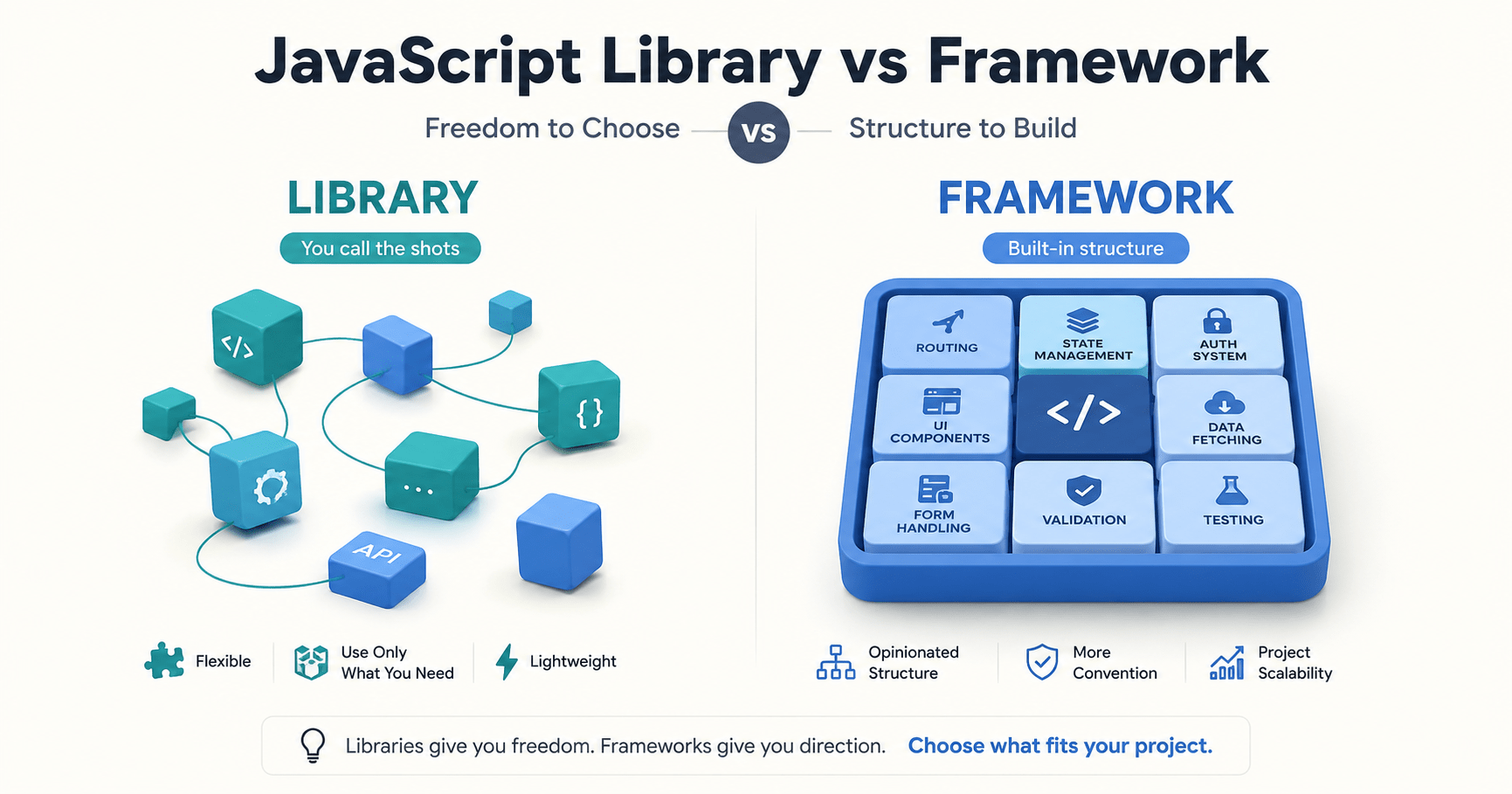
The fundamental difference between a library and a JavaScript framework comes down to a single engineering concept: Inversion of Control (IoC).

       LIBRARY PATTERN                     FRAMEWORK PATTERN
  (You are in control)                 (Framework is in control)

Your Application Code  --calls-->   Library Code (React / Lodash)
Framework (Next.js/Angular) --calls/invokes--> Your Component Code
What Is a Library?
A library is a collection of helper functions, utilities, or components built to solve one focused problem, such as rendering UI nodes to the DOM, formatting dates, or managing local state.
Inversion of control: you call the library. You decide the application’s file structure, routing mechanism, state management solution, build toolchain, and folder layout.
Flexibility: high freedom, but you’ll assemble several third-party packages to build a complete application.
Examples: React (UI rendering engine), Zustand (state management), Axios (HTTP client).
What Is a JavaScript Framework?
A JavaScript framework provides an opinionated blueprint and environment for your entire application. It defines the folder structure, routing conventions, data-fetching lifecycles, and build configuration out of the box.
Inversion of control: the framework calls your code. You write code inside prescribed slots, like routing folders or controller methods, and the framework decides when and how to run them.
Flexibility: lower initial architectural freedom, but you get standardization, faster developer velocity, and zero setup fatigue.
Examples: Angular, Next.js, SvelteKit, Nuxt.js.
2. Component Rendering Engines and UI Libraries
Before full-stack meta-frameworks existed, client-side web development ran on component-rendering engines that managed state and updated the browser DOM. These fall into three camps: Virtual DOM reconciliation (React, Vue), no-Virtual-DOM compilers (Svelte, Solid), and signal-based reactivity (Angular, Solid).
React: The Declarative UI Engine
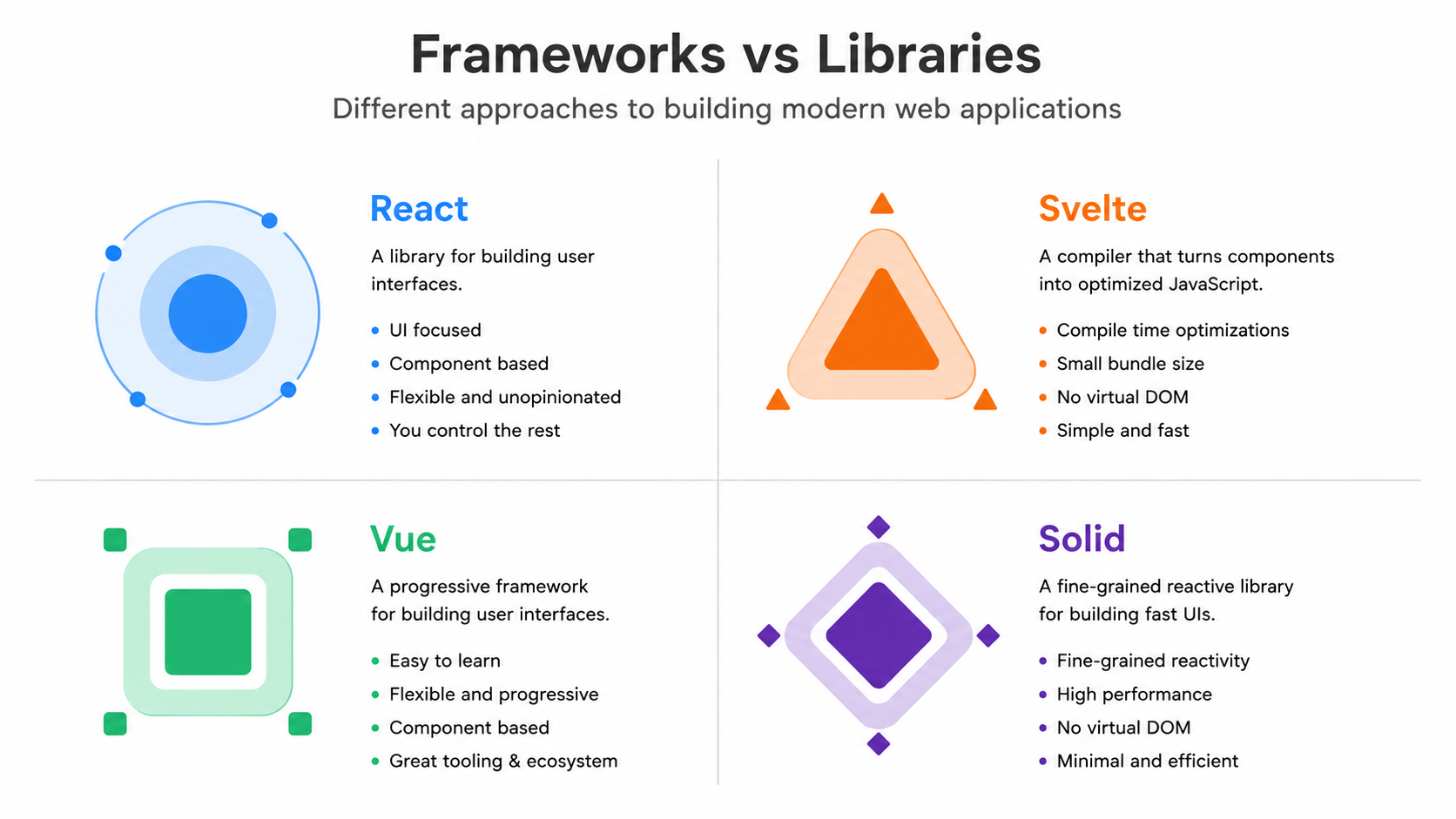
Released by Facebook in 2013, React isn’t a full JavaScript framework. It’s a UI library built around components, declarative state, and a Virtual DOM.
jsx
// React: State triggers Virtual DOM diffing & reconciliation
import { useState } from 'react';

export function Counter() {
  const [count, setCount] = useState(0);
  return (
    <button onClick={() => setCount(count + 1)}>
      Count: {count}
    </button>
  );
}
Architecture: component-driven, Virtual DOM reconciliation, JSX syntax, unidirectional data flow.
Pros: the largest ecosystem in web development, a massive job market, and unopinionated integration possibilities.
Cons: you have to choose external libraries for routing, forms, and state. Expect frequent re-render overhead without strict memoization (useMemo, useCallback).
Svelte: The Compiler-First Approach
Created by Rich Harris, Svelte takes a different approach entirely. Instead of doing heavy work in the browser with a Virtual DOM, Svelte works as a build-time compiler.
html
<!-- Svelte: Reactivity built into the language syntax -->
<script>
  let count = 0;
  function increment() { count += 1; }
</script>

<button on:click={increment}>
  Count: {count}
</button>
Architecture: a build-time compiler that turns component code into surgical, imperative vanilla JavaScript DOM updates.
Pros: zero Virtual DOM overhead, tiny client bundle sizes, built-in animation utilities, and clean reactive syntax ($: and Runes).
Cons: a smaller plugin ecosystem than React, and non-standard syntax that needs dedicated editor plugins.
Vue.js: The Progressive Middle Ground
Created by Evan You, Vue bridges the gap between a minimalist UI library and a structured JavaScript framework. It combines fine-grained reactive tracking with Single File Components (SFCs).
html
<!-- Vue SFC: Clean template, script, and style isolation -->
<script setup>
import { ref } from 'vue';
const count = ref(0);
</script>

<template>
  <button @click="count++">Count: {{ count }}</button>
</template>
Pros: a gentle learning curve, official ecosystem packages for routing (Vue Router) and state (Pinia), and fine-grained reactivity through Proxy objects.
Cons: smaller corporate backing than React or Angular, since Vue is community-funded.
SolidJS: Fine-Grained Reactive Primitives
SolidJS combines the JSX syntax of React with the compiled reactivity model of Svelte. Components run once on initial mount, and reactive signals update specific DOM text nodes directly, without re-running the whole component function.
Pros: performance that competes with raw vanilla JS, plus React-like developer experience without hook dependency arrays or re-render traps.
Cons: a niche community, and some confusion for React developers who expect functions to re-run.
3. Full-Stack Meta-Frameworks and Batteries-Included Ecosystems
As requirements shifted toward SEO, instant First Contentful Paint (FCP), edge delivery, and automatic server routes, standalone client libraries evolved into full-stack meta-frameworks.
Next.js: The React-Based JavaScript Framework
Maintained by Vercel, Next.js is the leading JavaScript framework built on React. It introduced hybrid Server Components (RSC), file-system routing, Server Actions, and dynamic streaming.
Best for: enterprise SaaS web apps, dynamic e-commerce platforms, and large-scale React platforms.
Angular: The Enterprise Monolith
Maintained by Google, Angular is a complete, batteries-included JavaScript framework that ships everything out of the box: a CLI, form validation, an HTTP client, a router, dependency injection, and RxJS or Signals for reactivity.
Architecture: TypeScript-first, object-oriented, Signals-driven state, dependency injection.
Best for: massive enterprise applications with long life cycles and complex multi-team internal portals.
Astro: The Islands Architecture Specialist
Astro changed static and content-focused web development with Islands Architecture. By default, Astro ships zero client-side JavaScript, rendering pure HTML and CSS. When you need interactive widgets, Astro loads JavaScript on demand for individual components, called “islands.”
astro
---
// Astro Component: Server-Side Execution Only
import ReactCounter from '../components/ReactCounter.jsx';
import SvelteWidget from '../components/SvelteWidget.svelte';
---

<html>
  <body>
    <h1>Marketing Page (Zero JS)</h1>
    <ReactCounter client:visible />
    <SvelteWidget client:idle />
  </body>
</html>
Best for: marketing websites, blogs, documentation platforms, and content-heavy sites where page speed and SEO matter most.
4. Comprehensive Comparison: Library vs JavaScript Framework

| Tool | Classification | Control Paradigm | DOM Strategy | Primary Strength | Ideal Use Case |
|---|---|---|---|---|---|
| React | UI Library | You call it | Virtual DOM | Massive ecosystem, flexible design | SPAs, cross-platform apps (React Native) |
| Svelte / SvelteKit | Compiled Framework | Framework calls you | No Virtual DOM | Minimal bundle size, clean syntax | High-performance interactive web apps |
| Vue / Nuxt | Progressive Framework | Framework calls you | Proxy reactivity / Virtual DOM | Gentle learning curve, great DX | SaaS products, dashboards, medium/large apps |
| Next.js | Full-Stack JavaScript Framework | Framework calls you | React Server Components / VDOM | Hybrid SSR/SSG, Server Actions, SEO | Full-stack web apps, e-commerce |
| Angular | Enterprise JavaScript Framework | Framework calls you | Incremental DOM (Ivy engine) | All-in-one tooling, strict patterns | Large enterprise systems, admin suites |
| Astro | Content Meta-Framework | Framework calls you | Islands / zero-JS default | Extreme performance, multi-framework support | Blogs, marketing sites, documentation |
| SolidJS | UI Library | You call it | Fine-grained signals | Extreme speed, reactive primitives | High-frequency data dashboards |
5. How to Choose the Right Tool for Your Project
Pick Astro if you’re building content-heavy sites, such as blogs, marketing landing pages, or docs, where initial page speed, Lighthouse score, and zero-JS defaults matter most.
Pick Next.js, Nuxt, or SvelteKit if you’re building an interactive full-stack application that needs user authentication, database persistence, dynamic server rendering, and SEO. This is the most common choice when developers ask which JavaScript framework fits a growing product.
Pick React, Vue, or Svelte standalone if you’re building a client-only single-page dashboard behind an authentication wall that talks to an existing backend API, like NestJS, Go, or Python.
Pick Angular if your organization needs rigid architectural standards, built-in dependency injection, and one uniform framework across hundreds of enterprise developers.
Most teams end up choosing their JavaScript framework based on team size and existing skills rather than raw performance benchmarks, since any of the tools above can ship a fast, production-ready product when used correctly.
Frequently Asked Questions
Is React a JavaScript framework or a library? React is a UI library, not a full JavaScript framework. It handles rendering and component state, but you choose your own routing, forms, and data-fetching tools separately.
Which JavaScript framework is best for beginners? Vue is usually the easiest entry point because of its gentle learning curve and clear documentation, though React’s job market size makes it a practical first choice too.
Do I need a JavaScript framework for a simple website? No. For a mostly static site or a small landing page, a lightweight tool like Astro, or even plain HTML and CSS, is often a better fit than a full JavaScript framework.
Can I mix frameworks and libraries in one project? Yes. Astro’s islands architecture explicitly supports mixing React, Svelte, and Vue components inside the same site, since each island loads independently, regardless of which JavaScript framework rendered it.
Is Next.js the same thing as React? No. Next.js is a JavaScript framework built on top of React. React handles the UI layer, while Next.js adds routing, server rendering, and backend capabilities around it.
Conclusion
The modern frontend ecosystem offers specialized tools for every architectural goal. Understanding the line between a flexible UI library like React and a structured JavaScript framework like Next.js, Angular, or Astro helps you pick the right operational foundation for your performance needs, team size, and application goals. Start by matching your project type to the decision guide above, then confirm the choice against your team’s existing skill set before you commit.