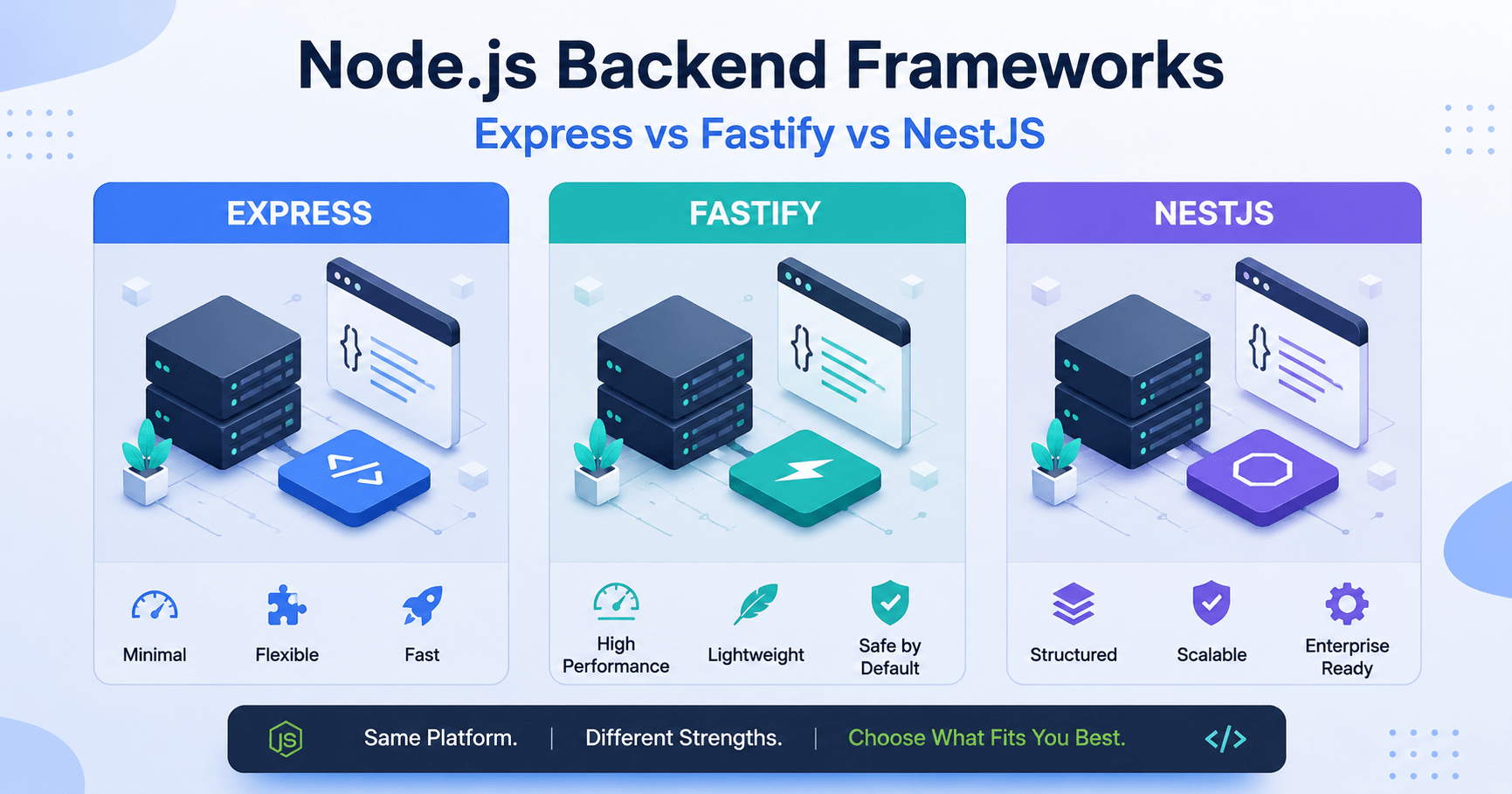

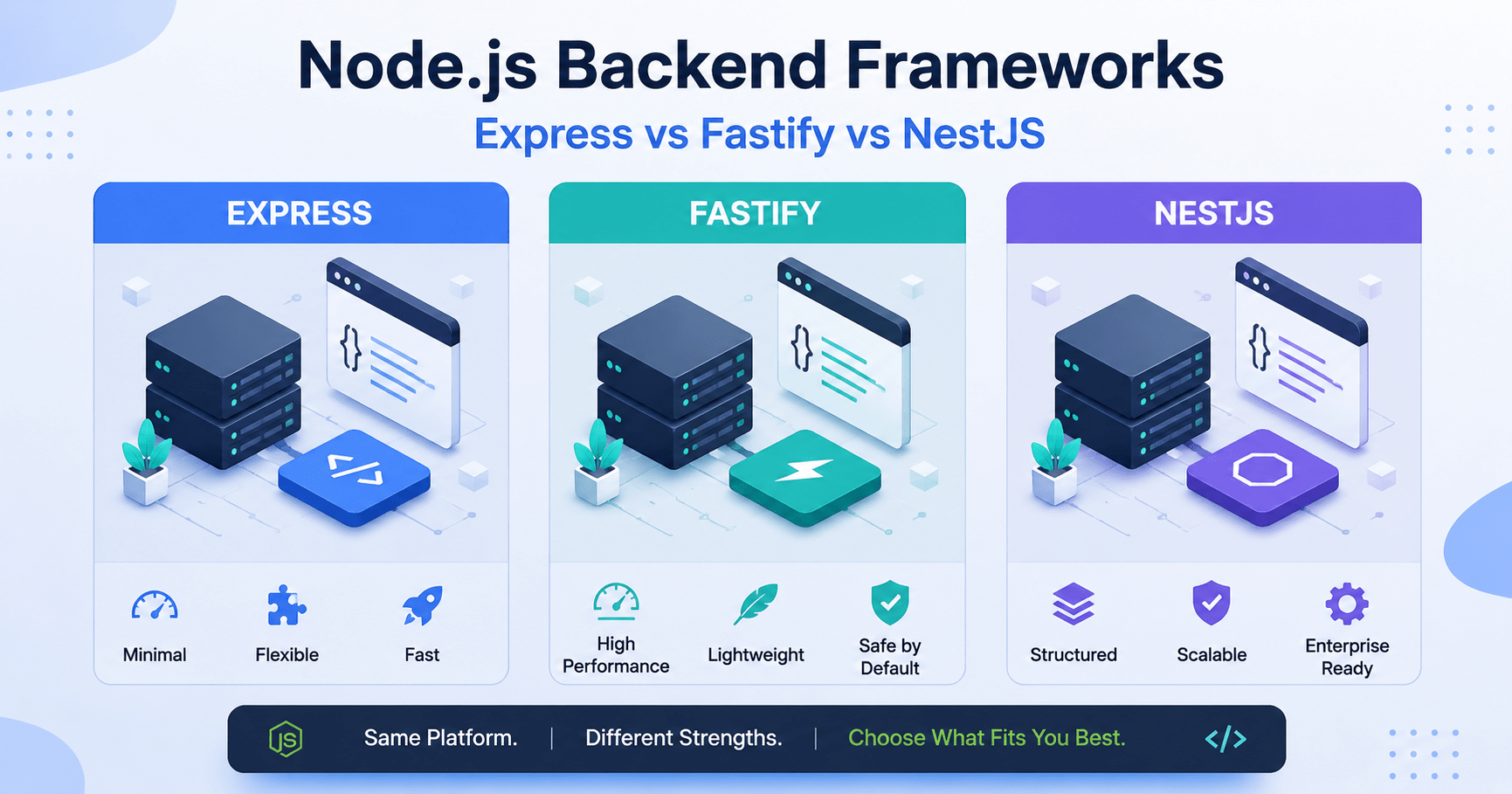
Choosing the right Node.js backend framework shapes everything that comes after it: how fast your API responds, how easy your codebase is to onboard new developers into, and how much boilerplate you write before you ship a single working endpoint.
Since Ryan Dahl created Node.js in 2009, JavaScript has grown from a browser scripting language into one of the most widely used server-side runtimes in the world. But Node’s native http module leaves you writing your own routing, body parsing, and error handling for every endpoint. That gap is exactly why the framework ecosystem exists.
In this guide, we compare seven Node.js backend frameworks, Express, Fastify, NestJS, Hono, Koa, Meteor, and AdonisJS, across architecture, performance, developer experience, and where each one actually belongs in production.
Why Your Choice of Node.js Backend Framework Matters
A backend framework is not just a convenience layer. It decides your project’s default architecture, how your team writes error handling, and how much your app can scale before you hit a wall. Picking the wrong backend framework early usually means a painful migration later, not a quick fix.
The seven Node.js backend frameworks below fall into four rough eras: minimalist and imperative, high-performance and schema-driven, enterprise and structured, and edge-native. Knowing which era fits your project narrows the decision fast.
The Minimalist Era: Express and Koa
Express.js: The Legacy Node.js Backend Framework Baseline
Express.js is the backend framework most Node developers learn first, and it’s still the default choice for quick utilities and legacy codebases.
Released in 2010, Express introduced the now-familiar middleware pattern: functions chained together as (req, res, next) => {}. Here’s a basic route:
javascript
import express from 'express';
const app = express();

app.use(express.json());

app.get('/api/users/:id', (req, res) => {
  res.json({ id: req.params.id, name: 'Alice' });
});

app.listen(3000);
Strengths: near-universal community adoption, an enormous library of npm plugins, and essentially zero learning curve for beginners.
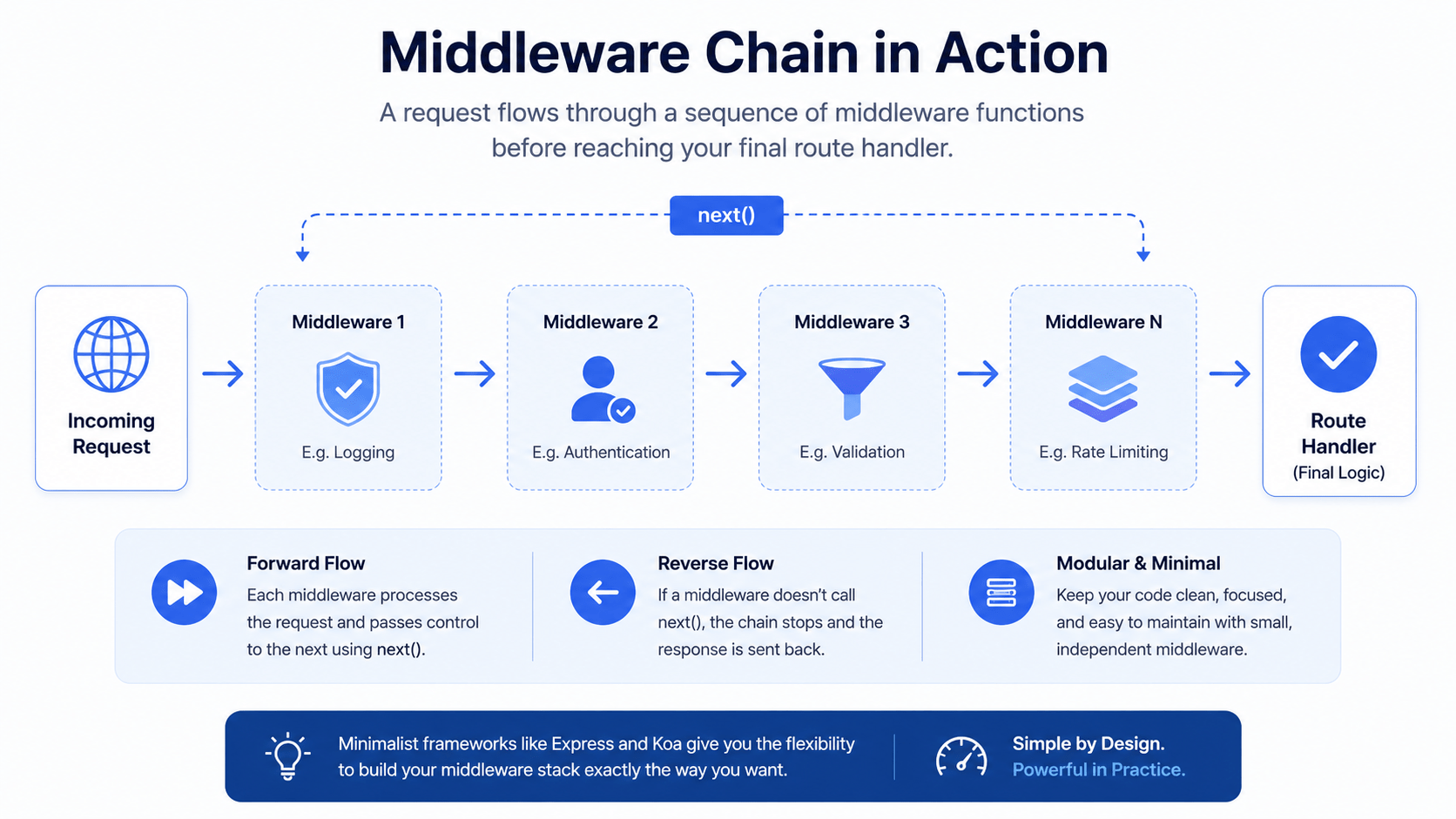
Trade-offs: TypeScript support relies on community-maintained types rather than a native implementation, and Express places no structural rules on your codebase. That freedom is convenient for a small project and a liability once a team of five people is contributing to the same routes folder.
Koa.js: Express’s Lightweight Successor
Koa.js is the backend framework built by Express’s original creators to fix the parts of Express that show their age. It replaces callback-style middleware with async/await and a cascading execution model:
javascript
import Koa from 'koa';
const app = new Koa();

app.use(async (ctx, next) => {
  const start = Date.now();
  await next();
  const ms = Date.now() - start;
  ctx.set('X-Response-Time', `${ms}ms`);
});

app.use(async (ctx) => {
  ctx.body = { message: 'Hello World' };
});
Koa ships without a router or body parser built in, so you’ll add @koa/router and a body-parsing package yourself. That’s the trade-off for a genuinely minimal core: more setup, less bloat.
Also Read: Optimistic UI Updates and Infinite Scroll Pagination
The High-Performance Generation: Fastify
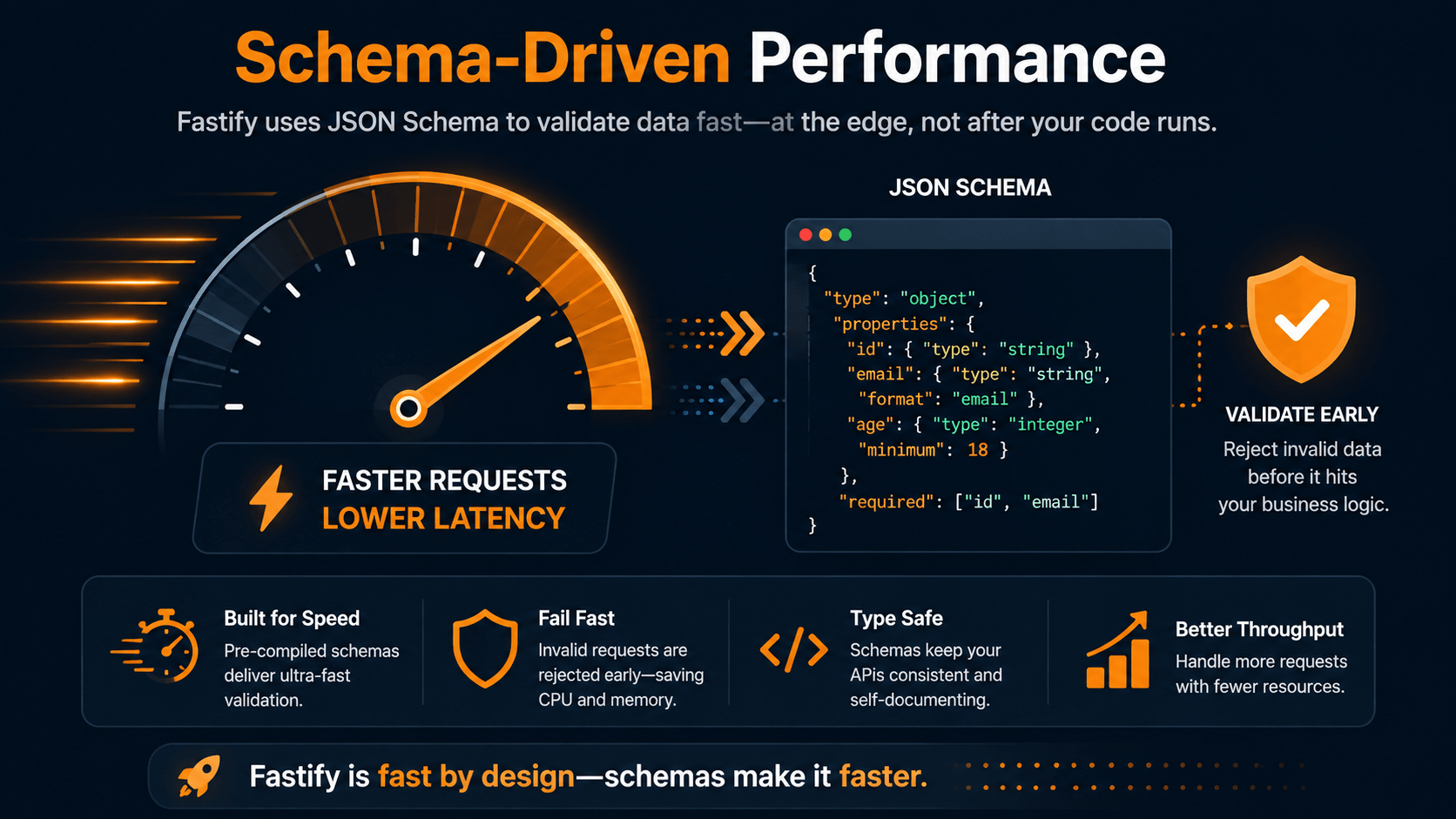
As API traffic scales, Express’s throughput ceiling becomes a real bottleneck. Fastify is the backend framework built specifically to push HTTP performance further while keeping the developer experience friendly.
javascript
import Fastify from 'fastify';
const fastify = Fastify({ logger: true });

fastify.get('/user/:id', {
  schema: {
    params: {
      type: 'object',
      properties: { id: { type: 'string' } }
    },
    response: {
      200: {
        type: 'object',
        properties: { id: { type: 'string' }, name: { type: 'string' } }
      }
    }
  }
}, async (request, reply) => {
  return { id: request.params.id, name: 'Bob' };
});
Fastify’s plugin-based architecture compiles JSON Schema definitions ahead of time using ajv for validation and fast-json-stringify for serialization. That’s the source of its speed advantage: benchmarks commonly put it at 4 to 5 times the throughput of a comparable Express app.
The trade-off is Fastify’s plugin encapsulation model. Plugins get their own scope by default, which trips up developers coming straight from Express’s flatter middleware style until it clicks.
Enterprise-Grade Node.js Backend Frameworks
When a project outgrows “whatever the team feels like today,” structure stops being optional. Two frameworks in this comparison are built explicitly for that stage.
NestJS: The Angular-Inspired Enterprise Standard
NestJS is the backend framework that borrows its architecture from Angular: controllers, providers, and modules wired together with dependency injection, written in TypeScript from the ground up.
typescript
@Controller('users')
export class UsersController {
  constructor(private readonly userService: UserService) {}

  @Get(':id')
  async findOne(@Param('id') id: string) {
    return this.userService.findOne(id);
  }
}
NestJS runs on top of Express or Fastify under the hood, so this backend framework gives you their performance characteristics plus a standardized structure. The trade-off is real: decorators, dependency injection, and OOP patterns take longer to learn than a plain Express route, and a five-line utility script doesn’t need this much scaffolding.
AdonisJS: The Batteries-Included MVC Framework
AdonisJS is the backend framework that takes a different enterprise route, closer to Laravel or Ruby on Rails than to Angular. It’s batteries-included: a built-in ORM (Lucid), authentication, database migrations, and a template engine (Edge) all ship in the box.
That means zero setup time for auth or database access, which is a real productivity win for a monolithic web app. The cost is a smaller community than NestJS or Express, so you’ll find fewer Stack Overflow answers when something breaks.
Edge-Ready: Hono for Multi-Runtime Apps
Edge platforms like Cloudflare Workers and Vercel Edge don’t tolerate the cold-start latency of a heavy Node dependency tree. Hono is the backend framework built around Web Standard APIs (Request, Response, fetch) specifically to run anywhere without that overhead.
javascript
import { Hono } from 'hono';
const app = new Hono();

app.get('/api/greet', (c) => {
  return c.json({ message: 'Hello from the Edge!' });
});

export default app;
Hono runs unmodified on Node.js, Bun, Deno, and Cloudflare Workers, with cold starts measured in single-digit milliseconds. The ecosystem is younger than Express or Fastify’s, particularly around traditional database connection pooling, though serverless-friendly ORMs are closing that gap quickly.
The Real-Time Legacy: Meteor.js
Meteor.js is the backend framework, released in 2012, that pioneered a full-stack reactive model where a database write on the server pushed instantly to the browser over WebSockets, using its own DDP protocol paired with MongoDB.
That reactivity was genuinely ahead of its time. But Meteor is tightly coupled to MongoDB, ships a heavier client bundle than modern alternatives, and has largely been superseded by pairing Next.js or NestJS with WebSockets or Server-Sent Events. It’s worth knowing for legacy codebases and niche real-time projects, not for a new build in 2026.
Also Read: WebMCP Explained: 7 Real Risks Before You Go AI-Ready
Node.js Backend Frameworks Compared: Feature Matrix
Here’s every backend framework from this guide side by side, so you can scan for the column that matters most to your project.
Node.js Backend Frameworks Comparison
Compare popular Node.js backend frameworks by architecture, primary strengths, TypeScript support, performance, and ideal use cases.
| Framework | Architecture | Primary Strength | TypeScript Support | Performance | Best For |
|---|---|---|---|---|---|
| Express | Unopinionated, minimalist | Ubiquitous ecosystem | Community types | Moderate | Small utilities, legacy APIs |
| Fastify | Schema-driven | Extreme HTTP throughput | Native | Very high | High-traffic REST APIs |
| NestJS | Enterprise OOP + DI | Standardized architecture | Native, first-class | High (via adapter) | Large teams, complex platforms |
| Hono | Edge / Web Standards | Sub-millisecond cold starts | Native | Ultra high | Serverless, edge functions |
| Koa | Lightweight async middleware | Clean cascading model | Good | High | Custom lightweight builds |
| AdonisJS | Full-stack MVC | Built-in auth and ORM | Native | High | Monolithic full-stack apps |
| Meteor | Reactive real-time | Out-of-the-box WebSocket sync | Moderate | Moderate | Real-time legacy/niche apps |
How to Choose the Right Node.js Backend Framework for Your Project
Match the backend framework to the actual constraint you’re solving for, not the one with the most GitHub stars this month.
- Building serverless or edge micro-APIs? Start with Hono. Its Web Standard foundation and near-instant cold starts are built for exactly this.
- Working on an enterprise platform with a large team? NestJS gives you dependency injection and enforced structure that keeps a big codebase consistent.
- Optimizing for raw throughput on a REST API? Fastify’s schema-driven validation and serialization make it the fastest general-purpose option here.
- Maintaining an existing codebase, prototyping, or learning backend basics? Express is still the lowest-friction starting point.
- Building a monolithic app and want auth and an ORM out of the box? AdonisJS saves real setup time.
Frequently Asked Questions
Is Express still worth learning in 2026?
Yes. As a backend framework, its ecosystem and community support remain unmatched, and most Node.js tutorials, courses, and Stack Overflow answers still assume Express as the baseline.
Which Node.js backend framework is fastest?
Hono and Fastify both post the highest raw throughput in independent benchmarks, with Hono’s edge-optimized runtime often edging ahead on cold-start time specifically.
Can I use NestJS with Fastify instead of Express?
Yes. NestJS supports a native Fastify adapter, which lets you keep NestJS’s architecture while gaining Fastify’s performance profile.
Do I need TypeScript to use these frameworks?
No, but NestJS, Hono, and AdonisJS are backend framework options built with TypeScript-first APIs, and they’re noticeably smoother to use with it. Express and Koa work fine in plain JavaScript.
Conclusion
There’s no single best Node.js backend framework in this comparison, only the right backend framework for what you’re building. Start from your actual constraint, team size, raw throughput, edge deployment, or full-stack speed, and let that decision tree point you to Fastify, NestJS, Hono, or one of the others above. Whichever you pick, understanding these trade-offs up front will save you a migration later.Choosing the right Node.js backend framework shapes everything that comes after it: how fast your API responds, how easy your codebase is to onboard new developers into, and how much boilerplate you write before you ship a single working endpoint.
Since Ryan Dahl created Node.js in 2009, JavaScript has grown from a browser scripting language into one of the most widely used server-side runtimes in the world. But Node’s native http module leaves you writing your own routing, body parsing, and error handling for every endpoint. That gap is exactly why the framework ecosystem exists.
In this guide, we compare seven Node.js backend frameworks, Express, Fastify, NestJS, Hono, Koa, Meteor, and AdonisJS, across architecture, performance, developer experience, and where each one actually belongs in production.
Why Your Choice of Node.js Backend Framework Matters
A backend framework is not just a convenience layer. It decides your project’s default architecture, how your team writes error handling, and how much your app can scale before you hit a wall. Picking the wrong backend framework early usually means a painful migration later, not a quick fix.
The seven Node.js backend frameworks below fall into four rough eras: minimalist and imperative, high-performance and schema-driven, enterprise and structured, and edge-native. Knowing which era fits your project narrows the decision fast.
The Minimalist Era: Express and Koa
Express.js: The Legacy Node.js Backend Framework Baseline
Express.js is the backend framework most Node developers learn first, and it’s still the default choice for quick utilities and legacy codebases.
Released in 2010, Express introduced the now-familiar middleware pattern: functions chained together as (req, res, next) => {}. Here’s a basic route:
javascript
import express from 'express';
const app = express();

app.use(express.json());

app.get('/api/users/:id', (req, res) => {
  res.json({ id: req.params.id, name: 'Alice' });
});

app.listen(3000);
Strengths: near-universal community adoption, an enormous library of npm plugins, and essentially zero learning curve for beginners.
Trade-offs: TypeScript support relies on community-maintained types rather than a native implementation, and Express places no structural rules on your codebase. That freedom is convenient for a small project and a liability once a team of five people is contributing to the same routes folder.
Koa.js: Express’s Lightweight Successor
Koa.js is the backend framework built by Express’s original creators to fix the parts of Express that show their age. It replaces callback-style middleware with async/await and a cascading execution model:
javascript
import Koa from 'koa';
const app = new Koa();

app.use(async (ctx, next) => {
  const start = Date.now();
  await next();
  const ms = Date.now() - start;
  ctx.set('X-Response-Time', `${ms}ms`);
});

app.use(async (ctx) => {
  ctx.body = { message: 'Hello World' };
});
Koa ships without a router or body parser built in, so you’ll add @koa/router and a body-parsing package yourself. That’s the trade-off for a genuinely minimal core: more setup, less bloat.
Also Read: If you’re building the frontend to pair with any of these backends, our React fundamentals guide covers the concepts you’ll need before wiring up API calls. (Slug inferred — verify against the live Tekraze React series before publishing.)
The High-Performance Generation: Fastify
As API traffic scales, Express’s throughput ceiling becomes a real bottleneck. Fastify is the backend framework built specifically to push HTTP performance further while keeping the developer experience friendly.
javascript
import Fastify from 'fastify';
const fastify = Fastify({ logger: true });

fastify.get('/user/:id', {
  schema: {
    params: {
      type: 'object',
      properties: { id: { type: 'string' } }
    },
    response: {
      200: {
        type: 'object',
        properties: { id: { type: 'string' }, name: { type: 'string' } }
      }
    }
  }
}, async (request, reply) => {
  return { id: request.params.id, name: 'Bob' };
});
Fastify’s plugin-based architecture compiles JSON Schema definitions ahead of time using ajv for validation and fast-json-stringify for serialization. That’s the source of its speed advantage: benchmarks commonly put it at 4 to 5 times the throughput of a comparable Express app.
The trade-off is Fastify’s plugin encapsulation model. Plugins get their own scope by default, which trips up developers coming straight from Express’s flatter middleware style until it clicks.
Enterprise-Grade Node.js Backend Frameworks
When a project outgrows “whatever the team feels like today,” structure stops being optional. Two frameworks in this comparison are built explicitly for that stage.
NestJS: The Angular-Inspired Enterprise Standard
NestJS is the backend framework that borrows its architecture from Angular: controllers, providers, and modules wired together with dependency injection, written in TypeScript from the ground up.
typescript
@Controller('users')
export class UsersController {
  constructor(private readonly userService: UserService) {}

  @Get(':id')
  async findOne(@Param('id') id: string) {
    return this.userService.findOne(id);
  }
}
NestJS runs on top of Express or Fastify under the hood, so this backend framework gives you their performance characteristics plus a standardized structure. The trade-off is real: decorators, dependency injection, and OOP patterns take longer to learn than a plain Express route, and a five-line utility script doesn’t need this much scaffolding.
AdonisJS: The Batteries-Included MVC Framework
AdonisJS is the backend framework that takes a different enterprise route, closer to Laravel or Ruby on Rails than to Angular. It’s batteries-included: a built-in ORM (Lucid), authentication, database migrations, and a template engine (Edge) all ship in the box.
That means zero setup time for auth or database access, which is a real productivity win for a monolithic web app. The cost is a smaller community than NestJS or Express, so you’ll find fewer Stack Overflow answers when something breaks.
Edge-Ready: Hono for Multi-Runtime Apps
Edge platforms like Cloudflare Workers and Vercel Edge don’t tolerate the cold-start latency of a heavy Node dependency tree. Hono is the backend framework built around Web Standard APIs (Request, Response, fetch) specifically to run anywhere without that overhead.
javascript
import { Hono } from 'hono';
const app = new Hono();

app.get('/api/greet', (c) => {
  return c.json({ message: 'Hello from the Edge!' });
});

export default app;
Hono runs unmodified on Node.js, Bun, Deno, and Cloudflare Workers, with cold starts measured in single-digit milliseconds. The ecosystem is younger than Express or Fastify’s, particularly around traditional database connection pooling, though serverless-friendly ORMs are closing that gap quickly.
The Real-Time Legacy: Meteor.js
Meteor.js is the backend framework, released in 2012, that pioneered a full-stack reactive model where a database write on the server pushed instantly to the browser over WebSockets, using its own DDP protocol paired with MongoDB.
That reactivity was genuinely ahead of its time. But Meteor is tightly coupled to MongoDB, ships a heavier client bundle than modern alternatives, and has largely been superseded by pairing Next.js or NestJS with WebSockets or Server-Sent Events. It’s worth knowing for legacy codebases and niche real-time projects, not for a new build in 2026.
Node.js Backend Frameworks Compared: Feature Matrix
Here’s every backend framework from this guide side by side, so you can scan for the column that matters most to your project.
Node.js Backend Frameworks Comparison
Compare popular Node.js backend frameworks including Express, Fastify, NestJS, Hono, Koa, AdonisJS, and Meteor based on architecture, TypeScript support, performance, and ideal use cases.
| Framework | Architecture | Primary Strength | TypeScript Support | Performance | Best For |
|---|---|---|---|---|---|
| Express | Unopinionated, minimalist | Ubiquitous ecosystem | Community types | Moderate | Small utilities, legacy APIs |
| Fastify | Schema-driven | Extreme HTTP throughput | Native | Very high | High-traffic REST APIs |
| NestJS | Enterprise OOP + DI | Standardized architecture | Native, first-class | High (via adapter) | Large teams, complex platforms |
| Hono | Edge / Web Standards | Sub-millisecond cold starts | Native | Ultra high | Serverless, edge functions |
| Koa | Lightweight async middleware | Clean cascading model | Good | High | Custom lightweight builds |
| AdonisJS | Full-stack MVC | Built-in auth and ORM | Native | High | Monolithic full-stack apps |
| Meteor | Reactive real-time | Out-of-the-box WebSocket sync | Moderate | Moderate | Real-time legacy/niche apps |
How to Choose the Right Node.js Backend Framework for Your Project
Match the backend framework to the actual constraint you’re solving for, not the one with the most GitHub stars this month.
- Building serverless or edge micro-APIs? Start with Hono. Its Web Standard foundation and near-instant cold starts are built for exactly this.
- Working on an enterprise platform with a large team? NestJS gives you dependency injection and enforced structure that keeps a big codebase consistent.
- Optimizing for raw throughput on a REST API? Fastify’s schema-driven validation and serialization make it the fastest general-purpose option here.
- Maintaining an existing codebase, prototyping, or learning backend basics? Express is still the lowest-friction starting point.
- Building a monolithic app and want auth and an ORM out of the box? AdonisJS saves real setup time.
Frequently Asked Questions
Is Express still worth learning in 2026?
Yes. As a backend framework, its ecosystem and community support remain unmatched, and most Node.js tutorials, courses, and Stack Overflow answers still assume Express as the baseline.
Which Node.js backend framework is fastest?
Hono and Fastify both post the highest raw throughput in independent benchmarks, with Hono’s edge-optimized runtime often edging ahead on cold-start time specifically.
Can I use NestJS with Fastify instead of Express?
Yes. NestJS supports a native Fastify adapter, which lets you keep NestJS’s architecture while gaining Fastify’s performance profile.
Do I need TypeScript to use these frameworks?
No, but NestJS, Hono, and AdonisJS are backend framework options built with TypeScript-first APIs, and they’re noticeably smoother to use with it. Express and Koa work fine in plain JavaScript.
Conclusion
There’s no single best Node.js backend framework in this comparison, only the right backend framework for what you’re building. Start from your actual constraint, team size, raw throughput, edge deployment, or full-stack speed, and let that decision tree point you to Fastify, NestJS, Hono, or one of the others above. Whichever you pick, understanding these trade-offs up front will save you a migration later.