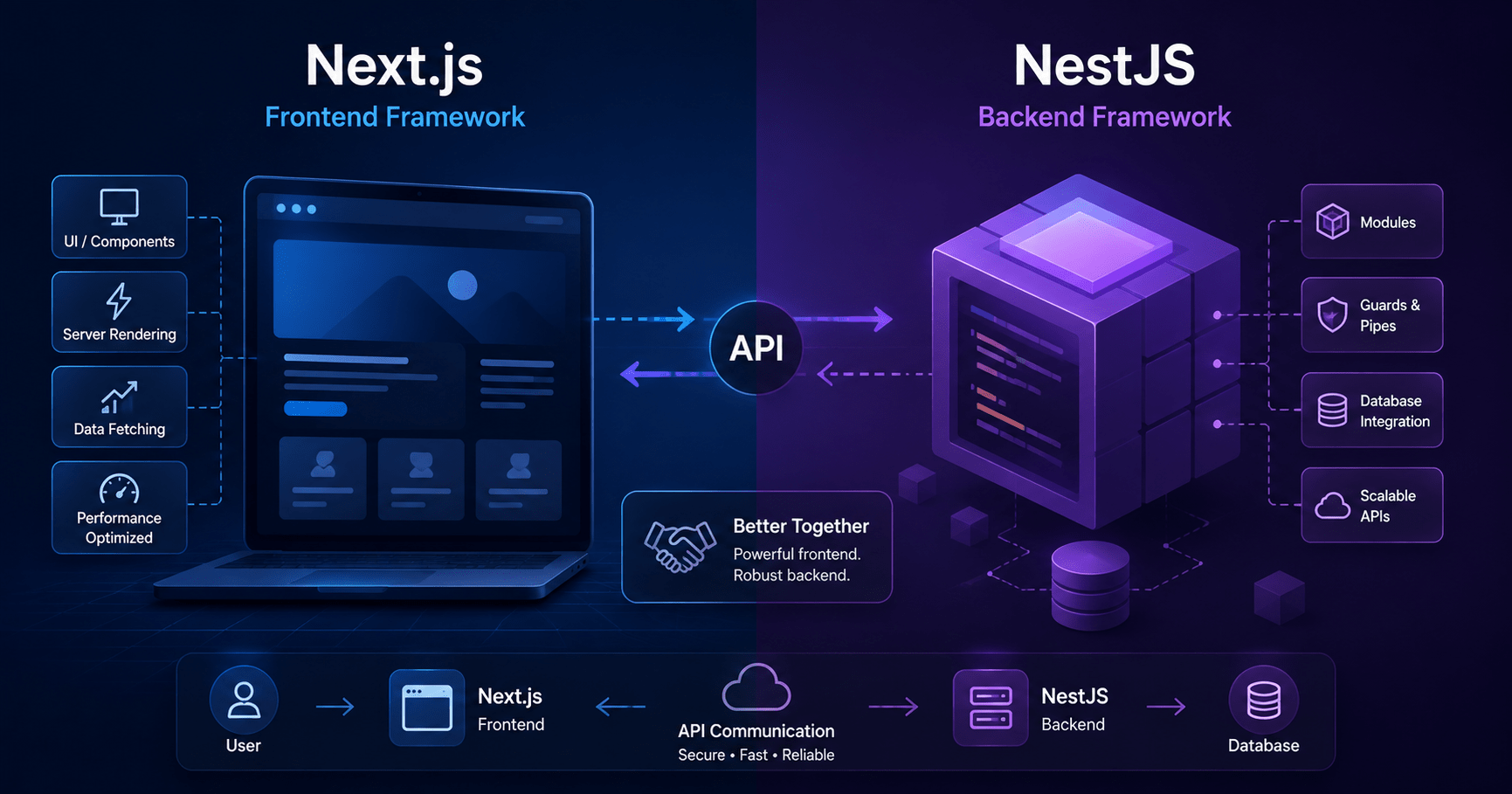

Next.js vs NestJS is one of the most common points of confusion for developers moving from frontend to full-stack work. The names sound alike, but the two frameworks solve almost completely different problems.
A typical sticking point: should you build your entire backend inside Next.js Route Handlers and Server Actions, or do you need a dedicated NestJS backend? Getting this wrong early on is how projects end up with tangled, hard-to-scale codebases.
In this post, we’ll clear up that confusion, compare their underlying architectures, look at how to pair them effectively in enterprise applications, and break down the modern ecosystem tools that bring them together.
Next.js vs NestJS: At a Glance
The foundational difference comes down to focus. Next.js is a React meta-framework centered on UI rendering, user experience, and BFF (Backend-for-Frontend) patterns. NestJS is an opinionated, enterprise-grade server framework built strictly for Node.js backends.
Next.js vs NestJS Architecture Comparison
A side-by-side breakdown of two dominant JavaScript frameworks. Compare their design paradigms, core architecture, state management, validation patterns, and ideal use cases.
| Architectural Dimension | Next.js | NestJS |
|---|---|---|
| Primary Domain | Frontend rendering (RSC, SSR, SSG) + light API layer | Pure backend microservices & REST/GraphQL APIs |
| Core Architecture | React, file-system routing, Server Components | Controllers, Services, Modules (Angular-style OOP) |
| Design Paradigm | Functional, component-driven | Object-Oriented Programming (OOP), Dependency Injection |
| State & Interactivity | Manages DOM updates, client state, and page streaming | Manages database transactions, queues, and sockets |
| Validation & DTOs | Zod / Server Action schema validation | Class-Validator, Class-Transformer, DTO decorators |
| Primary Use Cases | E-commerce, marketing sites, dashboards, SaaS frontends | Banking APIs, complex business logic, enterprise core backends |
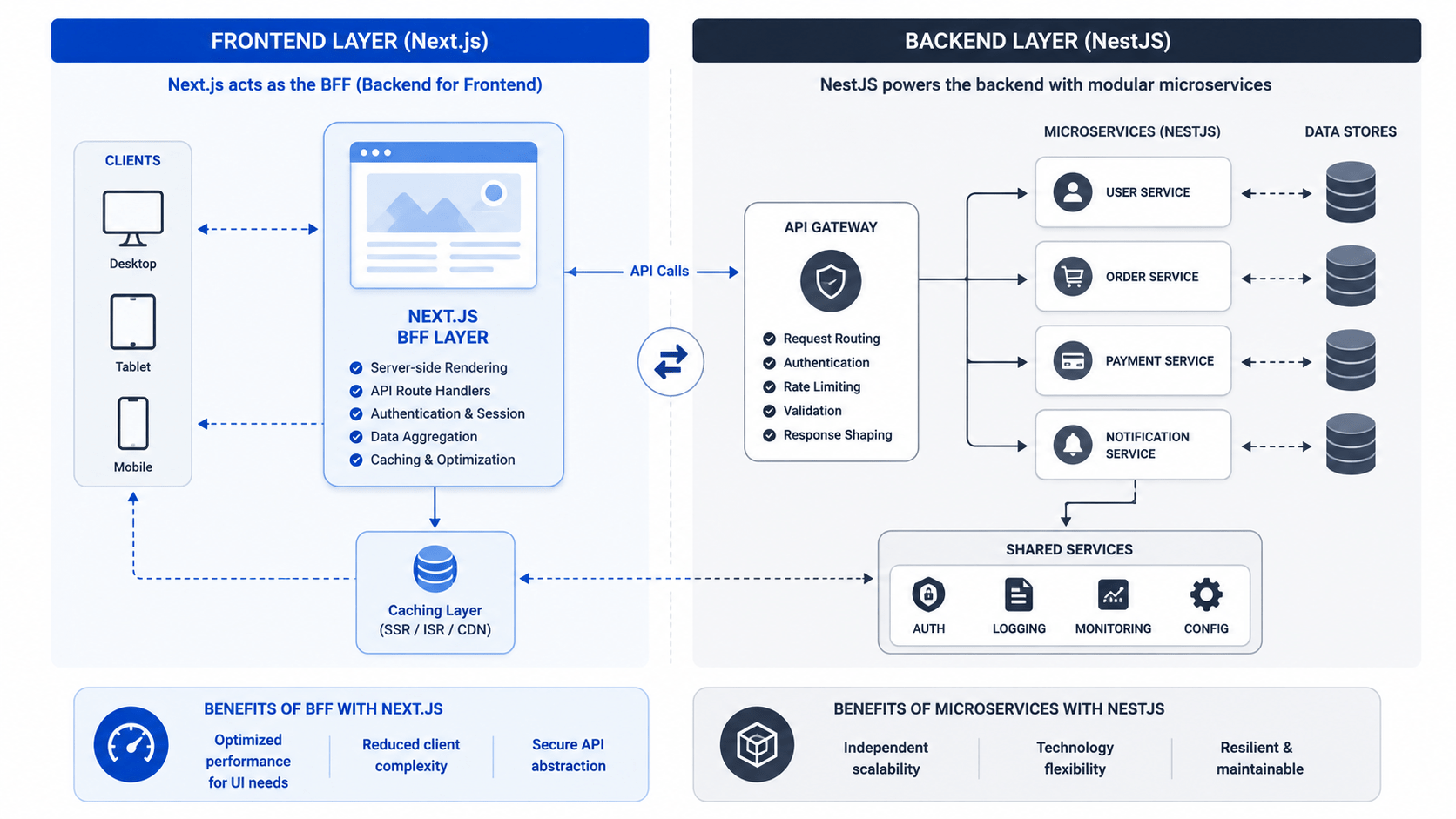
Architectural Comparison
Next.js vs NestJS: The Core Split
Before comparing code, it helps to see the split in one line: Next.js owns the browser-facing layer, NestJS owns the server-facing layer. Everything below follows from that single distinction.
Next.js Architecture: The React-Driven BFF
Next.js revolves around file-system routing, Server Components, and Server Actions. It excels as a Backend-for-Frontend (BFF): a thin backend layer tailored to format data for your React UI, render HTML on the server, and optimize page load speed.
Browser → Next.js (App Router) → Server Components → Database / Microservices
Next.js can query databases directly, but placing heavy business logic, background jobs, payment webhooks, and complex microservice integrations inside it can lead to a monolithic codebase that’s hard to decouple or reuse across other platforms, like a mobile app.
NestJS Architecture: The Enterprise Microservice Framework
NestJS is heavily inspired by Angular. It provides an explicit, highly structured architecture out of the box, using Modules, Controllers, and Services driven by TypeScript decorators and Dependency Injection (DI).
typescript
// NestJS Controller handling HTTP routes
@Controller('users')
@UseGuards(JwtAuthGuard)
export class UsersController {
  constructor(private readonly userService: UserService) {}

  @Get('profile')
  getProfile(@Request() req) {
    return this.userService.findById(req.user.id);
  }
}
NestJS forces a clean separation of concerns:
- Controllers — handle incoming HTTP requests and map routes
- Services — contain pure domain business logic
- Modules — group related domain boundaries together
- Guards & Pipes — intercept requests for authentication, authorization, and data transformation
How Next.js and NestJS Work Together
Instead of choosing one over the other, many large engineering organizations combine both frameworks into a decoupled architecture:
┌────────────────────────────────┐          ┌────────────────────────────────┐
│      Next.js (App Router)      │          │        NestJS API Server        │
│  Renders React UI & streaming  │  HTTP /   │  Core enterprise business logic │
│  Handles client interactivity  ├──────────►│  Authentication guards & roles  │
│  Executes Server Components    │  GraphQL  │  Database transactions & queues │
│  Optimized SEO & asset delivery│          │  Serves web, mobile, 3rd parties│
└────────────────────────────────┘          └────────────────────────────────┘
In this setup, NestJS acts as the single source of truth for core API endpoints, serving mobile apps, third-party integrations, and web frontends alike. Next.js acts as the web presentation engine, making server-to-server calls to NestJS from its Server Components to fetch data, perform SSR, and stream HTML to the browser.
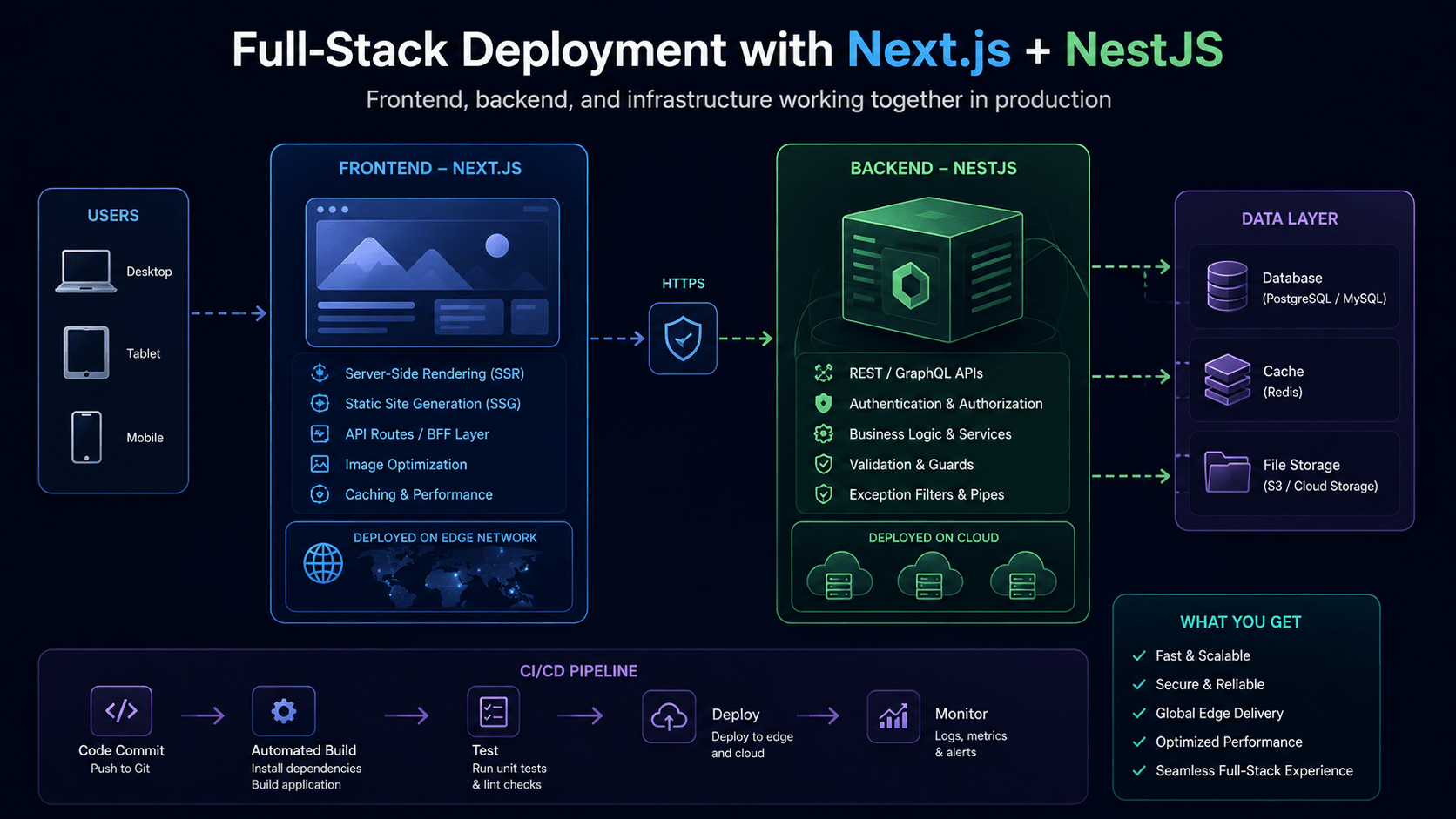
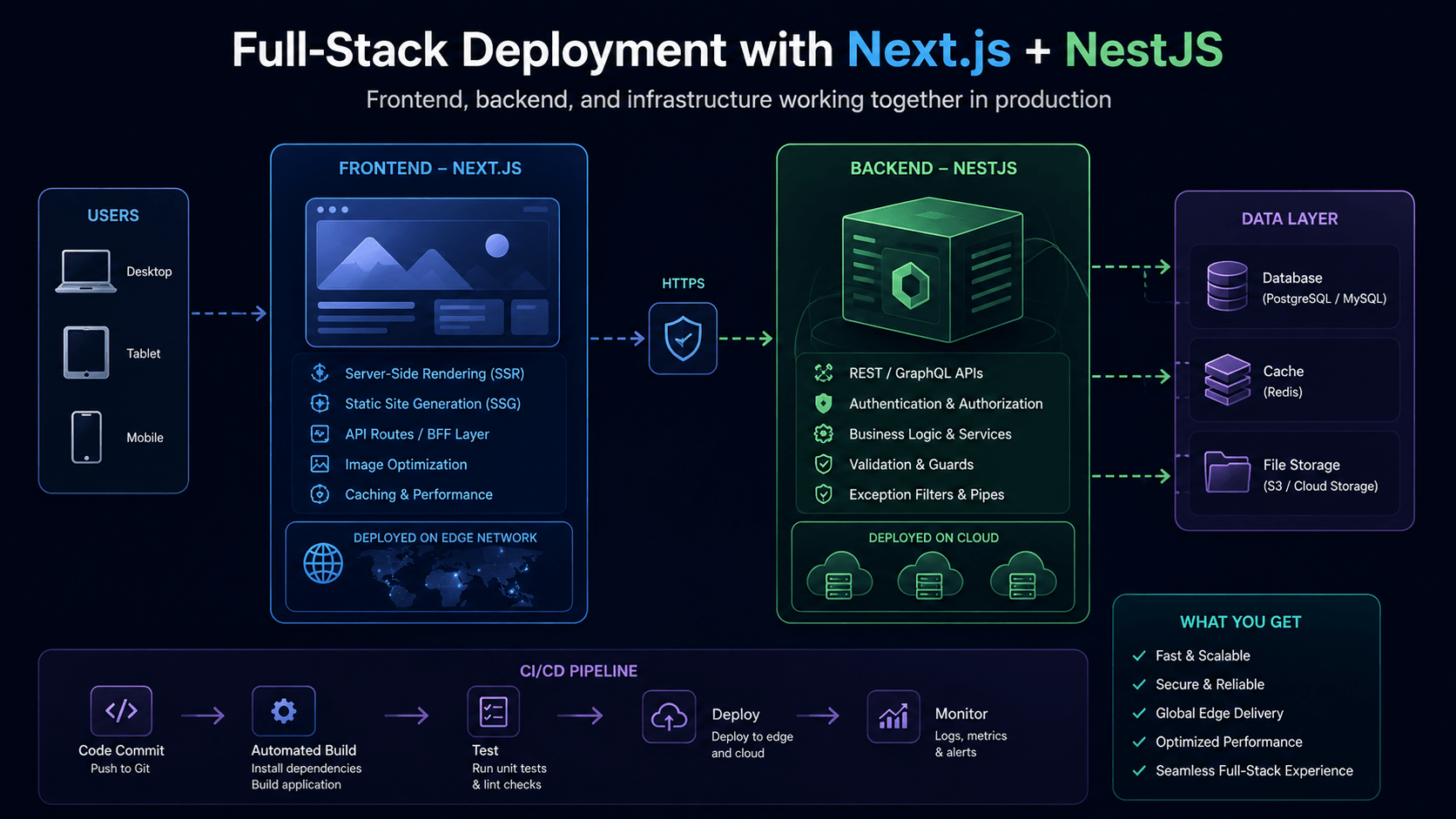
Deployment usually splits too: Next.js deploys well to edge-friendly platforms like Vercel, while NestJS typically runs as a containerized service on something like Railway, Render, or AWS ECS, since it needs a persistent Node process rather than serverless functions. Keeping the two on separate deployment targets also means your UI team can ship frontend changes without waiting on a backend release cycle, and vice versa.
The Modern Ecosystem Toolkit
Several specialized tools integrate into both Next.js and NestJS environments when you’re building a modern full-stack system.
Authentication
Auth.js (NextAuth.js) is built for Next.js. It handles session cookies, OAuth providers like GitHub and Google, and edge middleware protection seamlessly on the frontend.
Passport.js + JWT Guards is the NestJS standard. NestJS wraps Passport.js strategies in injectable @UseGuards() decorators to protect REST endpoints with JWT access tokens.
Database Layer & ORMs
Prisma works exceptionally well in both frameworks, giving you a single schema.prisma definition with auto-generated TypeScript types for type-safe database queries.
Drizzle ORM is gaining real popularity in Next.js for its lightweight, zero-overhead query builder.
TypeORM and MikroORM are class-based ORMs favored in NestJS thanks to their native fit with NestJS’s dependency injection and entity decorators.
Data Validation
Zod is the go-to choice for Next.js form inputs and Server Action validation.
Class-Validator and Class-Transformer are the NestJS standard. They use TypeScript decorators on DTO (Data Transfer Object) classes to validate request bodies automatically before they ever reach controller logic.
typescript
// NestJS DTO with Class-Validator
export class CreateUserDto {
  @IsEmail()
  email: string;

  @MinLength(8)
  password: string;
}
Summary: When to Use Which?
Use Next.js alone if you’re building an MVP, a SaaS product with straightforward CRUD operations, an e-commerce platform, or a content-rich application where SEO and rapid development matter most.
Use NestJS alone if you’re building a headless backend service, a REST or GraphQL API for mobile apps, a real-time WebSocket server, or microservices with complex transactional logic.
Combine Next.js and NestJS if you’re building an enterprise platform with a large team, where UI teams need to iterate fast on Next.js while core backend teams maintain strict API security, business logic, and microservices in NestJS.
Also Read: Already building on Next.js and ready to ship? Our guide on Deploying a Next.js App to Vercel walks through taking your frontend live once your architecture decision is made.
Conclusion
Next.js vs NestJS isn’t really a competition — it’s a question of what each framework is built to do. Use Next.js for UI presentation and SEO performance, and hand off heavy business logic to NestJS when your system needs to scale cleanly to millions of users. Start with the framework that matches today’s problem, and add the other only when your architecture actually needs it.
FAQ
Can I use Next.js and NestJS in the same project?
Yes — this is actually the most common Next.js vs NestJS setup in production. Next.js typically handles the frontend and calls a separate NestJS API over HTTP or GraphQL for core business logic.
Is NestJS harder to learn than Next.js?
NestJS has a steeper initial learning curve because of its Angular-style architecture and Dependency Injection. Next.js is generally faster to get productive in for developers already comfortable with React.
Do I need NestJS if I’m just building a small SaaS app?
Usually not. Next.js Route Handlers and Server Actions are enough for most small-to-medium SaaS products. Reach for NestJS when business logic and team size grow past what a BFF layer can cleanly handle.
Can NestJS replace Express.js?
Yes. NestJS is built on top of Express (or Fastify) by default, adding structure, Dependency Injection, and TypeScript-first conventions on top of it.